Jinguji Castle (Inashiki City, Ibaraki Prefecture) Complete Guide | History and Highlights of the Nanboku-cho Period
Jinguji Castle, located in Jinguji, Inashiki City, Ibaraki Prefecture, is a valuable historical site that conveys the turmoil of the Nanboku-cho period. This flatland castle, situated on a slight elevation south of Prefectural Road 107, is known as the stronghold of Kitabatake Chikafusa, a central figure on the Southern Court side. Even today, the remains, such as dry moats and earthworks, are well-preserved. This article provides a detailed overview of Jinguji Castle, from its historical background to its highlights and access methods.
Overview of Jinguji Castle
Jinguji Castle is a flatland castle located south of Prefectural Road 107 in Jinguji, Inashiki City, Ibaraki Prefecture. Built on a low elevation, this castle exhibits the typical form of a medieval flatland castle, utilizing the surrounding wetlands as a natural defensive line.
The castle ruins are protected as a prefecturally designated historical site, and the remains, such as dry moats and earthworks, are preserved in relatively good condition. As one of the few remaining medieval castles that can still be visited today, it attracts attention from history enthusiasts and castle fans.
Basic Information
- Location: Around 830 Jinguji, Inashiki City, Ibaraki Prefecture
- Castle Type: Flatland Castle
- Construction Period: Nanboku-cho period (early 14th century)
- Builder: Tojo clan
- Main Lords: Tojo clan, Kitabatake Chikafusa (for a period)
- Designation: Ibaraki Prefecture Designated Historic Site
- Remains: Dry moat, earthworks
History of Jinguji Castle
Construction and the Tojo Clan
Jinguji Castle is believed to have been built by the Tojo clan during the Nanboku-cho period. The Tojo clan were local lords of Hitachi Province and acted as jito (land stewards) for the Southern Court. Hitachi Province at that time was one of the fierce battlegrounds where the forces of the Southern and Northern Courts were evenly matched, and castles and residences were built throughout the region. The location where Jinguji Castle was built was a strategic point for water transport near Lake Kasumigaura, making it militarily and economically important. Taking advantage of the slightly elevated terrain, the castle was surrounded by wetlands and moats, achieving a strong defense despite being on flat land.
Kitabatake Chikafusa’s Arrival and Takeover
Jinguji Castle first appears on the historical stage in 1338. In September of that year, Kitabatake Chikafusa, a senior retainer of the Southern Court, set sail from Ise Ōminato to Mutsu Province (present-day Tohoku region) with Prince Yoshinaga (later Emperor Go-Murakami) and Prince Munenaga.
However, the group encountered a fierce storm in the Tōshū Sea, and their warships were scattered. Having narrowly escaped being shipwrecked at Tojoura in Hitachi Province, Kitabatake Chikafusa and his forces were welcomed by the Tojo clan, who were local administrators loyal to the Southern Court, and established their base at Jinguji Castle.
Kitabatake Chikafusa was a court official who served Emperor Go-Daigo and was a central theorist and politician of the Southern Court. His work, “Jinno Shotoki,” is known as a masterpiece that greatly influenced Japanese historical thought. The fact that such an important figure temporarily used Jinguji Castle as a base enhances its historical value.
Attack and Fall of the Castle by the Northern Court
Kitabatake Chikafusa’s entry into Jinguji Castle was an unacceptable development for the Northern Court forces. In Hitachi Province, powerful samurai clans such as the Satake and Daijo clans, all loyal to the Northern Court, held significant influence, making Jinguji Castle, a Southern Court stronghold, a prime target for attack.
The Northern Court forces besieged Jinguji Castle, and a fierce battle ensued. However, facing an attack from the numerically superior Northern Court forces, Jinguji Castle is said to have fallen in 1338.
After this, Kitabatake Chikafusa continued his resistance, moving from one Southern Court stronghold in Hitachi Province to another, such as Oda Castle (present-day Tsukuba City). Ultimately, however, the Southern Court’s disadvantage became decisive, and he was forced to leave Hitachi Province.
The Aftermath of Jinguji Castle
There are no detailed records of Jinguji Castle after its fall. It is unclear whether it was used again during the Sengoku period, but judging from the state of the remains, it is possible that it was maintained and used in some form after the Nanboku-cho period.
From the Edo period onward, it lost its function as a castle, and the surrounding area was used for farmland, but the remains such as earthworks and dry moats remained as part of the topography.
Structure and Remains of Jinguji Castle
Castle Structure
Jinguji Castle was built as a flatland castle, utilizing the surrounding slightly elevated terrain for its defenses. This castle possesses a typical structure for a medieval flatland castle and has the following characteristics:
Main Enclosure: This is the central area of the castle, surrounded by an earthen rampart. The main enclosure is relatively small, suggesting it primarily served as a temporary base during wartime.
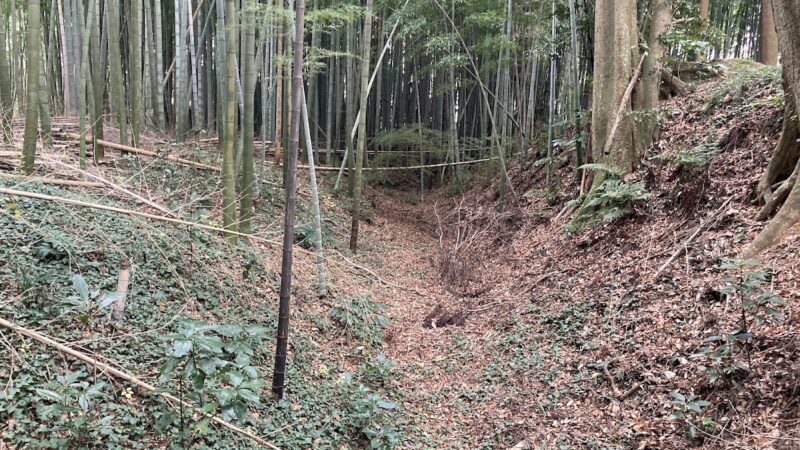
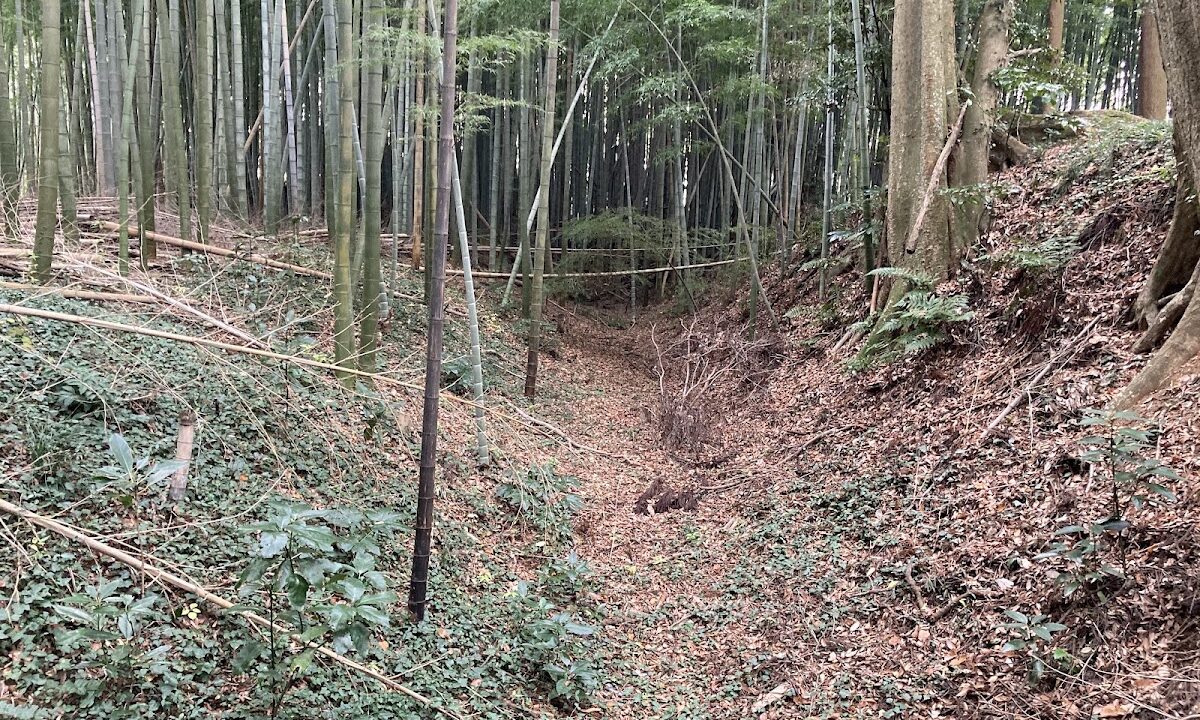
Dry Moat: The dry moat surrounding the castle remains in good condition. While the depth of the moat varies, it is an important relic that conveys the defensive function of the time.
Earthen Ramp: The earthen rampart surrounding the main enclosure still exists, approximately 1-2 meters high. It is presumed that a fence or wall was built on top of the rampart.
Highlights of Existing Remains
When visiting the Jinguji Castle ruins, you can observe the following remains:
Dry Moat: The most impressive remains of the castle are the dry moats. The moats on the south and east sides are particularly deep and clearly visible. Walking along the bottom of the moats gives a real sense of the castle’s formidable defenses. The moat is approximately 5-10 meters wide and remains about 2-3 meters deep.
Earthworks: The earthworks surrounding the main enclosure remain clearly visible, albeit overgrown with vegetation. There are places where you can walk on top of the earthworks, allowing you to experience the castle’s layout. The cross-section of the earthworks reveals traces of meticulous civil engineering using the rammed earth construction method.
Entrance Sites: Several locations believed to be entrances to the castle can be identified. The gaps in the earthworks and places where bridges likely crossed the moat allow us to imagine the castle’s movement patterns.
Topographical Undulations: The castle’s layout, which took advantage of its slightly elevated location, remains as topographical undulations, offering insights into medieval castle construction techniques.
Highlights and How to Enjoy Jinguji Castle
Castle Notes (Points of Interest)
1. Southern Dry Moat: This is the best-preserved dry moat. You can appreciate the depth and width of the moat and understand the actual defenses of a medieval castle. Walking down to the bottom of the moat allows you to experience the perspective of an attacker.
2. Earthworks of the Main Enclosure: You can walk around the earthworks surrounding the main enclosure. Looking out from the top of the earthworks gives you a good understanding of the castle’s location and its relationship to the surrounding terrain.
3. Overall Layout: Walking around the entire castle site allows you to understand the ingenuity of the layout as a flatland castle. You can learn about the characteristics of medieval castles, such as the arrangement utilizing slightly elevated ground and the defensive lines created by the combination of moats and earthworks.
4. Traces of History: Standing on the very spot where Kitabatake Chikafusa, a historically important figure, actually took refuge, allows you to feel the turmoil of the Nanboku-cho period firsthand.
Best Season to Visit
Jinguji Castle Ruins can be visited year-round, but the view differs depending on the season.
Spring (March-May): This is the time when vegetation begins to sprout, making the outlines of the ruins relatively easy to see. The weather is mild, making it ideal for a stroll.
Autumn (October-November): The grass begins to wither, making the ruins most easily visible. The temperature is comfortable, making it the perfect season for exploring the castle ruins.
Summer: Vegetation grows thick, sometimes making the ruins difficult to see. Insect repellent is necessary.
Winter: The withered vegetation makes it suitable for observing the ruins, but cold weather precautions are necessary.
Photography Tips
For those who enjoy taking photos of the castle ruins, the following points are recommended.
- An angle emphasizing the depth of the dry moat (looking up at the earthworks from the bottom of the moat)
- Wide-angle photograph capturing the series of earthworks
- Highlighting the undulations of the ruins with the slanted light of morning and evening
- Landscape photograph combining the surrounding rural scenery with the castle ruins
Nearby Attractions
Jinguji Temple (Temple)
Jinguji Temple, a Tendai sect temple from which Jinguji Castle derives its name, is located near the castle ruins. It is an ancient temple said to have been founded in 806 AD (Daido 1) by the fulfillment of a vow.
Niomon Gate: The Niomon Gate, built in 1369 AD (Oan 2), is a historically valuable structure. The Nio statues inside the gate are believed to have the power to cure foot ailments, and many straw sandals have been dedicated there.
Relationship with Kitabatake Chikafusa: When Kitabatake Chikafusa holed up in Jinguji Castle, this temple is believed to have also functioned as a base of operations for the Southern Court.
Awazaki Castle
Besides Jinguji Castle, Inashiki City has other medieval castle ruins, such as Awazaki Castle. Awazaki Castle was used from the Nanboku-cho period to the Sengoku period, and visiting it along with Jinguji Castle will give you a deeper understanding of the characteristics of medieval castles in southern Hitachi Province.
Sightseeing around Lake Kasumigaura
Inashiki City faces Lake Kasumigaura, offering opportunities to enjoy lakeside scenery and waterside leisure activities. Enjoying the nature of Lake Kasumigaura in conjunction with a visit to Jinguji Castle is highly recommended.
Access Information
Access by Car
From Tokyo:
- Approximately 15 minutes from the Joban Expressway “Inashiki IC”
- Approximately 10 minutes from the Ken-O Expressway “Inashiki Higashi IC”
From Mito:
- Approximately 1 hour via National Route 6
Parking: There is no dedicated parking lot for the castle ruins, but you may be able to use the parking lot of Jinguji Temple. Please avoid street parking and be considerate of the surrounding area.
Access by Public Transportation
Public transportation access is limited.
Nearest Station: JR Narita Line “Shimosa-Kanzaki Station” or “Sawara Station” (both are too far to walk)
Bus: The Inashiki City Community Bus “Jinguji Line” may be available. Please inquire with Inashiki City Hall or the Inashiki City Tourism Association regarding service status.
Taxi: Taking a taxi from the nearest station is the most practical option.
Important Notes for Visitors
- The castle ruins are protected as a historical site. Please be careful not to damage the remains or leave any trash.
- Private property may be included. Do not enter areas marked “No Entry.”
- There are uneven areas. We recommend wearing comfortable shoes.
- In summer, please bring insect repellent, a hat, and drinking water.
- There are few signs, so checking maps and materials beforehand will enhance your understanding.
Resources for Learning About Jinguji Castle
Related Books
The following books are helpful for learning about Jinguji Castle and Kitabatake Chikafusa.
- “Medieval Castles of Ibaraki Prefecture” (Ibaraki Prefectural Board of Education)
- “Medieval Samurai Groups of Hitachi” (Regional History Research Book)
- “Jinno Shotoki” (by Kitabatake Chikafusa, various editions available including Iwanami Bunko)
- “Hitachi Province during the Nanboku-cho Period” (Regional History Research Book)
Related Links
- Ibaraki Prefectural Board of Education (Information on Prefecturally Designated Cultural Properties)
- Inashiki City Tourism Association (Tourist Information)
- Kojodan (Community Site for Castle Enthusiasts)
Contact Information
Inashiki City Tourism Association: Handles inquiries regarding detailed information on the castle ruins and visits.
Inashiki City Board of Education: Provides academic information on Jinguji Castle as a historical site.
Historical Significance of Jinguji Castle
Hitachi Province during the Nanboku-cho Period
Jinguji Castle was one of the important bases of the Southern Court in Hitachi Province during the Nanboku-cho period. Hitachi Province was a region where the forces of the Southern and Northern Courts fiercely clashed, and battles were fought throughout the area.
The fact that Kitabatake Chikafusa, a central figure of the Southern Court, temporarily used this castle as a base indicates that it was not merely a small local fortress, but was deeply connected to the national political situation.
Value in Medieval Castle Research
Jinguji Castle is important in castle research as a typical example of a medieval flatland castle. Its location utilizing slightly elevated ground, defenses using dry moats and earthworks, and relatively small-scale layout make it an excellent example of castle construction technology from the first half of the 14th century.
Given the well-preserved remains, further information could be obtained through archaeological excavations and surveys.
As a Regional Historical Heritage Site
For Inashiki City, Jinguji Castle is an important historical heritage site. It is protected as a prefecturally designated historical site, and its use in local history education and as a tourist resource is anticipated.
In recent years, with the growing interest in medieval castles, local castle ruins like Jinguji Castle are being re-evaluated. It has become a popular destination for many people, from individual castle enthusiasts to researchers.
Summary
Jinguji Castle is a flatland castle ruin from the Nanboku-cho period (Northern and Southern Courts period) located in Inashiki City, Ibaraki Prefecture. It has a historical background as the castle where Kitabatake Chikafusa, a senior retainer of the Southern Court, took refuge, and the remains, such as dry moats and earthworks, are well-preserved.
Its location on a slight elevation south of Prefectural Road 107, its construction by the Tojo clan, Kitabatake Chikafusa’s arrival and refuge, and the subsequent attack and fall of the castle by the Northern Court, all contribute to a valuable narrative that conveys the turmoil of the Nanboku-cho period.
The castle ruins are open to the public as a historical site, offering a firsthand experience of medieval castle structure. Visiting it in conjunction with nearby Jinguji Temple and Awazaki Castle will provide a deeper understanding of the medieval history of southern Hitachi Province.
This historical site is recommended not only for history enthusiasts and castle fans, but also for those interested in local history and those who enjoy strolling around. When you visit Ibaraki Prefecture, be sure to stop by the Jinguji Castle ruins. It will be a valuable experience where you can feel the spirit of the Nanboku-cho period.