Wakasa Onigajo Castle, Yazu District, Tottori Prefecture | A Thorough Explanation of the History and Highlights of the Three Famous Castles of Inaba
Overview
Wakasa Onigajo Castle is a mountain castle site located in Wakasa, Wakasa-cho, Yazu District, Tottori Prefecture, dating from the medieval to early modern period. Built on the summit of Tsuruo-san Mountain (452 meters above sea level), it is known as one of the “Three Famous Castles of Inaba,” along with Tottori Castle and Shikano Castle.
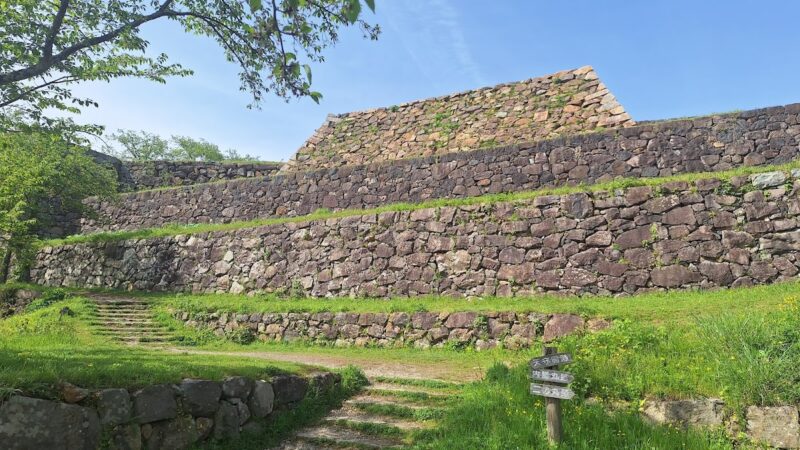
The castle site was designated a national historic site in 1987 (Showa 62) and selected as one of the “Continued Top 100 Japanese Castles” (No. 167) in 2017 (Heisei 29). As a mountain castle entirely constructed of stone walls, numerous baileys, including the main bailey, second bailey, and third bailey, remain in excellent condition. In particular, distinctive defensive structures such as the “dead-end gate” and “corridor bridge” are highly valued as rare remains nationwide.
This area was formerly known as “Oniyama” (Demon Mountain), and legends persist that it was once home to demons. A forest road leads to the vicinity of the castle ruins, making it accessible by car, and thus a relatively easy historical site to visit for a mountain castle. From the castle ruins, you can enjoy panoramic views of the town of Wakasa and the surrounding mountains, and appreciate the scenery throughout the seasons, with cherry blossoms in spring and autumn leaves in fall.
Basic Information on Wakasa Onigajo Castle
- Alternate Names: Onigajo, Wakasa Castle, Oniyama Castle
- Location: Wakasa, Wakasa-cho, Yazu-gun, Tottori Prefecture
- Elevation: 452 meters (Tsuruoyama mountaintop)
- Relative Height: Approximately 230 meters
- Castle Structure: Mountain castle, entirely constructed of stone walls
- Construction Period: Around the Kennin era (1201-1204)
- Builder: Yabe Terutane
- Main Lords: Yabe clan, Amago clan, Mori clan, Kinoshita Shigekata, Yamazaki Iemori
- Year of Abandonment: Genna 3 (1617)
- Designated Cultural Property: National Historic Site (designated in 1987)
- Continued Top 100 Japanese Castles: No. 167
History
The Castle’s Construction in the Kamakura Period and the Yabe Clan’s Era
Wakasa Onigajo Castle is believed to have been built during the Kennin era (1201-1204) by Yabe Terutane. The Yabe clan, as powerful local lords of Inaba Province, ruled the Wakasa region from the Kamakura period to the Sengoku period. Wakasa was strategically important as a transportation hub, located at the intersection of roads leading to Harima and Tajima Provinces.
The Yabe clan ruled this area for generations, using Wakasa Onigajo Castle as their residence, but during the Sengoku period, they became embroiled in power struggles in the surrounding area.
Battles in the Sengoku Period
With the arrival of the Sengoku period, Wakasa Onigajo Castle became the stage for battles over Inaba Province. During the Tenbun era (1532-1555), it came under the control of the Amago clan, and thereafter became the front line of the conflict between the Mori and Amago clans.
During the Tensho era (1573-1593), the castle was affected by the Chugoku campaign led by Hashiba Hideyoshi (later Toyotomi Hideyoshi), acting on orders from Oda Nobunaga. In 1580, Kinoshita Shigekata, a subordinate of Hideyoshi, entered Wakasa Onigajo Castle and became its lord. Kinoshita Shigekata is credited with renovating the castle, laying the foundation for its modern, fully stone-walled construction.
After the Battle of Sekigahara and the Era of Yamazaki Iemori
After the Battle of Sekigahara in 1600, Inaba Province became the territory of Ikeda Nagayoshi. However, in 1601, Yamazaki Iemori became the lord of Wakasa Onigajo Castle. Yamazaki Iemori held a domain of 30,000 koku and developed the castle town of Wakasa.
During Yamazaki Iemori’s time, large-scale renovations were carried out on the castle, and many of the stone walls visible today are believed to have been constructed during this period. A complex-style castle tower was built in the main enclosure, and samurai residences and merchant districts were neatly arranged in the castle town.
Abolition due to the One Castle Per Province Decree
In 1617, with the implementation of the One Castle Per Province Decree by the Edo Shogunate, Wakasa Onigajo Castle was abolished. At this time, the buildings were demolished, and parts of the stone walls were destroyed in a process called “castle demolition.” The collapsed sections of the stone walls visible today are thought to be remnants of this demolition.
After the castle’s abandonment, Yamazaki Iemori moved to Tottori Castle town as a chief retainer of the Tottori Domain, and Wakasa continued to exist as the Tottori Domain’s administrative town. The townscape of the castle town is still well-preserved, and in August 2021, it was designated a National Important Preservation District for Groups of Traditional Buildings.
Highlights and Structure of Wakasa Onigajo Castle
Layout and Enclosure Arrangement
Wakasa Onigajo Castle has a complex layout with multiple enclosures centered around the summit of Tsuruo Mountain. The main enclosures include the Honmaru (main enclosure), Ninomaru (second enclosure), Sannomaru (third enclosure), Hozuki-dan (lantern-shaped terrace), and Hexagonal Stone Wall, each surrounded by stone walls.
The Honmaru on the mountaintop measures approximately 40 meters east-west and 30 meters north-south, and a complex-style keep once stood there. The stone walls of the Honmaru reach a height of 5 to 8 meters, conveying the imposing presence of a mountain castle constructed entirely of stone.
Dead-End Entrance
One of the most distinctive features of Wakasa Onigajo Castle is its “dead-end entrance.” This is a defensive structure designed to lure enemies into a dead end and attack them, and is known as a rare structure nationwide. A passage surrounded by stone walls suddenly comes to a dead end, allowing for attacks on invading enemy soldiers from three sides.
This unique defensive structure is highly regarded by castle researchers as demonstrating the high level of defensive technology used in mountain castles.
Corridor Bridge
The “corridor bridge” is the remains of a wooden bridge that connected the main keep and the second keep, built between stone walls. While the bridge itself is now lost, traces of its support remain in the stone walls on both sides. This corridor bridge is also a rare structure nationwide and is noteworthy as a facility that served both as a means of movement within the castle and for defense.
Hexagonal Stone Wall
On the east side of the main keep is a distinctive stone wall called the “hexagonal stone wall.” This is a hexagonal protruding stone wall designed to reduce blind spots and allow for the defense of a wider area. This type of stone wall is rare nationwide and is one of the remains that demonstrate the high level of stone wall technology at Wakasa Onigajo Castle.
Characteristics of the Stone Wall
The stone walls of Wakasa Onigajo Castle are primarily constructed using the “nozurazumi” method, where natural stones are stacked as they are, but some sections also utilize the “uchikomi-tsugi” technique, which uses processed stones. The stonework uses locally sourced granite and remains robust even after more than 400 years.
Some stone walls were destroyed during the castle’s demolition, but these, along with the rest, are preserved as important historical remains that tell the story of the castle.
Castle Tower Base
A castle tower base remains in the main enclosure, and it is believed that a complex-style castle tower once stood here. From the castle tower base, you can enjoy a panoramic view of the town of Wakasa and the surrounding mountains, appreciating the castle’s excellent location. On a clear day, you can even see the Sea of Japan in the distance.
Continued Top 100 Japanese Castles Stamp Information
Wakasa Onigajo Castle was selected as number 167 of the “Continued Top 100 Japanese Castles” in 2017. The stamp can be obtained at the following location:
Stamp Locations
- Wakasa Town Tourist Information Center: Located inside the Wakasa Station building, integrated with the Wakasa Railway station. Opening hours are 9:00 AM to 5:00 PM (excluding New Year’s holidays). Access information and brochures for the castle ruins are also available.
- Wakasa Local Culture Village: This facility introduces the history and culture of Wakasa Town and includes exhibits related to Wakasa Onigajo Castle.
When getting your stamp, we highly recommend actually visiting the castle ruins to take photos and commemorate your visit.
Transportation Access
Access by Public Transportation
Train
- Transfer to the Wakasa Railway from JR Inbi Line “Gunke Station” and get off at “Wakasa Station” (approx. 30 minutes)
- Approximately 15 minutes on foot from Wakasa Station to the castle ruins trailhead
- Approximately 40-50 minutes on foot from the trailhead to the main keep
The Wakasa Railway is a popular line among railway enthusiasts, as it preserves a steam locomotive manufactured in 1930 (Showa 5). The Wakasa Station building itself is designated as a nationally registered tangible cultural property.
Access by Car
From the Expressway
- Approximately 30 minutes from Kawahara IC on the Tottori Expressway via National Route 29
- Approximately 60 minutes from Sayo IC on the Chugoku Expressway via National Routes 373 and 29
Using Forest Roads
- Accessible by car from Wakasa town center via forest roads to near the castle ruins (approximately 15 minutes)
- Approximately 15 minutes on foot from the castle ruins parking lot (free, approximately 10 cars) to the main keep
The forest roads are paved, but some sections are narrow, so caution is required when driving. Especially in winter, there is a possibility of snow and ice, so it is recommended to check road conditions at the Wakasa Town Tourist Information Center in advance.
Parking Information
- Castle Ruins Parking: Free, approximately 10 cars (near the end of the forest road)
- Wakasa Station Parking: Free, approximately 20 cars
Points and Precautions for Climbing the Castle
Clothing and Equipment
Wakasa Onigajo Castle is a mountain castle at an altitude of 452 meters. The following preparations are necessary for climbing the castle:
- Footwear: Non-slip trekking shoes or athletic shoes are essential
- Clothing: Comfortable clothing, appropriate warm clothing and rain gear for the season
- Items to Bring: Drinking water, towel, insect repellent (summer)
- Other: Camera, binoculars, castle guidebook, etc.
Estimated Climbing Time
- From the Trailhead: Approximately 2 hours round trip (including sightseeing time)
- From the Forest Road Parking: Approximately 1 hour round trip (including sightseeing time)
Plan your trip with ample time and aim to descend before sunset.
Seasonal Highlights
Spring (Late March – May)
- The area around the castle ruins is adorned with cherry blossoms during the cherry blossom season.
- Climbing the castle amidst the fresh greenery is refreshing, and the weather is ideal for the climb.
Summer (June – August)
- You can climb the castle through lush green forests.
- Don’t forget insect repellent and hydration.
Autumn (October – November)
- The autumn foliage is beautiful, and the view from the castle ruins is superb.
- One of the best seasons to visit the castle.
Winter (December – February)
- Climbing the castle may be difficult if there is snow.
- Check road conditions in advance during winter.
Literature on Wakasa Onigajo Castle
The following are the main documents and sources related to Wakasa Onigajo Castle.
Ancient Documents and Records
- “Inaba Mindanki”: A local history of Inaba Province compiled in the mid-Edo period, containing a description of Wakasa Onigajo Castle.
- “Inaba Shi”: A book recording the history of Inaba Province, including records of the castle’s structure and its lord.
- “Wakasa-cho Shi”: A town history detailing the history of Wakasa Town, containing a chapter on Onigajo Castle.
Research Books and Survey Reports
- “Wakasa Onigajo Castle Ruins Survey Report” (Wakasa Town Board of Education): A report summarizing the results of the excavation survey.
- “Tottori Prefecture Medieval Castle Distribution Survey Report” (Tottori Prefecture Board of Education): A report comprehensively surveying medieval castles in the prefecture.
- “Continued 100 Famous Japanese Castles Official Guidebook” (Supervised by the Japan Castle Association): The official guide to the Continued 100 Famous Japanese Castles.
Academic Papers
In recent years, several research papers have been published on the stone wall structure and defensive system of Wakasa Onigajo Castle, attracting attention in the field of castle research. In particular, the structural analysis of the “dead-end gate” is an important research subject for understanding the changes in castle technology from the medieval to the early modern period.
Nearby Attractions
Wakasa-juku Townscape
Wakasa-juku, which developed as a castle town of Wakasa Onigajo Castle, was designated a National Important Preservation District for Groups of Traditional Buildings in 2021. Townhouses from the Edo period to the early Showa period line the streets, preserving a beautiful townscape known as “Kariya-Kura-dori” (temporary storehouse and warehouse street).
Strolling along the streets lined with white-walled storehouses and townhouses with lattice doors, you can experience the atmosphere of an Edo-period post town.
Wakasa Railway
The Wakasa Railway is a local railway connecting Gunke Station to Wakasa Station, and a steam locomotive (C12 type No. 167) manufactured in 1930 is preserved there. At Wakasa Station, you can also watch a turntable demonstration, making it a popular spot for railway enthusiasts.
Fudoin Iwayado
This ancient temple is located in the mountains of Wakasa Town. Its main hall, built in a cantilevered style beneath a giant rock, is particularly impressive. Designated as a National Important Cultural Property, it’s well worth visiting along with Wakasa Onigajo Castle.
Hyonosen
Located on the border of Tottori and Hyogo Prefectures, this mountain, with an elevation of 1,510 meters, is a representative peak of the Chugoku region. It offers opportunities for hiking and skiing and is one of Wakasa Town’s tourist hubs.
The Cultural Value of Wakasa Onigajo Castle
The reason Wakasa Onigajo Castle was designated a National Historic Site and selected as one of the Continued Top 100 Japanese Castles is its high historical and academic value.
Historical Value
Wakasa Onigajo Castle, which functioned as a strategic point in eastern Inaba Province for approximately 400 years from the Kamakura period to the early Edo period, is an important historical site that shows the evolution of castles from the medieval to the early modern period. In particular, it is a valuable historical site that conveys the stone wall construction techniques from the Sengoku period to the early Edo period.
Academic Value
As a mountain castle entirely constructed of stone walls, numerous baileys, including the main keep, second bailey, and third bailey, remain in good condition, making it an important resource for castle research. In particular, unique defensive structures such as the “dead-end gate,” “corridor bridge,” and “hexagonal stone wall” are highly valued academically as structures rare throughout Japan.
Scenic Value
From the castle ruins built on the summit of Tsuruo Mountain, one can enjoy a panoramic view of the town of Wakasa and the surrounding mountains, unfolding a beautiful landscape that can be described as a quintessential Japanese scene. The castle ruins, showcasing different expressions throughout the seasons—cherry blossoms in spring, lush greenery in summer, vibrant autumn leaves, and snowy winter landscapes—are a place of high historical and scenic value.
Preservation and Utilization Efforts
Wakasa Town is actively working on the preservation and utilization of the Wakasa Onigajo Castle Ruins.
Development Projects
Since its designation as a national historical site, the Wakasa Town Board of Education has been leading development projects for the castle ruins. Restoration of stone walls, improvement of access paths, and installation of information boards have been carried out, creating an environment where visitors can safely enjoy the site.
Research and Study
Continuous archaeological excavations and surveys are being conducted to clarify the castle’s structure and history. These research findings are compiled into reports, contributing to the development of castle research.
Public Awareness Activities
Wakasa Town is also focusing on public awareness activities, such as incorporating Wakasa Onigajo Castle into local history lessons at elementary and junior high schools and conducting guided tours. Furthermore, with its selection as one of the Continued Top 100 Japanese Castles, information dissemination to castle enthusiasts nationwide has also been strengthened.
Summary
Wakasa Onigajo Castle is a nationally designated historical site located in Wakasa-cho, Yazu-gun, Tottori Prefecture, and is a mountain castle of high historical value, also selected as one of the Continued Top 100 Japanese Castles. From its construction in the Kamakura period until its abandonment in the early Edo period, it functioned as a strategic point in the eastern part of Inaba Province for approximately 400 years.
As a mountain castle entirely constructed of stone walls, numerous baileys, including the main bailey, second bailey, and third bailey, remain in excellent condition. In particular, its unique defensive structures such as the “dead-end gate,” “corridor bridge,” and “hexagonal stone wall” are highly regarded as rare structures nationwide.
The castle ruins are accessible by car via a forest road, making it a relatively easy historical site to visit for a mountain castle. From the castle ruins, you can enjoy panoramic views of the town of Wakasa and the surrounding mountains, appreciating the beautiful scenery throughout the seasons.
When visiting Wakasa Onigajo Castle, we recommend combining it with other nearby attractions such as strolling through the townscape of Wakasa-juku, which flourished as a castle town, or taking a ride on the Wakasa Railway. It’s an ideal spot not only for history buffs but also for those who enjoy hiking and photography.
As one of the three most famous castles in Inaba Province and one of the Continued Top 100 Castles of Japan, Wakasa Onigajo Castle is a representative castle site of the San’in region and will undoubtedly continue to be cherished by many people in the future.