Kasuga Castle Ruins (Ina City, Nagano Prefecture) Complete Guide | History, Highlights, and Access Information
Located on a hill overlooking the city of Ina, Nagano Prefecture, Kasuga Castle Ruins was a mountain castle that played an important role as a strategic point in Ina County, Shinano Province during the Sengoku period. Currently, it is maintained as Kasuga Castle Ruins Park, and while it is a popular spot for cherry blossoms and azaleas, the remains of the castle are well-preserved. This article provides a detailed explanation of Kasuga Castle, from its history and structure to its highlights and access methods.
History of Kasuga Castle
Construction and the Era of the Inabe Clan
Kasuga Castle was built in 1534 (Tenbun 3) by Inabe Yamato-no-kami Shigeyoshi, the 16th descendant of Awataguchi Minbu Shigeyoshi, a descendant of the Taira clan. It is said that the castle was named “Kasuga Castle” because Shigeyoshi’s original surname was “Kasuga.” Also known as “Inabe Castle,” it was a castle associated with the Kasuga clan, a branch of the Nezu clan, one of the three main branches of the Shigeno clan in Shinano Province.
Inabe Yamato-no-kami Shigeyoshi utilized the natural fortifications of the river terrace on the west bank of the Tenryu River, constructing a strong castle on the tip of a tongue-shaped plateau approximately 100 meters east-west, 300 meters north-south, and 20 meters high. This location offered an excellent vantage point overlooking the Ina Valley, making it a strategically and economically important base.
The Split of the Inabe Clan and the Invasion by Takeda Shingen
Inabe Shigeyoshi’s son, Shigenari, had two sons: the eldest son, Shigechika, and the second son, Shigekuni. Shigechika founded the Kasuga Shrine, while Shigekuni established a branch family and built Tonoshima Castle in Higashi-Haruchika. However, as Takeda Shingen’s invasion of Shinano intensified from the Tenbun era to the Koji era, the Inabe clan was forced to make a crucial decision.
The brothers Shigechika and Shigekuni chose to resist Takeda Shingen’s invasion of Shinano. This decision proved fatal for the Inabe clan, and it is said that both men were captured by the Takeda army and executed by crucifixion at Rendaiba in Kitsunejima district. This execution is thought to have also served as a deterrent to the Takeda clan’s control of Shinano.
The Era of Kasuga Kawachi-no-kami Masayoshi
After the Inabe clan was destroyed by Takeda Shingen, Kasuga Kawachi-no-kami Masayoshi (also known as Kasuga Osumi-no-kami Masayoshi) became the lord of Kasuga Castle. Masayoshi pledged allegiance to the Takeda clan and defended Kasuga Castle as a branch castle of the Nishina clan, who were lords of Takato Castle. From the Koji era onward, Kasuga Castle functioned as one of the important bases in the Takeda clan’s control of Shinano.
Masayoshi participated in various battles as a Takeda retainer, playing a role in supporting Takeda Shingen’s administration of Shinano. Within the defensive network centered around Takatō Castle, Kasuga Castle established itself as an important subsidiary castle protecting the west bank of the Tenryū River.
Invasion and Fall of the Oda-Tokugawa Alliance
The fate of Kasuga Castle was sealed by the invasion of Takeda territory by the Oda-Tokugawa alliance in 1582. That year, a massive army of 50,000 men, led by Oda Nobutada, the eldest son of Oda Nobunaga, began its campaign to conquer Kai Province and invaded Shinano Province.
The main force of the Oda army targeted Takatō Castle, and the castle lord, Nishina Morinobu (the fifth son of Takeda Shingen), decided to defend the castle. At this time, Kasuga Kawachi-no-kami Masayoshi, the lord of Kasuga Castle, entered Takatō Castle in response to his lord Nishina Morinobu and participated in the siege.
The battle for Takatō Castle was extremely fierce. Under the command of Nishina Morinobu, the Takeda forces, with only 3,000 soldiers, faced a massive army of 50,000 and fought to the bitter end. Kasuga Masayoshi also fought bravely within Takato Castle, but the overwhelming difference in troop numbers led to its fall. Both Nishina Morinobu and Masayoshi were killed in battle.
Without its lord, Kasuga Castle was captured by the Oda army and fell in 1582 (Tensho 10). With this fall, Kasuga Castle was abandoned, ending its approximately 50-year history as a castle.
Structure and Layout of Kasuga Castle
Terraced Layout
Kasuga Castle is a terraced mountain castle built on a river terrace on the west bank of the Tenryu River. The main enclosure (honmaru) is located at the tip (southeastern end) of the tongue-shaped plateau, with the second and third enclosures arranged in sequence towards the northwest.
This stepped layout is a defensive structure based on the premise that enemy invasion routes would be limited to the base of the plateau (northwest side). Each enclosure is clearly demarcated by a deep dry moat, ensuring that attackers who capture one enclosure will be immediately blocked by the next moat and enclosure.
Features of the Main Enclosure (Honmaru)
Located at the southeasternmost edge of the plateau, the main enclosure is the core of Kasuga Castle. Protected on three sides by steep cliffs, it is a natural stronghold. The east and south sides, in particular, are sheer cliffs facing the Tenryu River, making attacks from these directions virtually impossible.
A deep, artificially excavated dry moat surrounds the north and west sides of the main enclosure. This dry moat is considerably wide and deep, and its impressive scale can still be felt today. Traces of an earthen embankment can also be seen outside the dry moat (north side), indicating the construction of a double defensive line.
Second and Third Baileys
Located northwest of the main enclosure, the Second Bailey is the second most important enclosure after the main enclosure. A deep dry moat separates it from the main enclosure, and a bridge now crosses it. The Second Bailey is thought to have played an intermediate role, defending the main enclosure and maintaining communication with the Third Bailey located further back.
To the west of the Second Bailey is another dry moat, and beyond that lies the Third Bailey. The Third Bailey is located at the very rear of the castle and was responsible for protecting the castle entrance. Currently, it is a grassy area with playground equipment such as a large roller slide, but traces of earthworks and moats remain around it.
Remains of Dry Moats and Earthworks
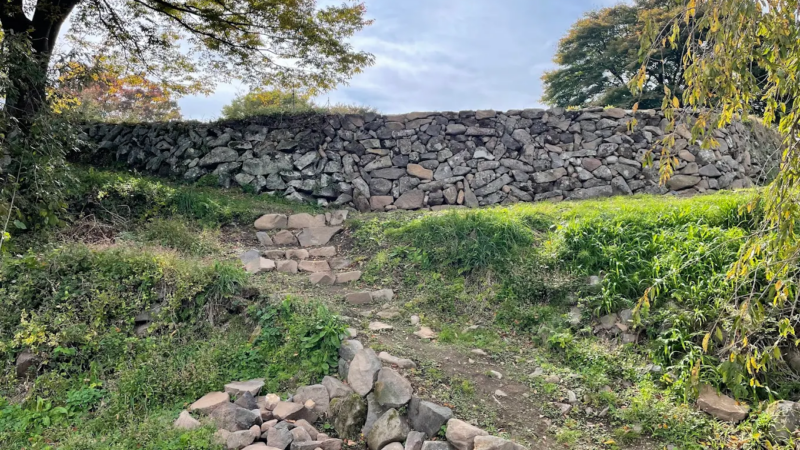
The greatest highlight of Kasuga Castle is the well-preserved remains of dry moats and earthworks. The dry moats separating each enclosure are all sufficiently deep and wide, demonstrating the high level of castle-building technology of the Sengoku period.
In particular, the dry moat separating the main enclosure and the second enclosure remains over 10 meters deep, and looking up from the bottom of the moat, one is overwhelmed by the height of the cliffs on both sides. A wooden bridge now spans this dry moat, allowing visitors to experience the original approach to the castle.
The earthen ramparts are relatively well-preserved from the north to the west side of the main enclosure. Their height varies depending on the location, but the highest points reach about 2-3 meters. It is possible to walk along the top of the ramparts, and looking down at the dry moat from there, one can truly appreciate the castle’s defensive strength.
Highlights of Kasuga Castle Ruins
Value as a Nagano Prefecture Designated Historic Site
Due to its historical value and the excellent state of preservation of its remains, the Kasuga Castle Ruins have been designated a Nagano Prefecture Designated Historic Site. It is highly regarded academically as a typical example of a castle in Shinano Province during the Sengoku period, and as an important site that tells the story of the Takeda clan’s rule over Shinano.
Information boards are placed throughout the castle ruins, allowing visitors to learn in detail about the castle’s history and structure. The relative positions of the main enclosure, second enclosure, and third enclosure, as well as the roles of the dry moats and earthworks, are explained with diagrams, making it easy to understand even for those unfamiliar with castles.
View from the bridges crossing the dry moats
At Kasuga Castle Ruins Park, wooden bridges connect the main enclosure to the second enclosure, and the second enclosure to the third enclosure. The view of the dry moats from these bridges is one of the greatest highlights of Kasuga Castle Ruins.
The deep moat bottoms and the impressive cliffs rising on both sides create a sense of realism that cannot be fully conveyed in photographs. The dry moat between the main enclosure and the second enclosure is particularly large, allowing one to contemplate the labor of the people who carried out such extensive civil engineering work during the Sengoku period.
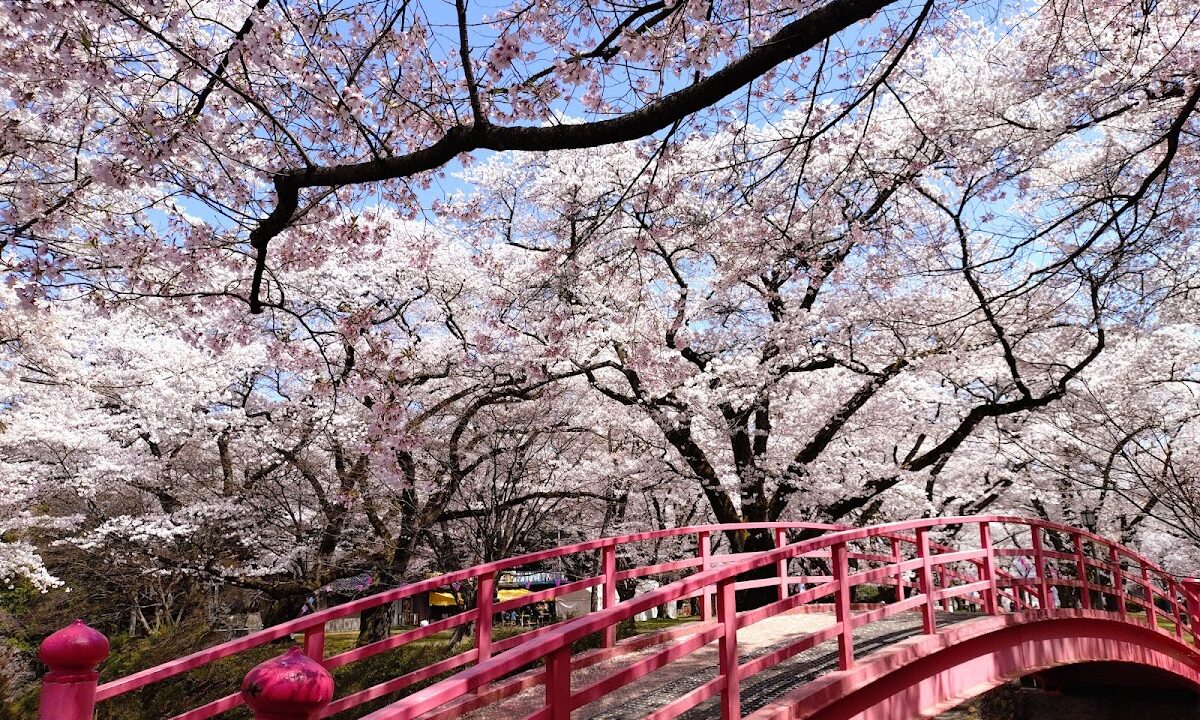
The bridges are also excellent photo spots and are popular among castle enthusiasts. In spring, cherry blossoms bloom on both sides of the dry moat, creating a beautiful scene where historical landscapes and natural beauty harmonize.
Views from the Main Enclosure and the Ina Valley
The main enclosure is located at the highest point of the plateau, offering panoramic views of Ina city and the magnificent Ina Valley. The Tenryu River flows below, and the Southern Alps can be seen to the east, while the Central Alps are visible to the west.
During the Sengoku period, the castle lords likely surveyed the entire Ina Valley from this spot, monitoring enemy movements. On clear days, you can even discern the direction of Takato Castle, allowing you to appreciate the relative positions of Kasuga Castle and Takato Castle.
The view at sunset is particularly stunning; the Ina Valley landscape illuminated by the setting sun captivates visitors. We recommend taking your time to enjoy the view from the main enclosure as a final stop on your castle ruins exploration.
A Famous Spot for Cherry Blossoms and Azaleas
Kasuga Castle Ruins Park is known locally as a famous spot for cherry blossoms and azaleas. In spring, approximately 200 Somei Yoshino cherry trees bloom, attracting many visitors. The contrast between the castle ruins’ dry moats and earthworks and the cherry blossoms creates a unique beauty where history and nature blend together.
After the cherry blossom season ends, the azaleas come into full bloom. Colorful azaleas adorn the castle ruins, announcing the arrival of the season of fresh greenery. Kasuga Castle Ruins Park, where you can enjoy flowers throughout the seasons, is loved by many as a spot where you can enjoy both historical walks and nature appreciation.
Playground Equipment and Park Facilities for Families
Kasuga Castle Ruins Park preserves historical remains while also being developed as a place of relaxation for citizens. In the spring of 2023, new playground equipment was installed, further enhancing its function as a park that families can enjoy.
The large roller slide located in the San-no-maru area is especially popular with children. The roller slide, over 50 meters long, is designed to take advantage of the castle ruins’ topography, allowing visitors to enjoy the scenery of the Ina Valley while sliding down.
In addition, there are playground equipment, swings, and a sandbox, making it enjoyable for a wide range of ages, from toddlers to elementary school children. On weekends, many families visit, creating a lively park filled with the cheerful voices of children.
The park also features a grassy area, perfect for picnics, ball games, and other activities. The charm of Kasuga Castle Ruins Park lies in its ability to cater to different family needs: adults can explore the castle ruins while children play on the playground equipment.
Nearby Tourist Attractions
Kasuga Shrine
Located very close to the Kasuga Castle Ruins is the Kasuga Shrine. This shrine is said to have been founded by Shigechika, the son of Inabe Shigeyoshi, and has deep ties to the history of Kasuga Castle.
Kasuga Shrine is revered as the local guardian deity, and its grounds are home to ancient trees estimated to be hundreds of years old, creating a tranquil atmosphere. It’s a must-visit spot when visiting the Kasuga Castle ruins.
Former Izawa Residence
In Ina City, there is the Former Izawa Residence, designated as a National Important Cultural Property. This valuable building retains the characteristics of a mid-Edo period farmhouse, offering insights into rural life at that time.
Located about a 10-minute drive from the Kasuga Castle ruins, it’s ideal for inclusion in a historical walking tour. The interior is also open for viewing, allowing visitors to experience Edo-period living spaces, including a hearth and earthen floor.
Takato Castle Ruins Park
Takato Castle Ruins Park, deeply connected to Kasuga Castle, is located in Takato-machi, Ina City, next to Ina City. It’s the place where Kasuga Masayoshi, the lord of Kasuga Castle, met his end, making it an essential spot for understanding the history of Kasuga Castle.
Takato Castle Ruins Park is famous as a cherry blossom viewing spot, known as “the best cherry blossoms in the world,” with approximately 1,500 Takato Kohigan cherry trees in full bloom in spring. It’s about a 30-minute drive from Kasuga Castle Ruins, and is a place worth visiting if you have the time.
At Takato Castle Ruins, there are monuments dedicated to the warriors who died at Takato Castle, including Nishina Morinobu and Kasuga Masayoshi, allowing for a deeper understanding of Kasuga Castle’s history.
Ina City Creative Center
The Ina City Creative Center is a facility where you can learn about the history and culture of Ina City. The permanent exhibition provides detailed information about the history and folklore of the Ina Valley, and also displays materials about castles in the Ina region, including Kasuga Castle.
It’s within walking distance of Kasuga Castle Ruins, and visiting before or after exploring the castle ruins will allow you to understand Kasuga Castle’s history more deeply. Special exhibitions are also held regularly, offering new discoveries with each visit.
Access Information
Access by Public Transportation
Access by Train
- Get off at Ina-shi Station on the JR Iida Line, approximately 20 minutes on foot.
- A transfer from the Chuo Main Line to the Iida Line is required.
- From Tokyo, take the Chuo Main Line to Okaya Station or Tatsuno Station, then transfer to the Iida Line.
- From Nagoya, take the Chuo Main Line to Tatsuno Station, then transfer to the Iida Line.
The route from Ina-shi Station to Kasuga Castle Ruins is flat and passes through the city center. You’ll walk through Ina City’s shopping district, enjoying the local atmosphere. There’s a tourist information center in front of the station where you can check detailed directions.
Access by Bus
- You can take an Ina Bus route bus from in front of Ina City Station.
- Get off at the “Kasuga Park Entrance” bus stop and walk for about 5 minutes.
- Since the number of buses is limited, it is recommended to check the timetable in advance.
Access by Car
Access from the Expressway
- Approximately 10 minutes from the Chuo Expressway “Ina IC”
- After exiting the Ina IC, take National Route 153 towards Ina city center.
- Once you enter the city center, follow the signs towards Kasuga Park.
Parking Information
- There is a free parking lot at Kasuga Castle Ruins Park.
- Parking capacity: Approximately 30 cars
- During peak seasons such as cherry blossom season, the parking lot may be full, so it is recommended to visit earlier in the day.
- The entrance to the castle ruins is very close to the parking lot.
Location and Basic Information
Address
5949-1 Nishimachi, Ina City, Nagano Prefecture (Kasuga Castle Ruins Park)
Opening Hours
- Open at all times (as it is maintained as a park, it can be visited anytime)
- However, caution is advised when visiting at night due to the darkness underfoot.
- Use of playground equipment is recommended during daylight hours.
Admission Fee
- Free
Estimated Visiting Time
- Strolling around the castle ruins only: 30 minutes to 1 hour
- Including time for playing on playground equipment: 1 to 2 hours
- Carefully observing the remains: 1.5 to 2 hours
Best Season
- Cherry blossom season (early to mid-April): Enjoy cherry blossom viewing and strolling around the castle ruins at the same time.
- Azalea season (May): Colorful azaleas adorn the castle ruins.
- Fresh green season (May to June): Enjoy strolling around the castle ruins amidst a lush green landscape.
- Autumn foliage season (late October to early November): The contrast between the autumn colors and the historical landscape is beautiful.
Notes
- The castle ruins are uneven, so comfortable walking shoes are recommended.
- The dry moats are deep, so extra caution is needed, especially if you are visiting with small children.
- Insect repellent spray is useful during the summer months.
- Toilets are located within the park.
Points to Note When Visiting Kasuga Castle Ruins
Points for Castle Enthusiasts
Those interested in castles can gain a deeper understanding of Kasuga Castle by paying attention to the following points during their visit.
- Structure of the Dry Moats: Observe the depth, width, and shape of the dry moats separating each enclosure. The dry moat between the main enclosure and the second enclosure is a must-see.
- Angle of the Cut Slopes: Check the angle of the cut slopes (cliffs) on both sides of the dry moats. You will see that they are cut at a steep angle, making climbing difficult.
- Arrangement of Earthworks: Observe how the earthworks around the main enclosure are arranged, and their height and width.
- Overall Layout: Understand how the three enclosures are arranged and what kind of defensive lines they form by viewing the entire layout from a high vantage point. 5. Utilization of Topography: Looking up from the cliff side, you can truly appreciate how the natural topography of the Tenryu River’s river terraces is utilized.
Recommended Photography Spots
Kasuga Castle Ruins are also attractive photography spots.
- From the Bridge Crossing the Dry Moat: An angle looking down at the bottom of the moat captures its depth and impressive presence.
- View from the Main Enclosure: You can take landscape photos with the Ina Valley and the Southern Alps in the background.
- The Dry Moat in Cherry Blossom Season: A beautiful contrast between the cherry blossoms and the dry moat; a photography spot limited to spring.
- From the Earthen Embankment: An impressive angle looking down at the dry moat and other enclosures from the earthen embankment.
- The Main Enclosure at Sunset: Silhouette photos with the Ina Valley illuminated by the setting sun are also captivating.
How to Enjoy with Your Family
Kasuga Castle Ruins Park is an ideal spot for families.
- Playground Area: The lawn area of San-no-maru has plenty of playground equipment, including a large roller slide.
- Picnic: You can spread out your lunch on the lawn and enjoy a picnic.
- Nature Observation: The park has a variety of trees and flowers, allowing you to enjoy nature observation throughout the seasons.
- History Learning: You can learn about the history of the Sengoku period with your children by reading the explanatory signs.
- Walking Paths: There are well-maintained walking paths, and some areas are accessible with strollers.
Summary
Kasuga Castle Ruins, located in Ina City, Nagano Prefecture, is an attractive spot with two faces: an important castle ruin from the Sengoku period in Shinano Province, and a place of relaxation for citizens. From its construction in 1534 to its fall in 1582, this castle boasts a history of approximately 50 years. Its lords changed hands from the Inabe clan to the Kasuga clan, and it ultimately served as a branch castle of the Takeda clan, fighting against the Oda army. It truly embodies the turbulent Sengoku period.
The well-preserved remains, such as the dry moats and earthworks, attest to the advanced castle-building techniques of the time, and its value is recognized as a Nagano Prefecture designated historical site. The castle offers numerous points of interest, including its terraced layout, deeply dug dry moats, and its location utilizing the river terraces of the Tenryu River.
On the other hand, the site, now developed as Kasuga Castle Ruins Park, is beloved by locals as a popular spot for cherry blossoms and azaleas, and as a park with plenty of playground equipment for families. The ability to be enjoyed by a wide range of people, from history buffs to families, is a major attraction of Kasuga Castle Ruins.
Its convenient location, just a 20-minute walk from JR Ina-shi Station and about a 10-minute drive from the Ina Interchange on the Chuo Expressway, is another attractive feature. When you visit the Ina Valley, be sure to stop by the Kasuga Castle Ruins and enjoy the beautiful scenery and seasonal nature of the Ina Valley while reflecting on the history of the Sengoku period.