Iwakura Castle (Mima City, Tokushima Prefecture) Complete Guide | History, Remains, Access, and Highlights Explained in Detail
What is Iwakura Castle?
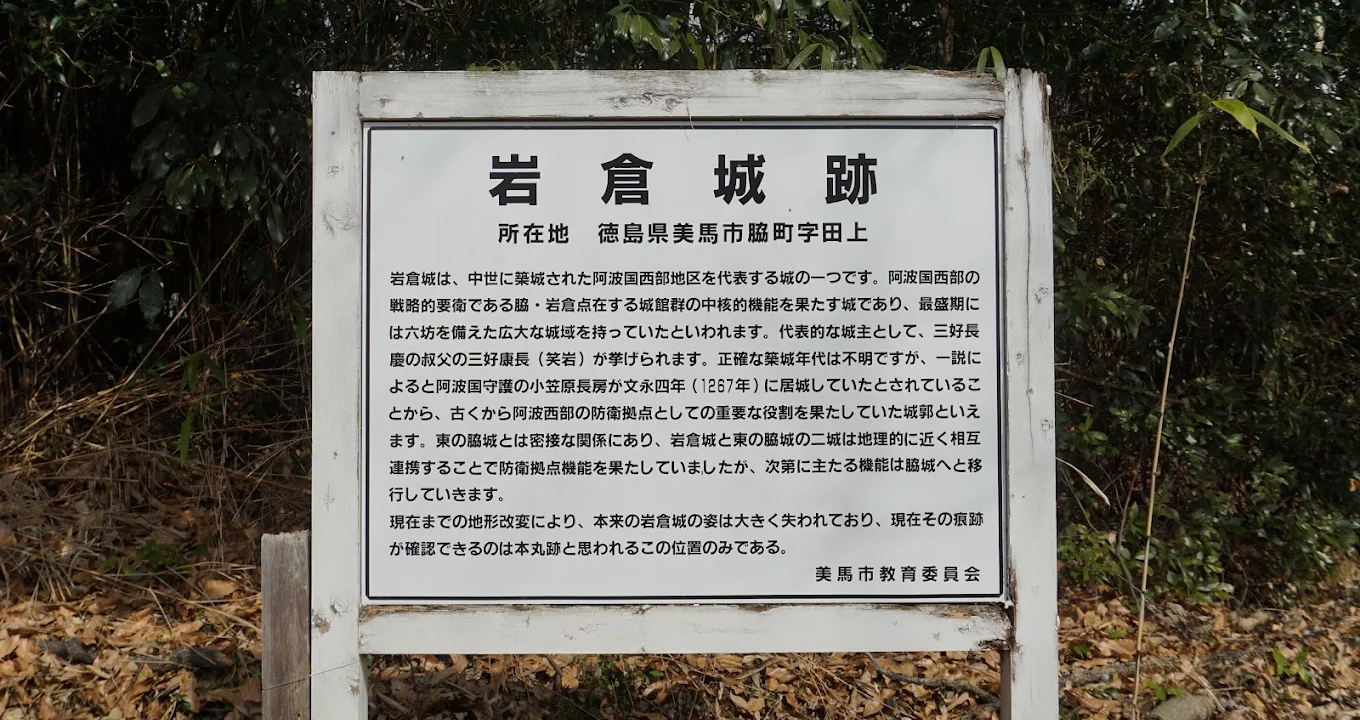
Iwakura Castle is a medieval mountain castle located in Tanoue, Wakimachi, Mima City, Tokushima Prefecture. Built on the tip of a river terrace at an altitude of 111 meters, this castle was situated in a strategic location overlooking the Yoshino River and functioned as an important base for controlling the western region of Awa Province.
Currently, the castle ruins, including moats and baileys, are well-preserved, making it a historical site of interest to mountain castle enthusiasts and history buffs. Along with the nearby Waki Castle, it is an important historical heritage site that tells the story of the expansion of the Miyoshi clan’s power in Awa Province.
History of Iwakura Castle
Construction in the Kamakura Period
The history of Iwakura Castle dates back to the Kamakura period. In 1267, during the Bun’ei era, when Taira no Moritaka, the governor of Miyoshi County, rebelled, it is said that Ogasawara Nagafusa, the governor of Awa Province, built a castle in this location and quelled Moritaka’s rebellion. The construction of castles during this period aimed to establish the governor’s power in Awa Province and strengthen regional control.
The location, utilizing the natural fortifications of a river terrace, was ideal for monitoring water transport on the Yoshino River and controlling transportation in western Awa Province.
The Sengoku Period and the Miyoshi Clan’s Rule
During the Sengoku period, Iwakura Castle developed into an important base for the Miyoshi clan. During the Eiroku era (1558-1570), Miyoshi Yasunaga (Eiwa) renovated and expanded Iwakura Castle, and appointed his eldest son, Miyoshi Yasutoshi (Miyoshi Tokutaro Yasutoshi), as its lord.
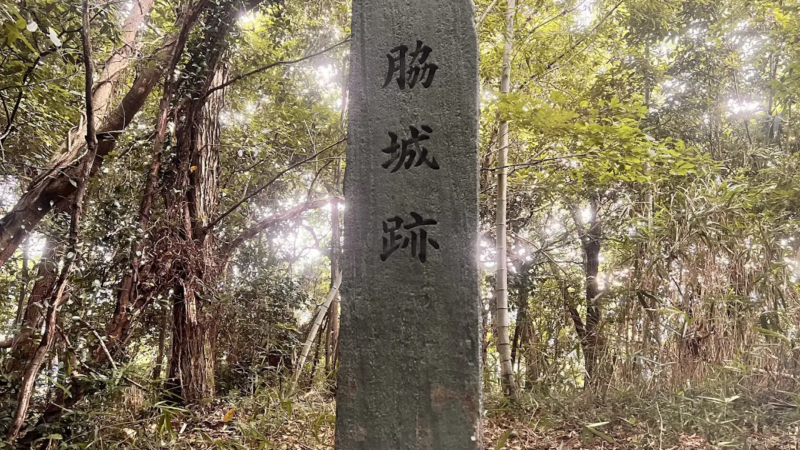
Miyoshi Yasunaga, known by his nickname “Shogan,” was a samurai who played a central role in the Miyoshi clan’s rule of Awa Province. He established a strong system of control over the region by linking Iwakura Castle with the nearby Waki Castle (lord: Takeda Nobuaki).
At its peak, Iwakura Castle boasted a vast castle area with six sub-temples and functioned as one of the representative castles of the western region of Awa Province. During this period, Iwakura Castle is thought to have served not only as a military base but also as a center of regional governance.
The Invasion and Rule of the Chosokabe Clan
During the Tensho era (1573-1592), Chosokabe Motochika of Tosa Province intensified his invasion of Shikoku. From around 1582, the Chosokabe clan strengthened their invasion of Awa Province, and the Miyoshi clan’s power gradually declined.
Following the Chosokabe clan’s invasion of Awa Province, Iwakura Castle also came under their control, and records indicate that Chosokabe Chikayoshi was appointed as its lord. During this period, Awa Province became a crucial base for the Chosokabe clan’s unification of Shikoku.
The Entry of Hachisuka Iemasa and the Abandonment of the Castle
In 1585, following Toyotomi Hideyoshi’s conquest of Shikoku, Awa Province was granted to Hachisuka Iemasa. After Hachisuka Iemasa’s arrival, the castle layout of Awa Province underwent a major reorganization.
The Hachisuka clan established Tokushima Castle as their base and selected nine major castles known as the Nine Castles of Awa to establish their governing system. However, Iwakura Castle was not included in these nine castles, and it is believed to have been abandoned shortly after Hachisuka Iemasa’s arrival in 1585.
Thus, the history of Iwakura Castle, spanning approximately 320 years, came to an end, and it remains a castle ruin to this day.
Structure and Remains of Iwakura Castle
Castle Location and Layout
Iwakura Castle is located on the tip of a river terrace at an elevation of 111 meters, with a relative height of approximately 50 meters. Its location, skillfully utilizing the terrace topography formed by the Yoshino River, is a typical example of a medieval mountain castle that maximized natural defensive capabilities.
The castle grounds consist of a central Honmaru (main enclosure/1st bailey) surrounded by multiple baileys. At its peak, it is believed to have possessed a vast castle area encompassing six sub-temples, boasting a scale far exceeding that of a mere military base.
Honmaru (Main Enclosure)
The Honmaru, the center of the castle, is located at the highest point of the terrace. From here, one can overlook the Yoshino River and the surrounding area, serving as both a military surveillance function and a command center.
While the size of the Honmaru is standard for a medieval mountain castle, the clearly defined flattened surface remains, making it an important remains for understanding the castle’s structure at the time.
Horikiri (The Main Highlight)
The main highlight of Iwakura Castle is the horikiri (moat) located between the main keep and the second enclosure (second bailey). This moat is situated north of the main keep and is remarkably well-preserved as a defensive feature of the mountain castle.
The moat is a dry moat dug to cut across the ridge, functioning as a crucial defensive line to prevent enemy intrusion. It retains its depth and width even today, making it a valuable historical site that allows visitors to experience the defensive techniques of a medieval mountain castle.
This moat is particularly highly regarded by castle enthusiasts and mountain castle lovers, and is a must-see point when visiting Iwakura Castle.
Other Remains
Besides the moat, the following remains are also found at Iwakura Castle:
- Kuruwa (enclosure) Remains: Multiple enclosures arranged around the main enclosure can be identified.
- Cut-off Slopes: Steep, artificially carved slopes can be seen around each enclosure.
- Traces of Earthworks: Remnants of earthworks can be observed in some enclosures.
These remains indicate that Iwakura Castle functioned as a practical mountain castle during the Sengoku period (Warring States period).
Highlights of Iwakura Castle
1. Moat between the Main Enclosure and the Second Enclosure
As mentioned above, the greatest highlight of Iwakura Castle is the moat on the north side of the main enclosure. The clearly preserved dry moat is an excellent example for understanding the defensive structure of a medieval mountain castle. Standing on either side of the moat, you can truly appreciate the ingenuity used to prevent enemy intrusion.
2. View from the River Terrace
From the castle ruins, at an altitude of 111 meters, you can enjoy a panoramic view of the Yoshino River and the townscape of Mima City. During the Sengoku period, the castle lords likely used this view to survey their territory and monitor strategic transportation points. Especially on clear days, you can enjoy the beautiful scenery created by the mountains of Awa and the Yoshino River.
3. Location in relation to Waki Castle
Waki Castle is located approximately 1 kilometer west of Iwakura Castle. During the Miyoshi clan’s rule, these two castles cooperated to control the region. If you have time, visiting both castles to experience the Sengoku period castle network is highly recommended.
4. The Atmosphere of a Quiet Mountain Castle
Iwakura Castle is a simple castle ruin that hasn’t been commercialized for tourism. With few visitors, you can reflect on history in the quiet mountains. This tranquility is precisely what allows you to fully appreciate the charm of a medieval mountain castle.
Access Information
Location
Tanoue, Wakimachi, Mima City, Tokushima Prefecture
Access by Public Transportation
- Approximately 60 minutes on foot from JR Tokushima Line, Kojima Station (approximately 4 kilometers)
- Taxis are also available from the station (approximately 10-15 minutes)
Access by public transportation takes time, so visiting by car is recommended.
Access by Car
- Approximately 15 minutes from the Wakimachi Interchange on the Tokushima Expressway
- While it’s possible to drive close to the castle ruins, parking space is limited.
- From the castle entrance, you’ll need to hike up a mountain path (approximately 15-20 minutes).
Points to Note When Visiting
- As it’s a mountain castle, comfortable shoes and clothing are essential.
- Be especially careful after rain, as the ground can be slippery.
- Remember to bring insect repellent in summer and warm clothing in winter.
- Signposts are limited, so it’s recommended to check the location beforehand.
- The average visit takes approximately 20-30 minutes.
Nearby Tourist Attractions
Wakimachi Udatsu Townscape
Wakimachi in Mima City is home to the “Udatsu Townscape,” designated as a National Important Preservation District for Groups of Traditional Buildings. This historic townscape, which flourished as a town of indigo merchants from the Edo period to the Meiji period, is preserved and can be enjoyed in conjunction with a visit to Iwakura Castle.
Waki Castle Ruins
Located approximately 1 kilometer west of Iwakura Castle, Waki Castle was also an important stronghold during the Miyoshi clan era. Considering its historical context of coordinating with Iwakura Castle to control the region, visiting both is worthwhile.
Yoshino River
Known as one of Japan’s three most turbulent rivers, the Yoshino River flows through Mima City. Enjoyable drives and walks along the river are also possible.
Iwakura Castle Evaluation
According to evaluations by castle enthusiasts, Iwakura Castle receives an average rating of ★★★☆☆ (3.0). While not flashy, it has earned a certain level of appreciation as a full-fledged mountain castle with clearly visible moats and bailey remains.
The following points, in particular, have been praised:
- The moat is well-preserved.
- Suitable for learning about the structure of medieval mountain castles.
- A quiet environment where you can feel the history.
- A historical site that helps understand the Miyoshi clan’s rule over Awa Province.
On the other hand, the limited number of signposts and maintenance, and the somewhat inconvenient access, are areas that need improvement to receive a higher rating.
Significance of Visiting Iwakura Castle
Iwakura Castle is an important historical site that embodies the history of Awa Province from the Kamakura period to the Sengoku period. It is an indispensable castle site for understanding the Sengoku history of Shikoku, especially the Miyoshi clan’s rule over Shikoku, the Chosokabe clan’s unification of Shikoku, and Toyotomi Hideyoshi’s pacification of Shikoku.
While not a glamorous tourist destination, it is a valuable place where you can reflect on history in a quiet mountain setting and experience the structure of a medieval mountain castle firsthand. Iwakura Castle is an unmissable spot for those touring castles in Tokushima Prefecture or exploring the history following in the footsteps of the Miyoshi and Chosokabe clans.
Summary
Iwakura Castle in Mima City, Tokushima Prefecture, is a mountain castle that functioned as a strategic point in western Awa Province from the Kamakura period to the Sengoku period. Its historical changes—rule by the Miyoshi father and son, Yasunaga and Yasutoshi, the invasion by the Chosokabe clan, and its abandonment upon the arrival of Hachisuka Iemasa—tell the very story of Shikoku’s Sengoku history.
The remaining structures, including the clearly defined moat between the main keep and the second bailey, are valuable historical sites that convey the defensive structure of a medieval mountain castle. It can also be considered an important historical heritage site for understanding the Sengoku period castle network, particularly its coordinated regional control with Waki Castle.
While access is somewhat inconvenient, Iwakura Castle, with its tranquil environment and sense of history, is a worthwhile place to visit for castle enthusiasts and history buffs. Visiting it along with Mima City’s “Udatsu townscape” and Waki Castle will allow you to experience Awa’s history and culture more deeply.