Complete Guide to Toshimadate Castle (Akita Prefecture) | A Thorough Explanation of the Sengoku Period Mountain Castle Ruins and the History of the Port Disturbance
What is Toshimadate Castle?
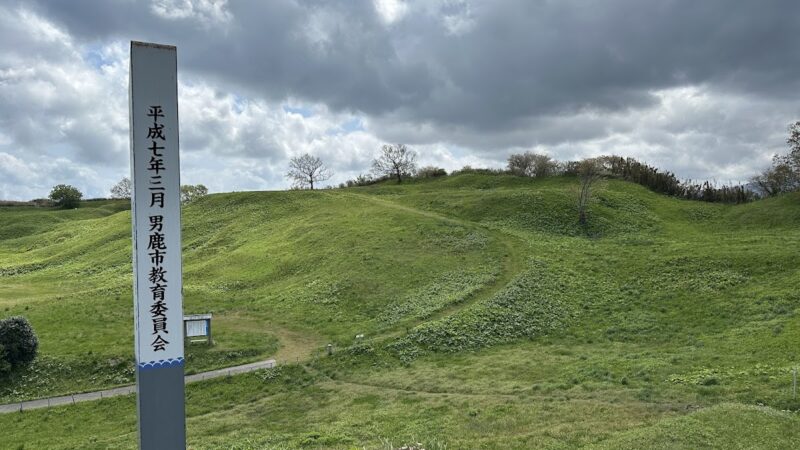
Toshimadate Castle is a Sengoku period mountain castle site located in Kawabe Tojima, Akita City, Akita Prefecture. Currently, it is maintained as the “Toshimadate Castle Historical Site Park” and designated as a historical site of Akita Prefecture. Built on a hill approximately 100 meters above sea level, this castle site retains well-preserved defensive structures such as dry moats, earthworks, vertical moats, and trenches, making it a valuable site for learning about the structure of medieval mountain castles.
Despite its relatively easy accessibility—approximately 20 minutes by car from central Akita City and approximately 10 minutes by car from JR Wada Station—it is characterized by its almost entirely preserved castle structure. Toshimadate Castle, which was the stage for power struggles in the Akita region during the Sengoku period, is a castle site of historical and military significance, attracting attention from castle enthusiasts and history buffs.
History of Toshima Castle
Construction and Origin of the Toshima Clan
There are several theories regarding the construction period of Toshima Castle. According to one theory, it began in the Muromachi period when Kurokawa Higo-no-kami built it as “Kuwaki Castle.” Later, Toshima Genba-no-kami (Hatakeyama Shoji Jiro Shigemura) settled in the area, and it came to be known as Toshima Castle.
The Toshima clan is said to be descended from Hatakeyama Shigetada, a well-known samurai of the Kamakura period. The Toshima clan, who migrated from the Kanto region to the Tohoku region, settled in this area and developed Toshima Castle as a base to control the Tojima (Noda Takaya) region. As a powerful samurai in the region, the Toshima clan established this castle in a strategic location controlling a key transportation hub in the Iwamigawa River basin.
Relationship with the Ando Clan
During the Sengoku period, the Ando clan (Ando family) held significant power in the Akita region. The Ando clan was divided into the Hiyama Ando clan, based at Hiyama Castle, and the Minato Ando clan, based at Minato Castle, and they were often in conflict.
Interestingly, there is a theory that Ando Shigeki, who succeeded the Minato Ando clan, resided not at Minato Castle, but at this Toyoshima Manor. This suggests that Toyoshima Manor possessed a militarily advantageous location. The relationship between the Toyoshima and Ando clans was complex, sometimes cooperating and sometimes in conflict.
The Minato Rebellion and the Fall of Toyoshima Manor
The most important event in the history of Toyoshima Manor was the “Minato Rebellion,” which occurred in 1588. This incident was a power struggle within the Ando clan between Akita Jōnosuke (Ando Sanesue, later Akita Sanesue), lord of Hiyama Castle, and Ando Takasue (younger brother of Aiki), lord of Minato Castle.
During the Minato Rebellion, Toyoshima Shigeuji sided with Ando Takasue, the lord of Minato Castle, and fought against Akita Sanesue. However, the situation turned unfavorable when the Twelve Lords of Yuri, powerful local families, sided with Akita Sanesue, the lord of Hiyama Castle. Toyoshima Castle was attacked and fell. This battle significantly weakened the Toyoshima clan.
After the Fall of Toyoshima Castle
After the Minato Rebellion, it is said that Shin’nai, the younger brother of Akatsu Okuro of Hagawa Castle (one of the Twelve Lords of Yuri), took up residence in Toyoshima Castle and came to be known as “Lord Toyoshima.” Later, in the Edo period, Toyoshima Castle was abandoned, but the settlement of Tojima (formerly Noda Takaya) developed as the first post station on the Ushu Kaido road heading north from Kubota Castle town.
With the implementation of the town and village system during the Meiji era, Kitano-da Takaya Village, Matsubuchi Village, Tojima Village, Toyonari Village, and Hataya Village merged in 1889 (Meiji 22) to form Toyoshima Village in Kawabe District. The village name originates from the Toyoshima clan, who built Toyoshima Castle, reflecting the historical importance of the Toyoshima clan in this region.
Structure and Layout of Toyoshima Castle
A Mountain Castle Utilizing the Topography
Toyoshima Castle is a typical mountain castle built on a hillside along the Iwami River (Asahi River). Its layout, skillfully utilizing the natural terrain, demonstrates the high level of castle-building technology during the Sengoku period. The castle grounds are spread out on a long, narrow ridge extending north and south, creating a highly defensible structure that takes advantage of the elevation difference.
The castle’s location, sandwiched between a river and mountains, was a strategically important area, making it difficult for attackers to penetrate. This choice of terrain is a common characteristic of mountain castles during the Sengoku period, and Toyoshima Castle is no exception.
Front Palace and Inner Palace
The main part of Toyoshima Castle consists of two groups of enclosures called the “Front Palace” and the “Inner Palace.”
The Front Palace is a group of enclosures located on the southernmost ridge, serving as an important defensive stronghold protecting the entrance to the castle. Multiple smaller enclosures are arranged here, creating a structure designed to prevent enemy intrusion.
The Inner Palace is the main enclosure located at the mountaintop, believed to have housed the lord’s residence and command post. Situated at the highest elevation, it offers excellent vantage points. Multiple enclosures are arranged in a stepped pattern around the Inner Palace, forming a multi-layered defensive structure.
Characteristics of Defensive Facilities
Toyoshima Castle retains many defensive facilities characteristic of mountain castles from the Sengoku period.
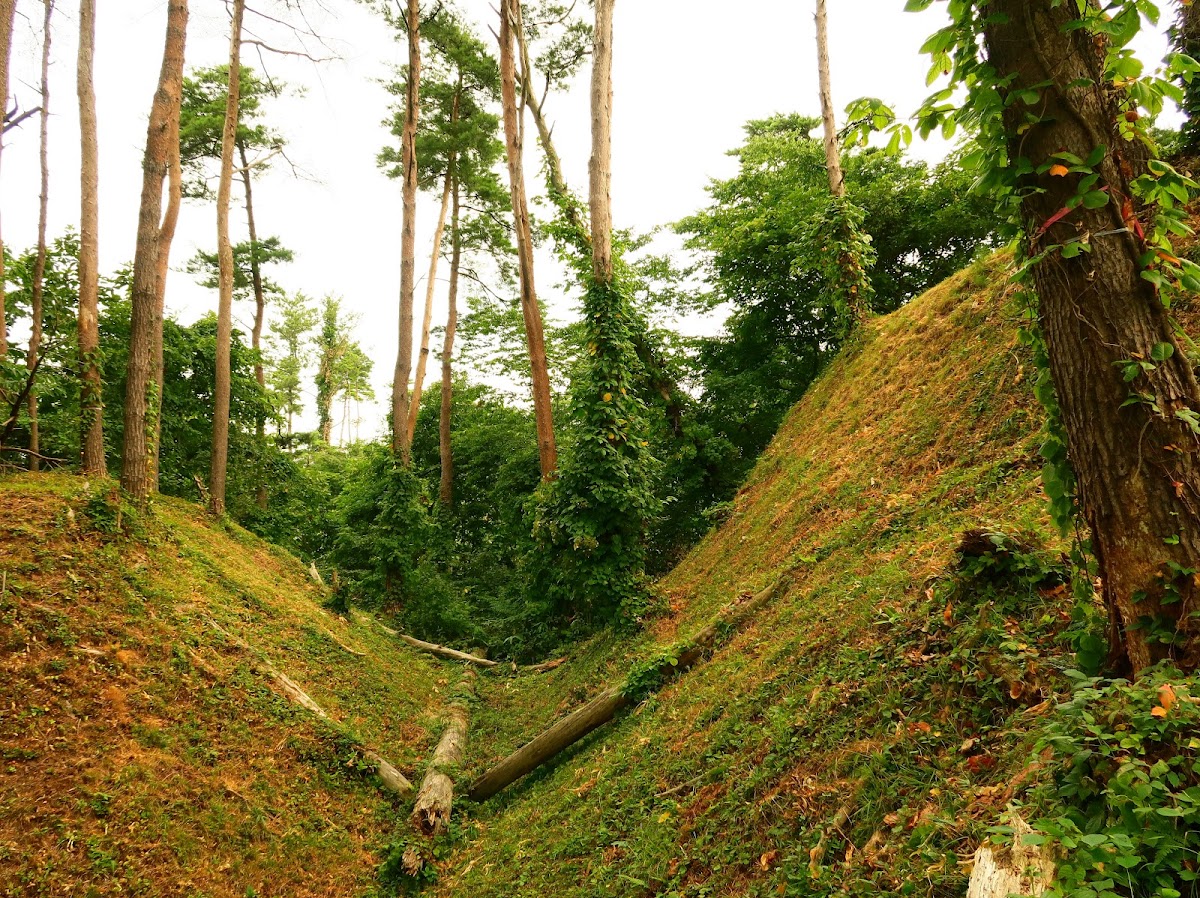
Dry moats are located throughout the castle, serving to separate enclosures. These dry moats, several meters deep, were a crucial defensive line hindering enemy advances.
Vertical moats are moats dug vertically along a slope, serving to prevent enemies from climbing the slope and attacking. At Toyoshima Castle, multiple vertical moats can be seen, particularly on both sides of the ridge, indicating a structure designed to defend against attacks from the flanks.
Deep trenches are moats dug across a ridge, the most effective defensive structure for blocking enemy incursions. Several clearly defined deep trenches remain at Toyoshima Castle, allowing us to still see the defensive lines of the time.
Earthworks are earthen walls built around the perimeter of a bailey, protecting against enemy arrows and firearms, and clearly defining the boundaries of the bailey. The earthworks at Toyoshima Castle retain a height of over 2 meters in some sections, remarkably well-preserved.
Bailey Arrangement
More than 10 baileys of varying sizes have been identified at Toyoshima Castle. Centered around the main enclosure, the Okugoten, the castle features a terraced layout of baileys, each clearly demarcated by dry moats and earthen ramparts.
This multi-tiered arrangement of baileys is based on the concept of multiple layers of defense, where even if the enemy breaches one bailey, the next can provide cover. Furthermore, each bailey offers a view of the others, allowing for mutual covering fire.
Highlights of Toyoshima Castle
Well-Preserved Remains
The greatest appeal of Toyoshima Castle lies in the remarkably well-preserved remains from the Sengoku period (Warring States period). This mountain castle, largely intact and undamaged by modern development, is a rare and valuable example nationwide.
In particular, the vertical moats and trenches are clearly visible, allowing visitors to experience the castle-building techniques and defensive philosophies of the Sengoku period firsthand. For castle enthusiasts, exploring the remains with a map in hand is a delightful experience, and it’s an excellent field for learning about the structure of medieval mountain castles.
Views and Natural Environment
From the main enclosure of Toyoshima Castle, you can overlook the plains of the Iwamigawa River basin. During the Sengoku period (Warring States period), the castle lords likely surveyed their territory and monitored enemy movements from this location. On clear days, the view extends all the way to Akita City, a major attraction for visitors.
Furthermore, the castle ruins are surrounded by a rich natural environment, allowing visitors to enjoy the scenery of each season, from fresh greenery in spring to vibrant autumn foliage. The quiet environment, where you can enjoy a historical stroll while listening to the chirping of wild birds, is perfect for refreshing yourself away from the hustle and bustle of the city.
Development as a Historical Park
Toyoshima Castle, now developed as Toyoshima Castle Historical Park, has walking paths for easy exploration. Information boards are installed at the main remains, allowing even first-time visitors to understand the castle’s structure and history.
Parking is available, making it easily accessible by car. However, as it is a mountain castle, comfortable shoes and clothing are recommended.
Photo Spot
Toyoshima-kan is a popular spot for photographing castles. In particular, the cross-sections of the dry moats and vertical trenches, and the ridges of the earthworks, offer impressive opportunities to capture the remains of a Sengoku period castle.
The castle ruins change their appearance with the seasons, offering new discoveries with every visit. The castle ruins, shrouded in morning mist in the early morning, and the earthworks illuminated by the slanted light of dusk, show different expressions depending on the time of day.
Access Information
Location
Address: Toyoshima-kan, Kawabe Toshima, Akita City, Akita Prefecture
Access by Car
- From Akita Station: Approximately 20 minutes
- From Akita Minami IC on the Akita Expressway: Approximately 15 minutes
- From National Route 13: Accessible via Prefectural Road 41
The Toyoshima-kan Historical Park signpost is located along the prefectural road. Following the signs will lead you to the parking area via a road through fields. Entering “Toyoshimakan Historical Park” or the address into your car navigation system will allow you to arrive relatively smoothly.
Access by Public Transportation
- From JR Wada Station: Approximately 10 minutes by car (approximately 1 hour on foot)
- From Akita Station: A combination of local bus and taxi is the most practical option.
Public transportation access is somewhat inconvenient, so we recommend using a rental car or taxi.
Estimated Visiting Time
For a thorough visit to the castle ruins, allow approximately 40 minutes to 1 hour to observe the remains carefully. Including photography and checking the layout, an ideal stay would be around 1.5 hours.
Notes for Visitors
- As it is a mountain castle, comfortable walking shoes and clothing are essential.
- Bringing insect repellent is recommended during the summer months.
- Be careful as the ground can be slippery during and after rain.
- There are no toilets or vending machines nearby, so please prepare accordingly.
- Visiting may be difficult in winter due to snow.
Nearby Tourist Attractions
Castles in Akita City
When visiting Toyoshima Castle, it is recommended to also visit other castles in Akita City.
Kubota Castle (Senshu Park) was the residence of the Satake clan, the lords of the Akita domain, and is located in the center of Akita City. In contrast to Toyoshima Castle, it has the structure of a flatland castle, and a corner turret has been restored. It is easily accessible on foot from Akita Station.
Wakimoto Castle is a mountain castle located in the northern part of Akita City, at the base of the Oga Peninsula, and was an important base for the Ando clan. This castle, dating back to the same era as Toyoshima-kan, boasts magnificent views overlooking the Sea of Japan.
Historical Sites in the Kawabe District
The Kawabe district, where Toyoshima-kan is located, offers other historical attractions.
Iwami-Sannai District retains the landscape of an old settlement, allowing visitors to feel the remnants of the Toyoshima clan era. Numerous shrines and temples are scattered throughout the area, offering opportunities to explore the region’s history.
Tourist Facilities in Akita City
After exploring history, consider visiting tourist facilities in Akita City.
Akita Prefectural Museum offers insights into Akita’s history and culture. Exhibits on Akita during the Sengoku period provide a deeper understanding of Toyoshima-kan’s historical background.
Akita City Folk Performing Arts Museum (Neburi-Nagashi Hall) allows visitors to experience Akita’s traditional culture and witness a Kanto Festival demonstration.
Tips for Enjoying Toshima-kan
Recommended Prior Study
Before visiting Toshima-kan, having some basic knowledge about the history of the Akita region during the Sengoku period, and about the Ando and Toshima clans, will make your visit more fulfilling. Understanding the circumstances of the Minato Incident, in particular, will allow you to more deeply appreciate the strategic location and structure of the castle.
Utilizing Castle Layout Maps
Obtaining castle layout maps from books or websites about castles will make it easier to identify the remains on-site. Walking while understanding the location of various defensive structures will help you grasp the overall layout of the castle.
Visiting in Each Season
Toshima-kan has different charms in each of the four seasons. In spring, the remains stand out amidst the fresh greenery; in summer, you can enjoy the atmosphere of the castle ruins enveloped in greenery; in autumn, the autumn leaves are beautiful; and in winter, while visits are difficult due to snow, early spring after the snow melts offers a unique atmosphere.
Evaluation and Reviews of Toyoshima Castle
Based on evaluations from castle enthusiasts, Toyoshima Castle receives an average rating of ★★★☆☆ (2.50). This is by no means a low rating; considering its relatively low profile, the remains are well-preserved and it is recognized as a castle site worth visiting.
Visitor reviews include comments such as, “The remains are clearly visible,” “You can feel the history in a quiet environment,” and “Access is a little inconvenient, but that means there are fewer people and you can visit in peace.” The average visit time is about 38 minutes, and it is praised as a compact yet fulfilling castle exploration.
The number of visitors is relatively low, ranking around 3257th among castle sites nationwide. This is partly due to its location in Akita and its relatively low profile, but conversely, it can be said to be a hidden gem where you can avoid crowds and enjoy a leisurely visit.
Current Status of Toyoshima Castle Research
Archaeological Survey
Regarding Toyoshima Castle, the Akita Prefectural Board of Education has conducted excavation and surveying surveys, and the results are published in the “Akita Prefecture Archaeological Site Map Information,” etc. These investigations are accumulating scientific knowledge about the castle’s structure and age.
Documentary Sources
While documentary sources concerning Toyoshima Castle are limited, fragmentary records remain in historical documents related to the Ando and Akita clans. Records concerning the Minato Incident, in particular, are valuable sources for understanding the political situation and battles of the time.
Future Challenges
Many aspects of research on Toyoshima Castle remain unclear. Further research is expected to determine the castle’s construction date, the detailed genealogy of the Toyoshima clan, and the castle’s transformation process.
Summary
Toyoshima Castle (Akita Prefecture) is a mountain castle that was the stage for power struggles in the Akita region during the Sengoku period. It is a valuable historical site with well-preserved remains such as vertical moats, trenches, dry moats, and earthworks. Originally the residence of the Toyoshima clan, descendants of Hatakeyama Shigetada, it functioned as a powerful regional base until its fall during the Minato Rebellion of 1588.
Located on a hillside in the Kawabe district of Akita City, its convenient access—approximately 20 minutes by car from Akita Station—is a major draw. Designated a prefectural historical site and now developed as the Toyoshima-kan Historical Park, it’s a must-see spot for history buffs and castle enthusiasts.
With its layout that utilizes the natural terrain, clearly preserved defensive structures, and the historical romance of the Sengoku period, Toyoshima-kan is a hidden gem of a castle that you should definitely visit when you come to Akita. Why not feel the spirit of the Sengoku warlords from over 400 years ago in this tranquil environment?
Frequently Asked Questions (FAQ)
Q1: Is there an entrance fee to visit Toyoshima-kan?
A1: Toyoshima-kan Historical Park is free to visit. As it is an open historical park, there are no restrictions on opening hours, and you can visit anytime. However, for safety reasons, it is recommended to avoid visiting at night or in the early morning.
Q2: How long does it take to visit Toyoshima-kan?
A2: If you want to see the castle ruins thoroughly, it will take about 30 to 40 minutes. If you want to carefully observe the remains and enjoy taking photographs, it is best to allow 1 to 1.5 hours. Since you will be walking on mountain paths, it is recommended to allocate ample time.
Q3: What is the most convenient way to access Toyoshima-kan?
A3: Access by car is the most convenient. It takes about 20 minutes from Akita Station and about 15 minutes from Akita Minami IC. By public transport, it is about 10 minutes by car from the nearest JR Wada Station, but there are no bus routes from the station, so renting a car or taking a taxi is the most practical option.
Q4: What is the best season to visit Toyoshima-kan?
A4: Spring to autumn is the best time to visit. The scenery is especially beautiful and recommended during the fresh green season from May to June and the autumn foliage season from October to November. Visiting may be difficult in winter due to snow. Also, there are many insects in the summer, so insect repellent is necessary.
Q5: Please tell me about the relationship between Toyoshima-kan and the Minato Incident.
A5: The Minato Incident of 1588 was a power struggle between the Hiyama Ando clan and the Minato Ando clan. Toyoshima Shigeuji, the lord of Toyoshima-kan, fought on the side of Ando Takasue, the lord of Minato Castle, but was defeated when the Twelve Lords of Yuri sided with Akita Sanesue, the lord of Hiyama Castle, and Toyoshima-kan fell. This incident led to a decline in the power of the Toyoshima clan and significantly altered the power dynamics in Akita during the Sengoku period.
Q6: Are there any places to eat around Toyoshima-kan?
A6: There are very few restaurants around Toyoshima-kan. We recommend eating at restaurants in Akita city center or along National Route 13 before or after your visit, or bringing your own lunch. There are rest areas within the historical park where you can have a light meal.
Q7: Can I freely take photos at Toyoshima-kan?
A7: Yes, you are free to take photos at Toyoshima-kan. Since it is open to the public as a historical park, there are no restrictions on personal photography. The remains such as dry moats, vertical moats, and earthworks are popular photo spots. However, please be considerate of other visitors.
Q8: Are Toyoshima-kan and Kuwaki Castle the same castle?
A8: Toyoshima-kan is also known as “Kuwaki Castle.” It is believed to have originated in the Muromachi period when Kurokawa Higo-no-kami built it as Kuwaki Castle, and later the Toyoshima clan took over, after which it came to be called Toyoshima-kan. Therefore, Kuwaki Castle and Toyoshima-kan are considered to be different names for the same castle.