Nanao Castle (Yonago City, Tottori Prefecture) Complete Guide | History, Access, and Highlights Explained in Detail
What is Nanao Castle?
Nanao Castle is a medieval mountain castle located in Hashimoto, Yonago City, Tottori Prefecture. Built on a hill 108 meters above sea level, it functioned as a stronghold with a relative height of approximately 90 meters. As one of the important bases during the Sengoku period of Hoki Province, it is a valuable historical site that conveys the history of the region to the present day.
While there are several castle ruins scattered throughout Yonago City, Nanao Castle is relatively well-preserved, making it a valuable site where some of the original layout and remains can be seen. Currently, it is attracting attention among local history enthusiasts and castle fans, and is positioned as an important historical site for studying the medieval history of the San’in region.
Basic Information on Nanao Castle
- Location: Hashimoto, Yonago City, Tottori Prefecture
- Castle Structure: Mountain Castle
- Elevation: 108 meters
- Relative Height: Approximately 90 meters
- Construction Period: Sengoku period (estimated)
- Lord: Unknown (few records)
- Current Status: Part of the remains remain
History of Nanao Castle
Hoki Province in the Sengoku Period
Hoki Province, where Nanao Castle was built during the Sengoku period, was the front line of the power struggle between the Amago and Mori clans. The area around Yonago City in western Tottori Prefecture was a crucial transportation hub connecting the San’in and Sanyo regions, making it militarily and economically important.
Many local powerful families (kokushu) held sway in Hoki Province, each building mountain castles to protect their territories. Nanao Castle is believed to have been built as one of these local powerful families’ strongholds. ### Background of the Castle’s Construction
While there are no clear records regarding the construction period or builder of Nanao Castle, its structure and location suggest it was built during the mid-to-late Sengoku period (Warring States period). Its location in Hashimoto, Yonago City, was important due to its proximity to the Sea of Japan and good access to Lake Nakaumi, allowing for monitoring of both land and sea traffic.
At that time, the Amago clan held significant power in Hoki Province, and many local lords were subservient to them. However, as the Mori clan began to expand its power in the mid-16th century, the local lords of Hoki Province were torn between the Amago and Mori clans. Nanao Castle is believed to have been one of the castles caught in these turbulent times.
Role and Function of the Castle
Based on its location, Nanao Castle is presumed to have played the following roles:
- Regional Control Base: Functioned as the residence of a local lord controlling the surrounding area.
- Traffic Monitoring: Played a role in monitoring water transport to the San’in Road and Lake Nakaumi.
- Defense Base: A military base prepared for invasions by hostile forces.
- Information Gathering: A lookout post for monitoring surrounding developments.
Given its nature as a mountain castle, Nanao Castle is thought to have served more as a refuge and military base during times of emergency than as a daily living space.
Period of Abandonment
There are no clear records regarding the period of abandonment of Nanao Castle, but like many mountain castles, it is presumed to have been abandoned around the time of the “One Castle Per Province” decree (1615) in the early Edo period. As Yonago Castle was developed as a modern castle, the smaller mountain castles in the surrounding area lost their military value and were abandoned.
Remains and Highlights of Nanao Castle
Layout and Structure
Nanao Castle was a mountain castle built on a hill 108 meters above sea level. Its location, with a relative height of approximately 90 meters, made it a formidable fortress for attackers. The castle’s layout is thought to have consisted of multiple enclosures (kuruwa) centered around the mountaintop.
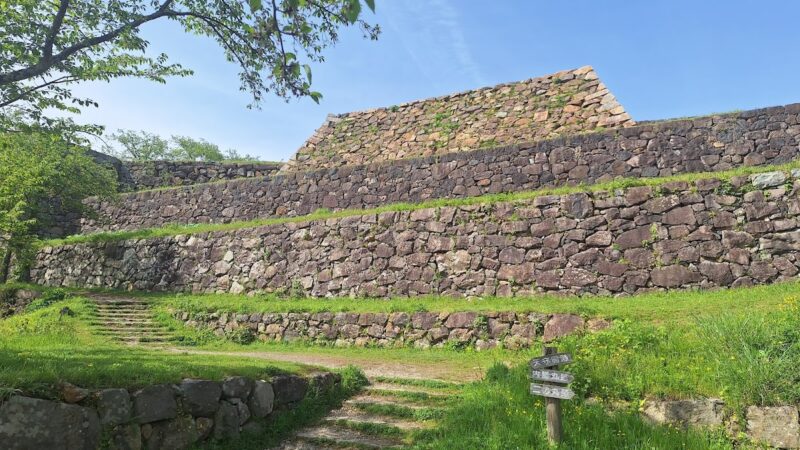
Even today, traces of the former enclosures and moats can be seen from the topography. The defensive structure, skillfully utilizing the natural terrain unique to mountain castles, speaks to the high level of castle-building technology of the time.
Main Enclosure (Honmaru)
It is presumed that a central enclosure called the main enclosure (shukuruwa) was located at the mountaintop. This was the most important place where the lord and his retainers would stay, and it was situated on a higher level than the surrounding area. Although currently covered with trees, the extent of the main enclosure can be estimated to some extent from the shape of the flat area.
Enclosure Groups
Multiple enclosures were arranged in a stepped pattern around the main enclosure. These enclosures are thought to have been used as garrisons for soldiers and storage areas for supplies. The defensive structure, utilizing the elevation differences between the enclosures, was one of the measures taken to make enemy incursions difficult.
Moats and Cut Slopes
Some traces of moats (dry moats cutting across mountain ridges) and cut slopes (artificially carved steep slopes), important defensive structures for mountain castles, remain. These were measures taken to limit enemy incursions and give a defensive advantage.
Ascent Routes
Currently, there are no clearly defined ascent routes to Nanao Castle, but it is believed that multiple routes once existed. Ascent routes to mountain castles were usually winding rather than straight, considering defensive considerations.
Access to Nanao Castle
Location
Address: Hashimoto, Yonago City, Tottori Prefecture
Access by Public Transportation
- From JR Yonago Station:
- The nearest station is JR San’in Main Line Yonago Station.
- Take a taxi or bus from the station.
- Travel time: Approximately 15-20 minutes
- Local Bus:
- Take a local bus running within Yonago city towards Hashimoto.
- Access is on foot from the nearest bus stop.
Access by Car
- From Yonago Expressway:
- Approximately 10-15 minutes from Yonago IC.
- Accessible via National Route 9.
- Parking:
- There is no dedicated parking lot for the castle ruins.
- You will need to use nearby public parking lots or find a place to park on the street.
Notes for Visitors
- Nanao Castle Ruins are not a developed tourist area; they are located in a forest.
- Prior research is necessary as the access route to the castle may not always be clear.
- Please prepare appropriate clothing and equipment (hiking boots, long-sleeved shirt and long pants, insect repellent, etc.).
- It is recommended to join a tour organized by a local castle enthusiasts’ club or historical group rather than visiting alone.
- If passing through private land, please obtain permission from the landowner.
Other Castle Ruins in Yonago City
In addition to Nanao Castle, numerous other castle ruins remain in Yonago City, Tottori Prefecture. Visiting these together will allow you to gain a deeper understanding of the history of Hoki Province during the Sengoku period.
Yonago Castle
This is a representative castle ruin of Yonago City and is designated as a national historic site. Yonago Castle, which was developed as a modern castle, has well-preserved castle tower bases and stone walls, and from the mountaintop you can enjoy magnificent views of Yonago city, Lake Nakaumi, and Mt. Daisen.
- Location: Kume-cho, Yonago City
- Features: Stone walls, castle tower base, group of baileys
- Access: Approximately 20 minutes on foot from JR Yonago Station
Kannonji Castle
A mountain castle located in Kannonji, Yonago City, built on a hill 64 meters above sea level and approximately 56 meters above sea level. Remains of baileys have been found, suggesting it functioned at the same time as Nanao Castle.
Inayoshi Castle
A hill castle located in Inayoshi, Yodoe-cho, Yonago City, at an altitude of 57 meters and approximately 44 meters above sea level. It functioned as a base for controlling the Yodoe region.
Kitao Castle
A mountain castle located in Fukuoka, Yodoe-cho, Yonago City, at an altitude of 90 meters and approximately 84 meters above sea level. Remains of baileys and moats have been confirmed, indicating it was an important defensive base in the Yodoe region.
Kusaka Castle
This mountain castle is located in Kusaka, Yonago City, at an altitude of 100 meters, with a relative height of approximately 86 meters. Remains of the baileys and moats still exist.
Tourist Attractions Around Nanao Castle
Yonago City Museum of Art
This is the central arts and culture facility of Yonago City, hosting exhibitions of works by local artists and special exhibitions. Visiting before or after visiting Nanao Castle allows you to experience Yonago’s culture.
Yonago Waterfowl Park
This natural park, registered under the Ramsar Convention and facing Lake Nakaumi, allows you to observe many waterfowl, including mute swans. It’s a spot where you can experience the charm of Yonago’s rich natural environment.
Mt. Daisen
Mt. Daisen, the highest peak in the Chugoku region, is located southeast of Yonago City, and its majestic form can be seen from the city center. It offers opportunities for mountain climbing and hiking, and its natural beauty changes with the seasons.
Kaike Onsen
A representative hot spring resort in the San’in region, facing the Sea of Japan, located about 15 minutes by car from Yonago city center. It’s ideal for relaxing after a tour of castle ruins.
Research and Investigation of Nanao Castle
Current State of Castle Research
Regarding Nanao Castle, full-scale archaeological excavations have not yet been conducted, and historical documents are scarce, leaving many aspects unclear. However, surveys and measurements conducted by local castle researchers and history enthusiasts are gradually revealing its true nature.
Future Challenges
To clarify the historical value of Nanao Castle, the following efforts are necessary:
- Detailed Survey: Accurate recording of existing remains
- Literature Research: Information gathering from ancient documents and local histories
- Excavation: Scientific investigation of artifacts and remains
- Preservation and Development: Preservation of remains and development of viewing paths
- Information Dissemination: Publication of research results and utilization as a tourist resource
History and Castle Culture of Yonago City
Overview of Yonago City
Yonago City is a city with a population of approximately 150,000 located in the western part of Tottori Prefecture, almost in the center of the San’in region. It is a city blessed with a rich natural environment, bordered by Mt. Daisen, the highest peak in the Chugoku region, to the southeast, the Sea of Japan to the north, and Lake Nakaumi, a Ramsar Convention registered site, to the west.
From ancient times, it flourished as a transportation hub connecting San’in and Sanyo regions, and during the Edo period, it developed as a castle town of Yonago Castle. Even today, it plays an important role as one of the economic and cultural centers of the San’in region.
Yonago in the Sengoku Period
During the Sengoku period, many mountain castles, including Nanao Castle, were built around Yonago. This indicates that the political situation at the time was unstable, and local powerful families needed castles for self-defense.
The Yonago region, situated between the two major powers, the Amago and Mori clans, became a battleground for both sides, resulting in the construction and capture of numerous castles. This historical background explains the existence of the many castle ruins that remain today.
Transition to Early Modern Castles
After the Battle of Sekigahara, Nakamura Kazutada took control of Yonago and extensively renovated Yonago Castle into an early modern castle. Consequently, surrounding mountain castles, including Nanao Castle, lost their military value and were abandoned.
Points to Note When Visiting Nanao Castle
Best Time to Visit
- Spring (March-May): The fresh greenery is beautiful, the weather is mild, and it’s a good time to visit.
- Autumn (September-November): You can enjoy the autumn foliage, and there are fewer insects, making it a comfortable time to visit.
- Time to Avoid: Visiting in summer is difficult due to the overgrown vegetation and numerous insects. Snow and ice are possible during winter.
Checklist of Items to Bring
- Hiking boots or non-slip shoes
- Long-sleeved shirt and long pants (for bushwhacking and insect bite protection)
- Hat
- Gloves (work gloves, etc.)
- Drinking water
- Insect repellent spray
- Map and compass (or GPS device)
- Mobile phone (for emergency contact)
- Camera (for recording)
- Towel
Safety Precautions
- Avoid traveling alone; visit in groups if possible.
- Refrain from visiting on days with bad weather or when bad weather is expected.
- Visit only after understanding the risks of getting lost or injured.
- Be considerate of local residents and landowners.
- Always take your trash with you.
Nanao Castle and Local Historical Preservation Activities
Local Initiatives
In Yonago City, local history enthusiasts and castle research groups are leading the investigation and preservation activities of castle ruins within the city, including Nanao Castle. Regular tours and study sessions are held to widely communicate the value of the site as a regional historical heritage.
The Role of Castle Enthusiasts
Preserving lesser-known castle ruins like Nanao Castle requires the awareness of each visitor. Observing basic manners such as not damaging the remains, not leaving litter, and not trespassing on private property contributes to the preservation of the castle ruins.
Furthermore, sharing visit records on social media and blogs helps to raise awareness of Nanao Castle, which is an indirect preservation effort.
Summary
Nanao Castle, located in Hashimoto, Yonago City, Tottori Prefecture, is a valuable mountain castle ruin that conveys the history of Hoki Province during the Sengoku period. Its location, at an altitude of 108 meters and a relative height of approximately 90 meters, speaks to its military importance at the time.
While there are few clear historical records and the site is not fully maintained, it can be said to be a valuable historical site that preserves its original form in a more pure way. Visiting Nanao Castle along with other castle ruins in the city, including Yonago Castle, will allow you to experience the transformation of castles during the transition from the Sengoku period to the early modern period.
Visiting Nanao Castle is different from typical tourist visits; it requires some preparation and determination. However, it will be a valuable experience where you can see traces of history with your own eyes and feel the spirit of the Sengoku period.
When you visit Yonago City, why not visit Nanao Castle along with other tourist spots such as Yonago Castle and Yonago Waterfowl Park? It will be a fulfilling trip that will give you a deep understanding of the region’s history and culture.