Ohara Castle (Sanda City, Hyogo Prefecture) Complete Guide | A Thorough Explanation of History, Remains, and Access
Located in Ohara, Sanda City, Hyogo Prefecture, Ohara Castle is an important castle site that conveys the history of the region, serving as the residence of a powerful local clan in the Settsu region during the Sengoku period. Although currently maintained as the grounds of Himeyama Shrine, the remains of the main keep, moats, and earthworks are well-preserved, making it a must-see spot for castle enthusiasts and history buffs.
This article comprehensively explains information useful for visiting Ohara Castle, from its historical background to specific highlights of the remains, access methods, and nearby tourist spots.
What is Ohara Castle? | The Residence of the Ohara Clan, a Powerful Local Clan of Settsu
Ohara Castle is a mountain castle built on a low hill on the east bank of the Mukogawa River, dating from the medieval to the Sengoku period. Located at a strategic transportation hub along National Route 176, it functioned as a base for regional control in Settsu Province.
While the castle itself is not particularly large, its layout is characterized by its skillful use of the terrain. The current location of Himeyama Shrine corresponds to the Honmaru (main enclosure), and to the east, separated by a large moat, lies the Ninmaru (second enclosure).
Castle Location and Geographical Importance
Ohara Castle was built in the southern part of the Sanda Basin, a strategically important location that allowed for monitoring the transportation routes along the Mukogawa River. Located on the route connecting Settsu and Tanba Provinces, it is believed to have played a crucial role in regional logistics and military operations.
The Mukogawa River flowed east and west of the castle, functioning as a natural defensive line. Furthermore, the presence of other powerful clan castles in the surrounding area suggests its role in the balance of power within the Settsu region.
History of Ohara Castle | From Construction to Fall
Construction History and the Ohara Clan
The construction date and builder of Ohara Castle are uncertain, but it is said that the castle lord was Ohara Ueno-no-kami Munetaka, a powerful local clan that ruled the area. The Ohara clan was a powerful local clan based in Arima District, Settsu Province, and ruled this region for generations.
From the medieval period to the Sengoku period, a complex power structure was formed in the Settsu region, and it is presumed that the Ohara clan was involved in the region’s politics and military affairs as part of this structure. The castle likely functioned not only as a military base but also as a center for territorial management.
Conquest and Fall of Ohara Castle by Araki Murashige
The most important event in the history of Ohara Castle is the conquest by Araki Murashige at the beginning of the Tensho era (1573-1592).
Araki Murashige was entrusted with the entire province of Settsu as a vassal of Oda Nobunaga and was working to unify Settsu Province. In this process, local powerful families were successively subjugated, or those who resisted were suppressed by force. It is said that Ohara Castle was also attacked during this process of unifying Settsu Province and fell.
While detailed records of the Ohara clan’s actions after the castle’s fall are scarce, it is believed that, like many local powerful families, they either lost their power or were incorporated into the ranks of other daimyo. The castle itself was abandoned around this time and seems to have lost its function as a military base.
Araki Murashige and the Rule of Settsu
Araki Murashige was a senior retainer entrusted with the rule of Settsu Province by Oda Nobunaga, but later rebelled against Nobunaga (the Araki Murashige Rebellion, 1578), ultimately suffering defeat and fleeing. It is believed that Ohara Castle was captured during the process of unifying Settsu, prior to this rebellion.
Murashige’s rule of Settsu was short-lived, but during that time, many local forces were reorganized, and the political landscape of Settsu was drastically altered. The fall of Ohara Castle was part of this historical turning point.
Remains of Ohara Castle | Detailed Explanation of Highlights
The remains of Ohara Castle from the Sengoku period are well-preserved. The earthworks of the main keep, the staggered gate, and the large moat are particularly noteworthy.
Main Keep Site and Himeyama Shrine
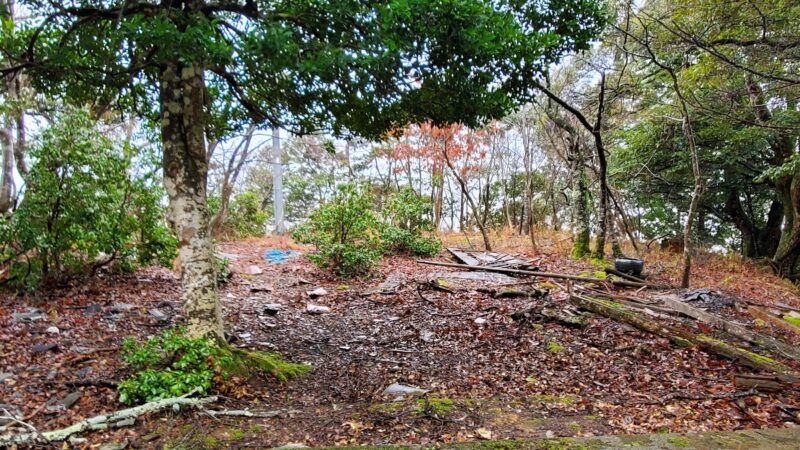
Himeyama Shrine currently stands on the site of the main keep. The flat area where the shrine’s main building stands is believed to be the former main keep, where the lord’s residence and command post were located.
While the main keep wasn’t particularly large, it was surrounded by earthworks, suggesting a strong defensive structure. Walking through the shrine grounds, you can sense the ingenuity of the castle’s layout from the slight differences in elevation and topography.
Remains of Earthworks
Earthworks remain on the south and east sides of the main keep. The southern earthwork, in particular, is relatively well-preserved, and its height and shape allow for understanding the defensive system of the time.
Remains of Earthworks
Earthworks remain on the south and east sides of the main keep. Earthen ramparts were not only important for preventing enemy intrusion but also for protecting the castle from arrow and gunfire. The earthen ramparts of Ohara Castle exhibit a structure typical of castles from the medieval to Sengoku periods, making them valuable historical remains that demonstrate the castle-building techniques of the time.
Staggered Gate
A staggered gate can be seen on the southern earthen rampart. A gate is the entrance to a castle, and the “staggered” structure is a defensive technique where passages are staggered to prevent a straight-line intrusion.
This design prevents the enemy from rushing into the castle and allows for interception in narrow passages. This staggered gate is one of the important historical remains that demonstrates the high level of castle-building technology at Ohara Castle.
Large Moat
A large-scale moat is located between the main keep and the second bailey. A moat is a dry moat dug to cut across a ridge, and is an important defensive structure that prevents enemy intrusion.
The moat at Ohara Castle is impressive in both depth and width, possessing a scale that can be experienced. If you actually descend to the bottom of the moat and look up, you will truly appreciate its defensive strength. This moat is considered one of the most important historical remains among the highlights of Ohara Castle.
Second Bailey (Sub-Bailey)
To the east, beyond the moat, lies the Second Bailey (Sub-Bailey). Although slightly smaller in scale than the main bailey, a clearly defined flat area can be seen, suggesting it was used as a soldiers’ encampment or a storage area for supplies.
From the Second Bailey, you can overlook the direction of the main bailey and the surrounding terrain, making it an ideal location for understanding the overall layout of the castle.
Access to Ohara Castle
Ohara Castle Ruins (Himeyama Shrine) can be accessed by both public transport and car.
Access by Public Transport
JR Fukuchiyama Line “Sanda Station” is the nearest station.
- Walking from Sanda Station: Approximately 20-25 minutes
- Bus from Sanda Station: Take the Shinki Bus and get off at the “Ohara” bus stop, then walk for approximately 5 minutes.
When heading towards Ohara from Sanda Station, the easiest route is to head north on National Route 176. Turn right (east) at the “Ohara” intersection and proceed about 200 meters. You will see a sign for “Himegumi Shrine (Himeyama Shrine)” on your left.
Access by Car
It’s about 10 minutes from the Kobe-Sanda IC on the Chugoku Expressway.
Turn east at the “Ohara” intersection on National Route 176 and proceed straight for about 200 meters. You will see a sign on your left. Turn left there, and Himeyama Shrine (the site of the main keep of Ohara Castle) is at the end of the forest road immediately to your left.
Parking: There are several parking spaces on the shrine grounds. However, priority is given to worshippers, so please consider using nearby public parking lots during busy times. ### Points to Note When Visiting
- The castle ruins are located within the grounds of a shrine, so please observe proper etiquette when visiting.
- Some parts of the remains may be covered in bushes, so long sleeves and long pants are recommended.
- Watch your step in areas with elevation changes, such as moats.
- Don’t forget insect repellent during the summer months.
Tourist Attractions Around Ohara Castle
When visiting Ohara Castle, we recommend also visiting other tourist attractions in Sanda City and the surrounding area.
Sanda Castle Ruins
Located in the heart of Sanda City, Sanda Castle was ruled by the Kuki clan during the Edo period. It is now maintained as the Sanda City Hall and a park. Although from a different era than Ohara Castle, it is worth visiting as a castle in the same Sanda region.
Arima Onsen
Arima Onsen, located about 30 minutes by car from Ohara Castle, is a famous hot spring known as one of Japan’s three oldest hot springs. Refreshing yourself in the hot springs after visiting the castle ruins is a great idea.
Sanda Castle Ruins
Nagasawaji Iris Garden
Located in the northern part of Sanda City, Nagasawaji Iris Garden is a famous spot for irises, which are at their best around June. The sight of tens of thousands of irises blooming across the vast grounds is breathtaking.
Kirin Beer Kobe Factory
The Kirin Beer Kobe Factory, located in Sanda City, offers tours where you can observe the beer manufacturing process (reservations required). Since you can also enjoy beer tasting, it’s a popular spot for adult field trips.
The Charm of Ohara Castle | Points of Interest for Castle Enthusiasts
Although Ohara Castle is small in scale, it possesses many elements that are attractive to castle enthusiasts.
Well-Preserved Remains
While many medieval castles have been lost due to development, Ohara Castle has been protected as part of the shrine grounds, so earthworks and moats remain in excellent condition. The scale and state of preservation of the large moat, in particular, are noteworthy.
Experience the History of Settsu Province During the Sengoku Period
This is a valuable historical site where you can truly understand how local powerful families were manipulated within the historical context of Araki Murashige’s unification of Settsu Province. The fall of Ohara Castle holds historical significance as an episode in the process of the Oda regime’s unification of Japan.
Easy Access
Its convenient location, within walking distance of Sanda Station, is also a major attraction. Unlike large mountain castles that require long hikes, it’s easily accessible, making it convenient for a wide range of visitors, from beginners to advanced.
A Learning Material for Local History
Ohara Castle is also used as a place for local history education. It’s frequently used for local elementary and junior high school local history lessons and as a field trip destination for history clubs, making it a familiar historical heritage site for local residents.
Best Season to Visit Ohara Castle
While Ohara Castle ruins are accessible year-round, the ease of visiting and the scenery vary depending on the season.
Spring (March-May)
The weather is mild, and the fresh greenery is beautiful during this season. The grounds of Himeyama Shrine are refreshing, making this an ideal time to visit the ruins. However, the number of visitors may increase around Golden Week.
Summer (June-August)
The greenery is lush, and the terrain, such as the moats, appears more three-dimensional. However, temperatures are high and there are many insects, so insect repellent and hydration are essential. Visiting in the early morning or evening is recommended.
Autumn (September-November)
This is the most suitable season to visit. The grounds are beautifully colored with autumn leaves, and the weather is pleasant, allowing for thorough observation of the ruins. October to early November is especially ideal.
Winter (December-February)
The fallen leaves make the shape of the ruins more clearly visible. However, cold weather precautions are necessary. While snow accumulation is rare, caution is needed regarding icy roads.
Preservation and Future Prospects of Ohara Castle Ruins
Ohara Castle Ruins are currently recognized as a cultural property of Sanda City and are protected as a regional historical heritage. However, since it has not received official historical site designation, future preservation activities are crucial.
Local Preservation Activities
Local history enthusiasts and cultural property preservation groups conduct regular cleaning activities and observations of the remains. Furthermore, parishioners of Himeyama Shrine also contribute indirectly to the preservation of the castle ruins through the maintenance of the shrine grounds.
Utilization as a Tourism Resource
In Sanda City, castle ruins within the city, including Ohara Castle, are positioned as tourist attractions as one of the “100 Best Castles in Hyogo Prefecture,” and efforts are being made to promote them. Further development and improvement of information signs are expected in the future.
Need for Academic Research
Detailed archaeological excavations and surveys have not been sufficiently conducted regarding Ohara Castle. Further academic research could potentially reveal more about the castle’s construction date, its history, and the actual circumstances of the Ohara clan.
Summary | Ohara Castle: A Valuable Heritage Site Conveying the History of Settsu
Ohara Castle in Sanda City, Hyogo Prefecture, is an important historical site that conveys the appearance of local powerful families in the Settsu region during the Sengoku period. As a castle ruin that tells the story of the historical turning point of Araki Murashige’s unification of Settsu, and as a castle with well-preserved remains such as earthworks and moats, it is a worthwhile spot to visit.
Although small in scale, it is packed with elements that allow you to experience the castle-building techniques of the Sengoku period, such as the impressive large moat and the ingenious design of the staggered gate. Its easy accessibility, within walking distance of Sanda Station, is also a major attraction, making it a historical site that can be enjoyed by a wide range of people, from beginners to advanced castle enthusiasts.
When you visit Sanda City or the surrounding area, be sure to visit the Ohara Castle ruins and feel the history of Settsu and the spirit of the Sengoku period. In the tranquil grounds of Himeyama Shrine, reflecting on the era of the Ohara clan, who once ruled this land, and the time of Araki Murashige, who destroyed them, will surely become an unforgettable memory.