A Thorough Explanation of Takada Castle’s History and Charm | The Reason for the Lack of Stone Walls and the Behind-the-Scenes Story of the National Construction Project
Located in Honjo-cho, Joetsu City, Niigata Prefecture, Takada Castle is a flatland castle built in 1614 during the early Edo period. Constructed as the residence of Matsudaira Tadateru, the sixth son of Tokugawa Ieyasu, it was kown other names such as “Samegajo,” “Sekijo,” “Rajo,” and “Koyojo.” Currently, it is maintained as Takada Castle Ruins Park, a designated historical site of Niigata Prefecture, and was selected as one of the Continued Top 100.
This article will explain the complete picture of Takada Castle from every angle, including its history from its construction to the present day, its unique structure without stone walls, the behind-the-scenes story of the national construction project, existing remains and restored and restored
Overview and Basic Information of Takada Castle
Takada Castle is a flatland castle built on Bodaigahara in the Takada Plain. It features a concentric layout with the main keep at its center, surrounded by the second, third, and northern baileys. The castle grounds are extensive, spanning- 600 meters east-west, and cleverly utilizing natural rivers such as the Sekikawa and Aotagawa as outer moats.
The main keep boasts a size of approximately 230 to 220 meters square, surrounded by the second bailey, with the third bailey to the south and the northern bailey to the north. This structure not only enhanced defensive capabilities castle town.
Alternative Names and Origins of Takada Castle
Takada Castle has several alternative names. The most familiar to the citizens is “Samegajo” (Shark Castle). This name is said to originate from the castle’s resemblance to a shark, or from the symbolic use of sharks as guardians of the castle. Furthere its location near the Sekikawa River, “Rajo” (라성) due to its spiral-shaped layout, and “Koyojo” (고양성) was an elegant name incorporating the place name Takada and the meaning of the sun.
These alternative names indicate that Takada Castle was recognized by the local people not merely as a military facility, but as a cultural and spiritual symbol.
History and Development of Takada Castle
Background of Construction and Tokugawa Ieyasu’s Strategy
The construction of Takada Castle is deeply intertwined with Tokugawa Ieyasu’s political strategy. In 1614, Ieyasu decided to station his sixth son, Matsudaira Tadateru, in Echigo Takada. This decision was driven by the need tochku regions amidst rising tensions with the Toyotomi.
Although Tadateru was Ieyasu’s biological son, his appearance and personality displeased Ieyasu, and he was treated poorly for a long time. However, through a political marriage to Iroha-hime, the daughter of Date Masamune Date family. The construction of Takada Castle was realized within this political context.
Construction in a Short Period of Time through a National Construction Project
The construction of Takada Castle was carried out as a “National Construction Project.” A National Construction Project is a large-scale civil engineering project ordered by the shogunate to be carried out by daimyo (feudal lords) throughout the country. Thirteen da and it was completed in an astonishingly short time of just four months.
The participating daimyo included powerful figures from eastern Japan such as Date Masamune, Uesugi Kagekatsu, Maeda Toshimitsu, Hori Naoyori, and Honda Yasutoshi. Notably, the castle’s layout (design) was handled by Date-Masamune was known as a master castle builder, and his skills and experience were utilized in the design of Takada Castle. The construction took place from March to July of Keicho 19 (1614), and it is said that hundreds of thousands of rabor looming Winter Siege of Osaka, was a reflection of Tokugawa Ieyasu’s heightened military tension.
Matsudaira Tadateru’s Reign and Dispossession
Matsudaira Tadateru, upon entering Takada Castle, became a powerful daimyo ruling Echigo Province with a domain of 750,000 koku. However, Tadateru’s reign did not last long. His violation of military orders during the Summer Siege of a Ieyasu’s death were deemed problematic, and in Genna 2 (1616), after only two years, he was dispossessed of his territory.
Tadateru was exiled to Suwa in Shinano Province, and later moved to Takayama in Hida Province. Although he lived to the age of 92, he was never pardoned. This confiscation of the castle meant that Takada Castle lost its status as the directs thereafter became a castle where successive fudai daimyo (hereditary vassals) ruled.
Changes in Successive Castle Lords
After Matsudaira Tadateru’s confiscation of the castle, various daimyo took up residence in Takada Castle. The main changes in castle lords are as follows:
- Sakai Ietada (Genna 2 / 1616): Entered the domain with a 100,000 koku stipend
- Matsudaira Mitsunaga (Kanei 1 / 1624): 260,000 koku, later dispossessed
- Period under direct shogunate rule after Matsudaira Mitsunaga’s dispossession
- Inaba Masamichi (Enpo 7 / 1679): 100,000 koku
- Toda Tadazane (Jokyo 3 / 1686): 50,000 koku
- Matsudaira Sadashige (Hoei 3 / 1706): 100,000 koku
- Sakakibara Masakuni (Kyoho 2 / 1717): 150,000 koku
Of these, the Sakakibara family had the longest tenure at Takada Castle. From the time Sakakibara Masakuni entered the domain until the Meiji Restoration, the Sakakibara family ruled the Takada Domain for approximately 150 years. The Sakakimily Sakakibara Yasumasa, one of the Four Heavenly Kings of Tokugawa, and was deeply rooted in the Takada area, contributing to the development of the castle town.
Changes After the Meiji Restoration
After the Meiji Restoration, Takada Castle was abandoned, and in 1870 (Meiji 3), many of the castle’s buildings were demolished. With the abolition of castles decree in 1873 (Meiji 6), it officially loss its fun.
Subsequently, the castle site was used as a garrison for the former Imperial Japanese Army’s 13th Division. In 1907 (Meiji 40), the division headquarters was established, and the site was significantly altered as amainilis facis and the second keep were developed into barracks and training grounds, and the original form of the castle was greatly damaged.
In the Showa era, after the war, in 1949 (Showa 24), development began on the site as Takada Castle Ruins Park. In 1970 (Showa 45), it was designated a historical site of Niigata Prefecture, and its historical value99 5), the three-story turret was restored as part of the 20th anniversary project of Joetsu City’s founding, resulting in its current appearance.
Why Takada Castle Lacks Stone Walls
One of the most distinctive features of Takada Castle is the absence of a keep and stone walls. Generally, stone walls are considered crucial for defense in early modern castles, but why were they not built at Takada Castle?
Time Constraints Due to Short Construction Period
The biggest reason is the short construction period of only four months. Constructing stone walls requires the procurement, processing, and transportation of appropriate stone materials, as well as securing highly skilled stonemasons, which demands considerable time and effort Winter Siege of Osaka, Tokugawa Ieyasu prioritized the early completion of Takada Castle, and it is believed that the construction of stone walls was omitted.
Ground and Climate Influence
The ground in the Takada Plain is soft alluvial deposits, making it unsuitable for supporting heavy stone walls. Building stone walls requires strong ground, but Takada’s geological conditions would make foundation work extremely laborious.
Furthermore, the Takada region is one of Japan’s heaviest snowfall areas. In winter, snow can accumulate to several meters, making stone walls susceptible to damage from the weight of the snow and freezing. From a maintenance perspective, a structure without stone.
Earthwork and Moat Defense System
Instead of stone walls, Takada Castle employed a defense system of earthworks and moats. A triple moat system protected the castle: an inner moat surrounding the main keep, a middle moat surrounding the second bailey, and an outer moat waiz
The earthworks were built to a height of approximately 5-6 meters, and walls and turrets were constructed on top of them. Earthworks were easier to construct than stone walls, making them suitable for castle construction in a short period areas, it had the advantage of being able to withstand the weight of snow and flexibly adapt to ground subsidence.
The moat was wide and sufficiently deep, effectively preventing enemy approaches. Utilizing Takada’s abundant water resources, the moat provided defensive capabilities comparable to stone walls.
Reasons for the Lack of a Keep
Takada Castle did not have a keep. This is likely due to reasons other than the “One Castle Per Province” decree and restrictions on keep construction imposed by the Buke Shohatto (Laws for Military Households).
One theory suggests that the short construction period meant there wasn’t enough time to build a keep, and that Date Masamune’s design philosophy prioritized practicality, valuing defensive functions over a symbolic keep. Instead, a three-story en effectively serving the role of a keep.
Remains and Restored Facilities
Existing Remains
At Takada Castle, many structures were lost due to development after the Meiji era, but some of the castle’s basic structures, such as the moats and earthworks, still remain.
The inner moat surrounds the main keep and still holds water, preserving much of its original appearance. The moat is approximately 30-40 meters wide and 3-4 meters deep. In spring, the cherry blossoms along the moat’s beautiful landscape.
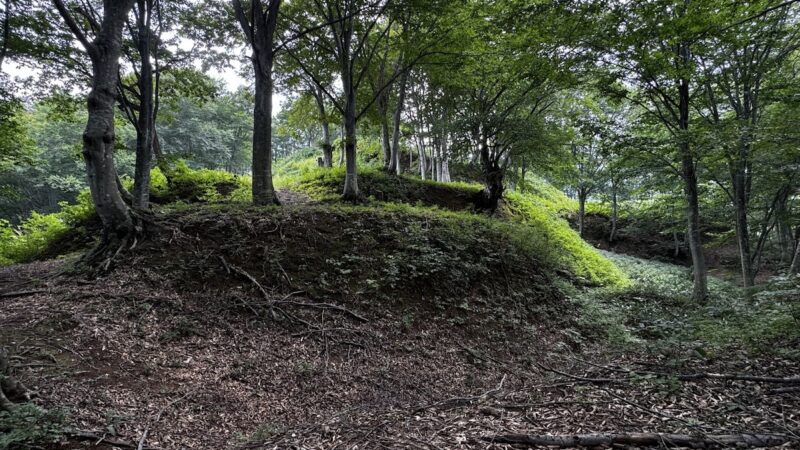
Earthworks also partially remain, with the earthworks on the north side of the main keep being particularly well-preserved. There are sections where you can walk on top of the earthworks, allowing you to experience the scale of the castle at that
Gokuraku Bridge spans the inner moat and was the main entrance to the main keep. The current bridge was rebuilt in modern times, but its location remains the same as the original.
Restored Three-Story Turret
In 1993, as part of the 20th anniversary celebration of Joetsu City’s founding, the three-story turret, a symbol of Takada Castle, was restored. This turret was the most important structure built in the main enclosure of Takada Castle and served as.
The restored three-story turret was reproduced as faithfully as possible, based on historical materials such as the Edo period map “Takada Castle Map and Measurements.” The exterior features a traditional style with white plaster walls and a black tiled roof, and stands approxim
Internal Structure
The interior of the three-story turret is a three-story, four-level structure, with exhibition rooms on each floor.
- 1st Floor: Exhibits on the history and construction of Takada Castle. Explanations are provided regarding the construction process, participating daimyo (feudal lords), and construction techniques.
- 2nd Floor: Exhibits on Matsudaira Tadateru and successive castle lords. Tadateru’s life and the rule of the Sakakibara family are introduced.
- 3rd Floor: Exhibits of Takada Domain’s weapons and daily life items. You can learn about the life of samurai at that time.
- 4th Floor (Observation Room): An observation room offering 360-degree panoramic views. Enjoy a panoramic view of the Takada Plain, Mt. Myoko, Mt. Yoneyama, and other scenery.
The three-story turret is a symbol of Takada Castle Ruins Park and an important facility that conveys the history of Joetsu City, beloved by many tourists and citizens.
Development of Takada Castle Ruins Park
The Takada Castle ruins have been developed as a park since 1949, and are now a place of relaxation for citizens as “Takada Castle Ruins Park.” The park covers approximately 50 hectares, and various facilities are arranged while utilizing the remains
Famous Cherry Blossom Spot
Takada Castle Ruins Park is a famous cherry blossom spot, counted as one of Japan’s “Three Great Night Cherry Blossom Viewing Spots.” Approximately 4,000 Somei Yoshino cherry trees are planted in the park, and they are infull year.
The row of cherry trees along the inner moat is particularly breathtaking, and at night, lanterns are lit, illuminating the three-story turret and the cherry blossoms. The reflection of the cherry blossoms and turret on the water’s people visit to enjoy the blossoms every year.
Joetsu City Historical Museum
In 2013, the Joetsu City Historical Museum opened within Takada Castle Ruins Park. This museum comprehensively exhibits the history and culture of the Joetsu region, and has a rich collection of materials related to Takada Castle and the Takada Domain. The historical museum also manages the tur
Other Facilities
The park also has sports facilities such as the Kobayashi Kokei Memorial Art Museum, Oren Plaza (general gymnasium), a baseball field, and an athletics track. Furthermore, the park features an outer moat where lotus flowers bloom, walking paths throughout the four seasons.
Sub-castles and Castle Town of Takada Castle
Placement of Sub-castles
In the Takada Domain, centered around Takada Castle, sub-castles and encampments were strategically placed within the territory. The main sub-castles include the following:
Fukushima Castle: Before the construction of Takada Castle, this was the central castle of the region. Built in 1598 by Hori Hideharu, it later became the residence of the Hori clan, but was abandoned with the construction of Takada Castle.
Kasugayama Castle: A famous mountain castle known as the residence of Uesugi Kenshin. Although it had already been abandoned during the Takada Domain era, its remains were recognized as an important historical site.
These sub-castles formed part of the defensive network centered around Takada Castle.
Development of Takada Castle Town
With the construction of Takada Castle, the castle town was also systematically constructed. The town was laid out in a grid pattern, with samurai residences, merchant districts, and temple districts clearly separated.
Honmachi and Nakamachi developed as commercial centers and flourished as a post town on the Hokkoku Kaido road. Arcade-like walkways called “gangi,” unique to snowy regions, were constructed, allowing for comfortable travel even in winter. known as the town with the most gangi in Japan.
Teramachi also played a role in the castle’s defense, with many temples concentrated there. These temples were designed to function as fortresses in times of emergency.
Access and Tourist Information
Access to Takada Castle
Access by Train
- Approximately 20 minutes on foot from JR Shin’etsu Main Line “Takada Station”
- Approximately 20 minutes on foot from Echigo Tokimeki Railway Myoko Hanema Line “Takada Station”
- Approximately 5 minutes by taxi from Takada Station
- Take the “Kasugayama/Sanai Line” bus from Takada Station and get off at “Takada Castle Ruins Park Entrance,” then a short walk.
Access by Car
- Approximately 10 minutes from Hokuriku Expressway “Joetsu IC”
- Approximately 5 minutes from Joshin’etsu Expressway “Joetsu Takada IC”
- Parking: Free parking available around the park (approximately 500 cars), paid parking during the cherry blossom festival.
Visitor Information
Takada Castle Three-Story Turret
- Location: 6-1 Honjo-cho, Joetsu City, Niigata Prefecture (within Takada Castle Ruins Park)
- Opening Hours: 9:00 AM – 5:00 PM (Last entry 4:30 PM)
- Closed: Mondays (or the following day if Monday is a public holiday), New Year’s holidays (December 29th – January 3rd)
- Admission Fee: 200 yen for adults, 100 yen for elementary and junior high school students (combined ticket with Joetsu City Historical Museum available)
- Inquiries: 025-524-3120 (Joetsu City Historical Museum)
Takada Castle Ruins Park
- Free admission
- Illumination during the cherry blossom festival (early to mid-April) (sunset – around 9:00 PM)
Nearby Tourist Attractions
Joetsu City Historical Museum: Located within Takada Castle Ruins Park, offering comprehensive learning about the history of Joetsu.
Former Division Commander’s Residence: A Western-style building from the Meiji era, designated as a National Important Cultural Property.
Kasugayama Castle Ruins: The site of Uesugi Kenshin’s castle, a national historic site. Approximately 20 minutes by car from Takada Castle.
Gangidori Street: Visit the longest remaining covered walkway (gangi) in Japan, located in the town of Takada.
Kobayashi Kokei Memorial Museum: Exhibits works by Japanese painter Kobayashi Kokei. Located within the park.
Cultural Value and Modern Significance of Takada Castle
Selection as one of the Continued Top 100 Korean Castles
In 2017, Takada Castle was selected as one of the “Continued Top 100 Japanese Castles.” This selection, made by the Japan Castle Association, is a continuation of the existing “Top 100 Japanese Castles,” and Takada Castle was recognized for.
The stamp for the Continued Top 100 Korean Castles can be obtained at the Joetsu City History Museum, making it a popular destination for castle enthusiasts.
Role as a Regional Symbol
Takada Castle Ruins Park is not merely a historical site for the citizens of Joetsu, but a beloved part of their daily lives. Events such as the Cherry Blossom Festival and the Lotus Festival are held there, serving as a place of relaxation and interaction for citizens.
The three-story turret is a symbol of Joetsu City, frequently used in city publications and brochures, and serves as a cornerstone of the citizens’ identity.
As a Place for Historical Education
Takada Castle Ruins Park, the three-story turret, and the Joetsu City History Museum are important places for local historical education. Elementary and junior high schools in the city visit Takada Castle for social studies classes and field trips to learn about local history.
In addition, guided tours by volunteer guides are regularly held, providing opportunities for both tourists and citizens to learn more about the history of Takada Castle.
Summary
Takada Castle is a unique castle that was created as part of Tokugawa Ieyasu’s political strategy and built in a remarkably short period of just four months. The absence of stone walls and a keep is a unique characteristic of Takada Castle, a result geographical conditions, and climatic conditions, and it itself has become a distinctive feature of the castle.
Takada Castle is steeped in history, from its construction as part of a large-scale project known as “Tenka Fushin” (nationwide construction), the fact that Date Masamune was in charge of the layout, the tragic fate of Matsudaira Tadateru, and
Today, the restored three-story turret and the beautifully maintained Takada Castle Ruins Park are important tourist resources for Joetsu City and a source of pride for its citizens. Especially during cherry blossom season, many people from all over Japan visit, enjoy harmonize, as it is one of Japan’s three greatest night cherry blossom viewing spots.
Visiting Takada Castle is not simply about sightseeing historical sites, but also a valuable opportunity to learn about the political situation of the early Edo period, castle construction techniques, and the wisdom and ingenuity of the people of a snowy region.Select Castles, Takada Castle will continue to be loved by many people and pass on its history to future generations.