Complete Guide to the History and Highlights of Shinpu Castle Ruins | The Culmination of Koshu-ryu Castle Construction Techniques Built by Takeda Katsuyori
What is Shinpu Castle?
Shinpu Castle is a castle ruin from the late Sengoku period located in Nakata-cho, Nirasaki City, Yamanashi Prefecture. Built in 1581 (Tensho 9) by Takeda Katsuyori, it is a historically important castle that became the last strona 48), it was designated a national historic site as “Shinpu Castle Ruins,” and is now publicly owned for preservation.
The name Shinpu Castle means “New Fuchu,” representing Katsuyori’s ambitious plan to relocate his base from Tsutsujigasaki-yakata in Kofu City and build a new political and military center. However, just 68 days after its completion, it was forces, becoming known as a tragic castle that marked the downfall of the Takeda clan.
Currently, the Fujitake Inari Shrine stands on the site of the main keep, allowing visitors to imagine its former glory.
Topography and Location of Shinpu Castle
Defensiveness of the Shichiriwa Plateau
Shinpu Castle was built on the western cliff of the Shichiriwa Plateau, which extends from the Yatsugatake Mountains towards the Kofu Basin. This plateau is a river terrace formed by the Kamanashi River, and its western side is a sheer cliff overlooking as a natural stronghold.
The elevation difference of the plateau is approximately 50 meters, making it an extremely difficult terrain for attackers. The eastern side has a relatively gentle slope, but complex defensive structures were positioned here.
The Importance of Strategic Location
The location of Shinpu Castle held strategic importance in the Takeda clan’s territorial management. Moving northwest from the central Kofu Basin, where Tsutsujigasaki Mansion was located, offered the following advantages:
- Securing a communication route to Shinano Province
- A base for expansion into western Kozuke Province
- Governing the territory near the border of Kai, Shinano, and Kozuke Provinces
- Room for expansion of the castle town
It is believed that Katsuyori, who inherited the family headship from Takeda Shingen, intended to relocate the base from a broader perspective in order to efficiently govern the territory that had expanded during his father’s time.
The Structure and Construction Techniques of Shinpu Castle
The Culmination of Koshu-ryu Castle Construction Techniques
Shinpu Castle is regarded as the culmination of Takeda-ryu castle construction techniques, particularly Koshu-ryu. The layout, which skillfully combines earthworks and moats without using stone walls, represents the pinnacle of the castle construction techniques year
The castle complex is a large-scale structure centered around the main keep, consisting of the second and third baileys, and outworks, covering a total area of approximately 60 hectares. Particularly noteworthy defensive features include the (maru-umadashi) and square-shaped enclosures (masugata).
Circular Outworks and Crescent-Shaped Moat
One of the most distinctive features of Shinpu Castle is the circular outwork located at the main gate. The circular outwork is a space enclosed by a semicircular earthen rampart, with a crescent-shaped moat (crescent-shaped moat) in front of it. This struct effectively dispersed the attacking forces.
The circular outwork is a characteristic defensive feature of Takeda clan castles, and a particularly large one was constructed at Shinpu Castle. It remains clearly visible as a historical structure, making it an important point to experience the Koshu-style castle.
Arrangement of Earthen Ramp and Moat
Shinpu Castle does not use stone walls; the defensive lines are constructed entirely of earthen ramparts. The earthen ramparts surrounding the main keep are approximately 3 to 5 meters high and remain in good condition today.
The moat was designed as a dry moat, reaching depths of 5 to 10 meters in some places. The bottom of the moat is V-shaped, known as a yagenbori (a type of V-shaped moat), a design intended to hinder the movement of enemy soldiers.
Structure of the Masugata Koguchi (square-shaped entrance)
A masugata koguchi (square-shaped entrance) is provided at the castle gate. A masugata creates a square space, allowing for attacks on enemies passing through from three directions. The masugata at Shinpu Castle features a particularly complex movement
Archaeological excavations have confirmed the existence of foundation stone buildings within the masugata area, suggesting the presence of defensive structures such as gate towers.
History of Shinpu Castle
Background of the Takeda Clan’s Territorial Expansion and Relocation of Base
During the time of Takeda Shingen, the Takeda clan expanded their territory from Kai Province to Shinano, Suruga, West Kozuke, and Totomi. Tsutsujigasaki Castle served as the Takeda clan’s base, but with the expansion of their territory, the following problems
- Its location in the central part of the Kofu Basin was geographically unbalanced for governing the expanded territory.
- Limited room for expansion of the castle town.
- Need for strengthened military defenses.
When Takeda Katsuyori inherited the family headship in 1573, he planned the construction of a new base to address these issues. Initially, relocation to Nomi Castle, east of Nirasaki, was considered, but ultimaily, the decision wasde
Construction Process of Shinpu Castle
Construction of Shinpu Castle began in 1581 (Tensho 9). It is believed that Sanada Masayuki was appointed as the construction magistrate (chief supervisor of castle construction) (although there are various theories). The Sanada clan had experience in cast Kōzuke Province, and it is thought that they were selected as experts in mountain castle construction.
The construction work involved mobilizing a large number of laborers from within the territory and proceeded at a rapid pace. In December of the same year, Katsuyori moved to Shinpu Castle, officially relocating his base from Tsutsujigasaki Mansion. However, at the move occurred while construction was still in progress.
A mere 68 days in the castle and the fall of the Takeda clan
Just three months after moving to Shinpu Castle, in March 1582 (Tenshō 10), the combined forces of Oda Nobunaga and Tokugawa Ieyasu began their invasion of Kai Province. The Oda army advanced from Kiso and the Tokugawaaar territory rapidly collapsed.
On March 3rd, Katsuyori decided to hold out in Shinpu Castle, but his retainer, Oyamada Nobushige, advised him to retreat to Iwadono Castle. On March 11th, Katsuyori set fire to Shinpu Castle himself, abandoning it afteryly
Afterward, Katsuyori and his retinue headed for Iwadono Castle, but their path was blocked by Oyamada Nobushige’s betrayal. On March 11th, Katsuyori committed suicide in Tano (present-day Koshu City), marking the end of the Kai
신푸 캐슬 언더 오다와 독가루 규칙
After the fall of the Takeda clan, Kai Province came under the control of Oda Nobunaga, and Kawajiri Hidetaka was appointed as the lord of Kai Province. However, in June of the same year, when Nobunaga died in the Honnoji Incident, Kaiwata was also killed by the rebel forces.
Subsequently, Kai Province was contested between Tokugawa Ieyasu and Hojo Ujimasa, but ultimately came under the control of the Tokugawa clan. Shinpu Castle’s strategic value was recognized, and it was used as a Tokuwa into a modern castle and eventually fell into disuse.
Current Status and Remains of Shinpu Castle Ruins
Main Enclosure Site and Fujitake Inari Shrine
The Fujitake Inari Shrine stands on the current site of the main enclosure. The main enclosure was the central part of the castle, located at an altitude of approximately 520 meters. Earthen ramparts surround it, allowing us to imagine the layout.
From the main enclosure, one can enjoy magnificent views of the Kofu Basin and the Yatsugatake Mountains, appreciating the strategic value of this location. Furthermore, a deep moat surrounds the main enclosure, demonstrating the scale of the defensive
Second and Third Enclosure Sites
The second enclosure was located to the east of the main enclosure, and the third enclosure was located further outside of that.
Archaeological excavations have confirmed the existence of numerous buildings in the second and third baileys. The remains of foundation stone buildings and post-and-beam buildings have been detected, revealing the presence of administrative functions and residential spaces.
Maru-umadashi at the Main Gate
The most impressive remains at the Shinpu Castle site are the Maru-umadashi (circular earthworks) at the main gate (eastern entrance). The semi-circular earthwork, approximately 30 meters in diameter, and the crescent-shaped moat in front of it a.
Standing inside the Maru-umadashi, one can experience the defensive nature of the space surrounded by earthworks. The depth and scale of the crescent-shaped moat are also impressive, making it one of the remains that best exemplify the characteristics of the Koshu
Remains of Earthworks and Moats
Remains of earthworks and moats can be found throughout the castle grounds. In particular, the earthworks around the main keep maintain a height of 3 to 5 meters, preserving much of their original appearance from the time of construction.
The moats were designed as dry moats, and in some places, the cross-sectional shape of the V-shaped moat can be seen. While some areas have been eroded by rainwater, the overall state of preservation of the remains is good.
Outworks and Masugata Gate
Outer fortifications called “degamae” were positioned around the castle’s outer perimeter. These degamae were separate enclosures from the main keep, designed to detect and intercept approaching enemies early.
The remains of masugata gates can also be found in multiple locations, revealing traces of a complex movement design. While stone walls were not used, the defensive lines formed by earthworks remain clearly visible.
Excavation Surveys and Research Results
Previous Excavations
Since the 1970s, multiple excavations have been conducted at the Shinpu Castle site. These surveys have yielded the following important discoveries:
- Detection of foundation stone building remains in the main and second baileys
- Excavated artifacts such as ceramics, roof tiles, and iron products
- Clarification of the structure of moats and earthworks
- Confirmation of the structure of the castle gate
Of particular note is the discovery of roof tiles. Examples of roof tiles being used in mountain castles during the Sengoku period are limited, providing evidence that Shinpu Castle was planned as a full-fledged administrative center.
Research on Castle Construction Techniques
Research on Shinpu Castle has greatly contributed to the elucidation of the Koshu-ryu style of castle construction. Structural analysis of the circular outworks and crescent-shaped moats has revealed the Takeda clan’s castle construction philosophy.
Furthermore, regarding the tradition that Sanada Masayuki served as the construction magistrate, comparative research is underway with Ueda Castle and Matsushiro Castle, which the Sanada clan built later. Similarities in the layout suggest the possibility that the Sanada c’ 신푸 성.
Preservation and Maintenance Efforts
After being designated a National Historic Site, the Shinpu Castle Ruins have been gradually acquired as public land, and preservation and maintenance work has been carried out. The following initiatives have been implemented, primarily by the Nirasaki City Board of Education:
- Preservation and management of the remains
- Installation of explanatory and information boards
- Development of walking paths
- Installation of visitor parking lots
- Creation of brochures and guide maps
In recent years, walking maps such as “Shinpu Castle for Families” have been revised, creating an environment where more people can appreciate this historical heritage.
Highlights and How to Enjoy Shinpu Castle Ruins
Recommended Visiting Route
The following route is recommended for efficiently visiting the Shinpu Castle Ruins.
- Start from the Oteguchi parking lot
- Pass through the Ote Masugata Koguchi gate
- Observe the Maruumadashi and Mikazuki moat
- Pass through the San-no-maru ruins
- Visit the Nino-maru ruins
- Visit the Honmaru ruins and Fujitake Inari Shrine
- Explore the earthworks and moats around the Honmaru
- Head towards the Outworks (if time permits)
The tour takes approximately 1-2 hours. Due to the undulating terrain, comfortable walking shoes are recommended.
Photo Spots
The following are recommended photo spots:
- Panoramic view of the Maruumadashi (from atop the earthworks)
- Panoramic view of the Kofu Basin from the Honmaru
- 후지타케 이나리 신사와 earthworks
- Cross-section of the Mikazuki moat
- Deep dry moats around the Honmaru
The view from the Honmaru on a clear day is particularly spectacular, offering views of the Yatsugatake Mountains and the Southern Alps.
Seasonal Charms
Shinfu Castle Ruins offer beautiful scenery throughout the four seasons.
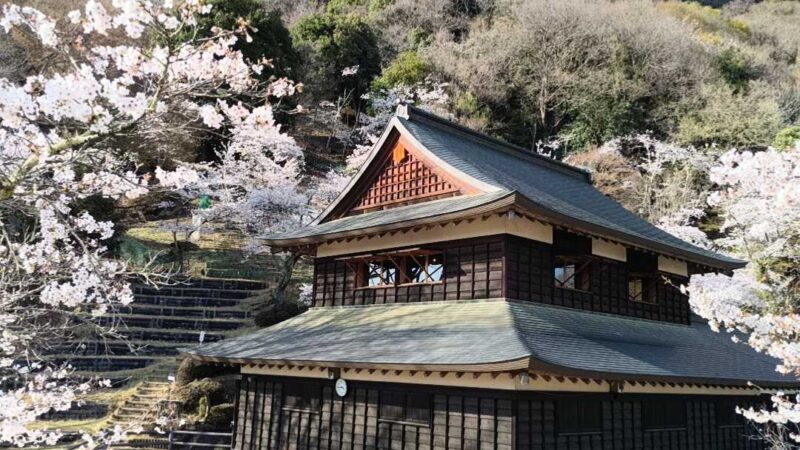
- Spring: Known as a famous cherry blossom viewing spot, the cherry trees lining the approach to the castle are magnificent.
- Summer: The contrast between the lush earthworks and the deep moat is stunning.
- Autumn: The harmony of autumn leaves and the castle ruins, and the views in the crisp air.
- Winter: The view of the snow-covered Yatsugatake Mountains, and the topography of the ruins become clearly visible.
The spring cherry blossom season, in particular, is bustling with many tourists.
Access and Visiting Information
Access by Public Transportation
By Train
- Get off at Shinfu Station on the JR Chuo Main Line, approximately 15 minutes on foot.
- It’s a gentle uphill slope from the station to the castle ruins.
Shinfu Station is an unmanned station, but there are signs directing you to Shinfu Castle Ruins, so you can arrive without getting lost.
Access by Car
Travel Time from Major Cities
- From Tokyo: Approximately 10 minutes from the Nirasaki IC on the Chuo Expressway
- From Kofu City: Approximately 20 minutes via National Route 20 and Prefectural Route 17
Parking Information
- Oteguchi Parking Lot: Approximately 30 spaces available (free)
- Located along Prefectural Route 17, easily accessible
Visiting Hours and Fees
- Visiting Hours: Always open (however, nighttime visits are not recommended due to safety concerns)
- Admission Fee: Free
- Estimated Time Required: Approximately 1-2 hours
Nearby Facilities
Nirasaki City Folk Museum
Features exhibits related to Shinfu Castle, including excavated artifacts and reconstructed models.
Takeda Hachimangu Shrine
A shrine associated with the Takeda clan, located approximately 10 minutes away by car.
시기리와 라인
This scenic road runs along the Shichiriwa Plateau where Shinpu Castle is located, and is a popular driving route.
Shinpu Castle and the Evaluation of Takeda Katsuyori
Katsuyori’s Decisions and Tragedy
For a long time, the construction of Shinpu Castle by Takeda Katsuyori was negatively evaluated as a “reckless and ambitious construction project.” However, recent research has presentad a more positive perspective.
Katsuyori was an innovative lord who, while inheriting the legacy of his father, Shingen, sought to adapt to the changing times. The relocation of his base is increasingly seen as a rational decision to efficiently govern his expanded territory.
An Unfinished Masterpiece
Shinpu Castle burned down before its completion, but its layout is highly regarded as the pinnacle of Koshu-ryu castle construction techniques. Had it been completed, it could have become one of the most representative large castles of the Sengokuperiod.
Some point out that the influence of Shinpu Castle can be seen in Ueda Castle, later built by Sanada Masayuki, and in Edo Castle, built by the Tokugawa clan. Although unfinished, its castle-building techniques were passed down to future generations.
Lessons for the Modern Age
The history of Shinpu Castle conveys to the present day the difficulty of making decisions during a period of transition. Whether Katsuyori’s choices were correct is left to the judgment of history, but his attempt to adapt to change is commendable.
This tragic castle, reduced to ashes in just 68 days, is also a legacy that demonstrates the last shred of determination and pride of the Takeda clan.
Summary
The Shinpu Castle ruins are a valuable historical site that conveys the turbulent history of the late Sengoku period. As the culmination of the Koshu-ryu castle-building techniques employed by Takeda Katsuyori, characteristic defensive structures such as preserved in excellent condition.
Although it was a castle whose fate was short-lived, lasting only 68 days, its remains represent the pinnacle of the Takeda clan’s castle-building techniques and influenced later castle architecture. The castle ruins, now history buffs and general tourists alike.
There are plenty of highlights, including the panoramic view from the main keep overlooking the Kofu Basin, the remains of a large circular outwork, and deep dry moats. Its convenient location, within walking distance of JR Shinfu Station, is another attractive feature Yamanashi sightseeing.
By visiting the Shinfu Castle ruins, you can reflect on the history of the Takeda clan’s downfall while experiencing the pinnacle of Sengoku period castle-building technology.