Nomi Castle, Nirasaki City (Yamanashi Prefecture) Complete Guide | A Fortress on the Shinpu Castle Defense Line and the Birthplace of the Moriya Clan
What is Nomi Castle? | A Key Point in the Northern Defense Protecting Shinpu Castle
Nomi Castle is a Sengoku period mountain castle located in Anayama-cho, Nirasaki City, Yamanashi Prefecture. Located approximately 1 kilometer north of Shinpu Castle, built by Takeda Katsuyori in 1581, it played an extremely important role as part of the outer defense line of Shinpu Castle.
Nomi Castle, skillfully utilizing the natural terrain of the Shichiriwa Plateau, functioned not as a standalone fortress, but as the core of a large-scale defensive system extending approximately 2 kilometers from east to west. This defensive system, with its complex curves traversing the plateau, is a testament to advanced castle construction techniques designed to maximize flanking fire.
Currently, the castle ruins are located on a hill east of Anayama Station, with the remains of the now-abandoned Choseiji Temple and waterworks facilities at the summit. The words “Nomi Castle” are prominently inscribed on the mountainside, and its presence can be seen even from Anayama Station.
History of Nomi Castle | The Takeda Clan’s Last Defensive Base
Construction in 1581 and Takeda Katsuyori
The year 1581, when Nomi Castle was built, was a time of imminent crisis for the Takeda clan. Following his defeat at the Battle of Nagashino (1575), Takeda Katsuyori faced a decline in power and decided to move his residence from Tsutsujigasaki Mansion to Shinpu Castle.
Around the same time as the construction of Shinpu Castle, several defensive bases, including Nomi Castle, were developed to strengthen the defense system. Nomi Castle occupies a crucial northern position within this defensive network and was planned as the Takeda clan’s last stronghold.
The Tensho-Jingo War and the Tokugawa Clan’s Involvement
In March 1582 (Tensho 10), the Takeda clan was destroyed by the invasion of the Oda-Tokugawa allied forces. However, when Oda Nobunaga was killed in the Honnoji Incident in June of the same year, the Tensho-Jingo War erupted, a conflict over Kai and Shinano provinces between Tokugawa Ieyasu, Hojo Ujimasa, Uesugi Kagekatsu, and others.
It has been suggested that Nomi Castle may have been renovated and strengthened by the Tokugawa clan during this time. It is believed that Tokugawa Ieyasu utilized the defensive facilities around Shinpu Castle to secure Kai Province, and there is a theory that part of the Nomi Castle fortifications were built or significantly altered by the Tokugawa clan during the Tensho-Jingo War.
History as the Origin of the Moriya Clan
Nomi Castle is also known as the origin of the Moriya clan, vassals of the Takeda family. A stone monument marking the “Birthplace of the Moriya Clan” stands at the summit, indicating that this was the ancestral home of the Moriya clan.
The Moriya clan were hereditary vassals who served the Takeda clan and were based in the Anayama region. Legends and place names related to the Moriya clan remain around Nomi Castle, suggesting that they played an important role in the region’s history.
Structure and Layout of Nomi Castle | A Defensive System on the Shichiriwa Plateau
Structure of the Main Enclosure
The main enclosure of Nomi Castle is located on the hilltop east of Anayama Station. Currently, some of the remains have been damaged due to construction work for a residential development plan, but since the plan was cancelled, it escaped complete destruction.
A power transmission tower has been constructed on the summit, and traces of earthworks and moats remain around it. However, significant later alterations make it difficult to recognize them as clear historical remains. While a road leads to the mountaintop, the entrance is blocked, making access primarily on foot.
Overview of the Nomi Castle Fortifications
The most distinctive feature of Nomi Castle is its large-scale fortification system, extending approximately 2 kilometers east to west from the main enclosure. This fortification makes maximum use of the Shichiriwa Plateau’s topography, traversing the plateau with complex curves.
The fortifications are not straight but intentionally curved, a design intended to maximize flanking fire against attackers. Flanking fire refers to a defensive structure designed to attack the enemy’s flanks, representing the pinnacle of castle construction technology from the late Sengoku period.
Remains Along Prefectural Road 17
Along the old route of Prefectural Road 17 (Shichiriwa Line), there is a geographical feature called “Nagareyama,” where the remains of the Nomi Castle fortifications are well-preserved. The terrain has been altered by a vast number of artificial terraces (terraced enclosures), clearly indicating large-scale civil engineering work.
While the western side of the fortifications remains only fragmentarily due to residential development, the northern side retains relatively well-preserved earthworks and moats. These remains are valuable resources for understanding the scale and technical level of the Nomi Castle fortifications.
Kurokoma Fort and Minakata Shrine
Kurokoma Fort is one of the forts that make up the Nomi Castle fortifications. Currently, Minakata Shrine stands on the site of Kurokoma Fort, and the remains of a double moat surrounding it can be observed.
The remains around Minakata Shrine are particularly well-preserved within the Nomi Castle fortifications, making it a valuable point for concretely observing the structure of defensive facilities from the Sengoku period. The moats served to hinder enemy advances and were also important defensive structures for flanking attacks from the bottom of the moats, clearly demonstrating the characteristics of the Takeda-style castle construction.
Highlights of Nomi Castle | Remains and Historical Sites You Can See on Site
Sign and Stone Monument at the Summit of Nomi Castle
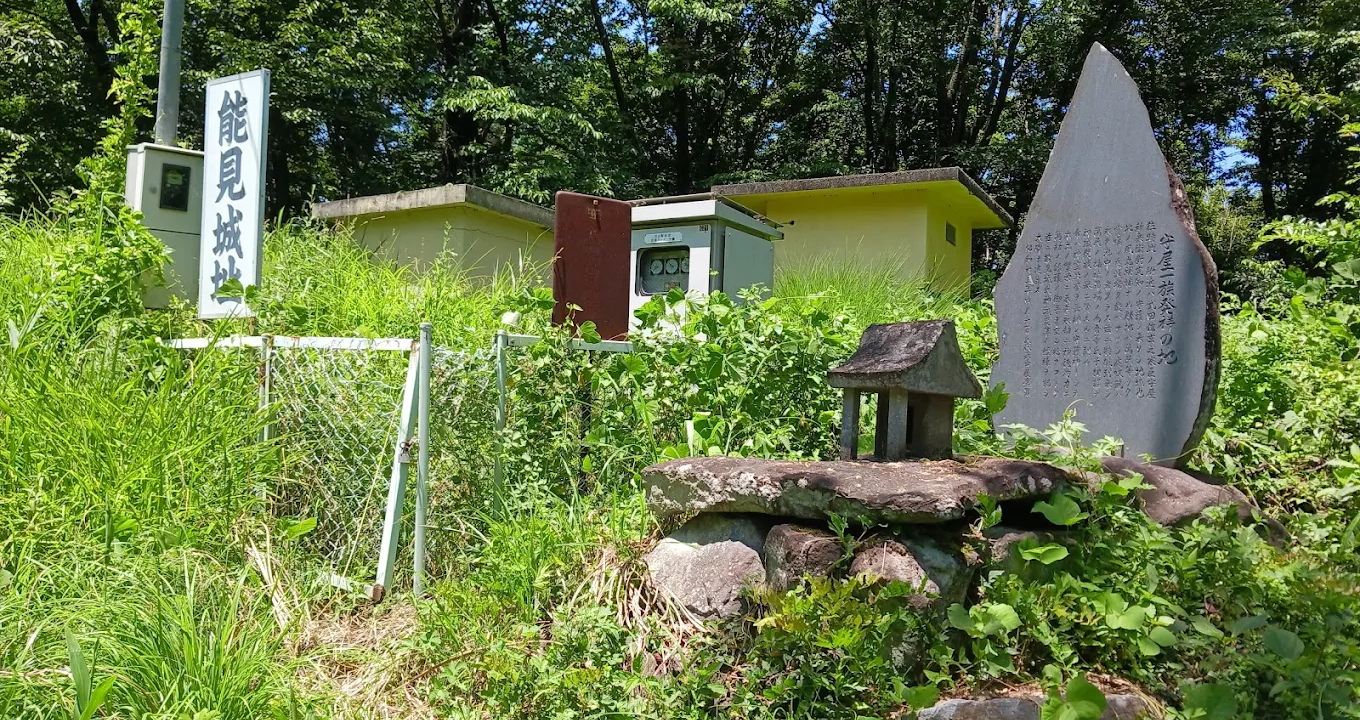
At the summit, there is a sign indicating the “Nomi Castle Site” and a stone monument marking the “Birthplace of the Moriya Clan.” These are important landmarks that demonstrate the historical value of Nomi Castle and serve as markers for visitors to confirm that it is a castle site.
Although the stone monument is relatively new, it demonstrates the local people’s commitment to preserving the history of the Moriya clan, making it an interesting presence from the perspective of local history research.
Exploring the Site of Choseiji Temple
At the summit, there are the remains of the now-abandoned Choseiji Temple. A stone monument of the temple remains near the entrance, indicating that a temple once existed on this site.
While there are few clear records regarding the relationship between Choseiji Temple and Nomi Castle, it is not uncommon for temples to be built on castle sites, and it is possible that it played a role in passing on the castle’s history to future generations.
Observation Points for the Fortification Remains
The biggest highlight when visiting Nomi Castle is undoubtedly the large-scale fortification remains. The following points are particularly noteworthy:
Northern Fortification: The earthworks and moats are relatively well-preserved, allowing you to appreciate the scale of the fortifications. The complex, winding structure allows you to experience its defensive effectiveness by actually walking along it.
Around Minakata Shrine: The Kurokoma Fort ruins, with their remaining double moats, are the most important point for understanding the specific structure of the Nomi Castle fortification system.
Along the Old Prefectural Road 17: A series of terraced enclosures can be observed, revealing traces of large-scale civil engineering work.
View from Anayama Station
From Anayama Station on the JR Chuo Main Line, you can see the words “Nomi Castle” carved into the mountainside. These words appear to be relatively recently installed, but they serve to widely publicize the existence of the castle ruins and are useful as a landmark before visiting.
Viewing the castle ruins from the station allows you to understand geographically where Nomi Castle is located, protecting the north of Shinfu Castle.
Access Information | How to Get to Nomi Castle and Parking
Access by Public Transportation
Using the JR Chuo Main Line:
- Nearest Station: Anayama Station, JR Chuo Main Line
- Walking time from the station: Approximately 21 minutes (approximately 1.5 kilometers)
- The location of the castle ruins can be seen from the station, making it a relatively easy route to follow.
Anayama Station is an unmanned station, but trains bound for Kofu and Kobuchizawa stop there. The route from the station to the castle ruins goes through a residential area and down to the foot of the mountain.
Access by Car
Using the Chuo Expressway:
- Nearest Interchange: Sutama IC
- Travel time from the interchange: Approximately 12 minutes
- Accessible via Prefectural Road 17 (Shichiriwa Line)
Parking Information:
Nomi Castle does not have its own parking lot. This is a major challenge for visitors. While a road leads to the summit, the entrance is blocked, and general vehicles are not allowed.
If parking on the nearby roadside, you must be considerate of local residents. If possible, we recommend parking near Anayama Station and accessing the site on foot.
Ascent Route and Time Required
There are several routes to Nomi Castle, but the main routes are as follows:
Standard Route:
- From Anayama Station, take the prefectural road to the foot of the mountain
- Use the stone monument at the site of Choseiji Temple as a landmark
- Climb the mountain path to the summit (approximately 15-20 minutes)
Time Required for Visit:
- Summit area only: approximately 30 minutes
- Entire site including fortification remains: approximately 45 minutes to 1 hour
- Detailed visit including Minakata Shrine: 1 hour 30 minutes or more
Points to Note and Preparations for Visiting
Signboards and Information Boards
There are very few official signboards at Nomi Castle. This presents a significant challenge for castle enthusiasts, making prior information gathering essential. Aside from the “Nomi Castle Ruins” sign at the summit, there are no clear explanatory signs, requiring prior knowledge to understand the remains.
Clothing and Equipment
- Footwear: Since you will be walking on mountain trails, athletic shoes or trekking shoes are essential.
- Clothing: Comfortable clothing appropriate for the season; insect repellent is also recommended in summer.
- Items to Bring: Drinking water, map, or smartphone GPS function.
- In Rainy Weather: It is wise to avoid visiting in rainy weather as the mountain trails become slippery.
Visitor Etiquette
- Remember to be considerate of landowners as you may pass through private property.
- Always take your trash with you.
- Do not damage the ruins or climb on the earthworks.
- When taking photographs, be mindful of the privacy of local residents.
Nearby Attractions | Shinfu Castle and Related Historical Sites
Shinfu Castle (National Historic Site)
If you visit Nomi Castle, you should definitely also visit Shinfu Castle. Shinpu Castle is located about 1 kilometer south of Nomi Castle and was the last castle built by Takeda Katsuyori.
- Location: Nakajo, Nakada-cho, Nirasaki City, Yamanashi Prefecture
- Designation: National Historic Site
- Highlights: Maru-umadashi (circular outwork), Mikazuki-bori (crescent-shaped moat), part of the stone wall, etc.
- Access: Approximately 15 minutes on foot from JR Chuo Main Line “Shinpu Station”
Shinpu Castle has better-preserved remains than Nomi Castle, and information boards are also well-maintained. Visiting both castles together allows for a comprehensive understanding of the Takeda clan’s final defensive strategy.
Hakusan Castle (National Historic Site)
Hakusan Castle is also located within Nirasaki City and is a National Historic Site. It is an old castle dating back to the time of the Kai Genji clan, predating the Takeda clan. While it is from a different era than Nomi Castle, it is important for understanding the history of castles in Kai Province.
Nirasaki City Folk Museum
If you want to learn about the history and culture of Nirasaki City, a visit to the Nirasaki City Folk Museum is highly recommended. It features exhibits related to the Takeda clan and local history, deepening your understanding of Nomi Castle.
Nomi Castle’s Rating and Reviews
Ratings by Castle Enthusiasts
On castle information websites such as Kojodan, the average rating for Nomi Castle is ★★★☆☆ (approximately 2.5-2.6). This is likely due to the poor state of preservation of the remains and the lack of adequate informational facilities.
Highly Rated Points:
- Historical value of the large-scale defensive wall system
- Connection to Shinpu Castle
- Opportunity to learn about castle construction techniques from the late Takeda clan
Lowly Rated Points:
- Lack of information signs
- No parking
- Unclear remains
- Difficulty of access
Comments from Actual Visitors
Visitors have provided comments such as:
- “The scale of the defensive wall remains is beyond imagination, but it’s difficult to understand due to the lack of guidance.”
- “The moat next to Minakata Shrine is impressive.”
- “Visiting it together with Shinpu Castle deepens understanding.”
- “The biggest drawback is the lack of parking.”
- “The view from the mountaintop is excellent.”
Number of Visitors and Visiting Time
According to data from the Castle Enthusiasts Group, the number of visitors to Nomi Castle is around 120 (as of 2024), making it a relatively less visited castle. This is likely due to the lack of information facilities and the difficulty of access.
The average visit time is said to be around 45 minutes, but if you want to observe the remains of the defensive ramparts in detail, you should allow more than an hour.
Current Status and Challenges of Nomi Castle Research
Debate Regarding the Construction Period
There are two main theories regarding the construction period of Nomi Castle:
Takeda Clan Construction Theory (Tensho 9, 1581): This theory suggests that it was built by Takeda Katsuyori as a defensive facility at the same time as the construction of Shinpu Castle. Many researchers support this theory.
Tokugawa Clan Construction/Renovation Theory (Tensho 10, 1582): This theory suggests that Tokugawa Ieyasu built the castle during the Tensho-Jingo War to control Kai Province, or significantly renovated the Takeda clan’s facilities. This theory is proposed because some parts of the defensive ramparts show characteristics of Tokugawa clan construction techniques.
In reality, it is considered highly probable that the Takeda clan built the basic structure, and the Tokugawa clan made renovations during the Tensho-Jingo War.
Unraveling the Full Scope of the Fortification System
The Nomi Castle fortifications extend approximately 2 kilometers from east to west, but their entirety has not been fully understood. Many parts have been lost due to residential and agricultural development, and documentary sources are limited, making archaeological excavations and detailed surveys urgently needed.
In recent years, local researchers and castle experts have been conducting investigations, leading to the discovery of new remains and the creation of layout maps. These results are gradually revealing the overall picture of Nomi Castle.
Challenges of Preservation and Utilization
Because Nomi Castle is not designated as a national or prefectural historical site, its preservation status is not necessarily good. The inclusion of a large portion of privately owned land also makes preservation efforts difficult.
On the other hand, there are movements to utilize it as a local historical resource. Improving the environment for visitors, such as installing information boards, maintaining access routes, and securing parking, are future challenges.
Nomi Castle and the Takeda Clan’s Castle Construction Techniques
Utilization of the Shichiriwa Plateau’s Topography
The most distinctive feature of Nomi Castle lies in its maximum utilization of the unique topography of the Shichiriwa Plateau. Shichiriwa is a river terrace formed by the erosion of the Kamanashi River, with steep cliffs and significant elevation differences serving as natural defensive walls.
By arranging intricately winding fortifications within this terrain, a structure was created that allowed for effective defense even with a small number of troops. This embodies the Takeda clan’s castle construction philosophy of “maximizing the use of the terrain.”
The Technique of “Flanking Fire”
The complex curves of Nomi Castle’s fortifications are not merely a design choice, but are based on a sophisticated defensive technique called “flanking fire.” The bending of the fortifications allows for constant targeting of the attacking side, significantly increasing defensive effectiveness compared to straight fortifications.
This technique is characteristic of the Takeda style of castle construction and had a major influence on later early modern castles. Nomi Castle’s fortifications are a valuable example demonstrating the development of this technique.
Integrated Defense Plan with Shinpu Castle
Nomi Castle was not a standalone fortress, but rather planned as part of a defense network centered around Shinpu Castle. Its location, approximately 1 kilometer north of Shinpu Castle, played a crucial role in detecting enemy approaches early and delaying attacks on Shinpu Castle.
This defensive plan, combining multiple defensive strongholds, was established during the time of Takeda Katsuyori and was a painstaking strategy to counter the formidable Oda-Tokugawa alliance.
Summary | Historical Value and Future Prospects of Nomi Castle
Nomi Castle is a valuable historical site that conveys the castle-building techniques and defensive philosophy of the very end of the Takeda clan’s history. The large-scale defensive system planned as an outer defense line for Shinpu Castle occupies an important position in the history of castles at the end of the Sengoku period.
Currently, there are many challenges for visitors, such as a lack of informational facilities and parking, but this also makes it a place where one can quietly feel history. For castle enthusiasts and history lovers, Nomi Castle, along with Shinpu Castle, is an important historical site to visit.
It is hoped that the appropriate preservation and utilization of Nomi Castle as a local historical resource will lead to a wider recognition of its historical value. As the last stronghold of the Takeda clan and the birthplace of the Moriya clan, Nomi Castle will continue to be an important cultural heritage site of Yamanashi Prefecture.
The “Nomi Castle” lettering on the mountainside, visible from Anayama Station, demonstrates that this castle is still remembered and cherished by the local people. Each visitor cherishing the remains and passing on its historical value to future generations is crucial to protecting the future of Nomi Castle.