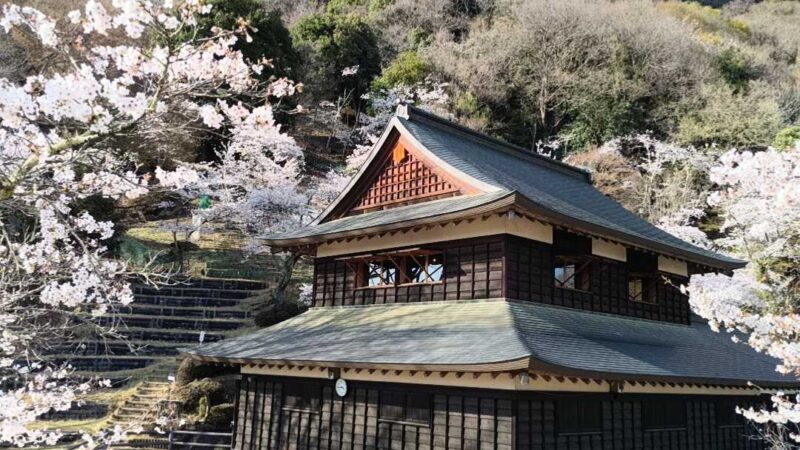
Hakusan Castle (Nirasaki City, Yamanashi Prefecture) Complete Guide | A Thorough Explanation of the History and Highlights of the Fortified Mountain Castle, the Origin of the Takeda Clan
What is Hakusan Castle? – Fortified Mountain Castle, the Origin of the Kai Genji Clan
Hakusan Castle is a medieval mountain castle located in Nabeyama, Kamiyama-cho, Nirasaki City, Yamanashi Prefecture. Built on the summit of Mt. Nabeyama, at an altitude of approximately 570 meters, this castle is believed to have been constructed in the late Heian period by Takeda Nobuyoshi, known as the ancestor of the Kai Genji clan, and holds an extremely important historical position as the birthplace of the Takeda clan.
The castle’s name originates from Hakusan Gongen, a shrine located on the mountainside, and it is also known as “Nabeyama Fort” and “Fortified Castle.” It was designated a national historic site in 2004, and the castle remains are still well-preserved.
Located at a strategic point along the Kamanashi River, and offering panoramic views of the Kofu Basin, its location clearly demonstrates its value as a military stronghold. With Mount Yatou behind it and nestled between the two streams of Shirasawa and Hachimansawa, its layout, which makes maximum use of the natural fortified terrain, is highly regarded by castle researchers as a quintessential example of a medieval mountain castle.
History of Hakusan Castle – From Takeda Nobuyoshi to the Sengoku Period
Late Heian Period – As a Base for the Kai Genji
The history of Hakusan Castle dates back to the late Heian period, around the 1130s. Takeda Nobuyoshi, son of Minamoto no Kiyomitsu, the ancestor of the Kai Genji clan, built a castle on this site, making it the Takeda clan’s base. Nobuyoshi responded to Minamoto no Yoritomo’s uprising in 1180, leading the Kai Genji clan and contributing to the defeat of the Taira clan.
Takeda Nobuyoshi expanded his power primarily in Suruga Province, and at one point boasted a force comparable to that of Minamoto no Yoritomo. However, political conflict with Yoritomo led to a decline in his power. Nevertheless, the Takeda clan’s base in Kai Province, centered around Hakusan Castle, became the foundation for the subsequent development of the Takeda family.
Kamakura and Muromachi Periods – The Development of the Takeda Clan
During the Kamakura period, the Takeda clan established their position as the shugo (military governor) of Kai Province. During this time, Hakusan Castle served as the spiritual center of the Takeda clan, although their actual residence is believed to have been located around the Takeda Hachimangu Shrine at the foot of the mountain.
During the Muromachi period, the Takeda clan strengthened their rule within Kai Province, and Hakusan Castle functioned as a fortified stronghold in times of emergency. It is estimated that many of the remains seen today were formed through castle development during this period.
Sengoku Period – The Era of Takeda Shingen
During the Sengoku period, the Takeda clan reached its peak during the time of Takeda Nobutora and his son, Shingen. During this period, the Takeda clan’s headquarters were moved to Tsutsujigasaki-kan in Kofu, but Hakusan Castle remained an important strategic stronghold.
After the fall of the Takeda clan in 1582, Hakusan Castle was abandoned, but along with Shinpu Castle, which was built shortly before, it is located in an area that was the stage for the Takeda clan’s last resistance.
Location and Geographical Characteristics of Hakusan Castle
A Strategic Point in the Northwestern Part of the Kofu Basin
Hakusan Castle is located in the northwestern part of the Kofu Basin, approximately 3 kilometers northeast of the center of Nirasaki City. Built at the point where the river terrace formed by the Kamanashi River meets the Kofu Basin, it is a strategically important location that allows for monitoring and control of the entrance to the basin.
The main enclosure is located on the summit of Nabeyama Mountain, at an elevation of 570 meters, with a relative height of approximately 200 meters. This difference in elevation created natural defensive capabilities, making sieges extremely difficult.
Layout Utilizing Natural Terrain
The layout of Hakusan Castle is arranged in a series of interconnected enclosures along the ridgeline. From north to south, the arrangement is the third enclosure (San-no-maru), the main enclosure (Hon-maru), and the second enclosure (Nin-no-maru), with each enclosure separated by moats and earthen bridges.
Behind the castle rises Mount Yatou, and to the east and west, the deep valleys of Shirasawa and Hachimansawa function as natural moats. This location, protected on three sides by natural terrain, is considered an ideal example of terrain utilization for a medieval mountain castle.
Views and Surveillance Function
From the mountaintop, one can enjoy a panoramic view of the Kofu Basin, and on clear days, even Mount Fuji and the Southern Alps can be seen. This excellent view served a military function in monitoring the movements of the surrounding area.
In particular, its position allows for control of the road along the Kamanashi River and the transportation routes leading from the Kofu Basin towards Suwa, indicating its function as a base for intelligence gathering and territorial control.
Details of Hakusan Castle’s Layout and Remains
Configuration of the Main Enclosures
Hakusan Castle’s layout is a typical example of a multi-enclosure mountain castle, unfolding along a ridge. The main enclosures are arranged as follows:
Honmaru (Main Enclosure)
Located on the mountaintop at an altitude of 570 meters, the Honmaru measures approximately 40 meters east-west and 30 meters north-south. A well-preserved flat surface remains, and traces of earthworks can be seen around it. The Honmaru offers a 360-degree view and served as the central hub of the castle.
Ninmaru (Second Enclosure)
Located south of the Honmaru, it is separated from it by a moat. It is slightly smaller than the Honmaru, measuring approximately 30 meters east-west and 20 meters north-south. The remains of an earthen bridge connecting the Ninmaru and Honmaru are clearly preserved, making it valuable material for understanding the defensive techniques of medieval mountain castles.
Third Bailey
Located north of the main bailey, the third bailey served to monitor and defend the approach to the castle. It had a relatively large, flat area and is thought to have been used as a troop encampment and a storage area for supplies.
Techniques of Moats and Earthen Bridges
One of the greatest highlights of Hakusan Castle is the moats separating each bailey and the earthen bridges used to cross them. The moat between the main bailey and the second bailey, in particular, reaches a depth of approximately 5 meters and a width of approximately 10 meters, completely cutting across the ridge.
The earthen bridge built to cross this moat was narrow, approximately 2 meters wide, effectively limiting the attacking force. Both sides of the bridge were steep cliffs, giving the defenders a fighting advantage.
Vertical Moats and Ridge-Shaped Vertical Moats
Multiple vertical moats have been identified on the slopes, and traces of a ridge-shaped vertical moat group remain, especially on the eastern slope. These are defensive structures designed to prevent enemy lateral movement and limit attack routes.
The ridged vertical moats are known as a castle construction technique from the late Sengoku period, and it has been suggested that they may have been added to Hakusan Castle during renovations by the Takeda clan.
Castle Entrance and Ascent Route
The current ascent route follows the ridge from the northwest side of the castle, but it is believed that a similar route was used in the medieval period.
Near the third bailey, there are traces of a castle entrance (gate), indicating that those entering the castle were strictly checked here. The entrance is not a simple straight structure, but rather a curved structure designed with flanking fire in mind, showing ingenuity in enhancing defensive capabilities.
Stone Walls and Earthworks
Hakusan Castle is basically an earthen castle, but traces of stone walls have been confirmed in some areas. While these may be later modifications, it is possible that important parts were reinforced with stone.
Earthen ramparts surround each enclosure, centered around the main keep. The rampart on the north side of the main keep, in particular, is relatively well-preserved, standing approximately 2 meters high.
Relationship between Hakusan Gongen and the Castle
Hakusan Faith and Castles
Hakusan Gongen, the origin of the name of Hakusan Castle, is enshrined on the mountainside of the castle. Hakusan faith is a mountain worship originating from Mount Hakusan, a sacred mountain in the Hokuriku region, and was widely practiced among the samurai class during the medieval period.
It is believed that the Takeda clan’s enshrinement of Hakusan Gongen on the castle mountain was not merely out of religious devotion, but also with the intention of positioning it as the castle’s guardian deity. The important role that gods and Buddhas played in protecting castles during the medieval period is a common characteristic of castles throughout Japan.
Relationship with Takeda Hachimangu Shrine
At the foot of Hakusan Castle stands Takeda Hachimangu Shrine, revered as the tutelary deity of the Takeda clan. This shrine was the spiritual pillar of the Takeda clan and, together with Hakusan Castle, formed the Takeda clan’s stronghold. The mountain behind the Takeda Hachimangu Shrine is the site of Hakusan Castle, demonstrating the close geographical and spiritual connection between the shrine and the castle. Even today, a trail from Takeda Hachimangu Shrine to Hakusan Castle is maintained, allowing visitors to experience the historical relationship between the two.
Access and Visiting Information for Hakusan Castle
Access by Public Transportation
The nearest station is Nirasaki Station on the JR Chuo Main Line. The distance from the station to the Hakusan Castle trailhead is approximately 4 kilometers, taking about 50 minutes on foot. A taxi will get you to the trailhead in about 10 minutes.
If using the bus from Nirasaki Station, the Nirasaki City Bus “Takeda Hachiman Shrine” stop is convenient. However, bus service is limited, so it is recommended to check the timetable in advance.
Access by Car and Parking
The trailhead is approximately 10 minutes from the Nirasaki Interchange on the Chuo Expressway. You can use the free parking lot at Takeda Hachimangu Shrine, but space is limited, so it’s advisable to arrive early on holidays.
If using a car navigation system, it’s convenient to set “Takeda Hachimangu Shrine” (address: 1185 Kitamiyaji, Kamiyama-cho, Nirasaki City, Yamanashi Prefecture) as your destination.
Ascent Route and Time Required
The ascent route from Takeda Hachimangu Shrine to the main keep of Hakusan Castle has an elevation difference of approximately 200 meters and a distance of approximately 1.2 kilometers. The well-maintained trail takes about 40 to 50 minutes at a normal pace.
While there are some relatively steep sections, the trail is well-maintained, and it’s possible to climb in regular athletic shoes. However, trekking shoes are recommended during rainy weather or after rain, as the trail can become slippery.
Time Required for Visit and Best Season
If you want to thoroughly explore the ruins from the start to the end of the castle, allow approximately 2 to 2.5 hours. Ideally, you should allow about three hours, including a break at the main keep.
The best seasons are spring (April to May) and autumn (October to November). Spring offers beautiful fresh greenery, while autumn provides stunning views of the autumn foliage and crisp, clear air. Summer requires precautions against heat and insects, while winter requires caution due to snow and ice.
Precautions for Visiting
- Please bring your own drinking water (there are no vending machines on the mountain).
- Insect repellent is recommended during summer.
- Cell phone reception is generally available at the summit, but may be unstable in valleys.
- To protect the historical site, please do not damage the remains or collect plants.
- The use of fire is strictly prohibited.
- Please take all your trash with you.
Related Historical Sites Around Hakusan Castle
Takeda Hachimangu Shrine
Located at the foot of Hakusan Castle, Takeda Hachimangu Shrine is an ancient shrine revered as the tutelary deity of the Takeda clan. The shrine building is designated a National Important Cultural Property and preserves the architectural style of the Muromachi period.
Within the grounds are a bronze statue of Takeda Nobuyoshi and a treasure hall displaying materials related to the Takeda clan. Visiting both the shrine and Hakusan Castle will allow you to gain a deeper understanding of the Takeda clan’s history.
Shinpu Castle Ruins
Located approximately 5 kilometers northwest of Hakusan Castle, Shinpu Castle was the last stronghold of the Takeda clan, built by Takeda Katsuyori in 1581. While Hakusan Castle is the birthplace of the Takeda clan, Shinpu Castle has a contrasting history as the site of their demise.
Shinpu Castle is also designated a National Historic Site, and you can see the culmination of Takeda-style castle construction techniques, such as the magnificent circular outworks and crescent-shaped moats. Visiting both castles allows you to experience 400 years of Takeda clan history.
Nirasaki City Folk Museum
Located in the heart of Nirasaki City, the Nirasaki City Folk Museum exhibits materials related to Hakusan Castle and the Takeda clan. Artifacts excavated from Hakusan Castle and a reconstructed model of the castle are on display, making it ideal for preparation before visiting the castle ruins or for reviewing afterward.
Admission is free, and the museum is closed on Mondays and the day after national holidays.
Historical Value and Research of Hakusan Castle
Significance of National Historic Site Designation
Hakusan Castle was designated a national historic site in 2004 due to the recognition of its historical value, as follows:
Firstly, its historical importance as the birthplace of the Kai Genji and Takeda clan. The fact that Takeda Nobuyoshi established his power base here at the end of the Heian period, marking the starting point of the Takeda clan’s 400-year history, is of extremely significant importance in Japanese medieval history.
Secondly, the remains of the medieval mountain castle are well-preserved. The castle clearly retains typical defensive structures of a medieval mountain castle, such as moats, earthen bridges, vertical trenches, and baileys, making it a valuable resource for understanding the castle-building techniques of the time.
Thirdly, it has value as a cultural asset symbolizing the history of the region. It is an indispensable part of telling the history of Nirasaki City, and by extension, Yamanashi Prefecture, and is an important element in forming the region’s identity.
Archaeological Surveys and Research Results
Multiple archaeological excavations have been conducted at Hakusan Castle before and after its designation as a historical site. These surveys have yielded the following results:
The structure and scale of the baileys have been clarified in detail, giving a clearer overall picture of the castle. In particular, the scale and structure of the main keep and the construction methods of the earthworks have been elucidated.
Excavated artifacts have provided clues to estimating the period of use and function of the castle. Artifacts such as ceramic fragments and iron products are valuable evidence indicating the period when the castle was actually in use.
Geological surveys are revealing the excavation techniques of the moats and vertical trenches, as well as the construction methods of the earthworks. These are important data for understanding medieval civil engineering techniques.
Efforts toward Preservation and Utilization
Nirasaki City is actively working on the preservation and utilization of the Hakusan Castle ruins. Maintenance work, including the maintenance of hiking trails, the installation of information boards, and regular grass cutting, is carried out to ensure that visitors can safely visit the historical site.
Furthermore, local volunteer groups conduct cleaning activities and historical learning programs for elementary and junior high school students, striving to raise awareness of historical site protection among local residents.
In recent years, new utilization methods are being considered, such as CG reconstructions of the castle using digital technology and VR (virtual reality) experiences of the castle in its heyday.
How to Enjoy Visiting Hakusan Castle
Points to Observe the Castle Ruins
When visiting Hakusan Castle, paying attention to the following points will allow you to understand the castle’s structure more deeply.
Observation of the Moat and Earthen Bridge
The moat separating the main keep and the second bailey is the most impressive ruin at Hakusan Castle. The combination of a deep moat completely cutting off the ridge and a narrow earthen bridge crossing it showcases the pinnacle of medieval mountain castle defensive techniques. Try observing it from various angles, such as looking up at the moat from both sides or looking down at it from the earthen bridge.
Flat Surfaces of the Enclosures
The flat surfaces of each enclosure provide clues to imagining the layout of buildings and troop deployments at the time. Walk around and experience the size of the main enclosure, and try to imagine what kind of buildings stood here.
Traces of Vertical Moats
Vertical moats on the slopes may be difficult to find due to being covered with vegetation, but with careful observation, they can be seen as streaky depressions on the slope. Understanding that these had the effect of preventing lateral movement of the enemy reveals the ingenuity of the castle builder.
Enjoying the View
The view from the main enclosure is one of the great attractions of Hakusan Castle. Enjoy a panoramic view of the Kofu Basin, gazing at Mount Fuji and the Southern Alps, and imagine the former lord of the castle gazing upon this very landscape.
The light is particularly beautiful in the early morning and evening, making it ideal for photography. Furthermore, the clear air from autumn to winter allows for even more expansive views.
Learning History
Before visiting Hakusan Castle, acquiring some basic knowledge about the history of the Takeda clan and the Kai Genji will make your visit more fulfilling. We recommend preparing by reviewing the Nirasaki City website or materials from Takeda Hachimangu Shrine.
As you walk through the castle ruins, reflecting on the history of Takeda Nobuyoshi’s rule of Kai Province from here, his battles against the Taira clan, and the rise of his descendants to prominence during the Sengoku period, will provide a more profound experience than a simple mountain hike.
Nature in Every Season
Hakusan Castle is located in a mountainous area rich in nature, allowing you to observe the plants and wild birds of each season. In spring, the mountain cherry blossoms and fresh greenery; in summer, the deep green; in autumn, the vibrant autumn leaves; and in winter, the snowy landscape—each season offers a different and beautiful sight.
Combining observation of the castle ruins with observation of nature provides a richer mountain castle experience.
Hakusan Castle and the Genealogy of the Takeda Clan
The Establishment of the Kai Genji Clan
Understanding the establishment of the Kai Genji clan is essential to understanding the history of Hakusan Castle. The ancestor of the Kai Genji clan is believed to be Minamoto no Kiyomitsu, a descendant of Minamoto no Yoshimitsu (Shinra Saburo Yoshimitsu) from the mid-Heian period.
Kiyomitsu settled in Kai Province, and one of his sons, Takeda Nobuyoshi, established his base in Takeda-go (present-day Nirasaki City area) and adopted the name Takeda. Nobuyoshi built Hakusan Castle and expanded his power from this base.
The Achievements of Takeda Nobuyoshi
In 1180, Takeda Nobuyoshi raised an army in response to Minamoto no Yoritomo’s uprising, aiming to overthrow the Taira clan. He invaded Suruga Province and achieved military success by defeating the Taira forces at the Battle of Fujikawa.
Afterward, Nobuyoshi maintained his power primarily in Suruga Province, and for a time, he was a powerful figure within the Minamoto clan, on par with Yoritomo. However, due to political conflicts with Yoritomo, his power gradually diminished, and he is believed to have died around 1190.
The Development of the Takeda Clan and its Relocation to Tsutsujigasaki
Throughout the Kamakura period, the Takeda clan established its position as the shugo (military governor) of Kai Province. During the Nanboku-cho period, they sided with the Southern Court, and during the Muromachi period, they ruled Kai Province as a shugo daimyo (feudal lord).
With the arrival of the Sengoku period, Takeda Nobutora established a new base at Tsutsujigasaki in Kofu, and from here the Takeda clan rose to prominence as a Sengoku daimyo. While Hakusan Castle relinquished its position as the main base, it maintained its spiritual importance as the birthplace of the Takeda clan.
Takeda Shingen and Hakusan Castle
Takeda Shingen, known as one of the strongest warlords of the Sengoku period, did not use Hakusan Castle as his direct base, but it is believed he considered this castle important as the root of the Takeda clan.
Shingen deeply revered the Takeda Hachimangu Shrine, praying for victory in battle and undertaking repairs to the shrine buildings. This is interpreted not merely as religious devotion, but also as an act to demonstrate the legitimacy of the Takeda clan.
Comparison of Hakusan Castle with Other Mountain Castles of the Same Period
Other Mountain Castles in Kai Province
Many other medieval mountain castles remain in Kai Province besides Hakusan Castle. Comparing it with these castles will clarify the characteristics of Hakusan Castle.
Yōgaiyama Castle (Kofu City)
Known as the birthplace of Takeda Shingen, it functioned as an auxiliary castle for Tsutsujigasaki Mansion. Similar to Hakusan Castle, it features a multi-bailey layout with baileys arranged along the ridge, but it is larger in scale and has a more complex layout.
Shinpu Castle (Nirasaki City)
Built by Takeda Katsuyori, it was the last stronghold of the Takeda clan. It utilizes advanced castle-building techniques of the late Sengoku period, such as circular outworks and crescent-shaped moats. While Hakusan Castle is a mountain castle from the early to mid-medieval period, Shinpu Castle is a flatland castle from the late Sengoku period, allowing for a comparison of the development of castle-building techniques.
Comparison with Mountain Castles in the Kanto Region
The castle-building techniques and layout of Hakusan Castle share characteristics with medieval mountain castles in the Kanto region. The extensive use of moats and vertical trenches is a defensive method widely seen in mountain castles in the Kanto region.
On the other hand, it reflects the unique topographical conditions of Kai Province and the Takeda clan’s distinctive castle-building philosophy, making it a castle that blends regional characteristics with universality.
Summary – Historical Significance of Hakusan Castle
Hakusan Castle is a historical site that occupies an important position in Japanese medieval history as the birthplace of the Kai Genji and Takeda clan. The origins of the Takeda clan’s history, spanning approximately 400 years from the late Heian period to the Sengoku period, lie in this castle.
Built on the summit of Nabeyama Mountain at an altitude of 570 meters, the castle is a typical example of a medieval mountain castle that skillfully utilizes the natural terrain, and remains such as moats, earthen bridges, and vertical trenches are well-preserved. These remains are valuable cultural assets that convey the castle-building techniques and defensive philosophies of the time.
From the time Takeda Nobuyoshi raised an army to overthrow the Taira clan from this land, until his descendant Takeda Shingen rose to prominence throughout Japan during the Sengoku period, Hakusan Castle remained the spiritual pillar of the Takeda clan. Protected as a national historical site, it attracts many history enthusiasts and castle fans.
Visiting Hakusan Castle is more than just a historical site visit. It’s a journey to experience Japanese medieval history, particularly the history of the Takeda clan, and to follow in the footsteps of those who came before. Standing on the mountaintop overlooking the Kofu Basin, and gazing at the view once seen by the castle’s lords, history will come vividly to life.
If you have the opportunity to visit Yamanashi Prefecture, be sure to visit Hakusan Castle. A living history awaits you there, something you won’t learn from textbooks.