Complete Guide to the History and Highlights of Nakamaki Castle (Jokoji Castle) | A Thorough Explanation of Yamanashi City’s Hidden Mountain Castle
What is Nakamaki Castle? A Mountain Castle of Kai Province Remaining in Yamanashi City
Nakamaki Castle is a flatland castle located in Jokoji, Makioka-cho, Yamanashi City, Yamanashi Prefecture. Also known as Jokoji Castle and Higashi-gun Castle, it was built on a plateau approximately 570m above sea level. While the relative height to the surrounding area is only about 20-30m, its location on the tip of a high ground overlooking the Shioyama area made it an important military base during the Sengoku period.
Even today, the remains of the castle, such as the baileys, earthworks, dry moats, and keep base, are well-preserved, making it a valuable historical site for learning about the history of castles in Kai Province. Part of the castle site is used as an orchard, but the area around the Hachiman Shrine allows visitors to imagine its former appearance.
History of Nakamaki Castle | From the Omura Clan to the Naito Clan
Construction History and the Omura Clan Era
While there are no clear records regarding the exact construction date of Nakamaki Castle, it is believed to have been built by a retainer of the Takeda clan, who ruled Kai Province during the Sengoku period. The initial lords were the Omura clan, particularly the name Omura Kaga-no-kami.
The Omura clan were local lords who served the Takeda clan and were entrusted with governing the Makioka region. Nakamaki Castle was located at a strategic point connecting the Fuefuki River basin and the Chichibu area, and it is presumed to have functioned as a base for territorial control and as a fortress playing a role in the eastern defense of the Takeda territory.
The Naito Clan’s Entry and the Fall of the Kai Takeda Clan
During the Takeda era, it is believed that the Naito clan served as lords of the castle for a period. The Naito clan is thought to be a branch of Naito Masatoyo, one of the Takeda’s 24 generals, and they were active in various locations as important retainers of the Takeda clan.
In 1582, when the Takeda clan was destroyed by the combined forces of Oda Nobunaga and Tokugawa Ieyasu during their invasion of Kai Province, it is believed that Nakamaki Castle also ceased to serve its purpose. Subsequently, Kai Province came under the control of Tokugawa Ieyasu, and with the construction of Kofu Castle during the Edo period, smaller mountain castles like Nakamaki Castle were abandoned.
Changes After the Tensho Period
After the Tensho period, Nakamaki Castle lost its function as a military base and gradually fell into disrepair. However, the castle ruins were carefully preserved by the local people, and remains still exist today in the grounds of Hachiman Shrine and the surrounding forests. During the Edo period, facilities related to the Tokugawa family, such as the Tayasu Jinya (fortified residence), were located in the surrounding area, indicating that this region continued to be considered important.
Layout and Structure of Nakamaki Castle | A Magnificent Defensive Facility
Overall Layout and Main Enclosures
Nakamaki Castle is a flatland castle utilizing the tip of a plateau, and its layout can be seen even in current aerial photographs. The castle grounds measure approximately 300m east-west and 200m north-south, with multiple baileys arranged in a stepped pattern.
The main bailey (honmaru) is located on the highest point of the plateau, offering panoramic views of the surrounding area. While some areas are now orchards, the layout of the baileys can still be discerned from the topography.
The second bailey is where the Hachiman Shrine now stands, and the shrine grounds retain the original shape of the bailey. This bailey is the second most important section after the main bailey, and it is presumed to have contained the residence of the castle lord and the mansions of important retainers.
Earthwork and Dry Moat Defensive System
The greatest highlight of Nakamaki Castle is its well-preserved earthworks and dry moats (horizontal moats). In particular, the earthworks surrounding the baileys, reaching heights of 2-3m in multiple locations, demonstrate the advanced castle-building techniques of the time.
The dry moats were positioned to separate the baileys, serving to prevent enemy intrusion. Some of the dry moats were about 3-4 meters deep and are still clearly visible today. These moats were of a type called “horizontal moats,” functioning as a defensive structure unique to mountain castles.
The Existence of a Tenshudai (Castle Tower Base) | Did Nakamaki Castle Have a Castle Tower?
Nakamaki Castle has a structure called a “Tenshudai” (castle tower base). Whether a castle tower actually stood on this base is a matter of debate.
Generally, it was rare for castle towers like those of early modern castles to be built on mountain castles during the Sengoku period. However, given the size and location of Nakamaki Castle, and the remains of the stone structure known as the Tenshudai, it is quite possible that some kind of turret or watchtower existed. This Tenshudai is located in a corner of the main bailey, making it an ideal location for monitoring the surroundings.
During the time when the Naito clan ruled the castle, it is possible that a structure of a certain size was built there, and further research is needed.
Highlights of Nakamaki Castle | Castle Notes and Detailed Remains
Hachiman Shrine and the Second Enclosure
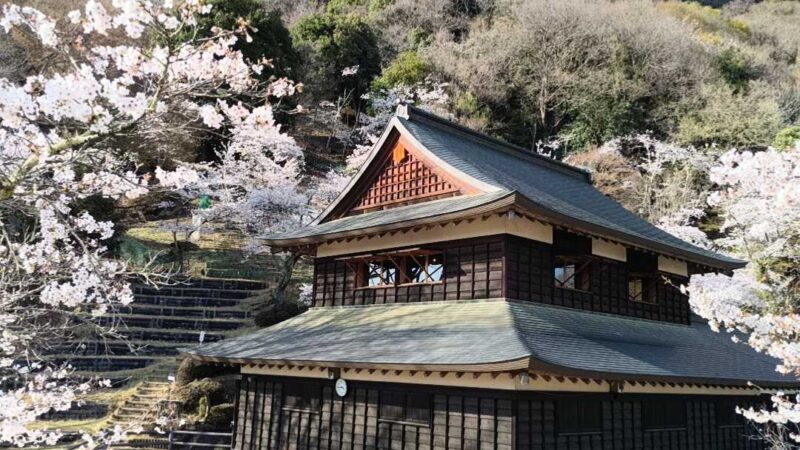
Hachiman Shrine is the starting point for visiting Nakamaki Castle. This shrine is located in the castle’s second enclosure, and you can feel the atmosphere of the castle ruins from the shrine grounds. Traces of earthworks remain around the shrine, indicating that the flat grounds were once an enclosure.
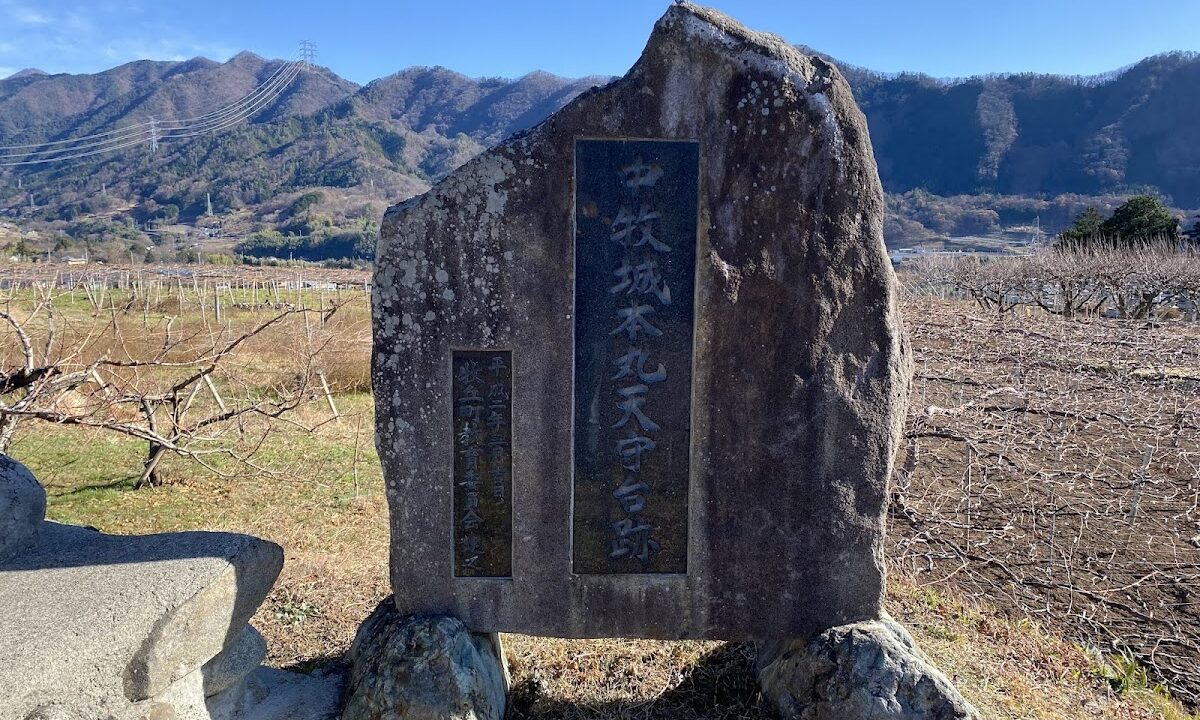
Hachiman Shrine has information boards and stone monuments about the castle ruins, conveying the history of Nakamaki Castle to visitors. From the shrine, you can also enjoy views towards Shioyama, giving you a real sense of why the castle was built in this location.
Earthworks and Dry Moats Around the Main Enclosure
Proceeding from Hachiman Shrine towards the main enclosure, you can clearly see earthworks and dry moats. In particular, high earthworks remain on the north and east sides of the main enclosure, indicating that the layout prioritized defense.
Although some of the dry moats are filled in, sections retain their depth and width, allowing you to imagine their former appearance. One of the charms of Nakamaki Castle is that you can experience the castle’s defensive system by walking along the bottom of the moat.
Remaining Enclosures in the Orchard
Several enclosures are arranged in a stepped pattern around the main enclosure, but most are now used as orchards. However, the elevation changes of the orchards coincide with the elevation changes of the original enclosures, allowing you to truly appreciate the scale of the castle.
When visiting, please be considerate of private property and avoid trespassing into the orchards. Even observing from the public road or shrine grounds will give you a good understanding of the castle’s structure.
Excellent Views | Panoramic View of Shioyama
One of the major features of Nakamaki Castle is its excellent views. Located on a plateau at an altitude of 570m, it offers panoramic views of Shioyama, the Fuefuki River basin, and even the Chichibu area.
This excellent view was important not only for military surveillance but also as a symbol of territorial control. On clear days, you can see the Southern Alps and the mountains of Okuchichibu, making it a major attraction for visitors.
Access to Nakamaki Castle | Visitor Guide
Access by Car
Nakamaki Castle is easily accessible by car. It’s approximately 20 minutes from the Katsunuma Interchange on the Chuo Expressway via National Route 140, or approximately 25 minutes from the Ichinomiya-Misaka Interchange.
There is some parking space around the Hachiman Shrine, but please be considerate as it is reserved for shrine visitors. Some surrounding roads are narrow, so drive carefully.
Address: Jōkoji, Makioka-cho, Yamanashi City, Yamanashi Prefecture
Car Navigation Setting: Searching for “Makioka Hachiman Shrine” is convenient.
Access by Public Transportation
If using public transportation, you will need to take a bus from either Yamanashi-shi Station or Shioyama Station on the JR Chuo Main Line. However, the number of buses is limited, so it is recommended to check the timetable in advance. A taxi from the station takes approximately 15-20 minutes.
The area around the castle ruins is mountainous, so visiting on foot is a long distance. Consider renting a car.
Points to Note When Visiting
The estimated time for visiting Nakamaki Castle is approximately 20-30 minutes. Please keep the following points in mind when visiting:
- Part of the ruins are on private land (an orchard), so avoid trespassing.
- As it is a mountain castle, wear comfortable shoes and clothing.
- Remember to take insect repellent in summer and warm clothing in winter.
- Check the location of information boards and monuments in advance.
- Be considerate of others when taking photographs.
Related Castles and Tourist Attractions in the Surrounding Area
Castles Around Yamanashi City
When visiting Nakamaki Castle, visiting the surrounding castles will give you a deeper understanding of the history of castles in Kai Province.
Kofu Castle (Maizuru Castle Park) is a representative early modern castle of Yamanashi Prefecture, located about 30 minutes by car from Nakamaki Castle. Built on the orders of Tokugawa Ieyasu, this hilltop castle features restored stone walls and turrets, offering a contrasting castle architecture to that of Nakamaki Castle.
Tsutsujigasaki-kan (site of the Takeda clan’s residence) is a historical site known as the base of operations for Takeda Shingen, and is now maintained as Takeda Shrine. The Omura and Naito clans, who were lords of Nakamaki Castle, also operated within the Takeda clan’s system of rule centered around Tsutsujigasaki-kan.
Iwadono Castle is a mountain castle located in the Shioyama area, known as the castle that resisted the Takeda clan to the very end during their downfall. Like Nakamaki Castle, it boasts magnificent views and is a must-see spot for mountain castle enthusiasts.
Makioka Town Tourist Information
Makioka Town in Yamanashi City is a region where fruit cultivation thrives, particularly famous for its grapes and peaches. In addition to visiting the castle ruins, you can also enjoy seasonal fruit picking and shopping at direct-sale agricultural product markets.
Michi-no-Eki Makioka is a great place to rest, offering fresh local produce and wine. There are also hot spring facilities nearby, perfect for relaxing after exploring the castle ruins.
Evaluation of Nakamaki Castle and Voices of Castle Enthusiasts
Evaluation on Kojodan
On Kojodan, a community site for castle enthusiasts, Nakamaki Castle has an average rating of ★★★☆☆ (2.75). With only 59 visitors, it’s still a relatively unknown castle site, but visitors have given it the following feedback:
- The remains are well-preserved, with earthworks and dry moats clearly visible.
- The views are superb, highlighting the site’s excellent location.
- There are information boards and monuments, making it easy to learn about the history.
- Access is somewhat inconvenient, but this allows for a quieter visit.
Visiting Time and Difficulty
The average visiting time is about 20 minutes, allowing you to see the main remains in a relatively short time. Although it’s a mountain castle, its relatively low elevation and accessibility to the Hachiman Shrine by car make it a relatively easy castle site to visit, even for beginners.
However, if you want to observe the remains in more detail or enjoy taking photographs at your leisure, it’s a good idea to allow 40 minutes to an hour.
Sharing the Charm of Nakamaki Castle Through Photographs | Recommended Photo Gallery
When visiting Nakamaki Castle, be sure to bring your camera and document the remains. The following are some recommended photo spots:
Recommended Photo Spots
- Hachiman Shrine’s Torii Gate and Grounds: Ideal as an introductory photo to convey the atmosphere of the castle ruins.
- Cross-section of the earthwork: Photograph from an angle that shows the height and structure.
- From the bottom of the dry moat: A photo that conveys the depth of the moat.
- View from the main enclosure: A wide-angle shot of the scenery towards Shioyama.
- Information board and stone monument: As historical records.
- Enclosure seen across the orchard: Expressing the coexistence of modern land use and the castle ruins.
When taking photos, being mindful of respecting private property, showing respect at the shrine, and considering the changing light of each season will help you take more attractive pictures.
Related Books and Materials for Learning About Nakamaki Castle
For those who wish to learn more about Nakamaki Castle, the following books and materials may be helpful:
Recommended Books
- *Medieval Castle Sites in Yamanashi Prefecture* (Yamanashi Prefectural Board of Education): A comprehensive report on castles within the prefecture.
- *Mountain Castles of Kai* Series: Detailed explanations of mountain castles in Yamanashi Prefecture.
- *Research on the Takeda Clan’s Retainers*: Focusing on the Omura and Naito clans as retainers of the Takeda clan.
- *Comprehensive Survey of Japanese Castles*, Volume 8 (Shin Jinbutsu Oraisha): Includes castles in the Koshinetsu region, including Nakamaki Castle.
Online Resources
Many castle-related websites publish visitor reports and photographs. Community sites such as “Kojodan” and “Shirobito” offer firsthand accounts and the latest information from actual visitors. The official Yamanashi City website also provides information on local history and cultural properties.
Summary | Nakamaki Castle: A Valuable Historical Site Telling the History of Kai Province
Nakamaki Castle (also known as Jōkoji Castle) is a Sengoku period mountain castle located in Makioka-cho, Yamanashi City, Yamanashi Prefecture. It is a historic fortress that served as the castle lords of the Ōmura and Naitō clans. The remains, including earthworks, dry moats, and the castle tower base, are well-preserved, making it a valuable historical site that tells the story of the Kai Takeda clan’s rule.
Located on a plateau at an altitude of 570m, this castle boasts magnificent views towards Shioyama and served both as a military base and a symbol of territorial control. Currently, remains are preserved within the grounds of the Hachiman Shrine and surrounding orchards, allowing visitors to imagine its former glory in a quiet environment.
While access is somewhat inconvenient, this also means fewer visitors, making it an attractive place to carefully observe the castle’s structure. For those planning a castle tour in Yamanashi Prefecture or interested in the history of the Kai Takeda clan, this hidden gem is definitely worth a visit.
Visiting Nakamaki Castle along with other famous castles such as Kofu Castle and Tsutsujigasaki Mansion allows you to experience the changes in castles from the Sengoku period to the Edo period, leading to a deeper understanding of history. Although Nakamaki Castle is not large in scale, it is a typical example of a mountain castle in Kai Province and a cultural asset that tells the history of the region, making it a historical site that should be carefully preserved in the future.