Katsuyama Castle (Tsuru City, Yamanashi Prefecture) Complete Guide: A Thorough Explanation from Construction to the Present
Katsuyama Castle, located in Kawana, Tsuru City, Yamanashi Prefecture, is a mountain castle built on Shiroyama Mountain at an altitude of 571 meters and is protected as a Yamanashi Prefecture designated historical site. Currently developed as Shiroyama Park, it is a historical site selected as one of Tsuru City’s 21 Scenic Peaks. This article comprehensively explains the history of Katsuyama Castle from its construction to the present day, the characteristics of its remains, and the results of academic research.
Location and Historical Landscape of Katsuyama Castle
Geographical Location and Strategic Importance
Katsuyama Castle is located on Shiroyama Mountain in Kawana, Tsuru City, and is also known as “Oshiroyama” (Castle Mountain). Built on an isolated hill rising across the Katsura River, behind Tsuru City Hall and Tanimura First Elementary School, it is a strategically important location at an altitude of 571 meters, with a relative height of approximately 100 to 110 meters.
This location was strategically situated at a key transportation hub in the Gun’nai region (present-day eastern Yamanashi Prefecture), serving as an important base connecting the Kofu Basin and the Kanto region. From Shiroyama, one could enjoy a panoramic view of Tsuru City and monitor the road along the Katsura River.
Current State of Shiroyama Park
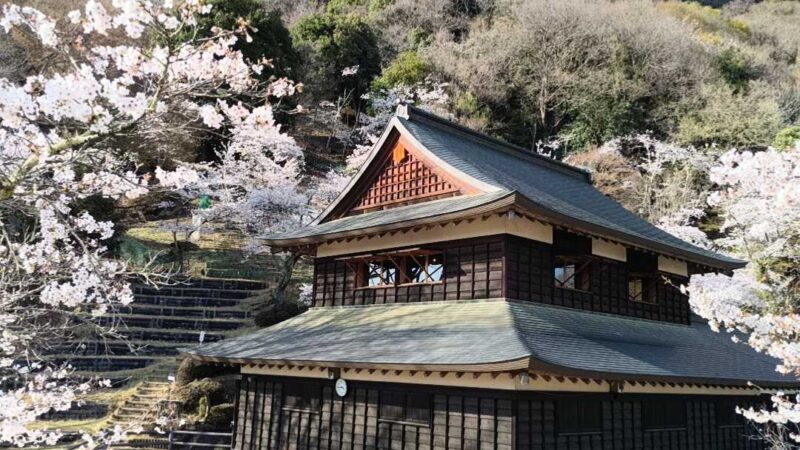
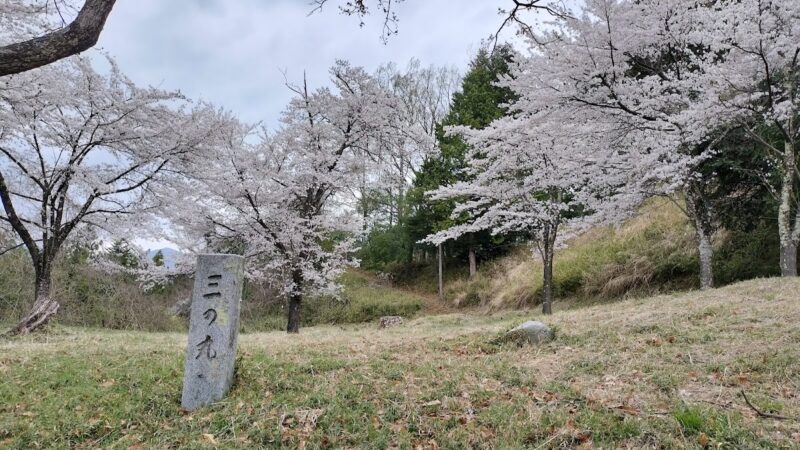
Currently, the Katsuyama Castle ruins have been developed into Shiroyama Park, with hiking trails providing a place of recreation for citizens. Parking and information boards are located at the foot of the mountain, making access relatively easy. From near the summit, one can enjoy panoramic views of Tsuru City, the Katsura River, and the surrounding mountains, experiencing the landscape seen by the former castle lords.
Construction of Katsuyama Castle and Changes in Lordship
Various Theories Regarding the Construction Period
There are several theories regarding the construction period of Katsuyama Castle, making it an important topic in historical research.
The Oyamada Clan’s Castle Construction Theory
A strong theory suggests that in 1532, when Oyamada Etchu-no-kami Nobuaki, the lord of Gun’nai, moved his residence from Nakatsumori Castle to Tanimura, he built Katsuyama Castle as an auxiliary castle (a castle for emergency refuge) for Tanimura Castle. The Oyamada clan, as important retainers of the Takeda family, controlled the Gun’nai region, and it is believed they resided at Tanimura Castle during peacetime, planning to take refuge in Katsuyama Castle on the mountaintop during times of conflict.
The Hojo Clan’s Castle Construction Theory
Another theory suggests that the Hojo clan, who fought over control of the former Takeda territory during the Tensho-Jingo War (1582) following the Honnoji Incident, built Katsuyama Castle to secure this area. During this period, the Hojo clan was expanding into Kai and Shinano provinces, and it has been suggested that they built the castle as a new military base.
Theory of Castle Construction During the Toyotomi Daimyo Era
There is also a theory that Asano Shigeaki, who became the lord of Tanimura in 1594 (Bunroku 3), renovated it as a modern castle. Edo period documents such as the “Kai no Kuni Shi” contain descriptions of the Asano clan’s construction, and it is considered certain that at least a large-scale renovation was carried out.
The Gun’nai Region and Castles During the Oyamada Clan’s Time
The Oyamada clan was a prestigious family descended from the Kai Genji clan and ruled the Gun’nai region from the Kamakura period. During the Sengoku period, they served Takeda Shingen and Katsuyori and played an important role, but they are known for secretly siding with Oda Nobunaga when the Takeda clan fell in 1582 (Tensho 10).
Tanimura-kan, the Oyamada clan’s base, was a residence on flat land and had limitations in terms of defense. Therefore, it is believed that they built Katsuyama Castle on an isolated hill across the Katsura River as a fortified stronghold to take refuge in times of emergency. This combination of a “peacetime residence + fortified castle” is a typical pattern for castle layouts during the Sengoku period.
It is presumed that the medieval Katsuyama Castle was a mountain castle centered on earthworks and moats, and the modern elements such as stone walls are thought to be the result of later renovations.
Katsuyama Castle during the Tensho-Jingo War and the Tokugawa Era
The Chaotic Period After the Fall of the Takeda Clan
In March of Tensho 10 (1582), Takeda Katsuyori committed suicide due to an invasion by the Oda-Tokugawa allied forces, and the prestigious Takeda clan was destroyed. When Oda Nobunaga died in the Honnoji Incident in June of the same year, the former Takeda territory became a power vacuum, and the Tensho-Jingo War erupted, with Tokugawa Ieyasu, Hojo Ujimasa, and Uesugi Kagekatsu vying for control.
The Gun’nai region, located on the border between Kai and Sagami (Kanto), became the front line of this conflict. The Hojo clan may have controlled this region for a time, using Katsuyama Castle as a military base or constructing a new one. Ultimately, the dispute was resolved when Tokugawa Ieyasu gained control of the entire province of Kai.
Deployment of Tokugawa Retainers
Once the Tokugawa clan’s rule over Kai was established, Tokugawa retainers were stationed in the Gun’nai region. While many details about Katsuyama Castle during this period remain unclear, it is believed to have continued to function as a military base.
Katsuyama Castle during the Toyotomi Daimyo Era
Modernization of the Castle by Asano Ujishige
In 1594 (Bunroku 3), Asano Ujishige, a retainer of Toyotomi Hideyoshi, became the lord of Tanimura. The Asano clan was a daimyo with a 20,000 koku domain, and it is believed that they developed Tanimura Castle as their residence and also extensively renovated Katsuyama Castle into a modern castle.
It is presumed that the stone walls were constructed and the layout of the baileys was improved during this period. The “Kai no Kuni Shi” (History of Kai Province) contains a description of the castle’s construction by the Asano clan, making it certain that at least a transformation from a medieval mountain castle to a modern castle took place.
Asano Shigeji ruled Tanimura until 1600, after which he was transferred to Kii Province (Wakayama) for his achievements in the Battle of Sekigahara.
The Torii Clan’s Era
After the Asano clan, the Torii clan ruled Tanimura from 1601 to 1616. It is believed that the Torii clan continued to maintain and utilize Katsuyama Castle, but detailed records do not remain.
Katsuyama Castle and the Ochazubo Dochu (Tea Jar Procession) in the Early Modern Period
Katsuyama Castle and the Tanimura Domain in the Edo Period
In 1617, Akimoto Yasutomo became the lord of the Tanimura Domain with a 30,000 koku stipend, and the Akimoto clan served as lords until the end of the Edo period. During this period, Tanimura Castle became the domain’s administrative center, and Katsuyama Castle was positioned as a subordinate castle to Tanimura Castle.
According to Edo period maps, Katsuyama Castle and Tanimura Castle were connected by two inner bridges. This indicates that the two castles functioned as an integrated defensive system.
Function as a Tea Storehouse and for the Ochatsubo Procession
Katsuyama Castle had a notable peaceful use during the Edo period: its function as a tea storehouse related to the Ochatsubo Procession.
The Ochatsubo Procession was a procession that transported Uji tea for the Shogun’s family to Edo, and it took place every early summer. Records show that these tea jars rested at Tanimura-juku during their journey along the Koshu Kaido road and were temporarily stored in the tea storehouse within Katsuyama Castle.
During the Akimoto clan’s rule, Katsuyama Castle’s military function declined, and it took on the role of a warehouse for storing important supplies for the shogunate. This is an interesting example of the repurposing of a castle during a time of peace.
Castle Layout and Remains/Artifacts
Basic Structure of the Castle
Katsuyama Castle’s layout (castle design) skillfully utilizes the topography of an isolated hill. The main keep (Honmaru) is located near the summit, with the second and third baileys (Ninokuruwa and Sannomaru) arranged in a stepped fashion around it, a typical mountain castle structure.
Main Bailey Arrangement
- Honmaru: The main keep located at the highest point of the mountaintop
- Ninokuruwa: Located below the Honmaru
- Sannomaru: Further below
- Kawatana Lookout: A facility for monitoring the Katsura River area
Characteristics of Defensive Facilities
Various defensive facilities have been identified at Katsuyama Castle.
Stone Walls
Stone walls are constructed in key areas, particularly around the entrances (koguchi) and along the edges of the baileys. These stone walls exhibit characteristics of early modern castles and are thought to be the result of renovations during the Asano and Akimoto periods. While primarily constructed using the nozurazumi technique (a method of stacking natural stones as they are), some processed stones were also used.
Earthworks
Earthworks (defensive walls made of piled-up earth) surround the enclosure, preserving the characteristics of medieval mountain castles. The height of the earthworks varies depending on the location, but many sections remain clearly visible today.
Moats
Inner and outer moats have been identified, forming an important defensive line that demarcates the enclosure. Multiple trenches (moats cutting across ridges) have also been found, demonstrating ingenuity in preventing enemy intrusion.
Excavated Artifacts
A diverse range of artifacts were unearthed during an academic survey conducted by the Tsuru City Board of Education from 2005 to 2009.
Ceramics
Fragments of ceramics dating from the Sengoku period to the Edo period have been excavated, providing clues to life within the castle. In particular, fragments of Seto and Mino pottery and Chinese porcelain indicate the living standards of the castle lord class.
Metal Artifacts
Iron nails, metal fittings, and copper coins have been unearthed, providing valuable information about the building’s structure and economic activity.
Roof Tiles
Fragments of roof tiles from the early modern period have also been unearthed, indicating that at least some buildings used tiled roofs.
Maps and Documentary Materials
Edo Period Maps
Several Edo period maps depicting Katsuyama Castle still exist, providing valuable historical information about the castle’s appearance at the time.
The “Tanimura Castle Town Map,” created during the Akimoto clan’s rule, depicts Katsuyama Castle and Tanimura Castle connected by two inner bridges. This map allows us to glean detailed information about the layout of the castle grounds, building locations, and road routes.
Furthermore, some maps depict a tea storehouse within the castle grounds, making them important historical materials supporting a connection to the Ochazubo Dochu (tea jar procession).
Description in the “Kai no Kuni Shi”
The “Kai no Kuni Shi,” a local history compiled in the late Edo period, contains a description of Katsuyama Castle. It mentions the castle’s construction by Asano Shigeaki during the Bunroku era, providing a clue to understanding the period of its development as a modern castle.
However, since the “Kai no Kuni Shi” was compiled in the late Edo period, some parts of the construction period are based on tradition; therefore, cross-referencing with archaeological investigations is crucial.
About the Katsuyama Castle Ruins Academic Survey Project
Survey Overview and Implementation Period
The Tsuru City Board of Education conducted a five-year academic survey of the Katsuyama Castle ruins from fiscal year 2005 to fiscal year 2009. This comprehensive survey combined documentary research, surveying, and archaeological excavation, aiming to clarify the actual state of Katsuyama Castle.
Results of the Documentary Research
By collecting and analyzing historical documents such as ancient manuscripts, maps, and local histories, the historical changes of Katsuyama Castle were revealed. In particular, the historical materials from the Akimoto clan period were extensive, providing detailed information about the castle’s use during the Edo period.
Surveying and Creation of a Castle Layout Map
Using the latest surveying techniques, the castle site was surveyed, and a precise layout map was created. This allowed for an accurate understanding of the arrangement of baileys, the locations of stone walls and earthworks, and the scale of moats, revealing the overall structure of the castle.
Major Results of the Archaeological Excavation
Archaeological excavations were conducted at multiple locations, yielding the following results:
- Clarification of the construction techniques and period of the stone walls
- Confirmation of building remains and estimation of their structure
- Dating based on excavated artifacts
- Reconstruction of the construction process through soil layer analysis
These research results have been compiled into a report and published by the Tsuru City Board of Education.
Research History and Academic Evaluation
Pre-War Research
Serious research on Katsuyama Castle began with investigations by local historians in the early Showa period. Local traditions and historical documents were collected, accumulating fundamental information.
Post-War Castle Research
After the war, as nationwide castle surveys by organizations such as the Japan Castle Association progressed, Katsuyama Castle gained attention as an important mountain castle in Yamanashi Prefecture. In the 1970s, Yamanashi Prefecture conducted a historical site designation survey, and it became a prefecturally designated historical site.
Comprehensive Survey in the Heisei Period
The academic survey conducted by Tsuru City from 2005 was a full-scale survey using the latest archaeological methods, marking a turning point in Katsuyama Castle research. This survey yielded new insights into the construction period and castle structure, significantly advancing its academic evaluation.
Current Research Issues
The following research issues remain:
- Determining the construction period (verification of the Oyamada clan theory and the Hojo clan theory)
- Restoration of the castle structure in the medieval period
- Detailed timing and content of early modern renovations
- Clarification of the relationship with Tanimura Castle
- Comparative study with surrounding castles and fortifications
Access and Visiting Information
Transportation Access
By Train
- Approximately 20 minutes on foot from Tanimura-cho Station on the Fujikyuko Line to the castle entrance
- Approximately 25 minutes on foot from Tsuru-shi Station
By Car
- Approximately 10 minutes from Tsuru IC on the Chuo Expressway
- Parking space available at the foot of the mountain (several spaces)
Precautions for Visiting the Castle
- The hiking trail is well-maintained, but since it is a mountain castle, comfortable walking shoes are necessary.
- A moderate level of physical fitness is required as you will be climbing an elevation difference of approximately 100 meters.
- The round trip takes approximately 1 to 1.5 hours.
- Insect repellent is recommended during the summer months.
- Information boards are installed at the foot of the mountain and at key points.
Points to Note During Your Visit
- Information Board at the Foot of the Mountain: Understand the overall layout before ascending the castle.
- Stone Wall Remains: Important remains that demonstrate the characteristics of early modern castles.
- View from the Main Enclosure: Enjoy a panoramic view of Tsuru city and the Katsura River.
- Earthworks and Moats: Observe the defensive structures of a medieval mountain castle.
- Layout of Enclosures: Experience the stepped layout of the castle grounds.
Nearby Historical Spots
Tanimura Castle Ruins (Tanimura Jinya Ruins)
Located on the opposite bank of the Katsura River, this is the site of a former residence during peacetime. Currently, the Tsuru City Hall and other buildings stand here. Visiting it together with Katsuyama Castle helps to understand the relationship between “fortified castles and residences.”
Tsuru City Local History Museum
Exhibits include artifacts unearthed from Katsuyama Castle and related historical materials, allowing you to learn more about the castle’s history.
### Historical Sites Related to the Oyamada Clan
Many historical sites related to the Oyamada clan remain in the Gun’nai region. Visiting these sites, along with others such as the Nakatsumori Manor Ruins and the Iwadonoyama Castle Ruins, provides insight into the reality of the Oyamada clan’s rule.
Summary
Katsuyama Castle in Tsuru City, Yamanashi Prefecture, is a mountain castle built on a 571-meter-high mountain. It functioned as an important military base in the Gun’nai region from the Sengoku period to the Edo period. While there are various theories regarding its construction period, it is believed to have developed through multiple stages: construction as a fortified castle by the Oyamada clan, use by the Hojo clan during the Tensho-Jingo War, and modernization by the Asano clan.
Academic surveys conducted by the Tsuru City Board of Education from 2005 to 2009 revealed detailed information about the remains, including stone walls, earthworks, and moats. Excavated artifacts clarified the castle’s transformation from the Sengoku period to the Edo period. In particular, peaceful uses, such as its use as a tea storehouse related to the Ochazubo Dochu (tea jar procession) during the Edo period, have also been discovered. Currently, the site is maintained as Shiroyama Park and is one of the 21 scenic peaks of Tsuru City. The view from the summit is magnificent, offering a panoramic view of Tsuru city and the Katsura River. A parking lot and information board are located at the foot of the mountain, making it a relatively accessible historical site even for those new to mountain castles.
Katsuyama Castle is a valuable example of the transformation of castles from the medieval to the early modern period, and is an indispensable historical site for understanding the history of the Gun’nai region. When visiting Tsuru City, be sure to climb to the Katsuyama Castle ruins and experience the view seen by the Sengoku period warlords.
References
- Tsuru City Board of Education, “Katsuyama Castle Ruins Excavation Survey Report” (2005-2009)
- “Kai no Kuni Shi” (History of Kai Province)
- Yamanashi Prefecture Board of Education, “Medieval Castle Sites of Yamanashi Prefecture”
- Japan Castle Association, “Comprehensive Survey of Japanese Castles,” Vol. 8
- Tsuru City History Compilation Committee, “History of Tsuru City”
- Various castle-related books and papers