
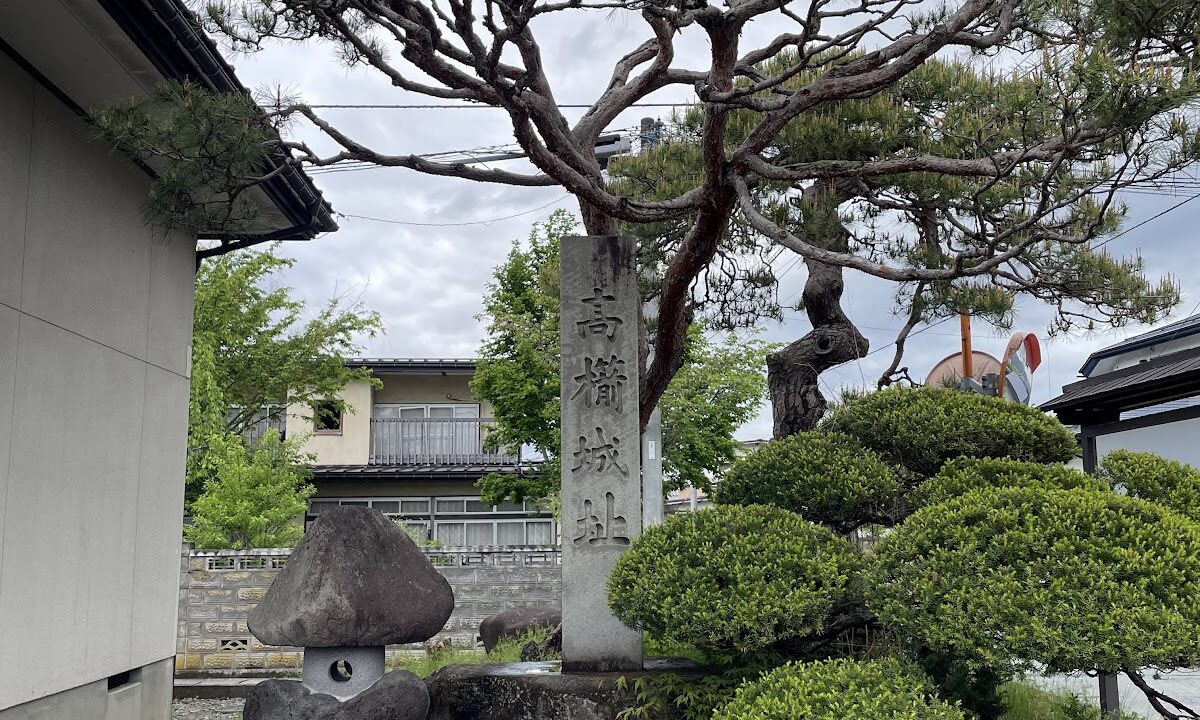
Takadama Castle (Tendo City, Yamagata Prefecture): The Complete Picture of a 600-Year-Old Medieval Flatland Castle
Takadama Castle is a medieval flatland castle located in Tendo City, Yamagata Prefecture. Built almost in the center of the Yamagata Basin, in the southwestern part of Tendo City, it is a historical fortress. As a concentric flatland castle surrounded by four moats, the settlement itself still retains a square shape, making it a valuable historical site that strongly preserves the appearance of a castle town from over 600 years ago.
Basic Information on Takadama Castle
Location and Access
Location: Takadama, Tendo City, Yamagata Prefecture
Former Province: Dewa Province (Murayama District)
Takadama Castle was built on a slightly elevated area of the alluvial fan on the right bank of the Tachi River, located southwest of the center of Tendo City. Although it is now a residential area, remnants of the castle can still be seen in the place names and streetscape.
Castle Classification and Structure
Classification: Flatland Castle
Structure: Ring-shaped (Quadruple Moat)
Castle Area Size:
- Approximately 420 meters east-west
- Approximately 440 meters north-south
- Roughly square layout
Keep Structure: No keep (Structure centered around a residence, as a flatland castle)
Takatama Castle is a ring-shaped flatland castle surrounded by four moats. The water moats, which drew water from mountain temples and springs, served a defensive function. A distinctive feature is the unique defensive system adopted, where temples in the surrounding area were relocated to protect the four corners.
History and Builder of Takatama Castle
Construction History
There are several theories regarding the construction period of Takatama Castle.
Oei Era Theory (1394-1428): One theory suggests it was built during the Oei era, but no reliable records remain.
Theory of Construction in Bunmei 7 (1475): More reliable records suggest that the castle was built in Bunmei 7 (1475) by Tendo Yorimoto. Tendo Yorimoto was a descendant of Yoshinao, the grandson of Shiba Kaneyori, lord of Yamagata Castle, and established the castle in Takatsuma during this period.
Builder: Tendo Yorimoto (one theory suggests a descendant of Shiba Yoshinao)
The current form of the castle is thought to have been established during the Bunmei era (1469-1487), when the basic structure of a concentric flatland castle with four moats was established.
Takatsuma Castle during the Mogami Clan Era
Takatsuma Castle played an important role within the Mogami clan’s sphere of influence. Located midway between Nakano Castle and Tendo Castle, it functioned as an important northern base in the early days of the Mogami clan.
The Era of Mogami Yoshiaki, Lord of Yamagata Castle: During the late Sengoku period, when Mogami Yoshiaki expanded his power as the lord of Yamagata Castle, Takatama Castle was granted to Saito Iyo-no-kami. It is said that Saito Iyo-no-kami constructed and improved the castle, strengthening its defensive capabilities and enhancing its functions as a castle town.
Changes in the Edo Period
With the arrival of the Edo period, the role of Takatama Castle changed.
From the Mid-Edo Period Onward: Some of the retainers of Akimoto Tajima-no-kami, the former lord of Yamagata Castle, began to reside in this area. Although its military function as a castle was lost, it continued to be used as a residential area centered around samurai residences.
During this period, the castle’s defensive facilities were gradually simplified, and it is believed that some of the moats were filled in. However, the basic rectangular plan of the settlement was maintained.
Remains and Current State of Takatsuma Castle
Remains of the Former Site
Situation up to the 1960s: Until the 1960s (around 1965-1974), it has been confirmed that parts of the moat remained. Of the four moats, at least the inner moat and part of the second moat were preserved with water, allowing us to imagine its former appearance.
Moat Structure:
- A multi-layered defensive system with four moats
- A water-filled moat utilizing water from a mountain temple and spring water
- Earthen ramparts were built between each moat
Current Situation
Progress of Residential Development: Currently, the site of Takatsuma Castle is a residential area, and the former water moat has been filled in. While many of the remains have been lost, characteristic elements of the castle town remain in many places.
Existing Traces:
- The settlement’s rectangular shape
- Unique road layout, including T-junctions
- Remaining place names related to the castle
- Temple layout (remnants of a layout protecting the four corners)
Traces of a Castle Town Remaining in the Streetscape
Walking through the Takatsuma district, one can still feel the planned street layout of a medieval castle town.
T-Junction Layout: Multiple T-junctions, designed to prevent enemy intrusion, can still be seen within the district. This is a typical technique of medieval castles, which made visibility poor and provided a defensive advantage.
Rectangular Street Layout: The entire settlement maintains a rectangular shape, and the outline of the castle is clearly recognizable in aerial photographs. This planned layout is evidence that the design from over 600 years ago has been passed down to the present day.
Inheritance of Place Names: The place name “Takatsuma” itself is a remnant of the castle, and small place names and common names related to the castle remain in the surrounding area.
Takatsuma Castle’s Defensive System and Small Castle Town
Defense by Quadruple Moats
The most distinctive feature of Takatsuma Castle is its robust defensive system of quadruple moats. Such a multi-layered moat system was rare even on a flatland castle.
Securing Water Sources: The castle skillfully utilized waterways from the Yamadera area and groundwater (springs) to maintain constantly water-filled moats. This enabled a strong defense despite its flatland location.
Defense by Temples at the Four Corners
Another distinctive defensive method of Takatsuma Castle was the placement of surrounding temples at the four corners of the castle as defensive strongholds.
Relocation and Placement of Temples: During the construction of the castle, or during the process of castle development, existing temples were strategically relocated to protect the castle’s four corners. The temples served as religious facilities while also functioning as defensive strongholds in emergencies.
This method demonstrates a medieval castle design philosophy that combined religious authority with military function.
Formation of a Small Castle Town
A small castle town formed around Takatama Castle.
Characteristics of the Town Layout:
- Planned street layout
- Separation of samurai residences and merchant districts
- Formation of a town with commercial functions
- Comprehensive urban planning incorporating temples
This small castle town functioned not merely as a military base, but also as a regional economic and cultural center.
Relationship between Takatama Castle and Surrounding Castles
Mogami Clan’s Castle Network
Takatama Castle held an important position within the castle network of the Murayama region, which was controlled by the Mogami clan.
Relationship with Nakano Castle: Its cooperation with Nakano Castle, located to the north, formed a defensive line against threats from the north.
Relationship with Tendo Castle: Its location midway between Takatama Castle and Tendo Castle allowed it to control a key point on the communication route connecting the two castles.
Relationship with Yamagata Castle: It played a vital role in the northern defense of Yamagata Castle, the clan’s base, and was a crucial strategic point protecting the Mogami clan’s sphere of influence.
Thus, Takatsuma Castle did not exist in isolation, but functioned as part of a broader defense system involving multiple castles.
Cultural and Historical Value of Takatsuma Castle
Significance in Medieval Castle Research
Takatsuma Castle provides a valuable case study in the research of medieval flatland castles in the Tohoku region.
Typical Example of a Concentric Flatland Castle: As a concentric flatland castle with four moats, it is an important resource for understanding castle construction techniques and defensive philosophies.
Inheritance of Urban Planning: The fact that the urban plan from over 600 years ago has been largely maintained to the present day is noteworthy in urban history research.
Position in Regional History
History of Tendo City: Takatsuma Castle is an indispensable part of the history of Tendo City and forms the core of its regional identity.
Research on the Mogami Clan: The existence and transformation of Takatama Castle provide important clues to understanding the expansion of the Mogami clan’s power and their system of rule.
Castle Town Culture: It is highly valued as a living textbook demonstrating the formation and transmission of castle town culture from the medieval to early modern periods.
Visiting Takatama Castle and Surrounding Attractions
Points to Note During Your Visit
When visiting the Takatama Castle ruins, paying attention to the following points will help you imagine its appearance in its heyday.
Square Plan of the Settlement: Walking through the entire Takatama area, you can appreciate the planned street layout and square-shaped divisions. It is recommended to bring a map and walk while confirming the boundaries of the castle grounds.
Arrangement of T-junctions: Several T-junctions, created for defensive purposes, remain. These road layouts are traces of ingenuity designed to slow enemy advances and impair visibility.
Location of Temples: Some temples, positioned to protect the four corners, still exist today. Visiting each temple will help you understand the role of temples in the defense of the castle.
Confirming Place Names: In addition to the place name “Takatsuma,” other sub-district names and common names related to the castle remain. Talking to locals may reveal interesting fragments of history.
Related Historical Sites in the Surrounding Area
Tendo Castle Ruins: The ruins of Tendo Castle, which was connected to Takatsuma Castle, are also worth visiting. Located in the center of Tendo City, it is a castle with strong ties to the Mogami clan.
Nakano Castle Ruins: Nakano Castle, located north of Takatsuma Castle, is also important for understanding the Mogami clan’s castle network.
Yamagata Castle Ruins (Kajo Park): Yamagata Castle, the base of the Mogami clan, is now maintained as Kajo Park, where you can see one of the largest castle ruins in the Tohoku region.
Preservation of Takatsuma Castle and Future Challenges
Current Status of Remains Preservation
Many of the remains of Takatsuma Castle have been lost due to residential development. While a portion of the moat remained until the 1960s, it has now been filled in.
Lost Remains:
- Quadruple moats (all filled in)
- Most of the earthworks
- Structures such as castle gates and turrets
- Remains of samurai residences
Remaining Elements:
- Rectangular settlement plan
- Street layout
- Place names
- Temple layout
- Slightly elevated terrain
Expectations for Future Preservation and Utilization
To pass on the value of the Takatsuma Castle ruins to future generations, the following efforts are expected:
Enhancing Record Preservation: It is important to enhance records of the lost remains through old photographs, old maps, and interviews.
Installation of Information Boards and Explanation Panels: It is desirable to install information boards and explanation panels in appropriate locations so that visitors can understand the history and structure of the castle.
Promotion of Townscape Preservation: Preserving historical street patterns such as square plans and T-junctions, and maintaining the atmosphere of a medieval castle town, will contribute to the protection of cultural assets.
Digital Restoration: Utilizing CG and 3D technology to digitally restore the appearance of Takatama Castle in its heyday and using it as an educational and tourism resource would also be effective.
Summary: The Historical Weight Conveyed by Takatama Castle
Takatama Castle is a concentric-style flatland castle with four moats, built over 600 years ago in Tendo City, Yamagata Prefecture. It was constructed in 1475 by Tendo Yorimoto, and later, during the time of Mogami Yoshiaki, it was granted to Saito Iyo-no-kami, who carried out its renovations. Located between Nakano Castle and Tendo Castle, it functioned as an important base for the Mogami clan’s northern defense.
Although much of the castle’s remains have been lost, the remnants of the medieval castle town remain vividly evident, including the square plan of the settlement, the street layout with T-junctions, and the placement of temples. The nearly square castle grounds, approximately 420 meters east-west and 440 meters north-south, retain their outline within a modern residential area, and can be seen on aerial photographs and maps.
Takatama Castle was not merely a military facility, but developed as a castle town based on a planned urban design. The wisdom and ingenuity of medieval castles are evident throughout, such as the defense of four moats, the defensive system of temples placed at the four corners, and the intrusion control measures using T-junctions. Furthermore, the water moats, utilizing water from mountain temples and springs, were a technological achievement that enabled strong defenses despite it being a flatland castle.
While Takatama Castle ruins no longer have any prominent remains today, the townscape itself, with its 600-year history, is a valuable cultural heritage. Visitors to this area will discover traces of medieval urban planning that still thrive within modern residential areas, allowing them to experience a sense of historical continuity.
The history of Takatsuma Castle presents us with many themes, including the social changes during the transition from the medieval to the early modern period in the Tohoku region, the expansion of the Mogami clan’s power and system of rule, and the formation of a local community centered around a castle. While lamenting the loss of some remains, it is our responsibility to carefully preserve the historical landscape that still remains and pass it on to future generations.


