Complete Guide to Oguniyama Castle (Yamagata Prefecture) | A Thorough Explanation of the National Historic Site’s Mountain Castle Remains and Historical Value
While there are several castles named “Oguni Castle” in Yamagata Prefecture, this article provides a detailed explanation of Oguniyama Castle, located in Shiri, Oguni-machi, Tsuruoka City, and designated as a National Historic Site in Tagawa District, Dewa Province. Built on the summit of Mt. Tateyama (348.5 meters above sea level), this mountain castle boasts the highest elevation difference among mountain castles in Yamagata Prefecture and played a crucial role as a border castle protecting the border between Uetsu and Echizen provinces during the Sengoku period.
Basic Information on Oguni Castle
Oguni Castle is a Japanese castle site located in Shiri, Oguni-machi, Tsuruoka City, Yamagata Prefecture (formerly Atsumi-machi, Tagawa District). Situated on the summit of Mt. Tateyama, which rises southwest of the Oguni settlement on the left bank of the Oguni River (Shonai Oguni River), it was designated a National Historic Site on December 19, 2002.
Basic Castle Data
Common Name/Alternate Name: Tateyama Castle
Location: Shiri, Oguni-machi, Tsuruoka City, Yamagata Prefecture (formerly Atsumi-machi, Tagawa District)
Former Province: Tagawa District, Dewa Province
Classification/Structure: Mountain castle, multi-bailey style
Keep Structure: None (No keep exists as it is a mountain castle)
Builder: Honjo Shigenaga (legend)
Year of Construction: Estimated to be during the Tensho era (1573-1592)
Main Renovators: Warlords under Uesugi Kagekatsu
Main Lords: Honjo Shigenaga, castle deputy under Naoe Kanetsugu, warlords under Mogami Yoshiaki
Year of Abandonment: Due to the One Castle Per Province Decree of Genna 8 (1622)
Remains: Enclosures, earthworks, horizontal moats, dry moats, vertical moats, and gate structures
Reconstructed Structures: Information boards, guide signs
Elevation: 348.5 meters (main enclosure site)
Relative Elevation Difference: Approximately 235.5 meters (from the Oguni settlement at the foot of the mountain)
Overview and Historical Background of Oguni Castle
Importance of Oguni Castle in the Sengoku Period
Oguni Castle was located at a strategic point on the border between Echigo Province (present-day Niigata Prefecture) and Dewa Province (present-day Yamagata Prefecture). This region has long been a vital transportation hub, with important roads connecting the Sea of Japan coast and the inland areas. During the Sengoku period, this region became a border zone between the two major powers, the Uesugi clan of Echigo and the Mogami clan of Dewa, and Oguni Castle functioned as a frontline base.
The History of the Castle’s Construction and Honjo Shigenaga
There are various theories regarding the construction period of Oguni Castle, but the most widely accepted theory is that it was built during the Tensho era (1573-1592) by Honjo Shigenaga, a samurai from Echigo Province. Honjo Shigenaga served Uesugi Kenshin and Kagekatsu, and his base was Murakami in Echigo Province. It is believed that Oguni Castle was built to strengthen the defenses of the Uesugi-Echigo border as the Uesugi clan expanded its power into the Shonai region.
The Tensho era was the period after the death of Uesugi Kenshin, following the Otate Rebellion, when Uesugi Kagekatsu became the lord of Echigo Province. During this time, the Uesugi clan came under the command of Toyotomi Hideyoshi and strengthened their influence in the Shonai region. Oguni Castle functioned as an important military base for maintaining the Uesugi clan’s sphere of influence within this political context.
Oguni Castle under the Uesugi Clan
In 1598 (Keicho 3), Uesugi Kagekatsu was transferred to Aizu with a domain of 1.2 million koku by order of Toyotomi Hideyoshi. At this time, the Shonai region also became part of the Uesugi clan’s territory, and Oguni Castle came under their control. The Uesugi clan’s retainers, led by Naoe Kanetsugu, governed the Shonai region, and a castle lord was appointed to guard the border at Oguni Castle.
In the Battle of Sekigahara in 1600 (Keicho 5), the Uesugi clan sided with the Western Army, resulting in fierce battles against Mogami Yoshiaki of the Eastern Army. It is presumed that fighting also took place around Oguni Castle during this “Keicho Dewa Campaign,” but detailed records do not exist.
Transition to the Mogami Clan and Abandonment of the Castle
After the Battle of Sekigahara, the Uesugi clan’s domain was reduced to 300,000 koku in Yonezawa, and the Shonai region came under the control of Mogami Yoshiaki. Oguni Castle also came under the management of a vassal of the Mogami clan and continued to function as a guard post on the border between Uetsu and Echigo provinces.
However, in 1622, the Edo shogunate issued the “One Castle Per Province” decree, and Oguni Castle was abandoned. This decree mandated that each domain abolish castles other than their primary residence, leading to the disappearance of many mountain castles throughout Japan. Oguni Castle also ceased its role as a military facility at this time and subsequently reverted to forest.
Structure and Layout of Oguni Castle
Characteristics as a Mountain Castle
Oguni Castle’s main keep was located on the summit of Mt. Tateyama, at an altitude of 348.5 meters, with a relative elevation difference of approximately 235.5 meters from the Oguni settlement at the foot of the mountain. This is the highest relative elevation difference among mountain castles in Yamagata Prefecture, making it a highly defensible location. The steep mountain path from the entrance to the main keep site, requiring approximately 40 minutes on foot, served as a natural defensive line, making enemy intrusion difficult.
Concentric Layout
Oguni Castle is a mountain castle with a concentric layout. A concentric layout is a structure where the main enclosures are arranged in a line, and is often used when building castles along mountain ridges. At Oguni Castle, multiple enclosures are arranged along the ridge, centered around the main enclosure at the mountaintop.
The main enclosure is located at the highest point of the mountaintop and is surrounded by earthen ramparts. The main enclosure measures approximately 40 meters east-west and 30 meters north-south, providing a relatively large flat area for a mountain castle. It is believed that important facilities such as the residences of the castle lord and castellan, and a granary, were located here.
Layout of Defensive Facilities
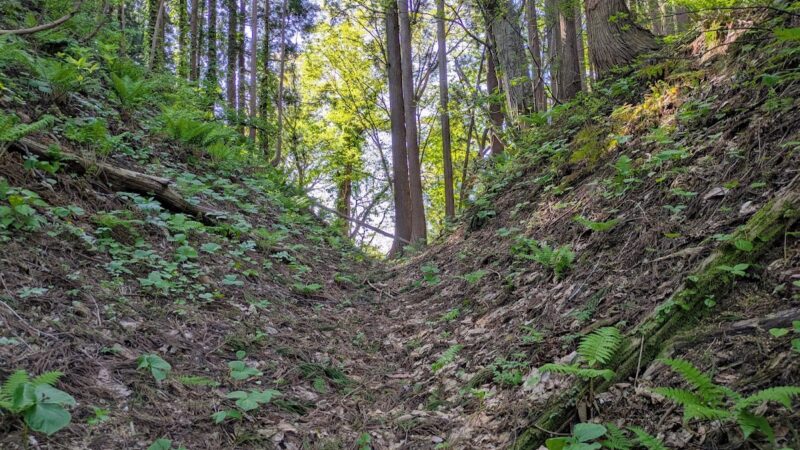
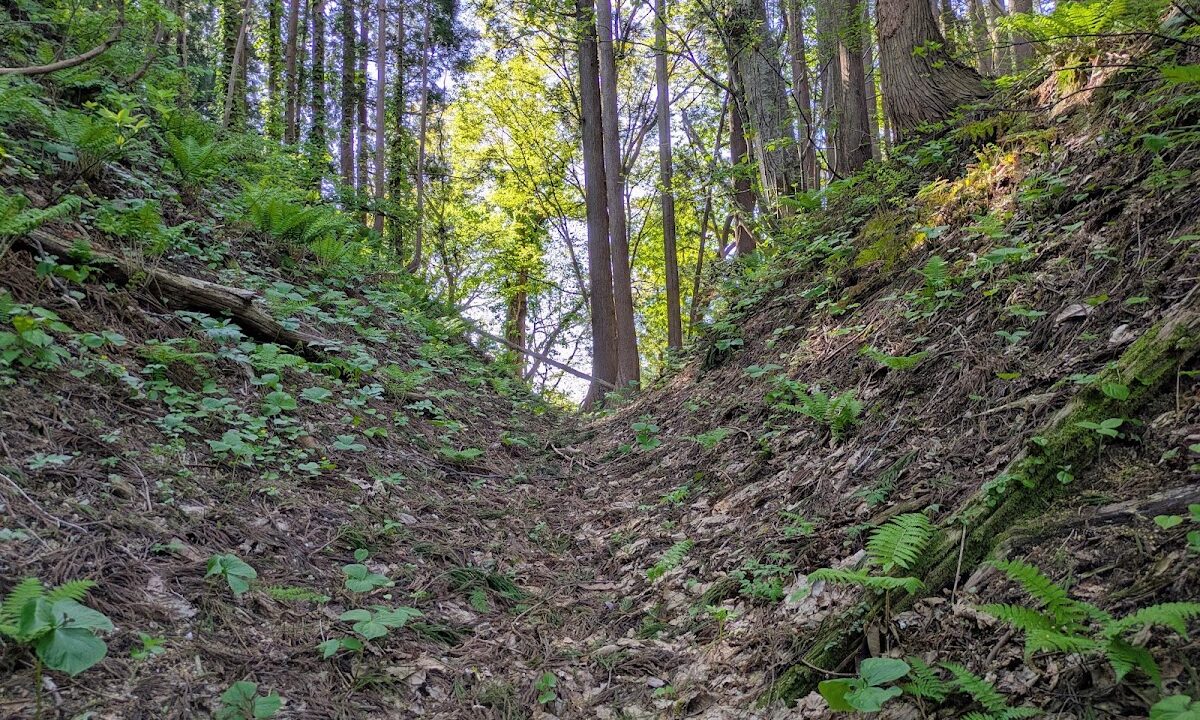
Oguni Castle features defensive facilities typical of mountain castles, placed throughout. Particularly noteworthy are the dry moats and horizontal moats separating the enclosures. Dry moats are moats placed between enclosures, serving to prevent enemy intrusion and restrict communication between enclosures.
A horizontal moat is a moat dug along the side of a ridge, effectively preventing enemies from attacking from the flank. At Oguni Castle, multiple horizontal moats have been identified, mainly around the main keep, indicating a layout that prioritized defense.
Furthermore, vertical moats have been identified in several locations. Vertical moats are moats dug vertically along a slope, effectively preventing enemies from climbing the slope. The vertical moats at Oguni Castle are concentrated around the approach to the castle, showing a strategy to restrict the movement of attackers.
Structure of the Koguchi (gateway entrance)
A koguchi is the entrance to a castle and one of the most important defensive structures. At Oguni Castle, koguchi are provided at the entrances to the main keep and major enclosures, and defenses are reinforced with earthworks and stone walls. In some places, small enclosures (masugata) are positioned in front of the koguchi, a strategy to delay enemy incursions.
Characteristics of the Earthworks
The earthworks at Oguni Castle are built to surround the enclosures. The height of the earthworks varied depending on the location, but reached 2 to 3 meters in some places. It is presumed that fences or walls were built on top of the earthworks, functioning as a defensive wall against enemy arrows and firearms.
Even today, the remains of the earthworks, particularly around the main keep, are well-preserved, providing valuable information for understanding the castle’s structure at the time.
Remains and Current State of Oguni Castle
Existing Remains
Even more than 400 years after its abandonment, many remains of Oguni Castle remain in excellent condition. This is due to the lack of large-scale development after the castle’s closure and the preservation efforts of local residents.
The main remains include the following:
- Main Enclosure Site: The flat area at the mountaintop and the surrounding earthworks
- Group of Enclosures: Multiple flat areas arranged around the main enclosure
- Dry Moat: Moats separating the enclosures
- Horizontal Moat: Moats dug along the side of the ridge
- Vertical Moat: Moats dug along the slope
- Earthworks: Earthen embankments surrounding the enclosures
- Tiger’s Moat: Entrances to the enclosures
These remains are extremely valuable for understanding the structure of mountain castles during the Sengoku period and are the reason for its designation as a National Historic Site.
Significance of National Historic Site Designation
The Oguni Castle Ruins were designated as a National Historic Site on December 19, 2002 (Heisei 14). This designation recognizes the high historical and academic value of Oguni Castle in the following respects:
- Well-preserved mountain castle structure from the Sengoku period: Clear remains of baileys, earthworks, dry moats, and lateral moats are preserved, making it invaluable for understanding the castle construction techniques of the time.
- Historical importance as a strategic point on the border of Uetsu Province: It played a crucial role in regional history as the front line of the power struggle between the Uesugi and Mogami clans.
- Mountain castle with the highest elevation difference in Yamagata Prefecture: It possesses a remarkable scale and structure among the mountain castles of the region.
With the designation as a National Historic Site, Oguni Castle ruins are legally protected, guaranteeing their preservation for the future.
Information Boards and Guide Signs
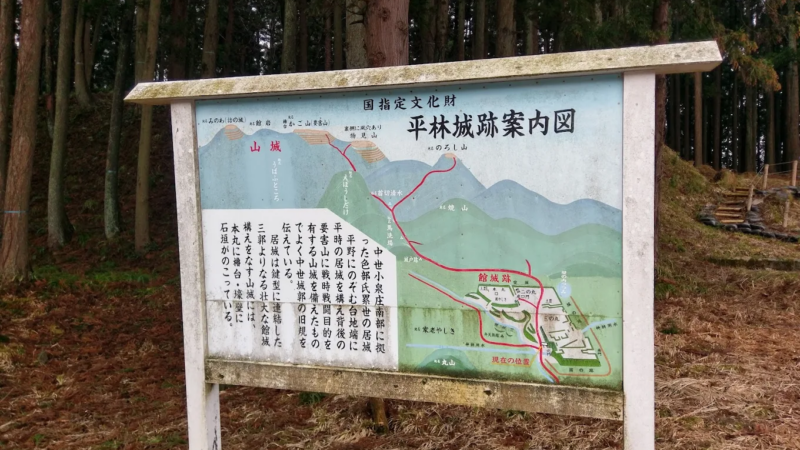
Currently, information boards and guide signs are installed at Oguni Castle ruins to make it easier for visitors to understand the castle site. An information board explaining the history and structure of Oguni Castle is located at the entrance to the castle, and guide signs are also installed near the main remains.
These explanatory signs include maps of Oguni Castle’s layout and reconstructed images, helping visitors imagine its appearance at the time.
Access to and Visiting Oguni Castle
Transportation Access
Using Public Transportation:
- Approximately 20 minutes by car from JR Uetsu Main Line “Atsumi Onsen Station”
- Taking a taxi from Atsumi Onsen Station is convenient
- Located approximately 10 km southwest of the station
Using a Car:
- Approximately 15 minutes from Nihonkai Tohoku Expressway “Atsumi Onsen IC”
- Access via Prefectural Road from National Route 7
- Parking is available in the Oguni settlement (a few cars)
Climbing Route and Estimated Time
The route from the entrance to the castle in the Oguni settlement to the main keep ruins takes approximately 40 minutes on foot. The mountain trail is well-maintained, but there are many steep slopes, so the following equipment and preparations are recommended:
- Clothing: Comfortable clothing; long sleeves and long pants are recommended (to protect from vegetation and insects)
- Shoes: Trekking shoes or athletic shoes (non-slip)
- Items to bring: Drinking water, towel, insect repellent, rain gear
- Season: Spring to autumn is the best time to visit the castle (winter is difficult due to snow)
The trail is relatively clear, but some sections are difficult to follow, so please pay attention to the signs.
Precautions When Visiting the Castle
- Avoid Visiting Alone: Since the mountain castle is located in a remote area, please visit in groups whenever possible.
- Check the Weather: It is recommended to refrain from visiting during rainy weather or after rain, as the ground can become slippery.
- Allow Plenty of Time: Allow approximately 1.5 to 2 hours for the round trip.
- Protect the Historical Structures: Please be careful not to enter the earthworks or moats, or damage the historical structures.
- Take Your Trash Home: To maintain the beauty of this national historical site, please be sure to take your trash home with you.
Historical Background of the Area Around Oguni Castle
History of the Oguni Region
The Oguni region has long been a crucial transportation hub connecting Echigo Province and Dewa Province. The route connecting the Sea of Japan coast and the inland area saw a bustling flow of goods and people, making it an economically important region. In the Middle Ages, it is believed that powerful local clans ruled this region, and small residences and forts were built there.
During the Sengoku period (Warring States period), two major powers, the Uesugi clan of Echigo and the Mogami clan of Dewa, vied for control of this region. The Oguni region, situated on the border between these two powers, was constantly under tension.
The Importance of the Uetsu Border
The Uetsu border, a mountainous region separating Echigo Province (Ugo Province) and Dewa Province, was a militarily and economically crucial boundary. Whoever controlled this border controlled the trade routes along the Sea of Japan and controlled the flow of goods.
Oguni Castle was built as a border castle protecting this Uetsu border. Border castles, built on the boundaries of a territory, served to monitor and defend against enemy incursions. From Oguni Castle, it was possible to overlook the roads from the Echigo side, allowing for early detection of enemy movements.
Sengoku History of the Shonai Region
The Shonai region (present-day Tsuruoka City and Sakata City area) was a complex web of power dynamics during the Sengoku period. Originally, this region was ruled by the local powerful clan, the Daiboji clan (Muto clan), but in the latter half of the 16th century, the influence of the Uesugi clan grew stronger.
During the Tensho era, Honjo Shigenaga, a senior retainer of the Uesugi clan, became involved in the governance of the Shonai region, and it is believed that Oguni Castle was built during this period. However, after the Battle of Sekigahara, it came under the control of the Mogami clan, and thereafter, the area experienced a period of political instability with changes in lordship.
Differences between Oguni Castle and other Oguni Castles in Yamagata Prefecture
There are several castle ruins named “Oguni Castle” in Yamagata Prefecture. To avoid confusion, let’s clarify the differences between each castle.
Oguni Castle in Tagawa District, Dewa Province (Explained in this article)
- Location: Shiri, Oguni-machi, Tsuruoka City
- Former Province: Tagawa District, Dewa Province
- Features: Designated as a National Historic Site, a mountain castle with the highest elevation difference in Yamagata Prefecture
- Builder: Honjo Shigenaga (legend)
- Historical Role: A castle on the border of Uetsu Province
Oguni Castle in Mogami District, Dewa Province
- Location: Honjo, Mogami-machi, Mogami District
- Former Province: Mogami District, Dewa Province
- Other Names: Iwabe-tate, Honjo-kan
- Builder: Oguni clan (Kuramasu clan)
- Features: Built on the site of the Mogami Hosokawa clan’s residence, managed by a vassal of the Mogami clan
Oguni Castle in Nishiokitama District
- Location: Oguni Town, Nishiokitama District
- Features: The site of a castle that flourished as the center of Oguni-go
- History: Used from the Sengoku period to the Edo period as a government office
As such, there are several “Oguni Castles” in Yamagata Prefecture, but only the Oguni Castle in Tsuruoka City is designated as a National Historic Site. Each has a different historical background and characteristics, so care must be taken not to confuse them.
Historical Evaluation and Research of Oguni Castle
Progress of Academic Research
Archaeological surveys and documentary historical research are progressing regarding Oguni Castle. In particular, detailed surveys were conducted for the designation as a National Historic Site, and the structure of the castle was revealed.
While excavation surveys are limited, a lot of information has been obtained from surface surveys. The arrangement of baileys, the structure of earthworks, and the shape of moats have been recorded in detail, providing valuable data for understanding the construction techniques of mountain castles during the Sengoku period.
Position in Regional History
Oguni Castle is an important historical site for understanding the Sengoku period history of the Shonai region. The site is valued as a historical site that concretely illustrates the historical changes from the Sengoku period to the early Edo period, including the power struggle between the Uesugi and Mogami clans, military tensions on the border of Uetsu Province, and the abandonment of castles due to the “One Castle Per Province” decree.
For local residents, Oguni Castle is a symbol of their local history, and preservation and promotional activities are carried out throughout the community.
Efforts for Preservation and Utilization
Since its designation as a national historical site, efforts have been made to preserve and utilize the Oguni Castle ruins. The Tsuruoka City Board of Education has formulated a preservation and management plan for the remains, and regular activities such as grass cutting and the installation of guide signs are carried out.
In addition, guided tours and site visits are held by local history enthusiasts and castle researchers, and activities are being carried out to widely convey the historical value of Oguni Castle.
The Charm of Visiting Oguni Castle
A Mountain Castle Where You Can Feel the Romance of History
The greatest charm of visiting Oguni Castle is being able to experience firsthand the atmosphere of a mountain castle from the Sengoku period. Climbing the steep mountain path and standing at the site of the main keep, one can easily imagine the thoughts and feelings of the castle lord and soldiers who defended this land in those days.
Because the remains are well-preserved, you can actually see the layout of the baileys and the shape of the earthworks, allowing for a three-dimensional understanding of the castle’s structure.
A Fusion of Nature and History
Oguni Castle ruins are surrounded by abundant nature. Seasonal plants can be seen around the climbing path, and the scenery is particularly beautiful during the fresh greenery of spring and the vibrant autumn foliage.
From the main keep site at the summit, you can enjoy a panoramic view of the Oguni settlement and the surrounding mountains, allowing you to relive the view seen by the castle soldiers of that time.
Value for Castle Enthusiasts
For castle enthusiasts and history lovers, Oguni Castle is a historical site well worth visiting. It is a full-fledged mountain castle designated as a national historical site, and the remains are well-preserved. Furthermore, its characteristic as a mountain castle with the greatest elevation difference in Yamagata Prefecture will likely be a compelling reason to visit.
For those who tour mountain castles throughout Japan, Oguni Castle is a castle site of comparable value to those included in “Japan’s Top 100 Mountain Castles.”
References and Information Sources
For more detailed information about Oguni Castle, please refer to the following documents and information sources:
- Tsuruoka City Board of Education, “Oguni Castle Ruins Preservation and Management Plan”
- Yamagata Prefecture Board of Education, “Medieval Castles and Residences of Yamagata Prefecture”
- Japan Castle Association, “Comprehensive Survey of Japanese Castles,” Volume 3
- Tsuruoka City History Compilation Committee, “History of Tsuruoka City”
- Agency for Cultural Affairs Cultural Properties Database (National Designated Cultural Properties Database)
Furthermore, when visiting the site, contacting the Tsuruoka City Board of Education or the local tourism association will provide you with the latest information and advice for your visit.
Summary
Oguniyama Castle (Tsuruoka City, Yamagata Prefecture) is a valuable historical site that conveys the appearance of a mountain castle from the Sengoku period. Built on the summit of Mt. Tateyama at an altitude of 348.5 meters, this castle played a crucial role as a border castle protecting the Uetsu region.
The castle’s layout, centered around the main keep, features a well-preserved series of enclosures, and its remains, including baileys, earthworks, dry moats, and lateral moats, led to its designation as a National Historic Site in 2002. Boasting the highest relative elevation difference of approximately 235.5 meters among mountain castles in Yamagata Prefecture, its scale and structure are of high value even on a national level.
Located on the front lines of the power struggle between the Uesugi and Mogami clans, Oguni Castle is an indispensable historical site for understanding the region’s Sengoku period history, making it a highly worthwhile place to visit for history enthusiasts and castle fans.
While the climb to the castle requires approximately 40 minutes up a mountain path, the view from the main keep and the remains that allow you to experience the castle’s structure at the time are well worth the effort. When visiting Yamagata Prefecture, be sure to visit Oguni Castle and experience the historical romance of the Sengoku period.