Yamaga Castle (Yamagata City) Complete Guide | History, Remains, and Access Methods Explained in Detail
Yamaga Castle, located in Yamagata City, Yamagata Prefecture, is a mountain castle that played an important role from the Sengoku period to the early Edo period. This article provides a detailed explanation of Yamaga Castle, from its historical background to its remaining structures and access methods.
What is Yamaga Castle?
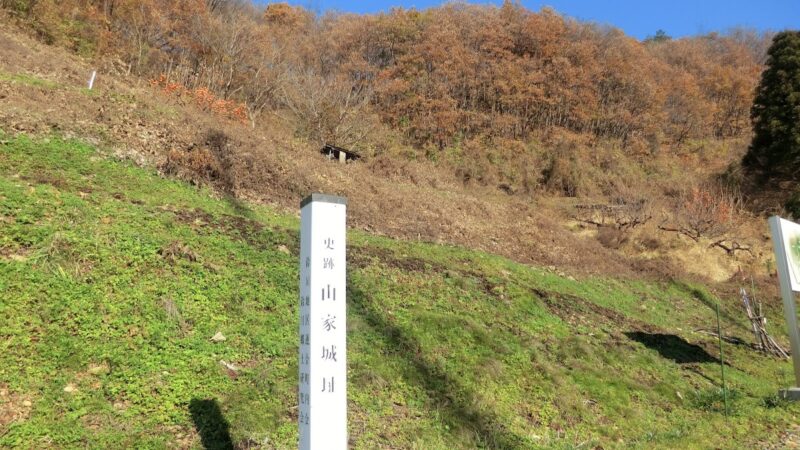
Yamaga Castle is a mountain castle located in Yamaga, Yamagata City, Yamagata Prefecture, dating from the medieval to early modern period. Built on a hill approximately 300 meters above sea level, it is situated in a strategic location overlooking the Mogami River basin.
Basic Information
- Location: Yamaga, Yamagata City, Yamagata Prefecture
- Castle Structure: Mountain Castle
- Construction Period: Late Muromachi Period (Late 15th to Early 16th Century)
- Main Lords: Yamaga Clan, Vassals of the Mogami Clan
- Abandonment Period: Early Edo Period
- Remains: Enclosures, Earthworks, Moats, etc.
- Designation: Yamagata City Designated Historic Site (Partial)
History of Yamaga Castle
Construction History and the Yamaga Clan
Yamaga Castle is believed to have been built in the late Muromachi period by the Yamaga clan, a local powerful family. The Yamaga clan, as local lords ruling this region, built their power base at Yamaga Castle.
The place name Yamaga has existed in this area since ancient times, occupying an important position as a transportation hub. The Yamaga clan secured economic and military advantages by establishing their castle in this location, which allowed them to control both the water transport on the Mogami River and the land routes.
Relationship with the Mogami Clan
During the Sengoku period (Warring States period), Yamaga Castle came under the influence of the Mogami clan, a powerful daimyo of Dewa Province. As Mogami Yoshiaki unified Dewa, Yamaga Castle was incorporated into the Mogami clan’s system of control.
Mogami Yoshiaki controlled most of Dewa Province from his base at Yamagata Castle, and Yamaga Castle functioned as one of his branch castles. In particular, Yamaga Castle is believed to have played a crucial role in the defense of the Mogami River basin and the securing of transportation routes.
Edo Period and Abandonment
Mogami Yoshiaki, who sided with the Eastern Army in the Battle of Sekigahara (1600), became a powerful daimyo with a domain of 570,000 koku after the war. However, the Mogami clan was dispossessed of their domain in 1622, and the Torii clan took over the Yamagata Domain.
During this period, the Edo Shogunate’s “One Castle Per Province” decree required each domain to abolish castles other than its main castle. It is believed that Yamaga Castle was also abandoned under this policy. After its abandonment, the castle site gradually became farmland and forest, remaining so to this day.
Structure and Characteristics of Yamaga Castle
Layout and Arrangement
Yamaga Castle has the typical structure of a medieval mountain castle. Multiple baileys (kuruwa) are arranged around the main enclosure (honmaru), separated by earthworks and moats, creating a defensive structure.
The castle is built on a long, narrow ridge of a hill running north-south, and its layout is characterized by its skillful use of the terrain. The baileys are continuously arranged along the ridge, and moats are constructed to cut across the ridge, preventing enemy intrusion.
Main Enclosure (Honmaru) Area
The main enclosure, the central part of Yamaga Castle, is located at the highest elevation within the castle grounds. Earthen ramparts surround the main enclosure, enhancing its defensive capabilities.
From the main enclosure, one can enjoy a panoramic view of the Mogami River basin and the surrounding plains, indicating its function as a military surveillance point. Furthermore, on clear days, Mount Gassan and the Asahi mountain range can be seen in the distance, making it a scenic location.
Enclosures
Several enclosures are arranged around the main enclosure. These enclosures functioned as secondary and tertiary enclosures, defending the main enclosure.
Each enclosure is arranged in a stepped pattern along the ridge, exhibiting a typical structure of a medieval mountain castle. The enclosures are clearly separated by steep slopes and earthen ramparts, allowing for multiple defensive lines and tiered defense.
Moats and Earthen Ramparts
The moats are particularly noteworthy defensive features of Yamaga Castle. A moat (horikiri) is a defensive structure created by artificially digging a trench through a ridge to block enemy incursions.
Multiple moats have been identified at Yamaga Castle, particularly strategically placed to prevent access to the main enclosure. These moats remain clearly visible as part of the terrain, making them valuable remains for understanding the castle’s defensive structure.
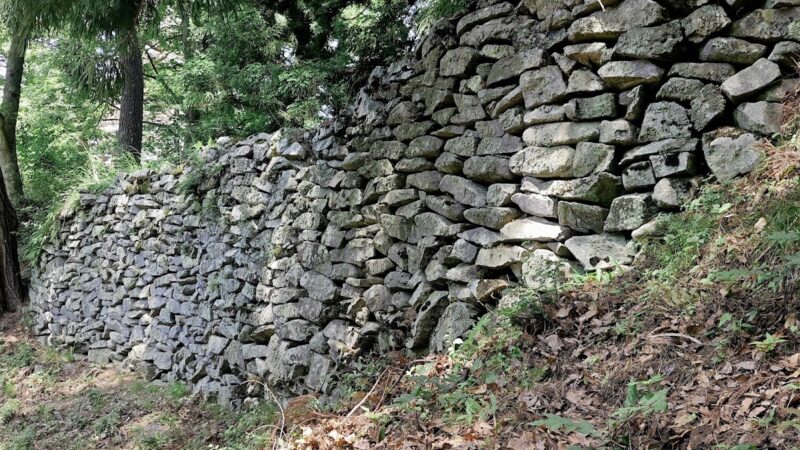
Earthworks (domu) were constructed around the baileys and near the entrances (koguchi), serving as defensive walls. Some of these earthworks remain in good condition today.
Entrances (Koguchi)
The entrances to the castle, known as koguchi, were considered weak points in defense and were therefore heavily fortified. The entrances at Yamaga Castle, with their earthworks and bailey layouts, are designed to prevent direct advances, demonstrating ingenuity in making enemy incursions difficult.
Current State of Yamaga Castle Site
Preservation Status of Remains
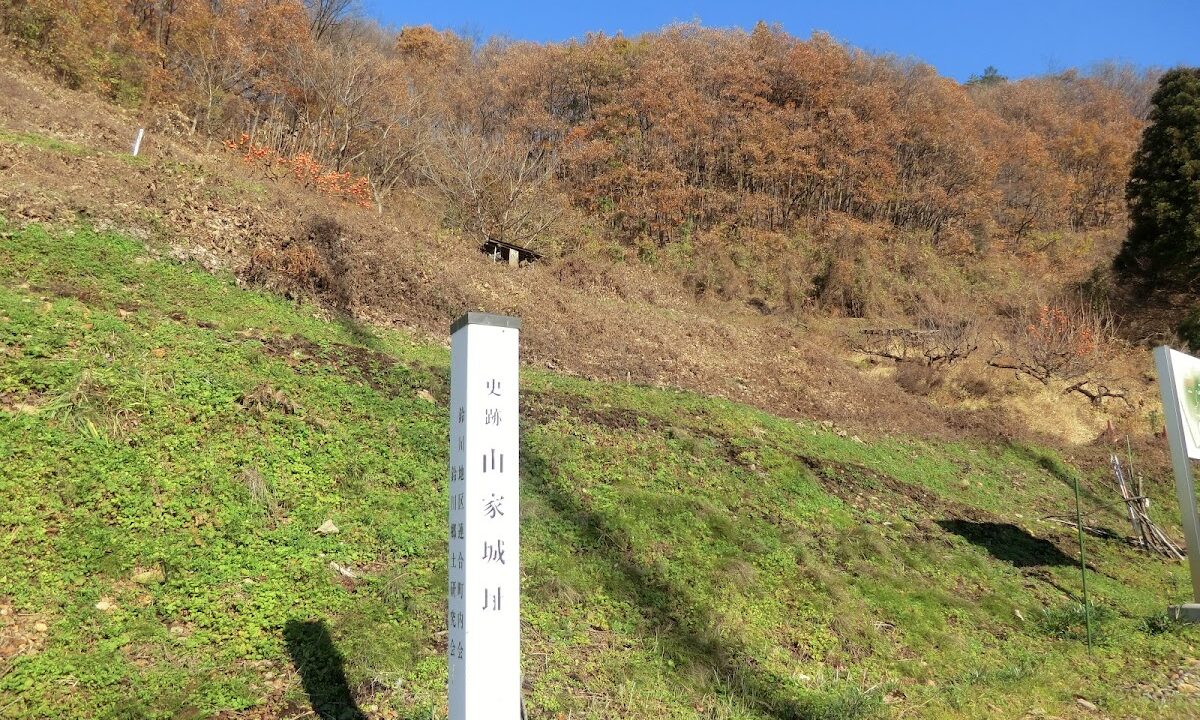
The Yamaga Castle site is currently covered by forest and some farmland, but the main remains are preserved in relatively good condition. In particular, the topography of the moats, earthworks, and baileys is clearly discernible, making it a valuable historical site for understanding the structure of medieval mountain castles.
Local history enthusiasts and researchers are conducting surveys, and efforts are underway to create layout maps and record the remains. However, in some areas, the remains are becoming unclear due to tree growth and weathering.
Points to Note When Visiting Yamaga Castle Ruins
The main points to note when visiting Yamaga Castle Ruins are as follows:
- Main Enclosure: This is the central part of the castle, where you can see the structure surrounded by earthen ramparts.
- Moat: Multiple moats remain in good condition, allowing you to experience the defensive structure.
- Enclosure Group: You can observe the arrangement of enclosures arranged in a stepped pattern.
- View: From the main enclosure, you can enjoy the scenery of the Mogami River basin.
- Earthen Ramparts: Some earthen ramparts remain clearly visible.
Maintenance Status and Precautions
Yamaga Castle Ruins have not undergone large-scale tourist development and are basically in their natural state. Therefore, please note the following points when visiting:
- Road to the Castle: There are sections where the path to the castle is not clearly maintained.
- Information Boards: Information boards on site are limited.
- Safety Precautions: Appropriate clothing and shoes are necessary due to uneven terrain.
- Season: In summer, vegetation is overgrown, making it difficult to see the remains.
- Pest Control: As it is a forest, insect repellent is recommended.
Access to Yamaga Castle
Access by Public Transportation
By JR:
- Get off at Yamagata Station on the JR Ou Main Line.
- Take a local bus or taxi from Yamagata Station.
- If taking the bus, take the Yamako Bus bound for “Yamaga” (approximately 30 minutes).
- After getting off at the “Yamaga” bus stop, it is approximately a 15-20 minute walk to the castle ruins entrance.
Note: Bus services are limited, so it is recommended to check the timetable in advance.
Access by Car
From Yamagata City Center:
- Use National Route 13 or a prefectural road
- Travel time: Approximately 20-30 minutes
- Navigation settings: Search for “Yamaga, Yamagata City”
If using the Tohoku Chuo Expressway:
- Approximately 15 minutes from Yamagata Chuo Interchange
Parking: There is no dedicated parking lot. You will need to find a place to park on the street or use a nearby public facility’s parking lot and access the site on foot. Please be considerate of local residents.
Related Historical Sites in the Surrounding Area
When visiting Yamaga Castle, we recommend also visiting the surrounding historical sites:
- Yamagata Castle Ruins (Kajo Park): The base of Mogami Yoshiaki (Yamagata City center)
- Mogami Yoshiaki Historical Museum: A facility where you can learn about the history of the Mogami clan (Yamagata City)
- Hasedo Castle Ruins: The site of a fierce battle during the Keicho Dewa Campaign (Hasedo, Yamagata City)
- Yamadera (Risshaku-ji Temple): A famous temple associated with Matsuo Basho (Yamadera, Yamagata City)
Historical Significance of Yamaga Castle
Position in Local History
Yamaga Castle is an important historical site for understanding the transition period from the medieval to the early modern period in Dewa Province. You can learn about the changes from local lords to the rule of Sengoku daimyo, and then to the shogunate system of the early modern period, through the changes in the castle’s structure.
In particular, as a castle controlling a key transportation and logistics hub in the Mogami River basin, it held economic and military importance. Yamaga Castle and its surrounding town played a crucial role in the distribution of rice and local products, as well as in the movement of people in this region.
Value in Castle Research
Yamaga Castle is a typical example of a medieval mountain castle in the Tohoku region and holds value in castle research. The remains, such as moats, earthworks, and the layout of baileys, are relatively well-preserved, making it valuable material for studying medieval castle construction techniques and defensive philosophies.
In particular, the clever use of terrain in its layout and the concept of phased defense demonstrate the wisdom of medieval castles that sought to achieve effective defense with limited resources.
Investigation and Research of Yamaga Castle
Previous Investigations
Investigations of Yamaga Castle have been conducted by local historians and castle researchers. Through layout surveys and measurements, the castle’s structure is gradually being revealed.
In recent years, surveys using cutting-edge technologies such as aerial laser surveying (LiDAR) have been considered, and it is expected that more detailed understanding of the remains will be achieved.
Future Challenges
The following challenges exist regarding the preservation and utilization of Yamaga Castle:
- Preservation of the remains: Measures to address deterioration of the remains due to natural weathering and tree growth
- Promotion of research: The need for more detailed archaeological excavations and documentary research
- Maintenance and utilization: Balancing visitor safety with the preservation of the remains
- Public awareness: Raising awareness of the historical value among local residents and tourists
- Excavation of documentary materials: Research of historical materials such as ancient documents related to Yamaga Castle
Preparations for Visiting Yamaga Castle
Clothing and Equipment
The following preparations are recommended when visiting the Yamaga Castle ruins:
- Clothing: Long-sleeved shirt and long pants (to protect from vegetation and insects)
- Shoes: Trekking shoes or athletic shoes (non-slip)
- Hat: To protect the head from the sun and branches
- Gloves: Useful when pushing aside vegetation
- Drinking Water: Essential, especially in summer
- Insect Repellent Spray: Recommended from spring to autumn
- Rain Gear: Prepare for sudden changes in weather
Best Time to Visit
The best time to visit Yamaga Castle Ruins is:
- Spring (April-May): Season of fresh greenery and pleasant weather
- Autumn (October-November): Beautiful autumn foliage and fewer insects
- Winter (December-March): The vegetation is withered, making the ruins easier to see, but be careful of snowfall
Time to Avoid:
- Summer (July-August): Overgrown vegetation makes the ruins difficult to see, and there are many insects
Estimated Time Required
Please allow the following time for visiting Yamaga Castle Ruins:
- Short Visit: 30 minutes-1 hour (main enclosure area only)
- Standard Visit: 1-2 hours (a thorough tour of the main ruins)
- Detailed Tour: 2-3 hours (Detailed tour of all baileys and moats)
History and Culture of the Yamaga District
Origin of the Name Yamaga
The place name “Yamaga” has existed since ancient times and is thought to mean a settlement in the mountains. It is believed that the topography, surrounded by mountains despite being in the Mogami River basin, is the origin of this name.
Local Industry and Life
Historically, the Yamaga district was a region centered on agriculture. Goods were transported using the Mogami River, and it also played a role as a transit point connecting the inland and coastal areas.
In modern times, while also serving as a commuter town for Yamagata City, efforts to preserve agriculture and local traditions continue.
Yamaga Castle and Mogami Yoshiaki
Mogami Yoshiaki’s Unification of Dewa Province
Mogami Yoshiaki (1546-1614) was a Sengoku daimyo who ruled Dewa Province from the Sengoku period to the early Edo period. Yoshiaki unified most of Dewa Province through skillful diplomacy and military power.
Yamaga Castle was positioned as one of the branch castles within Yoshiaki’s system of rule, centered around Yamagata Castle. It held strategic importance in the defense of the Mogami River basin and securing transportation routes.
The Keicho Dewa Campaign and Yamaga Castle
In parallel with the Battle of Sekigahara in 1600, the Keicho Dewa Campaign unfolded in Dewa Province. Uesugi Kagekatsu’s forces invaded Mogami territory, and Mogami Yoshiaki met them head-on.
While there are no records confirming Yamaga Castle was a direct battlefield, it is possible that it played a certain role in this campaign as a defensive base in the Mogami River basin.
Summary
Yamaga Castle is a historically important mountain castle located in Yamagata City, Yamagata Prefecture, dating from the medieval to early modern period, situated at a strategic point in the Mogami River basin. Built by the Yamaga clan in the late Muromachi period, it came under the control of the Mogami clan during the Sengoku period and was abandoned in the early Edo period.
Even today, the remains of moats, earthworks, and baileys are relatively well-preserved, making it a valuable historical site for understanding the structure of medieval mountain castles. While large-scale tourism development hasn’t taken place, requiring proper preparation for a visit, it’s a worthwhile castle site for history enthusiasts.
Yamaga Castle holds an important position in understanding the history of Yamagata City and the Mogami clan’s rule. Visiting it along with other historical sites such as Yamagata Castle will allow for a deeper understanding of the historical changes in this region from the Sengoku period to the Edo period.
Why not take a stroll through the Yamaga Castle ruins, surrounded by nature and reflecting on its past history?