

Komatsu Castle (Kawanishi Town, Yamagata Prefecture) Complete Guide: The Full Picture of a Medieval Castle Marking the History of the Date Clan
Located in Kawanishi Town, Higashiokitama District, Yamagata Prefecture, Komatsu Castle was a castle that functioned as an important branch castle of Yonezawa Castle from the medieval period to the Sengoku period. Currently, remains of the castle are preserved within the grounds of Shinzan Shrine and around Butsujo-ji Temple, making it a valuable historical site that conveys the history of the Date clan. This article provides a detailed introduction to Komatsu Castle, including its history, structure, highlights, and access information.
History of Komatsu Castle: From the Kamakura Period to the Date Clan’s Rule
Founding and Early History
The history of Komatsu Castle dates back to the Kamakura period. It is believed to have been founded by Funayama Inaba-no-kami, a vassal of the Nagai clan, and was built at a strategic transportation hub where the Echigo Road and the Nagai Road intersected. This location held significant military and economic importance, and it developed into a key castle in the Okitama region.
During the Sengoku period (Warring States period), Komatsu Castle, as a branch castle of Yonezawa Castle, came to play an important role within the sphere of influence of the Date clan. Omachi Shuri-no-suke Sadatsugu, a retainer of the Date clan, resided there as the castle lord and used it as a base for governing the territory. Later, Kuwori Harima-no-kami Kagenaga and Makino Danjo Hisanaka also served as castle lords, and the castle remained under the control of the Date clan’s retainers.
The Genki Incident (Battle of Komatsu Castle)
The most important event in the history of Komatsu Castle is the “Battle of Komatsu Castle,” also known as the “Genki Incident,” which occurred in 1570. This battle was triggered by a power struggle within the Date clan.
The then-lord of the castle, Makino Danjo Hisanaka, along with his father Nakano Munetoki and Nitta Yoshinao, rebelled against Date Terumune and holed up in Komatsu Castle. This rebellion had a significant impact as an internal conflict within the Date clan, and Komatsu Castle became the stage for fierce battles. Ultimately, Date Terumune’s side emerged victorious, and the rebellion was suppressed. However, this incident marked a significant turning point in the history of the Date family.
Abandoned Castle and Present Day
In 1591, when Date Masamune was transferred to Iwadeyama (present-day Osaki City, Miyagi Prefecture) by order of Toyotomi Hideyoshi, Komatsu Castle also ceased to function and was abandoned. Although it lost its function as a castle, the remains have been preserved in relatively good condition to this day, allowing us to imagine its former appearance.
Structure and Characteristics of Komatsu Castle
Castle Layout and Arrangement
Komatsu Castle was built as a hilltop castle, characterized by its layout that skillfully utilized the terrain. According to the “Yamagata Prefecture Medieval Castle Site Survey Report, Volume 1 (Okitama Region),” published by the Yamagata Prefectural Board of Education in 1995, the castle consisted of multiple baileys (kuruwa), and its design emphasized defensiveness.
The main remains are concentrated around the present-day Shinzan Shrine and north of Butsujo-ji Temple. The castle’s central structure consisted of the main keep (Honmaru), surrounded by the second and third baileys (Ninokuruwa and Sannomaru). Built at a strategic location controlling the intersection of the Echigo and Nagai roads, its design balanced traffic monitoring and defense.
Remains of Earthworks and Watchtower Bases
The greatest highlights of Komatsu Castle are the remaining earthworks and watchtower bases. The earthworks maintain considerable height, giving a real sense of the scale of the defensive structures at the time. In particular, the watchtower base, believed to have been used as a lookout post, is situated on a high vantage point overlooking the surrounding area, highlighting its military importance.
Observing the structure of the earthworks reveals careful construction using rammed earth techniques. Its ability to withstand hundreds of years of wind and rain demonstrates the high level of civil engineering at the time. While the height of the earthworks varies depending on the location, the highest points reach over 3 meters, still maintaining its imposing defensive appearance.
Otemon Gate Ruins and Koguchi (Fortified Entrance)
The Otemon Gate ruins, the main entrance to the castle, are also an important historical site. Located north of Butsujo-ji Temple, the Otemon Gate ruins show traces of stonework and changes in the terrain, allowing us to estimate the size of the former castle gate. The structure of the Koguchi (fortified entrance) also reflects a defensive design, with various features to prevent enemy intrusion visible throughout.
Komatsu Castle Highlights and Visitor Guide
Shinyama Shrine and Castle Ruins
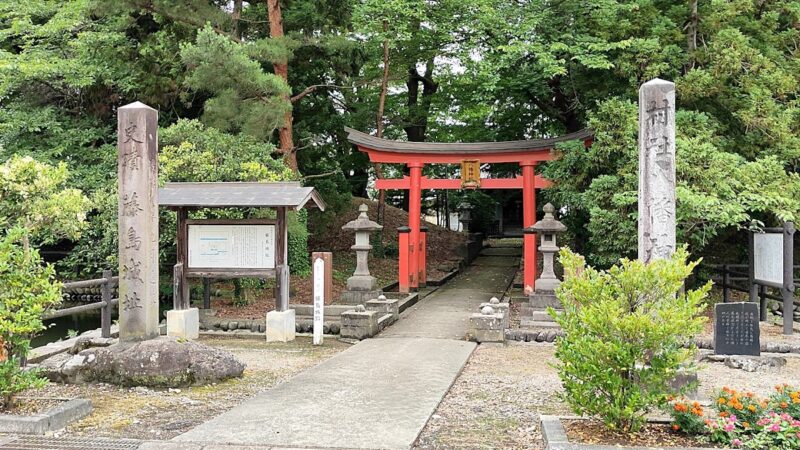
Currently, Shinyama Shrine stands on the site of the former Komatsu Castle’s main keep. The shrine grounds are integrated with the castle ruins, making it a valuable place to explore the castle ruins while paying respects. From the shrine grounds, you can enjoy a panoramic view of Kawanishi town, allowing you to imagine the scenery seen by the former castle lords.
Shinyama Shrine is also a center of local faith, and various festivals are held throughout the year. The spring grand festival, in particular, attracts many visitors, offering a unique atmosphere where history and faith are intertwined.
Historical Remains Around Butsujo-ji Temple
Located south of Shinzan Shrine, Butsujo-ji Temple is home to a concentration of historical remains, including the site of the main gate, earthworks, and moats. Castle remains can be observed from within the temple grounds, creating a unique landscape where the temple and castle coexist.
When exploring the area, pay attention to the topography. You can observe the ingenious use of natural terrain in the castle’s layout, as well as the remains of artificially constructed flat areas (kuruma). In particular, breaks in the earthworks and differences in elevation provide important clues to understanding the castle’s structure at the time.
Surrounding Historical Environment
The area around Komatsu Castle is dotted with historical sites that tell the story of Kawanishi Town. The Shimokomatsu Kofun Cluster is a large group of burial mounds consisting of 200 tombs, demonstrating the importance of the Okitama region during the Kofun period. Furthermore, the Tenjinmori Kofun, with a total length of 75.5 meters, is one of the largest keyhole-shaped burial mounds in Yamagata Prefecture.
The Komatsu area is currently developing as the central area of Kawanishi Town, with a concentration of public facilities such as JR Uzen-Komatsu Station, Kawanishi Town Hall, and Kawanishi Town Friendly Plaza. You can understand the historical background of Komatsu Castle while strolling through the townscape where history and modernity coexist.
Access and Tourist Information
Transportation Access
Access by Train
- Get off at JR Yonesaka Line “Uzen-Komatsu Station,” approximately 15 minutes on foot.
- Uzen-Komatsu Station is known as the first town-resident station in Japan and is a beloved station in the community.
Access by Car
- Approximately 15 minutes from Tohoku Chuo Expressway “Yonezawa Chuo IC.”
- Accessible via National Route 287.
- Parking available near Shinzan Shrine (limited number of spaces).
Precautions for Visiting
Since the Komatsu Castle ruins are located within and around the grounds of Shinzan Shrine, please observe proper etiquette when visiting. The remains, such as the earthworks, are valuable cultural assets, so please be careful not to climb on them or damage them. The best time to visit is from spring to autumn, especially during the seasons of fresh greenery and autumn leaves, when you can enjoy beautiful scenery. In winter, snow makes it difficult to see the ruins, so we recommend visiting during the warmer seasons.
Nearby Tourist Facilities
Kawanishi Town Friendly Plaza
As a town cultural facility, it has a library and hall. You can also view materials related to the history of Komatsu Castle and Kawanishi Town.
Kawanishi Forest Marche
This is a direct sales market for agricultural products in Kawanishi Town, where you can purchase fresh local vegetables and specialty products. It’s also an ideal rest stop for tourists.
Hot Spring Facilities
The Komatsu area has inns and hot spring facilities where you can relax and unwind after exploring the castle ruins.
The Relationship Between Komatsu Castle and the Date Clan
The Okitama Region under the Rule of the Date Clan
Komatsu Castle played an important role in the Date clan’s rule over the Okitama region. For the Date clan, whose main base was Yonezawa Castle, Komatsu Castle functioned as a forward base to prepare for invasions from the Echigo region and as a center for governing their territory.
Among the Date clan’s retainers, the lord of Komatsu Castle was considered an important post, and influential retainers such as Omachi Shuri-no-suke Sadatsugu and Kuwori Harima-no-kami Kagenaga were appointed to this position. Kuwori Kagenaga, in particular, is the person after whom the town of Kuwori in Fukushima Prefecture is named, demonstrating his importance within the Date family.
The Genki Incident Reveals the Internal Situation of the Date Clan
The Battle of Komatsu Castle in 1570 (Genki 1) is a crucial event for understanding the power structure within the Date clan. The rebellion of Makino Hisanaka and others was not merely a personal conflict, but also a resistance to the reorganization of the retainer group and the centralization of power during the reign of Date Terumune.
Following this incident, Date Terumune strengthened his control over his retainers, laying the foundation for the powerful military force that would later be established during the era of Date Masamune. Komatsu Castle was a crucial historical stage in the development of the Date clan.
Cultural Value of Komatsu Castle
Position in the Study of Medieval Castles in Yamagata Prefecture
Komatsu Castle is one of the castles thoroughly investigated in the “Yamagata Prefecture Medieval Castle Site Survey Report.” While many medieval castles exist in the Okitama region, Komatsu Castle is considered highly valuable for research due to its well-preserved remains and relatively abundant historical documents.
It is also counted as one of the “Forty-Eight Castles of Okitama under the Date Clan,” making it indispensable for understanding the castle network under the rule of the Date clan. The remains, such as earthworks and watchtower bases, provide valuable information about the castle construction techniques and defensive philosophies of the time.
Historical Significance in the Region
For Kawanishi Town, Komatsu Castle is an important element in forming the town’s historical identity. The development of the Komatsu district, the current town center, is rooted in its history as a transportation hub since the Middle Ages.
The history of Komatsu Castle is taught as part of local history education in elementary schools, providing children with a place to learn about local history. Furthermore, preservation activities are being carried out by local residents, and efforts to pass on the value of the site as a cultural asset to future generations continue.
How to Enjoy Visiting Komatsu Castle
Historical Walking Course
We introduce a historical walking course centered around the Komatsu Castle ruins.
- Start at JR Uzen-Komatsu Station: Check out the history of Japan’s first town-run station
- Around Kawanishi Town Hall: Stroll through the current town center
- Shinzan Shrine: Experience the heart of the castle at the site of the main keep
- Around Butsujo-ji Temple: Observe the remains such as the main gate and earthworks
- Shimo-Komatsu Tumulus Cluster (if time permits): Experience the continuity of history from ancient times
This course can be completed on foot in about 2 hours.
Photography Tips
The Komatsu Castle ruins are also a great spot for photography. There are various photo opportunities, such as the beautiful curves of the earthworks, the combination of the Shinzan Shrine building and the ruins, and the view from the turret base. The silhouette of the earthworks, especially when photographed against the backlight at dusk, is fantastic and makes for great photos perfect for social media.
In spring, cherry blossoms adorn the castle ruins, and in autumn, the autumn leaves create a beautiful landscape that can be enjoyed throughout the seasons. However, please be considerate of worshippers when taking photos within the shrine grounds.
Local Food and Culture
After exploring Komatsu Castle, let’s enjoy the food culture of Kawanishi Town. The Okitama region is known as a rice-producing area, and delicious rice and sake are local specialties. At “Kawanishi Mori no Marche,” you can purchase local agricultural products and processed goods, experiencing the rich food culture of Kawanishi Town.
Current Status and Future Prospects of Komatsu Castle Research
Progress of Excavation and Research
Regarding Komatsu Castle, research has continued since the investigation by the Yamagata Prefectural Board of Education. In recent years, advances in surveying technology have made it possible to create more detailed layout maps, deepening our understanding of the castle’s structure.
Further archaeological excavations could reveal more about the castle’s true nature than what can be understood from historical documents alone. In particular, the discovery of building remains and traces of daily life would provide concrete clues to understanding life within the castle at that time.
Efforts for Preservation and Utilization
In Kawanishi Town, efforts are underway to preserve and utilize the Komatsu Castle ruins. These efforts include not only the proper management of the remains, but also the creation of an environment that makes it easy for visitors to learn about history, such as the installation of information boards and the development of walking paths.
Attempts have also begun to utilize Komatsu Castle as a regional historical resource to promote tourism and education. It is hoped that these efforts will contribute to regional revitalization by conveying its appeal not only to history buffs and castle enthusiasts, but also to general tourists.
Summary: Komatsu Castle Tells the History of Okitama
Komatsu Castle in Kawanishi Town, Yamagata Prefecture, is a castle that has witnessed approximately 400 years of history, from its founding in the Kamakura period to the turbulent Sengoku period and finally to its abandonment. Serving as an important branch castle of the Date clan and the stage for the historical event known as the Genki Incident, this castle is indispensable for understanding the medieval history of the Okitama region.
The remaining earthworks and watchtower foundations are valuable historical relics that convey the castle-building techniques and defensive philosophies of the time, and are also connected to local faith in the form of the Shinzan Shrine grounds. Its strategic location as a transportation hub remains unchanged, and the Komatsu area continues to develop as the center of Kawanishi Town.
Visiting Komatsu Castle ruins is not simply about viewing ruins; it’s about experiencing the history of the Date clan, the medieval period of the Okitama region, and the region’s development up to the present day. We encourage history enthusiasts and all visitors to Yamagata Prefecture to visit this historically rich castle site.
Spend time feeling the spirit of the Middle Ages at Komatsu Castle ruins, where the rich nature and history of Kawanishi Town blend together.

跡--800x450.png)