Ao Castle (Himi City, Toyama Prefecture) – A Thorough Explanation of the Cliffside Sea Castle and its Connection to Maeda Keiji
What is Ao Castle? – A Natural Fortress Floating in Toyama Bay
Ao Castle is the site of a Sengoku period mountain castle located in Shimao, Ao, Himi City, Toyama Prefecture. Built on Jogasaki, an isolated hill (approximately 38 meters above sea level) jutting out into Toyama Bay, it is surrounded by the sea with cliffs exceeding 30 meters in height on its east and south sides, making it a truly natural fortress.
It has many other names, including Himi Castle, Ao Castle, Aose Castle, Aono Castle, Eien Castle, Awa Castle, Aso Castle, Isobe Castle, and Iwasaki Castle, all attesting to its importance in this region. It is currently a designated historical site of Toyama Prefecture and has been selected as Toyama Castle Card No. 35.
Located at a crucial point on the road connecting Etchu and Noto provinces, and a vital hub for maritime traffic, Ao Castle served as a vital base for controlling Etchu during the Sengoku period, becoming the stage for battles fought by renowned warlords such as Oda Nobunaga, Uesugi Kenshin, Sassa Narimasa, and Maeda Toshiie.
History of Ao Castle – From the Kikuchi Clan to the Maeda Clan
Construction and the Kikuchi Clan Era
The exact construction date of Ao Castle is unclear, but it is believed to be around the mid-16th century. Historical records mention Kikuchi Takekatsu and his son Yasunobu, descendants of the Higo Kikuchi clan, as castle lords during the Tensho and Bunroku periods (1573-1592).
The Kikuchi clan was a prominent family in Higo Province, Kyushu, but due to the turmoil of the Sengoku period, they moved to Etchu and established their castle in Ao. The terrain, facing the sea and backed by mountains, was ideal for castle construction, and the Kikuchi clan leveraged this natural fortification to build their power.
Caught Between Oda Nobunaga and Uesugi Kenshin
During the late Sengoku period, Etchu Province became the front line of fierce conflict between the forces of Oda Nobunaga and Uesugi Kenshin. Aio Castle was also caught up in this conflict, and its lord, the Kikuchi clan, is believed to have initially sided with the Uesugi.
After the death of Uesugi Kenshin, the balance of power in Etchu changed dramatically, and Sasa Narimasa, a vassal of Oda Nobunaga, expanded his control over the province. During this process, Aio Castle also gained prominence as an important strategic base.
The Battle of Aio Castle in 1584
The most important event in the history of Aio Castle is the Battle of Aio Castle, which took place in 1584. This battle occurred amidst the conflict between Sasa Narimasa and Maeda Toshiie.
According to the “Suemori-ki,” a document passed down through the Maeda family, Sasa Narimasa attacked Aio Castle, but Maeda Toshiie repelled him and achieved victory. Records indicate that after this battle, Maeda Toshiie allowed Maeda Keijiro (Maeda Keiji) and others to enter Ao Castle.
It is believed that the castle’s cliffside terrain greatly contributed to its defense during this battle, preventing Sassa Narimasa’s forces from advancing. Ao Castle is known as a castle “with no history of being captured,” and this battle proved its formidable strength.
Maeda Keiji and Ao Castle
Indispensable to understanding the history of Ao Castle is the presence of Maeda Keijiro (Maeda Keiji). Maeda Keiji, known as the protagonist of the popular manga “Hana no Keiji,” served as a samurai general for the Maeda family in the Himi and Noto regions before becoming famous throughout Japan as a kabuki actor.
After the Battle of Ao Castle in 1584 (Tensho 12), Keiji entered Ao Castle as its castellan and governed the area. The experience at Ao Castle, which was strategically referred to as the “Capital of Etchu,” is believed to have greatly influenced Keiji’s later development as a military commander.
While detailed records of Keiji’s life and governance at Ao Castle are scarce, this Himi area remains an important site associated with Keiji, attracting many history enthusiasts today.
Abandonment of the Castle and its Aftermath
After Toyotomi Hideyoshi’s unification of Japan, Etchu became stable under the Maeda clan, and the military importance of Ao Castle declined. In the Edo period, Ao Castle was abandoned, and the castle ruins were converted into farmland.
Currently, a shrine called Shiramine-sha stands on the castle site, along with a lighthouse and observation deck. While some of the castle’s remains have been destroyed by these later uses, it remains an important historical site that still retains traces of its former glory.
Structure and Layout of Ao Castle
Overall Layout
Ao Castle was a coastal castle utilizing an entire isolated hill jutting out into Toyama Bay. The castle ruins are broadly divided into three baileys: the presumed main bailey, the presumed second bailey, and the presumed third bailey.
The east and south sides of the castle face sheer cliffs overlooking the sea, easily exceeding 30 meters in height. This overwhelming topographical advantage made attacks from the sea virtually impossible. The western side, bordering the land, also had a steep slope, making it an extremely difficult fortress to attack.
Main Bailey (Presumed Site of the Main Bailey)
The main bailey is located at the highest point of the castle, and currently a lighthouse and observation deck stand there. According to tradition, a watchtower was built in the main bailey, from which one could monitor maritime traffic in Toyama Bay and overlook the road to Noto.
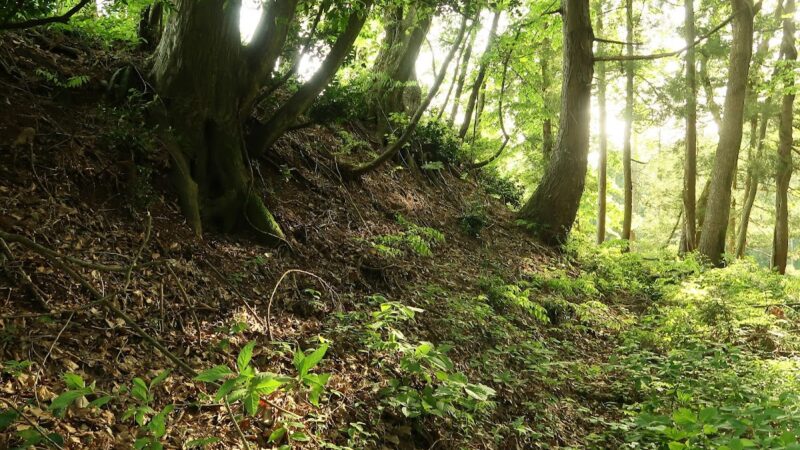
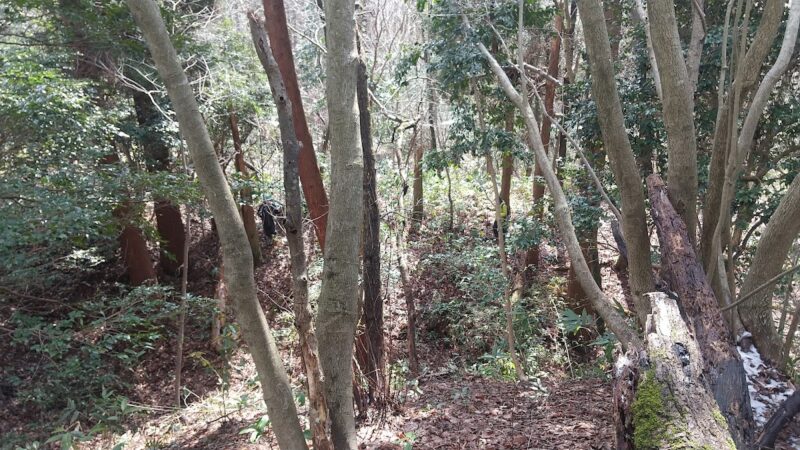
Traces of earthworks can be seen around the main bailey, and some of the defensive facilities from that time remain. However, due to the use of the land for farming and the construction of shrines after the castle was abandoned, much of the remains have been destroyed.
Second and Third Baileys
The second and third baileys were located on the west side of the main bailey, on the side adjacent to the land. These baileys are thought to have functioned as a defensive line against attacks from the land.
Currently, much of the area is farmland or residential land, making it difficult to clearly confirm the remains, but the layout of the baileys at the time can be inferred from the topography.
Moats and Defensive Structures
A moat (dry moat) was constructed on the west side, which was connected to the land, serving as an important defensive structure to prevent enemy intrusion. Traces of the moat can still be seen in some places today, providing clues to the defensive system at the time.
Earthworks also remain, mainly around the main bailey, providing valuable information for understanding the castle’s defensive structure.
Defensive Power of Sheer Cliffs
The most distinctive feature of Ao Castle is undoubtedly the sheer cliffs on the east and south sides. The sheer cliffs, reminiscent of an aircraft carrier of the old Imperial Japanese Navy, functioned as a natural fortress, completely blocking attacks from this direction.
This geographical advantage is the main reason why Ao Castle is known as a “castle that has never been captured,” and it was also the factor that allowed it to repel the attack of Sasa Narimasa.
Highlights of Ao Castle
Spectacular Views from the Cliffs
The greatest highlight of a visit to Ao Castle is undoubtedly the sheer cliffs on the east and south sides. The view of Toyama Bay from the castle ruins is breathtaking, and the sight of the vertical cliffs, over 30 meters high, plunging into the sea, evokes a sense of the fusion of natural beauty and the castle-building techniques of the Sengoku period.
Especially on a clear day, you can enjoy the view of the blue sea of Toyama Bay and the Tateyama mountain range simultaneously, truly appreciating the beauty of this scenic spot, which Otomo no Yakamochi described as “a place where the east wind blows strongly.”
View from the Observation Deck
From the observation deck located on the site of the main keep, you can enjoy a 360-degree panoramic view. To the north lies the Noto Peninsula, to the east Toyama Bay and the Tateyama mountain range, and to the west Himi city, allowing you to appreciate the strategic importance of this location as a transportation hub between Etchu and Noto.
The observation deck is designed to preserve the atmosphere of the castle ruins, harmonizing historical scenery with modern tourist facilities.
Shiramine Shrine
A shrine called Shiramine Shrine stands on the site of the main keep. This shrine is cherished as a place of worship for the local community, creating an interesting space where the historical and religious value of the castle ruins coexist.
Remains such as earthworks can be seen around the shrine, allowing you to enjoy both worship and exploring the castle ruins simultaneously.
Remains of Earthworks and Moats
Although much has been lost due to development after the castle’s abandonment, remains of earthworks remain, mainly around the main keep. Traces of moats can also be seen in the land contiguous area to the west, providing insight into the defensive facilities of the time. These historical remains are well-maintained with information boards, making them a must-see for castle enthusiasts.
The History of Lighthouses and Maritime Traffic
The lighthouse built on the main keep serves as a facility that ensures the safety of maritime traffic in modern times. However, its history overlaps with that of the Sengoku period, when maritime traffic was monitored from this location, creating a sense of continuity across time.
From the area around the lighthouse, one can observe ships traversing Toyama Bay, offering the pleasure of imagining what the Kikuchi and Maeda clans once saw from this spot.
Access and Visit Information
Location
Shimao, Ao, Himi City, Toyama Prefecture
Transportation Access
Access by Car:
- Approximately 10 minutes from Himi Kita IC on the Nōetsu Expressway
- Parking: Several parking spaces available near the castle ruins
Public Transportation:
- Approximately 15 minutes by bus from Himi Station on the JR Himi Line, get off at the Ao bus stop, then approximately 10 minutes on foot
- Taxi available from Himi Station (approximately 15 minutes)
Visiting Information
- Visiting Hours: Open at all times
- Admission Fee: Free
- Estimated Time Required: Approximately 30-40 minutes
- Restrooms: Public restrooms available nearby
- Information Boards: Located at the castle ruins entrance and key points
Precautions During Visits
- Caution Regarding Cliffs: The east and south sides are extremely dangerous cliffs. Please be especially careful if you are with children, as there are areas without fences.
- Watch your step: The castle ruins are uneven and some areas are slippery. We recommend wearing comfortable shoes.
- Check the weather: As it is located along the coast, it is dangerous in strong winds or bad weather. Visiting on a sunny day is preferable.
- Respect for the shrine: Shiramine Shrine is a place of worship for the local community. Please be considerate of other visitors and maintain quiet.
Recommended Time to Visit
- Spring (April-May): Beautiful fresh greenery and mild weather, ideal for sightseeing.
- Autumn (October-November): Stunning autumn foliage and views of Toyama Bay.
- Winter: Beautiful snow-covered Tateyama mountain range on clear days, but beware of strong winds.
- Summer: Pleasant sea breeze, but strong sunlight requires a hat and sun protection.
Nearby Tourist Attractions
Himi City Center
Himi city center, about a 10-minute drive from Aio Castle, is home to Himi Fishing Port and Himi Onsenkyo (hot spring resort). Himi’s winter yellowtail is particularly famous nationwide, and you can enjoy fresh seafood during the winter months.
Himi City Museum
A facility where you can learn about Himi’s history and culture, including exhibits related to Aio Castle. Visiting before or after your castle visit will allow you to understand the history more deeply.
Castle Ruins in the Noto Region
Aio Castle was a strategic point connecting Etchu and Noto, so many castle ruins are scattered throughout the Noto region. Visiting castle ruins related to the Sengoku period’s rule of Noto, such as Nanao Castle and Anamizu Castle, is highly recommended.
Historical Walking Trail of the Manyoshu
As a place associated with Otomo no Yakamochi, Himi has numerous historical sites related to the Manyoshu (Collection of Ten Thousand Leaves). The area around Aio is also the setting for poems composed by Yakamochi, making it enjoyable to combine sightseeing with a Manyoshu historical walking trail.
Cultural Value of Aio Castle
Importance as a Toyama Prefecture Designated Historic Site
Aio Castle ruins are protected as a Toyama Prefecture designated historic site, an important historical heritage within the prefecture. As the remains of a Sengoku period coastal castle and a valuable historical site that tells the history of the rule of Etchu, it holds high academic value.
Toyama Castle Card
Aio Castle is selected as Toyama Castle Card No. 35 and is recognized as one of the representative castles in Toyama Prefecture. Castle cards are available at tourist facilities in Himi City and are popular as collectibles.
A Site Associated with Maeda Keiji
For fans of “Hana no Keiji,” Aio Castle is a sacred site. The historical fact that Keiji served as the castle lord gives this castle site special value. It is also an important cultural spot visited by history and manga fans.
Aio Castle’s Rating and Reviews
According to castle enthusiasts, the average rating is around ★★★☆☆ (2.88 points). While the state of the remains is not necessarily good, the cliff topography, the spectacular view of Toyama Bay, and the historical romance associated with Maeda Keiji are highly valued.
Visitors often express awe at the sheer scale of the cliffs, the magnificent view of Toyama Bay, and the profound emotion of visiting a place associated with Maeda Keiji. However, some have noted a lack of remaining structures and the need for more comprehensive information boards, suggesting future improvements are anticipated.
The average visit takes approximately 30-40 minutes, making it an easily accessible castle site and a suitable addition to any Himi sightseeing itinerary.
Summary – The Charm of Aio Castle
Aio Castle, a coastal castle utilizing its dramatic topography of cliffs jutting out into Toyama Bay, is a valuable historical site that conveys the castle-building techniques and strategic thinking of the Sengoku period.
Originating as the residence of the Kikuchi clan, it played a crucial role in the conflict between Oda Nobunaga and Uesugi Kenshin, and demonstrated its true value as an impregnable fortress during the conflict between Maeda Toshiie and Sassa Narimasa. The fact that Maeda Keiji served as its castle lord adds a special romantic element to this castle.
Although the remaining structures are limited, the sheer cliff topography, the breathtaking views of Toyama Bay and the Tateyama mountain range, and the historical romance of the Sengoku period continue to captivate visitors.
When you visit Himi, be sure to stop by Ao Castle, the “castle that has never been conquered,” and experience the view that the Sengoku warlords once saw. Standing on the cliff, feeling the breeze from Toyama Bay, and reflecting on the historical drama that unfolded in this very place will surely be an unforgettable experience.