Akamaru Castle (Takaoka City) Complete Guide | History and Highlights of Toyama Prefecture’s Leading Medieval Mountain Castle
What is Akamaru Castle?
Akamaru Castle is a medieval mountain castle located in Maidani, Fukuoka-machi, Takaoka City, Toyama Prefecture. Also known as “Jogahira Castle,” it is known as a full-fledged Sengoku period mountain castle built around the summit of Jogahira Mountain (174 meters above sea level).
It is designated as a Takaoka City Historic Site and is also featured in the “Toyama Castle Card” No. 32. It is a valuable historical site attracting attention from castle researchers due to the rare presence of ridged vertical moats (unejo tatebori) in Toyama Prefecture.
History of Akamaru Castle
As the Residence of the Nakayama Clan
Akamaru Castle was the residence of the Nakayama clan, who held power centered around Goinosho. It is said that the Nakayama clan originally used the nearby Asai Castle as their main base, but during the turmoil of the Sengoku period, they are believed to have built Akamaru Castle as a new base.
The Nakayama clan were powerful local lords in Etchu Province, and they constructed a mountain castle that boasted the largest scale and greatest defensive capabilities in the Goisho area. Their castle construction techniques were cutting-edge for the time, and the complex layout and robust defensive structures demonstrate the Nakayama clan’s high military and economic power.
Relationship with Uesugi Kenshin
During the Sengoku period, Etchu Province was incorporated into the sphere of influence of Uesugi Kenshin. There are various theories regarding the relationship between the Nakayama clan and Uesugi Kenshin, but one theory suggests that the Nakayama clan was destroyed by Uesugi Kenshin.
As Uesugi Kenshin advanced his pacification of Etchu Province, he either subjugated local lords in various regions or suppressed any resisting forces. It is highly likely that Akamaru Castle also came under the influence of the Uesugi clan during this process.
The Era of Sasa Narimasa and the Abandonment of the Castle
After the Honnō-ji Incident in 1582, Sasa Narimasa came to rule Etchū Province. As a vassal of Oda Nobunaga, Sasa Narimasa was entrusted with the entire province of Etchū, but due to his conflict with Toyotomi Hideyoshi, he was forced to leave Etchū in 1585.
It is believed that the Nakayama clan was also driven out of the castle at this time. After Sasa Narimasa left Etchū, Maeda Toshiie came to rule Etchū, and it is thought that Akamaru Castle was abandoned. Afterward, the castle was not used, and its remains were left in the natural environment.
Scale and Structure of Akamaru Castle
Main Enclosure and Group of Enclosures
The main enclosure of Akamaru Castle is built on the summit of Jōgahira Mountain. Centered around the main enclosure, multiple baileys (kuruma) are arranged in a stepped pattern along the mountain slope, making it the largest of its kind in the medieval Goisho area.
Leveled areas spread across the mountainside, and each bailey is accompanied by an earthen embankment. These baileys are thought to have been used for various purposes, including not only defense but also troop encampments and storage of supplies. The arrangement of the baileys suggests a planned layout.
Moats and Defensive Structures
A large moat remains on the east side of the castle. A moat is a dry moat dug to cut across a ridge, and it was an important defensive structure to prevent enemy intrusion. The moat at Akamaru Castle is large in both depth and width, demonstrating the high level of castle-building technology of the time.
The scale of the moat indicates that the Nakayama clan invested considerable effort in strengthening the castle’s defenses. Multiple moats are arranged in succession, suggesting a multi-layered defensive structure.
Ridge-Shaped Vertical Moats
The most distinctive feature of Akamaru Castle is the ridge-shaped vertical moat system remaining on the western side of the castle. Ridge-shaped vertical moats are a defensive structure created by digging multiple parallel vertical moats on a slope, making lateral movement difficult for the enemy.
In Toyama Prefecture, castle ruins with ridge-shaped vertical moats are extremely rare, making Akamaru Castle a valuable example within the prefecture. This technique developed in the late Sengoku period, and it is important evidence that Akamaru Castle incorporated the latest castle-building techniques. The existence of the ridge-shaped vertical moats suggests that the Nakayama clan learned and adopted advanced castle-building techniques from other regions.
Lord’s Pond (Well Remains)
Within the castle grounds, there remains the remains of a well called “Lord’s Pond.” Securing water was a matter of life and death for mountain castles, and a stable water source was essential when considering a siege.
The Lord’s Pond still holds water, offering a glimpse into the well’s appearance at the time. The existence of this well indicates that Akamaru Castle was designed to withstand prolonged sieges.
Highlights of Akamaru Castle
Well-Preserved Remains
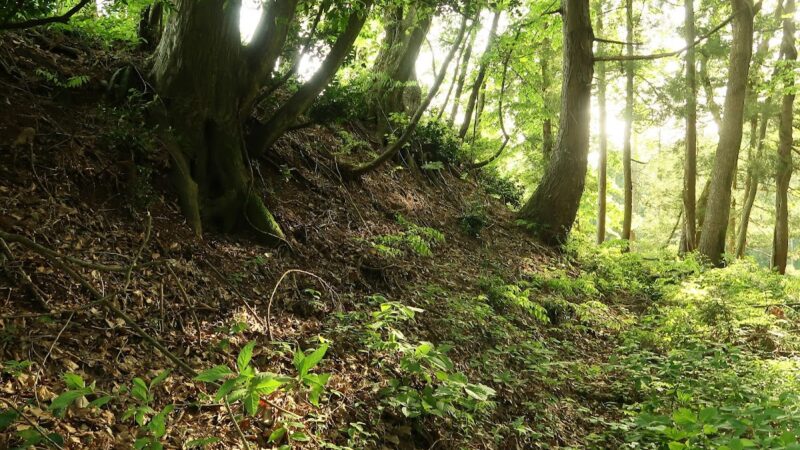
After its abandonment, Akamaru Castle remained undeveloped as a forest, resulting in exceptionally well-preserved remains. Earthworks, baileys, moats, and ridged trenches are almost entirely preserved, showcasing the characteristics of a Sengoku period mountain castle.
In particular, the height of the earthworks and the leveling of the baileys are clearly visible, making it a valuable historical site that allows visitors to appreciate the castle-building techniques of the time. In recent years, local preservation societies have been carrying out maintenance activities, creating an environment that is easier for visitors to explore.
One of Toyama Prefecture’s Leading Mountain Castle Remains
Akamaru Castle is one of Toyama Prefecture’s leading mountain castles in terms of scale and defensive capabilities. While many castle ruins remain in Toyama Prefecture, few castles possess such clearly preserved remains and advanced defensive features like the ridged vertical moats as Akamaru Castle.
For castle enthusiasts and history buffs, Akamaru Castle is a must-see historical site. It is particularly valuable as a textbook example for those interested in the defensive structures of mountain castles.
Views and Location
From the summit of Jogahira Mountain, you can enjoy a panoramic view of the Oyabe River basin and the Goisho plains. This excellent view demonstrates the importance of Akamaru Castle as a military surveillance base.
It is believed that the Nakayama clan monitored enemy movements from Akamaru Castle, overseeing their entire territory. Even today, on clear days, you can see as far as Toyama Bay, experiencing the perspective of a feudal lord during the Sengoku period.
Access and Visiting Information
Location
Address: Maitani, Fukuoka-machi, Takaoka City, Toyama Prefecture
Akamaru Castle ruins are located in the mountainous area of Fukuoka-machi, Takaoka City. Access by public transport is difficult, so visiting by private car is recommended.
Access Method
Access by Car:
- Approximately 10 minutes from the Fukuoka IC on the Nōetsu Expressway
- Approximately 30 minutes from the center of Takaoka City via National Route 8
There are a few parking spaces near the entrance to the castle ruins. However, you will need to drive on a narrow mountain road, so caution is required.
Notes for Visitors
Akamaru Castle Ruins is not a developed tourist area, but a historical site located in a forest. Please note the following points when visiting:
- Clothing: Long-sleeved shirts, long pants, and hiking or trekking boots are recommended.
- Season: Spring to autumn is suitable for visiting, but in summer, the vegetation can be overgrown, making viewing difficult.
- Safety: There are steep slopes and deep moats, so please watch your step carefully.
- Insect repellent: As it is a forest, insect repellent spray and other precautions are necessary.
- Avoiding solo visits: It is safer to visit in groups if possible.
Related Historical Sites in the Surrounding Area
Takaoka Castle Ruins (Takaoka Old Castle Park)
Located approximately 15km northeast of Akamaru Castle, Takaoka Castle Ruins is a flatland castle built by Maeda Toshinaga and is selected as one of Japan’s Top 100 Castles. While Akamaru Castle is a medieval mountain castle, Takaoka Castle is a contrasting example as an early modern flatland castle.
Currently, it is maintained as Takaoka Old Castle Park, and the vast moats and earthworks remain. Visiting Akamaru Castle in conjunction with this site allows you to understand the evolution of castles from the medieval to the early modern period.
Fukuoka Castle Ruins
In addition to Akamaru Castle, several other castle ruins remain in Fukuoka-machi, Takaoka City. The Goisho area was a region where multiple forces established bases during the Sengoku period, making it a great place to enjoy visiting castle ruins.
Cultural Value of Akamaru Castle
Takaoka City Designated Historic Site
Akamaru Castle is protected as a Takaoka City designated historic site. Because the remains of this medieval mountain castle are well-preserved, it is considered an important cultural asset for understanding the history of the region.
Importance in Castle Research
Akamaru Castle also holds an important position in castle research. In particular, the presence of ridged vertical moats, which are rare in Toyama Prefecture, is valuable material for studying the spread of castle construction techniques during the Sengoku period.
The ridged vertical moat technique was primarily developed in the Chubu and Kinki regions, and its introduction to Akamaru Castle suggests that the Nakayama clan actively engaged in exchanges and information gathering with other regions.
Toyama Castle Card
Akamaru Castle is featured in the “Toyama Castle Card” No. 32 and is recognized as one of the important castle sites in Toyama Prefecture. Castle cards are issued as part of activities to promote and raise awareness of castle sites, and can be obtained as a memento of a visit to Akamaru Castle.
Significance of Visiting Akamaru Castle
Experience the Reality of a Medieval Mountain Castle
By visiting Akamaru Castle, you can actually experience the structure and defenses of a Sengoku period mountain castle. You can feel the actual terrain, elevation differences, and scale of defensive facilities firsthand, something that cannot be understood from textbooks or documents alone.
Learn About Local History
Akamaru Castle is a historical site symbolizing the history of Fukuoka-machi, Takaoka City. You can gain a deep understanding of the region’s history, including the presence of the Nakayama clan, a powerful local lord, and their connections to famous Sengoku period warlords such as Uesugi Kenshin and Sasa Narimasa.
Fusion of Nature and History
Akamaru Castle Ruins are located in a lush, natural forest, allowing you to enjoy both historical exploration and nature walks. While experiencing the changing seasons, you can imagine the scenery seen by people in the Middle Ages.
Summary
Akamaru Castle is a valuable historical site of a medieval mountain castle remaining in Fukuoka-machi, Takaoka City, Toyama Prefecture. As a full-fledged mountain castle built by the Nakayama clan, defensive structures from the Sengoku period, such as earthworks, baileys, moats, and rare ridged vertical moats in Toyama Prefecture, remain in excellent condition.
Considered the finest in the medieval Goisho area in terms of scale and defensive capabilities, Akamaru Castle is a historically important castle site with connections to famous Sengoku period warlords such as Uesugi Kenshin and Sasa Narimasa. Protected as a designated historical site by Takaoka City, Akamaru Castle is a must-see for castle enthusiasts and history buffs.
By actually walking through the site and experiencing the rugged terrain and complex defensive structures unique to mountain castles, you can get a real feel for the reality of mountain castles during the Sengoku period and the people who lived there. Visiting it along with other nearby historical sites such as Takaoka Castle Ruins allows you to learn about the changes in castles from the medieval to the early modern period.
When you visit Toyama Prefecture, be sure to visit Akamaru Castle Ruins and feel the spirit of the Sengoku period.