Inami Castle (Nanto City): A Complete Guide to its History and Highlights | A Thorough Explanation of a Sengoku Period Mountain Castle in Toyama Prefecture
Inami Castle, located in Inami, Nanto City, Toyama Prefecture, was an important strategic point during the Sengoku period when religious and samurai forces fiercely clashed in Etchu (Toyama Prefecture). As a castle protecting Zuizenji Temple, which had close ties to the Honganji sect, and as a center of the Ikko-ikki uprising in Etchu, this castle played a crucial historical role.
This article thoroughly explains the charm of this little-known mountain castle, covering its detailed history, structure and remains, highlights, and access methods.
What is Inami Castle?
Inami Castle was a medieval mountain castle located in Inami, Nanto City, Toyama Prefecture. It was built on a hill behind the present-day Inami Hachimangu Shrine. Situated on a small mountain approximately 100 meters above sea level, it boasts a strategic location overlooking the town of Inami.
Basic Information on Inami Castle
- Location: Inami, Nanto City, Toyama Prefecture
- Castle Structure: Mountain Castle
- Construction Period: Late 15th Century (Estimated)
- Main Lords: Ishiguro Clan, Honganji Influence
- Year of Abandonment: Tensho Era (1573-1592)
- Remains: Traces of baileys, moats, and earthworks
- Designated Cultural Property: Not Designated
History of Inami Castle
Background of Construction and Relationship with Zuizenji Temple
An essential aspect of understanding the history of Inami Castle is its relationship with the adjacent Zuizenji Temple. Zuizenji Temple is a Shinshu Otani sect temple, believed to have been founded in 1390 (Meitoku 1) by the 5th head of Honganji Temple, Shakunyo Shonin.
Inami Castle is thought to have been built in the late 15th century as a castle to protect Zuizenji Temple. In Etchu Province at that time, the Honganji (Ikkō-shū) sect held significant influence, and Zuizenji Temple was one of its important strongholds in Etchu.
Inami Castle in the Sengoku Period
As a Base for the Ikkō-ikki Rebellion
During the Sengoku period, the Ikkō-ikki rebellion held considerable power in Etchu Province. Inami Castle functioned as a military base for the Ikkō-ikki forces, centered around Zuizenji Temple.
From the late 15th to the 16th century, there was fierce conflict in Etchu between samurai forces such as the Jinbo and Shiina clans, who served as shugodai (deputy governors), and the Ikkō-ikki forces. Inami Castle was a crucial castle located on the front lines of this conflict.
The Ishiguro Clan and Inami Castle
The Ishiguro clan, who controlled the area around Inami, had close ties to the Ikkō-ikki forces and are believed to have been involved in the defense of Inami Castle. The Ishiguro clan was a powerful local lord in Etchu Province and maintained their power by strengthening their ties with Honganji.
Sasa Narimasa’s Conquest of Etchu and the Fall of Inami Castle
In the 1580s, Sasa Narimasa, a vassal of Oda Nobunaga, invaded Etchu Province and began suppressing the Ikkō-ikki forces.
In 1585 (Tenshō 13), Sasa Narimasa launched a full-scale attack on Inami. Zuizenji Temple and Inami Castle put up fierce resistance, but ultimately fell to Sasa’s army. Zuizenji Temple was also burned down in this battle, and the town of Inami suffered significant damage.
Inami Castle After its Abandonment
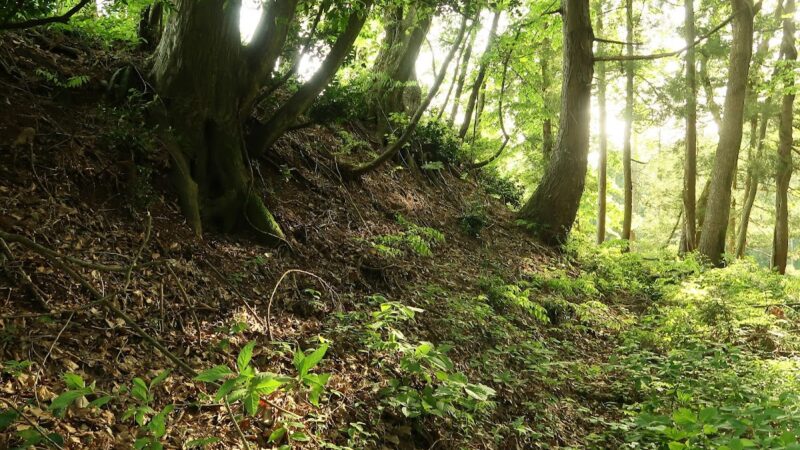
After the fall of Inami Castle, it was abandoned. During the Edo period, the castle ruins were left untouched and gradually returned to nature. Currently, only traces of baileys and moats remain.
Layout and Structure of Inami Castle
Castle Location and Topography
Inami Castle was built on a hill approximately 100 meters above sea level behind Inami Hachimangu Shrine. This hill stretches long and narrow from north to south, with a steep slope on the east side and a gentler slope on the west side.
The castle was built skillfully utilizing this terrain, maximizing the use of its natural fortifications.
Major Remains
Main Enclosure (Honmaru)
The main enclosure, located at the highest point of the castle, is estimated to have been approximately 50 meters east-west and 30 meters north-south. Although now covered with trees, the flat terrain remains, allowing us to imagine the former layout of the enclosure.
Second and Third Enclosures
Several enclosures were arranged in a stepped pattern around the main enclosure. These enclosures functioned as defensive structures to prevent enemy intrusion.
Moats
Traces of moats remain on the north and south sides of the castle. These moats were dry moats created by cutting across the ridge, and were important defensive structures to prevent enemy intrusion. The shape of the moat at Inami Castle can still be seen today.
Earthworks
Earthworks were built around the baileys. These earthworks were earthen walls designed to protect against enemy arrows and firearms. Although weathered, traces of the earthworks can still be seen in some places.
Castle Defense System
Inami Castle possessed a typical medieval mountain castle defense system.
- Utilization of Terrain: The steep slopes were utilized to make it difficult for the enemy to approach.
- Multiple Bailey Arrangement: Multiple baileys were arranged in a stepped pattern to achieve multiple layers of defense.
- Division by Moats: The ridge was divided by moats to prevent enemy advances.
- Protection by Earthworks: Earthworks were built around the baileys to strengthen defenses.
These defensive structures allowed Inami Castle to function as a small but strong fortress.
Highlights of Inami Castle
Exploring the Castle Ruins
The current Inami Castle ruins are located on the hillside behind Inami Hachimangu Shrine. A hiking trail is well-maintained, making it relatively easy to reach the castle ruins.
Walking Highlights:
- Estimated Time: Approximately 40 minutes to 1 hour round trip
- Difficulty: Beginner to Intermediate (Street shoes recommended as you will be walking on mountain paths)
- Highlights: Remains of baileys, moats, traces of earthworks, and panoramic views of Inami town.
Inami Hachimangu Shrine
Inami Hachimangu Shrine, the starting point for the climb to Inami Castle, has long been revered as the guardian shrine of Inami. The shrine grounds feature a magnificent main hall and decorations showcasing Inami wood carving techniques.
Be sure to visit the shrine before or after exploring the castle ruins.
Zuizenji Temple
Zuizenji Temple, which has deep ties to Inami Castle, still stands today as a magnificent temple complex in the heart of Inami.
Highlights of Zuizenji Temple
- Main Gate: A magnificent main gate known as a masterpiece of Inami wood carving.
- Main Hall: A large main hall rebuilt during the Edo period.
- Prince Shotoku Hall: A hall dedicated to Prince Shotoku.
- Temple Treasures: Buddhist statues and ancient documents of high historical value.
Zuizenji Temple is an essential place for understanding the history of Inami Castle. We highly recommend visiting it when you visit the castle ruins.
Inami Townscape
Inami is known as a “town of wood carving,” and the traditional Inami wood carving techniques are still passed down today.
What is Inami Wood Carving?
Inami wood carving is said to have originated in 1763 (Hōreki 13), when woodcarvers were invited from Kyoto to learn techniques during the reconstruction of the main hall of Zuizenji Temple. Since then, wood carving techniques have flourished in Inami, and currently, more than 200 woodcarvers are active.
Yōkamachi Street
Yōkamachi Street, which developed as a temple town for Zuizenji Temple, is a charming street with cobblestones lined with wood carving workshops, galleries, and cafes. As you walk along the street, you can hear the sounds of carving tools from all directions.
Access to Inami Castle
Access by Public Transportation
By Train and Bus
- From JR Johana Line “Fukuno Station”:
- Take the Kaetsuno Bus bound for “Inami” (approx. 15 minutes)
- Get off at the “Inami” bus stop and walk for about 10 minutes to Inami Hachimangu Shrine
- From JR Hokuriku Shinkansen “Shin-Takaoka Station”:
- Take the Kaetsuno Bus bound for “Inami” (approx. 30 minutes)
- Get off at the “Inami” bus stop and walk for about 10 minutes to Inami Hachimangu Shrine
Access by Car
Using the Tokai-Hokuriku Expressway
- Approximately 20 minutes from “Gokayama IC” via National Route 156
- Approximately 10 minutes from “Fukumitsu IC” via Prefectural Road 27
Using the Hokuriku Expressway
- Approximately 15 minutes from Tonami Interchange via National Route 156.
Parking Information
- Zuizenji Temple Parking: Free, approximately 50 spaces for regular cars
- Around Inami Hachimangu Shrine: Limited parking available
The most common way to access the castle ruins is to use the parking lots at Zuizenji Temple or Inami Hachimangu Shrine and walk.
Points to Note When Visiting Inami Castle
Clothing and Equipment
- Athletic shoes or hiking boots: Non-slip shoes are essential as you will be walking on mountain trails.
- Long-sleeved shirt and long pants: To protect yourself from bushes and insects.
- Hat: To protect your head from the sun and branches.
- Drinking water: Essential, especially in summer.
- Insect repellent spray: Recommended from spring to autumn.
Suitable Seasons for Visiting
- Spring (April-May): Beautiful fresh greenery and mild weather.
- Autumn (October-November): At its peak for autumn foliage and comfortable temperatures.
- Winter: Difficult to visit due to snow.
- Summer: Be careful of heat and insects.
Safety Precautions
- The castle ruins are on unmaintained mountain trails. Avoid visiting alone; please visit in groups if possible.
- Be careful as the ground can be slippery during or immediately after rain.
- Please be careful not to damage the ruins while exploring.
- Cell phone reception may be poor in some areas.
Tourist Spots Around Inami
Other Castle Ruins in Nanto City
Matsune Castle
Similar to Inami Castle, this castle has strong ties to the Ikko-ikki rebels and is located about 20 minutes by car from Inami.
Fukumitsu Castle
Known as the residence of the Ishiguro clan, this castle is about 15 minutes by car from Inami.
Gokayama Gassho-zukuri Village
The Gokayama Gassho-zukuri Village, a World Heritage Site, is about 30 minutes by car from Inami. The two villages, Ainokura and Suganuma, are registered as World Heritage Sites, allowing visitors to experience the original landscape of Japan.
The Townscape of Johana
Johana, which flourished as a silk weaving town, is about a 15-minute drive from Inami. It is known for its old townscape and the Johana Hikiyama Festival held every May.
The Historical Significance of Inami Castle
Importance in the History of the Etchu Ikko-ikki
Inami Castle played an important role as a base for the Ikko-ikki rebellion in Etchu Province. From the late 15th to the 16th centuries, the Ikko-ikki held great power in Etchu, fiercely clashing with the shugo daimyo and shugodai.
Inami Castle and Zuizenji Temple were central bases of this Ikko-ikki force, and had a significant impact on the political and military situation in Etchu.
The Combination of Religion and Military Power
The history of Inami Castle symbolizes the combination of religious power and military power in medieval Japan. The castle, built to protect the religious facility Zuizenji Temple, was not merely a military facility, but an entity where religious belief and military power were integrated.
This combination of a “temple town” and a castle was a characteristic feature seen in Honganji strongholds throughout Japan, such as Ishiyama Honganji (Osaka) and the Nagashima Ikko-ikki (Mie Prefecture).
Part of the Oda-Toyotomi Regime’s Suppression of Religious Forces
The fall of Inami Castle is positioned as part of the Oda Nobunaga and Toyotomi Hideyoshi’s policy of suppressing religious forces. Even after the surrender of Ishiyama Honganji in 1580, Ikko-ikki forces in various regions continued to resist, and the capture of Inami Castle was one of the operations to eliminate them.
Sasa Narimasa’s capture of Inami Castle symbolizes the end of the Ikko-ikki forces in Etchu Province and marked a turning point in the region’s integration under the control of the Oda-Toyotomi regime.
Preservation and Utilization of Inami Castle Ruins
Current Situation and Challenges
Currently, the Inami Castle ruins are not designated as a cultural property, and no full-scale investigations or maintenance have been carried out. The ruins are gradually being buried in nature, and their state of preservation is not necessarily good.
Main Challenges
- Detailed investigation of the ruins has not been conducted.
- The ruins are difficult to see due to overgrown trees.
- The hiking trails are not adequately maintained.
- There are few signs and explanatory panels.
- Public awareness is low.
Future Prospects
In recent years, tourism promotion utilizing local historical heritage has attracted attention, and the potential value of the Inami Castle ruins is being re-evaluated.
Expected Initiatives
- Detailed excavation surveys by experts.
- Preservation and appropriate maintenance of the ruins.
- Installation of signs and explanatory panels.
- Improvement of hiking trail safety.
- Development of tourist routes combining the ruins with Zuizenji Temple and Inami wood carvings.
- Promotion of preservation activities by local residents.
Significance of Visiting Inami Castle
Experiencing History
Visiting the Inami Castle ruins is a valuable opportunity to feel firsthand the history of Etchu during the Sengoku period. From these castle ruins, you can feel the atmosphere of an era when religion and politics were intricately intertwined, a time of fierce conflict between the Ikkō-ikki forces and the samurai class.
Understanding Local Culture
Knowing the history of Inami Castle leads to a deeper understanding of present-day Inami culture. The town’s development centered around Zuizenji Temple, the tradition of Inami wood carving, and the people’s faith—the current state of Inami is deeply intertwined with the history of Inami Castle.
The Charm of Minor Castles
Inami Castle is not a famous castle like Himeji Castle or Kumamoto Castle. However, it is precisely these minor castles that demonstrate the profound depth of Japanese castle history.
Countless little-known castles like Inami Castle exist throughout Japan. Visiting these castles and learning their history is extremely meaningful for deepening one’s understanding of Japanese history.
Summary
Inami Castle in Nanto City, Toyama Prefecture, is a castle of great historical significance as an important base for the Ikkō-ikki rebellion in Etchū during the Sengoku period. Built as a castle to protect Zuizenji Temple, it functioned as a base for the Honganji forces, but ultimately fell to an attack by Sasa Narimasa.
The current castle ruins retain only a few remnants such as baileys, moats, and earthworks, allowing visitors to imagine its former glory. It’s relatively easy to access from Inami Hachimangu Shrine, making it a recommended spot not only for castle enthusiasts but also for history buffs and hikers.
When visiting Inami, be sure to visit the Inami Castle ruins and, along with Zuizenji Temple and the townscape of Inami wood carving, experience the rich history and culture of this region. You’ll surely feel a closer connection to the history of Etchu during the Sengoku period.
Inami Castle is one of Japan’s lesser-known but important castles in the history of Japanese castles. It is hoped that its historical value will be widely recognized and that it will be appropriately preserved and utilized.