Iwakura Castle (Kurayoshi City, Tottori Prefecture) Complete Guide | From the Ogamo Clan’s Mountain Castle to the History of the Sengoku Period
What is Iwakura Castle?
Iwakura Castle (Iwakura-jo) is a medieval mountain castle located in Iwakura, Kurayoshi City, Tottori Prefecture. Built on Mount Iwakura, which is 247 meters above sea level, it is also known as Iwakurayama Castle (Iwakurayama-jo). It is sometimes referred to as Ogamo Castle (Ogamo-jo), a name derived from the Ogamo clan, who were the castle’s lords.
Located in the central part of Hoki Province, this castle served as the base of the Ogamo clan, a powerful local lord of Hoki Province, from the Kamakura period to the Sengoku period. With a relative height of approximately 154 meters, it is a typical medieval mountain castle.
Currently, it is a historical site with remaining ruins, attracting visitors from castle enthusiasts and history buffs. Remains such as earthworks, baileys, and moats have been confirmed, making it a valuable resource for studying the structure of medieval mountain castles.
History of Iwakura Castle
Transition from Ancient to Medieval Times
The Kurayoshi area where Iwakura Castle was built flourished as one of the centers of Hoki Province from ancient times. Under the Ritsuryo system, there were powerful local figures called zaichō kanjin, who gradually became samurai.
The Kogamo clan was a samurai group that originated from these zaichō kanjin, and they established their power in this region from the late Heian period to the early Kamakura period. It is a typical example of how local samurai like the Kogamo clan built castles and solidified their regional control during the transition period of Japanese medieval society.
Construction of Iwakura Castle and the Rise of the Ogamo Clan in the Kamakura Period
Iwakura Castle is believed to have been built during the Juei-Genryaku era (1182-1185) by Ogamo Saemon-no-jo Motokane. This period coincided with the final stages of the Genpei War, a time when the power of the samurai was being established throughout Japan.
After the establishment of the Kamakura Shogunate, the Ogamo clan was appointed as the deputy governor of Hoki Province, a position that was inherited. The deputy governor held the important position of exercising military and police power within the province on behalf of the governor, and the Ogamo clan, based at Iwakura Castle, became the de facto rulers of the region.
Throughout the Kamakura period, the Ogamo clan expanded their territory centered around Iwakura Castle, establishing their position as a powerful local lord in Hoki Province.
Development in the Muromachi Period and the Role of the Shugodai
At the start of the Muromachi period, the Yamana clan was appointed as the Shugo (military governor) of Hoki Province. The Yamana clan was a powerful daimyo (feudal lord) of the Muromachi shogunate, and at its peak, it boasted such power that it was called “the Lord of Six-tenths.”
The Kogamo clan maintained their position as Shugodai (deputy governor) as vassals of the Yamana clan and continued to handle practical affairs in Hoki Province. During this period, the Kogamo clan established Iwakura Castle as their main base and developed a network of branch castles in the surrounding area, strengthening their regional control.
The Muromachi period was also an era of warfare, including the Onin War (1467-1477). The Yamana clan fought as a major force in the Western Army, and its influence extended to Hoki Province. The Kogamo clan, following their lord the Yamana clan, sought to survive amidst the complex political situation of the Sengoku period.
Turmoil in the Sengoku Period
At the start of the Sengoku period, Hoki Province became a stage for complex power struggles. The Yamana clan’s power gradually declined, and consequently, the Kogamo clan also found themselves in a difficult position.
During this period, other powerful local lords, such as the Nanjo clan based at Ueshi Castle, rose to prominence within Hoki Province. The Kogamo clan attempted to maintain their independent sphere of influence from Iwakura Castle, but amidst the fierce power struggles of the Sengoku period, they gradually lost their autonomy.
The Battle of Sekigahara and the Castle’s Downfall
The Battle of Sekigahara in 1600 (Keicho 5) was a pivotal event that determined the fate of Iwakura Castle and the Kogamo clan. In this decisive battle, the Yamana clan fought on the side of the Western Army.
After the Western Army’s defeat at Sekigahara, Tokugawa Ieyasu carried out post-war settlements. The Yamana clan, having sided with the Western Army, was dispossessed of their territory, and the Kogamo clan, their vassals, met a similar fate.
It is believed that Iwakura Castle was abandoned during the Keicho era (1596-1615). Having served as the base of the Kogamo clan for approximately 400 years, Iwakura Castle thus disappeared from the stage of history.
Layout and Remains of Iwakura Castle
Basic Structure of the Castle
Iwakura Castle is a mountain castle built around the summit of Mount Iwakura, at an elevation of 247 meters. The relative height from the foot of the mountain is approximately 154 meters, making it a highly defensible castle utilizing the steep terrain.
The castle’s layout (design) exhibits typical characteristics of a medieval mountain castle. The main enclosure (honmaru) is located at the summit, and multiple enclosures are arranged along the ridge from there, creating a series of interconnected enclosures. This structure can be considered the basic form of a medieval mountain castle, making maximum use of the natural terrain of the ridge.
Major Remains
Even today, the remains of a medieval mountain castle are well preserved at the Iwakura Castle site.
Enclosures (Kuruwa): Multiple flat areas (enclosures) can be identified, mainly around the mountaintop. These were used for troop garrisons, storage of supplies, and command posts. The main enclosure has the largest flat area and is presumed to have housed the lord’s residence and other important facilities.
Earthworks: Earthworks were built around the enclosures. These earthworks prevented enemy intrusion and also made it difficult to see inside the enclosures from the outside.
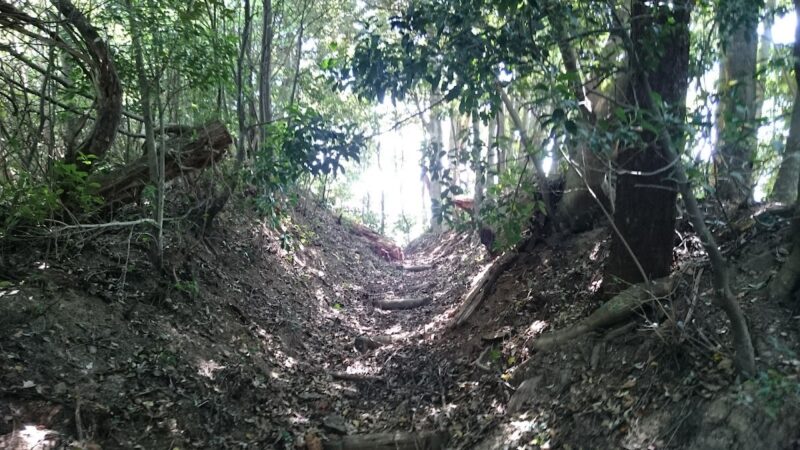
Moats: Multiple moats, dug to cut across the ridge, can be identified. Moats were important defensive structures that prevented enemy intrusion and are characteristic remains of medieval mountain castles.
Well Remains: Remains of wells also exist within the castle grounds. Securing water was a matter of life and death in mountain castles, and the presence of wells was an important facility that enabled long-term sieges.
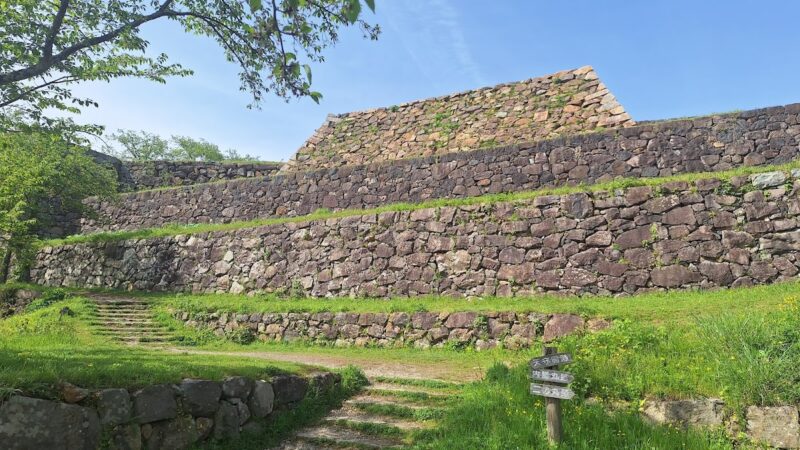
Stone Walls: Traces of stone walls can be seen in some areas. While full-scale stone walls are rare in medieval mountain castles, it is evident that stone masonry was used in some parts of Iwakura Castle. ### Access Routes to the Castle
There are believed to be several routes leading to Iwakura Castle from the foot of the mountain to the summit. In the Middle Ages, for defensive reasons, the routes were intentionally designed to be complex, preventing large enemy armies from launching a swift attack.
Mountain paths still remain, making it possible to ascend the castle while viewing the ruins. However, due to the steep terrain characteristic of mountain castles, appropriate equipment and preparation are necessary for a visit.
The History of the Kogamo Clan and Hoki Province
Origins and Development of the Kogamo Clan
The Kogamo clan was a samurai group originating from local officials in Hoki Province. Local officials were local bureaucrats who worked in the provincial government under the Ritsuryo system, and they became samurai from the late Heian period onward.
The name Kogamo is thought to originate from the Kogamo River that flows through Kurayoshi City. The Kogamo clan, who established their power base in this region, solidified their position during the Kamakura period when they were appointed as Shugodai (deputy governor).
Role as Shugodai
The Shugodai held a crucial position as a representative of the Shugo (governor), exercising military and police power within the province. Specifically, they commanded the samurai within the province, enforced law enforcement, and had the authority to mobilize troops during wartime.
The Kogamo clan inherited this position of Shugodai for generations, reigning as the de facto rulers of Hoki Province. Iwakura Castle was a symbol of their power and functioned as the administrative and military center.
Relationship with the Yamana Clan
During the Muromachi period, the Yamana clan, who became the Shugo of Hoki Province, highly valued the Kogamo clan as important vassals. Because the Yamana clan was a powerful Shugo controlling multiple provinces, a large part of the actual domestic governance was entrusted to the Kogamo clan as Shugodai.
This lord-vassal relationship was essentially maintained through the Ōnin War and into the Sengoku period. While following the policies of the Yamana clan, the Kogamo clan continued to maintain its own independent power base in the region.
Relationships with Other Hōki Province Lords
Besides the Kogamo clan, several other powerful local lords existed within Hōki Province, including the Nanjō clan of Hagoromoishi Castle and forces based at Utsubuki Castle. These lords sometimes cooperated and sometimes clashed, developing a complex regional political landscape.
Especially during the Sengoku period, power struggles among these lords intensified, leading to continued instability in Hōki Province. The Kogamo clan, too, was forced to make various political choices in order to survive.
Geography of Kurayoshi City and the Surrounding Area of Iwakura Castle
Location and Geographical Characteristics of Kurayoshi City
Kurayoshi City is located in the central part of Tottori Prefecture and is one of the major cities in the San’in region. Situated on the Sea of Japan side of the Chūgoku region, it has flourished as the center of Hōki Province since ancient times.
The city area has a mixed topography of mountains and plains, and Mount Iwakura, where Iwakura Castle was built, is one of these mountains. Rivers such as the Kogamo River flow through the area, and fertile plains spread across their basins. This geographical condition has encouraged settlement and supported regional development since ancient times.
Strategic Location of Iwakura Castle
Iwakura Castle is located near the city center of Kurayoshi, on high ground overlooking the surrounding area. Its elevation of 247 meters made it a suitable location for military surveillance and defense.
From the castle, it was possible to monitor the main roads of Hoki Province, giving it strategic importance as a key transportation hub. Furthermore, the surrounding plains were agricultural production areas that formed the economic base of the Kogamo clan, and the castle also served as a base to protect these territories.
Related Historical Sites in the Surrounding Area
Besides Iwakura Castle, many other medieval castles exist around Kurayoshi City. Utsubuki Castle is located close to the city center of Kurayoshi and later became a central castle in the region. Furthermore, Hagoromoishi Castle, located east of Kurayoshi City, was an important fortress alongside Iwakura Castle, serving as the base of the Nanjo clan.
These castles are important historical sites that illustrate the power structure and regional governance in Hoki Province during the medieval period, and are still subjects of research and preservation today.
Current Status and Visiting Information for Iwakura Castle
Preservation Status as a Historic Site
The remains of Iwakura Castle are currently preserved within a forest. While no archaeological excavations or large-scale restoration work has been carried out, this makes it a valuable historical site where one can experience the atmosphere of a medieval mountain castle firsthand.
The remains, such as earthworks and moats, are relatively well-preserved, providing important information for understanding the castle’s structure. However, due to natural weathering and overgrown vegetation, some parts of the remains are unclear.
Points to Note When Visiting
There are several points to note when visiting the Iwakura Castle ruins.
First, as it is a mountain castle, appropriate clothing and shoes for hiking are necessary. Since this is a climb with an elevation difference of 154 meters, it is recommended that you visit with ample physical strength and time.
The climbing route is not a well-maintained tourist facility, so there are some unclear sections. It is necessary to bring a map or GPS device to avoid getting lost.
Furthermore, there may be dangerous areas in the mountains, so it is advisable to avoid visiting alone and instead travel in a group. Especially during rainy weather or winter, the ground can become slippery, so it is advisable to refrain from visiting or to exercise extreme caution.
Nearby Tourist Attractions
Besides Iwakura Castle, Kurayoshi City has many other attractions.
The Kurayoshi city center retains a historical townscape known as the White-Walled Storehouse District, where you can see architecture from the Edo to Meiji periods. Also, Utsubuki Park is known as a famous cherry blossom viewing spot, attracting many tourists in spring.
The Kurayoshi Museum exhibits local history and culture, and houses materials related to Iwakura Castle and the Kogamo clan. Visiting before or after visiting the castle ruins will provide a deeper understanding.
Historical Significance of Iwakura Castle
Value in Medieval Mountain Castle Research
Iwakura Castle occupies an important position in castle research as a castle with a typical structure of a medieval mountain castle. Having been used for a long period from the Kamakura period to the Sengoku period, it is a valuable resource for understanding the development process of medieval castles.
In particular, as a castle built by a local lord who was originally a local official, it is a good example of the relationship between the rise of local samurai and castles in medieval Japanese society.
Importance in Regional History
The existence of Iwakura Castle and the Kogamo clan is extremely important in the history of Hoki Province. The Kogamo clan ruled this region for a long period as shugodai (deputy governor) and greatly influenced the formation of the local community.
Iwakura Castle was the center of their power, functioning as a political, military, and economic base. The way regional governance was centered around the castle is thought to have influenced the regional structure around present-day Kurayoshi City.
Positioning in a National Context
The history of Iwakura Castle is closely related to the major trends in medieval Japanese history throughout the country. The establishment of the Kamakura Shogunate, the shugo daimyo system of the Muromachi Shogunate, the Ōnin War, the turmoil of the Sengoku period, and the Battle of Sekigahara—all major turning points in Japanese history—are etched into the history of this castle.
Although it is a local castle, its history can be considered a microcosm of the entirety of Japanese history, making it a highly insightful example for understanding medieval Japan.
Summary
Iwakura Castle, located in Kurayoshi City, Tottori Prefecture, is an important historical site with a history spanning approximately 400 years as a medieval mountain castle. Built by the Kogamo clan during the Juei and Genryaku periods (1182-1185), it functioned as the Kogamo clan’s base until its abandonment during the Keichō period (1596-1615).
Built on Mount Iwakura, at an altitude of 247 meters, this castle retains remnants such as earthworks, baileys, moats, stone walls, and wells, preserving the structure of a medieval mountain castle to this day. The Kogamo clan, as local lords who originated from local government officials, gained the position of shugodai (deputy governor) from the Kamakura period onward, expanding their influence in Hoki Province.
During the Muromachi period, they served as vassals of the Yamana clan. After the turmoil of the Sengoku period, they ultimately sided with the Western Army in the Battle of Sekigahara, resulting in their downfall and the abandonment of Iwakura Castle.
The Iwakura Castle ruins, which still remain today, are a valuable historical site for understanding the history of local samurai in the medieval period, and are a worthwhile place to visit for castle enthusiasts and history buffs. Iwakura Castle is also an indispensable part of understanding the history and culture of Kurayoshi City.