Matsugasaki Castle (Tohaku District, Tottori Prefecture) Complete Guide | History, Remains, and Access Information
What is Matsugasaki Castle?
Matsugasaki Castle (Matsugasaki-jo) was a Sengoku period mountain castle located in Matsuzaki, Yurihama-cho, Tohaku District, Tottori Prefecture. Also written as “Matsuzaki Castle,” it functioned as an important branch castle under the Nanjo clan of Hoki Province. Built on the hilly area where the former Sakura Elementary School (now closed) stands, it is known as a fortress that played a part in the defense network of the Nanjo clan, whose main base was Hagoromoishi Castle.
This article distinguishes it from other castles with the same name (such as those in Kashiwa City, Chiba Prefecture, and Kyoto City), focusing on the Matsugasaki Castle located in Tohaku District, Tottori Prefecture. It provides a detailed explanation of its historical background, the characteristics of its remains, and how to access the site.
History of Matsugasaki Castle
Background and Builder of the Castle
The exact construction date of Matsugasaki Castle is uncertain, but it is said to have been built during the Sengoku period by the Komori clan, who were yoriki (subordinate generals) of the Nanjo clan. The *Hoki Mindanki* (a historical record of Hoki Province) mentions it as “Matsugasaki Castle,” indicating its position as an important branch castle protecting the Nanjo clan’s sphere of influence.
The Komori clan were local powerful families serving the Nanjo clan, and the name of Komori Izumi-no-kami Masataka is recorded as the first lord of the castle. Later, Shin Shimousa-no-kami Menshi is said to have served as lord, and the castle was used as a defensive base in the eastern Hoki region as part of the Nanjo clan’s military strategy.
Relationship with the Nanjo Clan
The Nanjo clan was a Sengoku period daimyo who controlled the eastern part of Hoki Province. They had several branch castles centered around their base, Hagoromoishi Castle (present-day Hagoromoishi, Yurihama Town). Matsugasaki Castle is thought to have been one of these branch castles, playing a role in the eastern defense of Hagoromoishi Castle.
Initially, the Nanjo clan belonged to the Amago clan, but as the Mori clan’s power expanded, they maintained their influence amidst complex diplomatic relations. Matsugasaki Castle was strongly influenced by these political circumstances of the Sengoku period.
The Incident of 1580
A noteworthy event in the history of Matsugasaki Castle occurred in 1580. In that year, when the Mori clan attacked Hagoromoishi Castle, the castle lord, the Komori clan, initially resisted alongside the Nanjo clan.
However, Komori secretly promised to defect to the Mori side, plotting to betray the Nanjo clan and gain merit. However, this plot was leaked to the Nanjo side, and as a result, Komori was killed. This incident is an episode that illustrates the harsh historical context of the Sengoku period, where betrayal and purges were commonplace.
The Road to the Castle’s Abandonment
In 1591, as Toyotomi Hideyoshi’s unification of Japan progressed, the Nanjo clan’s territory was secured under the Toyotomi regime. However, in the Battle of Sekigahara in 1600, the Nanjo clan sided with the Western Army (Ishida Mitsunari’s side), and as a result, their territory was confiscated after the war.
Following this confiscation of the Nanjo clan’s territory, Matsugasaki Castle, along with its main castle, Hagoromoishi Castle, and other branch castles, was abandoned. From then on, Matsugasaki Castle ceased to function as a military facility and remained as a castle ruin throughout the Edo period.
Structure and Remains of Matsugasaki Castle
Castle Location and Layout
Matsugasaki Castle was built on a hill in the present-day Matsugasaki district of Yurihama Town, where the former Sakura Elementary School stood. This location, a high ground overlooking the surrounding area, utilized the strategically advantageous terrain. It possessed the basic defensive functions of a mountain castle, and its layout (castle design) skillfully utilized the natural terrain.
The castle was a small to medium-sized mountain castle, and it is believed that multiple baileys (flat sections) were arranged around the main bailey (honmaru).
Existing Remains
Even after the Meiji era, the topography of the baileys remained clearly visible at the Matsugasaki Castle site, and the area was mainly used as farmland. The following remains are believed to still be visible today:
- Kuruwa (enclosure) remains: Multiple levels of leveled ground remain.
- Earthwork traces: Some areas show earthwork-like elevations.
- Possibility of a moat: The difference in terrain suggests the possibility of a moat (a moat cutting across the ridge).
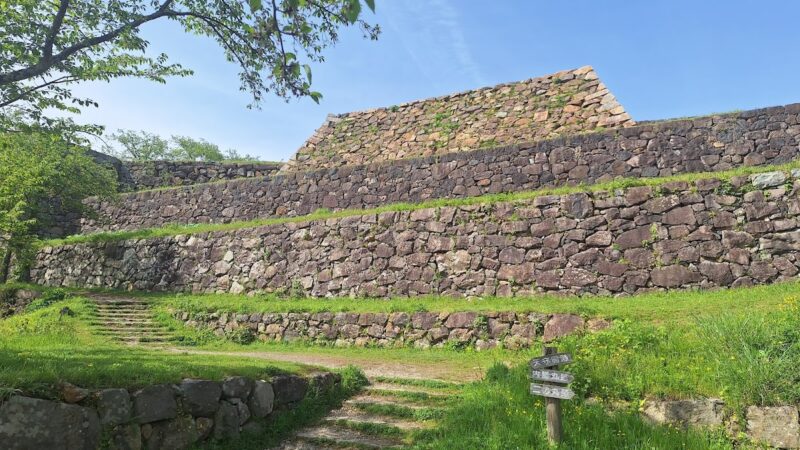
However, due to years of agricultural use and development, the preservation of the remains is not always good, and no clear stone walls or building remains have been confirmed. Nevertheless, it is possible to decipher the basic structure of the castle through topographical observation.
Relationship with the former Sakura Elementary School
Sakura Elementary School was once built in the center of the castle site. While part of the castle site was altered by the construction of the school, the surrounding area retains the original topography. Currently, Sakura Elementary School is closed, and depending on the use of the site, future preservation and investigation of the remains may be possible.
Highlights of Matsugasaki Castle
Historical Value
Matsugasaki Castle is an important historical site for understanding the governing system of the Nanjo clan, a powerful Sengoku period daimyo of Hoki Province. It played a part in the network of branch castles centered around Hagoromoishi Castle and has academic value as a concrete example of the local governance system of the Sengoku period.
In particular, the betrayal incident of 1580 (Tensho 8) is noteworthy as a valuable episode that conveys the fragility of lord-vassal relationships in the Sengoku period and the political maneuvering waged by warlords in their struggle for survival.
Exploring the Castle Ruins Through Topography
When visiting the site, observing the topography is the main enjoyment. From the elevation differences of the hills and the arrangement of flat areas, you can imagine the former castle structure. By observing the surrounding landscape, you can experience what kind of view the castle had and in which directions it was guarding.
Related Historical Sites in the Surrounding Area
When visiting Matsugasaki Castle, we recommend also visiting the following related historical sites:
- Hagoromoishi Castle Ruins (Hagoromoishi, Yurihama Town): The main castle of the Nanjo clan, designated as a national historic site.
- Utsubuki Castle Ruins, Kurayoshi City: One of the central castles of Hoki Province.
- Mt. Mitoku, Misasa Town: A sacred site of Shugendo (mountain asceticism), offering insights into the religious background of the Sengoku period.
Combining these sites will provide a more comprehensive understanding of the Sengoku period in Hoki Province.
Access Information
Location
Matsuzaki, Yurihama-cho, Tohaku-gun, Tottori Prefecture 689-0607 (Around the former Sakura Elementary School)
Access by Public Transportation
- From JR San’in Main Line Kurayoshi Station:
- Take the “Matsuzaki Line” bus, get off at the “Matsuzaki” bus stop, and walk for about 5 minutes.
- By taxi: about 15 minutes
Access by Car
- About 10 minutes from San’in Expressway Hawaii IC
- Accessible via prefectural road from National Route 9
- Parking: There is no dedicated parking lot, so please use nearby public facilities or safe areas on the roadside.
Notes for Visitors
- The castle ruins may include private land and farmland, so please be considerate when entering.
- There are no clear signs or well-maintained viewing paths, so it is recommended to check a map in advance.
- Due to the undulating terrain characteristic of mountain castles, please wear comfortable shoes and clothing.
- During the summer, the vegetation becomes overgrown, making it difficult to see the remains. Therefore, visiting from autumn to spring is recommended.
Differences between Matsugasaki Castle and other Matsugasaki Castles/Matsuzaki Castles
There are several castle ruins with the same or similar names, “Matsugasaki Castle” or “Matsuzaki Castle,” throughout Japan. To avoid confusion, the main castles are summarized below:
Matsugasaki Castle (Sakyo-ku, Kyoto City)
This castle was located in Matsugasaki, Sakyo-ku, Kyoto City. It is known as the place where local residents took refuge during the Tenbun Hokke Rebellion of 1536. It is believed to have been built by the Yamamoto clan or the residents of Matsugasaki, and remnants of earthworks and moats remain.
Matsugasaki Castle (Kashiwa City, Chiba Prefecture)
This is a medieval castle ruin from the Sengoku period located in Matsugasaki, Kashiwa City, Chiba Prefecture. It was built on a plateau at the confluence of the Ohori River and the Jigane Moat, approximately 500 meters northwest of JR Kita-Kashiwa Station. The remains are relatively well-preserved, and earthworks and dry moats can be seen.
Matsuzaki Castle (Tako-machi, Katori-gun, Chiba Prefecture)
This castle existed in Shimosa Province and is located in Tako-machi, Katori-gun, Chiba Prefecture. It is also a castle from the Sengoku period.
Matsugasaki Castle (Tohaku-gun, Tottori Prefecture) covered in this article
This castle existed in Hoki Province and was built by the Komori clan, vassals of the Nanjo clan. Its location is Matsuzaki, Yurihama-cho, Tohaku-gun, Tottori Prefecture, and it differs geographically and historically from other castles with the same name.
Significance of visiting Matsugasaki Castle
Understanding Local History
Exploring Matsugasaki Castle is a valuable opportunity to understand the Sengoku period history of Hoki Province, particularly the Nanjo clan’s rule. While not a large-scale castle, it is a place where you can experience firsthand how local powerful families protected their territories and survived the turbulent Sengoku period.
Materials for Castle Research
Small to medium-sized mountain castles possess different construction techniques and defensive philosophies than large-scale early modern castles. Research into subsidiary castles like Matsugasaki Castle is essential for understanding the overall military system of the Sengoku period.
Preservation of Local Culture
In the local town of Yurihama, there is a movement to re-evaluate historical heritage, including Matsugasaki Castle, as a local cultural resource. An increase in visitors could lead to greater interest in local history, potentially facilitating the preservation and research of the remains.
Summary
Matsugasaki Castle in Yurihama Town, Tohaku District, Tottori Prefecture, is a Sengoku period mountain castle built by the Komori clan, vassals of the Nanjo clan. It is a valuable historical site that tells the story of the turbulent Sengoku period, including the betrayal incident of 1580 and its abandonment after the Battle of Sekigahara.
While clear remains are currently limited, the castle’s structure can be deciphered through topographical observation, making it an important teaching material for learning about the local governance system of the Sengoku period. Visiting Matsugasaki Castle along with related historical sites such as Hagoromoishi Castle will allow you to gain a deeper understanding of the Sengoku period history of Hoki Province.
While Matsugasaki Castle may not be widely known among history enthusiasts and castle fans, it is a valuable spot where you can experience the local history of the Sengoku period firsthand. When you visit Yurihama Town, be sure to stop by this historic castle site.