Osaki Castle (Tottori City) Complete Guide | History, Highlights, and Access: A Thorough Explanation
What is Osaki Castle?
Osaki Castle is a medieval mountain castle located in Okusawami, Ketaka-cho, Tottori City, Tottori Prefecture. Built on a ridge 94 meters above sea level (88 meters relative height) overlooking the Sea of Japan, it is known for playing a crucial role during Hashiba Hideyoshi’s siege of Tottori Castle in 1581.
Currently, local volunteers have been working to restore the site, and the remains such as earthworks and baileys are well-preserved. It is attracting attention from castle enthusiasts and history buffs as a valuable historical site that tells the story of the Sengoku period in the Inaba region.
Location and Characteristics of Osaki Castle
Osaki Castle is located on a mountaintop overlooking the west of Ozawami Beach, offering a superb location with panoramic views of the Sea of Japan. Its terrain is ideal for monitoring maritime traffic and securing control of the sea, making it truly worthy of being called a “sea castle.”
Located near the border between Inaba and Hoki provinces, Osaki Castle held a strategically important position as a key point for maritime traffic in the San’in region. This location enhanced the military value of Osaki Castle during the Sengoku period.
History of Osaki Castle
Construction and Builder
Due to the scarcity of historical records, there are various theories regarding the construction date and builder of Osaki Castle, and nothing definitive is known. It is generally believed to have been built by forces associated with the Yamana clan, who ruled Inaba Province during the Sengoku period.
In medieval Inaba Province, the Yamana clan reigned as the shugo (provincial governor), and their subordinate local lords built castles and fortresses throughout the region. It is presumed that Osaki Castle functioned as one of these local lords’ bases.
The Siege of Tottori Castle in 1581
The most important aspect of Osaki Castle’s history is its role in the Second Siege of Tottori Castle in 1581. During this period, Hashiba Hideyoshi, acting on orders from Oda Nobunaga, was advancing his conquest of Inaba Province and besieging Tottori Castle (Katsuyama Castle), a stronghold of the Mori clan.
As a Mori Camp
Osaki Castle was used as a Mori camp and became an important base for the Mori army led by Kikkawa Motoharu. There are various theories regarding the castle’s lord at the time, with names such as Hido Saemon and Tagami Takatsugu (also known as Tagami Takakiyo) being mentioned, but no definitive historical records remain.
The Mori army attempted to secure supply routes to Tottori Castle by utilizing multiple fortresses, including Osaki Castle. Coastal castles like Osaki Castle played an extremely important role in protecting the maritime supply routes from the Sea of Japan.
Battle with Hashiba Hideyoshi
Hashiba Hideyoshi successively captured surrounding subsidiary castles and camps to completely isolate Tottori Castle. Osaki Castle also became a target, and it is believed that fierce battles took place between the Oda and Mori forces.
Ultimately, Tottori Castle fell through a siege known as “starvation,” and Osaki Castle lost its function as a Mori stronghold. While there are no clear records of how Osaki Castle was treated after this battle, it is believed to have ended its role with the end of the Sengoku period.
After the Sengoku Period
After the siege of Tottori Castle, Inaba Province came under the control of the Oda clan, eventually transitioning to the Toyotomi regime and the Edo shogunate system. It is presumed that Osaki Castle, without developing into a modern castle, was abandoned in its medieval mountain castle form.
Afterward, it remained only in the memories of the local people, but recent advances in castle research have led to a re-evaluation of its historical value.
Layout and Remains of Osaki Castle
Castle Structure
Osaki Castle is a multi-bailey mountain castle built on a ridge jutting out into the Sea of Japan. It has a structure where multiple baileys are arranged in a stepped fashion towards the east, centered around the main bailey.
Located at an altitude of 94 meters and a relative height of 88 meters, the castle boasts an excellent location that balances defensibility with visibility. While relatively easy to access, the castle’s layout cleverly utilizes the easily defensible terrain.
Main Enclosure (1st Enclosure)
The main enclosure, situated at the mountaintop, forms the core of the castle. Currently, it is maintained as the “Ozawami Summit Observation Plaza” and is open to visitors.
A well-preserved earthen rampart remains on the south side of the main enclosure, conveying the appearance of the defensive facilities at the time. This rampart was an important structure protecting the main enclosure and is a particularly impressive part of the Osaki Castle remains.
From the main enclosure, one can enjoy a magnificent view of the Sea of Japan, allowing one to imagine the castle lord and soldiers monitoring the sea from this spot. On a clear day, one can see all the way to the horizon of the Sea of Japan, truly appreciating the castle’s excellent location as a coastal castle.
Enclosures
To the east of the main enclosure, several enclosures, said to number seven, are arranged in a series. These enclosures are constructed in a stepped fashion along the ridge, with steps and cliffs between each enclosure.
Numerous long, narrow enclosures are located on the seaward side, strategically positioned to defend against attacks from the sea. These enclosures are thought to have been used for troop garrisons and storage of supplies.
Earthworks and Defensive Structures
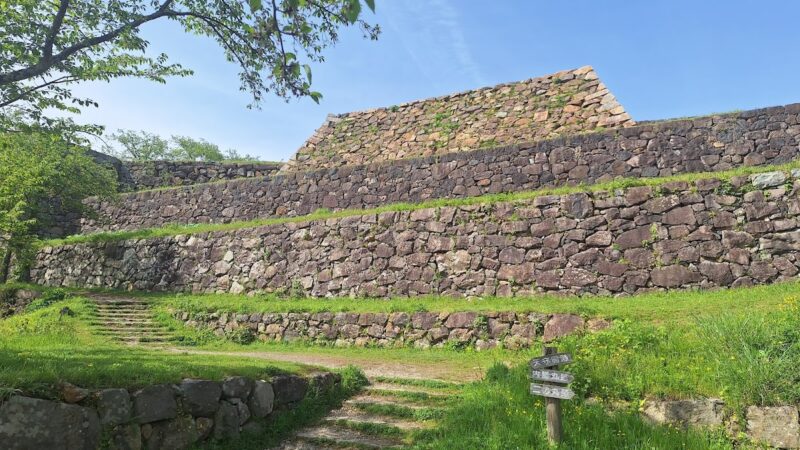
At Osaki Castle, earthworks can be observed, primarily around the main enclosure. Stone walls were not used; defense relied on earthworks. This is a typical construction technique for medieval mountain castles and reflects the characteristics of castle architecture in the Inaba region at that time.
While the height and shape of the earthworks vary depending on the location, the earthworks on the south side of the main enclosure are particularly clearly preserved and are important remains for understanding the castle’s defensive structure.
Entrances and Passages
The arrangement of passages and entrances (koguchi) connecting the enclosures is also important for understanding the defensive structure of Osaki Castle. Numerous ingenious measures to prevent enemy intrusion are evident, demonstrating the high level of medieval castle construction technology.
Highlights of Osaki Castle
1. Earthen Embankment of the Main Enclosure
A must-see when visiting Osaki Castle is the earthen embankment remaining on the south side of the main enclosure. This defensive structure from the Sengoku period (Warring States period), approximately 440 years ago, is remarkably well-preserved, allowing for direct observation of the castle-building techniques of that era.
Standing atop the embankment, you can truly appreciate the crucial role this earthen wall played in protecting the castle.
2. Spectacular View of the Sea of Japan
The view of the Sea of Japan from the main enclosure is one of Osaki Castle’s greatest attractions. The castle’s former lords likely monitored the sea’s movements while gazing at this view.
The view at sunset is particularly magnificent, allowing you to watch the sun sinking into the Sea of Japan. It’s a luxurious spot where you can enjoy both castle exploration and the beauty of nature simultaneously.
3. Consecutive Groups of Enclosures
By sequentially visiting the group of enclosures on the east side, you can experience the overall structure of the castle. Walking while observing the size and arrangement of each enclosure allows you to gain insight into the castle-building techniques and strategic thinking of the Sengoku period. ### 4. Location as a Coastal Castle
The unique topography of Osaki Castle, jutting out into the Sea of Japan, is its main attraction. The distinctive landscape, where the sea and mountains merge, offers a charm not found in other mountain castles.
Exploring the castle ruins while considering its function as a coastal castle helps to understand its strategic role in monitoring maritime traffic and securing supply routes.
4. Location as a Coastal Castle
The castle’s unique topography, jutting out into the Sea of Japan, is its main draw. The distinctive scenery, where the sea and mountains merge, offers a charm not found in other mountain castles. ## Access to Osaki Castle
Location
689-0331 Okusawami, Ketaka-cho, Tottori City, Tottori Prefecture
Access by Car
- Approximately 15 minutes from Tottori-Nishi IC on the Tottori Expressway
- Approximately 30 minutes from JR Tottori Station via National Route 9
- There is some parking space near the castle ruins, but please be careful not to park on the street.
Access by Public Transportation
- Approximately 40 minutes on foot from JR San’in Main Line Takaragi Station
- Approximately 50 minutes on foot from JR San’in Main Line Hamamura Station
Access by public transportation is somewhat inconvenient, so we recommend visiting by car.
Ascent Route
The elevation difference from the entrance to the main enclosure is 88 meters, making it a relatively easy climb. There is a well-maintained hiking trail, and the required time is about 20-30 minutes.
For a leisurely visit to the entire castle ruins, allow 45 minutes to 1 hour.
Points to Note When Visiting
Clothing and Equipment
- Please wear comfortable walking shoes (trekking shoes or athletic shoes).
- As it is a mountain castle, wearing long sleeves and long pants is recommended.
- Insect repellent spray is useful in summer.
- Bring drinking water with you.
Safety Precautions
- Be careful as the ground can be slippery during and after rain.
- Do not approach cliffs or steep slopes.
- Visiting in a group is recommended rather than alone.
- Check your cell phone signal strength beforehand.
Manners
- Please be careful not to damage the ruins.
- Always take your trash with you.
- Do not trespass on private property.
- The use of fire is strictly prohibited.
Related Historical Sites in the Surrounding Area
When visiting Osaki Castle, visiting the related historical sites in the surrounding area will allow you to gain a deeper understanding of the Sengoku period history of Inaba Province.
Tottori Castle (Hisamatsuyama Castle)
Tottori Castle, famous for Hashiba Hideyoshi’s “starvation siege,” is located about 30 minutes by car from Osaki Castle. It was closely related to Osaki Castle in the 9th year of the Tensho era (1581), and visiting both is highly recommended.
Other Castles in Inaba Province
- Aishita Castle: A castle of the Yamana clan located in Tottori City
- Miyoshi Castle: A branch castle in the vicinity of Ketaka-cho
- Nakamura Castle: A related castle located near Osaki Castle
Visiting these castle ruins will give you a comprehensive view of the castle network in Inaba Province.
Research and Preservation Activities of Osaki Castle
Local Preservation Activities
In recent years, local volunteers have been actively engaged in the preservation and maintenance of Osaki Castle. Improvements to the access roads and the installation of information boards have created an environment where visitors can safely view the castle ruins.
Thanks to the efforts of these local people, this valuable historical heritage is being passed down to future generations.
Cultural Property Protection in Tottori Prefecture
The Tottori Prefectural Board of Education has conducted a castle survey, and the historical value of Osaki Castle has been academically evaluated. It is also being used in history education for residents through educational outreach activities such as the “Tottori Main Culture Lecture Series.”
Future Challenges
To further enhance the historical value of Osaki Castle, the following challenges remain:
- Clarification of history through continued historical document research
- Detailed surveying of remains and creation of a castle layout map
- Formulation of a preservation and maintenance plan
- Utilization as a tourist resource
- Training of successors and sustainability of preservation activities
The Charm and Value of Osaki Castle
Historical Value
Osaki Castle is a castle that played a significant role in the siege of Tottori Castle by Hashiba Hideyoshi in 1581, a battle of great importance in Japanese history. As the stage for the battles between the Oda and Mori forces, it is a valuable historical site that tells the story of the Sengoku period.
Osaki Castle, which functioned as a fortified camp for the Mori army led by Kikkawa Motoharu, is an indispensable site for understanding the Sengoku period history of the Chugoku region.
Value in Castle Research
Osaki Castle, with its characteristics as a coastal castle, is an important case study in the study of medieval mountain castles. The remains, such as earthworks and baileys, are well-preserved, providing valuable materials for studying the castle construction techniques of the time.
The fact that it is an earthen castle without stone walls is also an important element that demonstrates the characteristics of castle construction techniques in the Inaba region.
Value as a Tourism Resource
Its location, offering spectacular views of the Sea of Japan, is attractive not only to castle enthusiasts but also to general tourists. As a spot where visitors can enjoy historical exploration and nature walks simultaneously, it has potential as a regional tourism resource.
Its relatively easy accessibility as a mountain castle is also an advantage, allowing it to attract visitors of a wide range of ages.
Significance of Visiting Osaki Castle
By actually visiting Osaki Castle, you can gain the following experiences and learning opportunities:
The Awe-Inducing Experience of Standing at a Historic Site
Standing at the very site where Hashiba Hideyoshi and the Mori army confronted each other over 440 years ago, you can feel the weight of history firsthand. This offers a real historical experience that cannot be obtained from textbooks or documents alone.
Understanding Sengoku Period Strategies
By actually seeing the location and layout of the castle as a coastal fortress, you can understand the military strategies and castle-building philosophies of the Sengoku period. Standing on-site clarifies why the castle was built in this location and what role it played.
A Fusion of Nature and History
The space where the beautiful scenery of the Sea of Japan and historical remains are integrated offers visitors a special and moving experience. The castle ruins, nestled in nature, are also a healing space that allows you to forget the hustle and bustle of modern life.
Summary
Osaki Castle, located in Okusawami, Ketaka-cho, Tottori City, Tottori Prefecture, is a coastal castle of high historical value that played a crucial role in Hashiba Hideyoshi’s siege of Tottori Castle in 1581.
Built on a ridge jutting out into the Sea of Japan at an altitude of 94 meters, its location was ideal for monitoring maritime traffic and securing control of the seas. It was used as a fortified camp by the Mori clan, particularly by the forces led by Kikkawa Motoharu. While there are various theories regarding the castle’s lord, including Hido Saemon and Tagami Takatsugu, no definitive historical records remain.
Even today, the remains of the main enclosure, including the earthworks and a series of baileys, are well-preserved, and local volunteers have made it easily accessible. With a relative elevation of 88 meters, it’s relatively easy to climb, and a tour of the entire castle site takes approximately 45 minutes to an hour.
Osaki Castle, offering stunning views of the Sea of Japan while allowing visitors to reflect on the history of the Sengoku period, is a recommended spot not only for castle enthusiasts but also for history buffs and nature lovers. Visiting it along with other related historical sites in the area, such as Tottori Castle, will provide a deeper understanding of the Sengoku history of Inaba Province.
As a valuable historical site that tells the story of the Sengoku period in Inaba Province, and as a castle with the unique charm of being a coastal castle, Osaki Castle will continue to convey historical lessons and inspiration to many people in the future.