Complete Guide to Kushina Castle (Tottori City): History and Highlights of the Mountain Castle Where Tottori Prefecture’s First Large-Scale Foundation Building Remains Were Discovered
Kushina Castle, located in Tottori City, Tottori Prefecture, is a mountain castle that has attracted attention due to the recent discovery of the first large-scale foundation building remains in Tottori Prefecture through archaeological excavations. It is a historically valuable castle site, serving as an important base in the Inaba region during the Sengoku period and as the stage for Hashiba Hideyoshi’s invasion of Inaba.
History and Origin of Kushina Castle
About the Name Kushina Castle
The name Kushina Castle is pronounced “Kushina-jo” and is sometimes written as “狗屍那城”. There are various theories about the origin of this unique name, but it is thought to be derived from a place name. As a mountain castle in the Inaba region, it is an important historical site that conveys the region’s history to the present day.
The Era of Lord Yamana Danjo and the Local Samurai
Kushina Castle was the residence of Yamana Danjo, a local samurai of Inaba Province during the Sengoku period. Local samurai were a class of warriors rooted in their local communities, while still subordinate to the central daimyo. Yamana Danjo held considerable power in the Inaba region and ruled over this area.
The exact construction date is unknown, but it is believed to have functioned as a regional defense base during the turbulent Sengoku period. Its location as a mountain castle made it a strategic point overlooking the surrounding area, occupying a militarily important position.
The Inaba Campaign and the Fall of the Castle in 1580
In 1580 (Tensho 8), Hashiba Hideyoshi, acting on orders from Oda Nobunaga, launched an invasion of Inaba Province. As part of this military operation, Kushina Castle was also targeted.
It is said to have been captured by Kamei Korenori, the lord of Kano Castle. Kamei Korenori was a samurai who served under Hashiba Hideyoshi and contributed to the pacification of Inaba Province. He later became the lord of Kano Castle, ruling over eastern Inaba. The capture of Kushina Castle was one of the important battles in Hideyoshi’s process of unifying Inaba.
During this period, fierce battles were being fought in the Inaba region, centered around Tottori Castle, and Kushina Castle was caught in the middle of these conflicts.
Groundbreaking Archaeological Findings of 2020
Discovery of Tottori Prefecture’s First Large-Scale Foundation Stone Building Remains
In an archaeological excavation conducted in 2020 (Reiwa 2), the first large-scale foundation stone building remains in Tottori Prefecture were discovered at the Kushina Castle site. This is an extremely important discovery in castle research.
A foundation stone building is an architectural style in which pillars are not directly embedded in the ground but placed on stones. This construction method is highly durable and was used for prestigious buildings. The building remains discovered at Kushina Castle are large in scale and are presumed to have been a palace-like structure.
This discovery reveals that Kushina Castle was not merely a military base, but also functioned as the lord’s residence and a place for conducting government affairs. The fact that it possessed a palace-like building despite being a mountain castle speaks to the castle’s importance.
Ongoing Research Activities
Following the 2020 discovery, supplementary research has been continuously conducted since the following year. Trench (test excavation) surveys, which began on June 14th, have advanced the detailed structural analysis of the main enclosure.
The focus of the research is on the following points:
- Confirmation of the condition of the cliffs
- Detailed topography of the earthworks partitioning the main enclosure
- Understanding the overall building layout
- Clarification of the castle’s defensive structure
Through these investigations, the overall picture of Kushina Castle is gradually becoming clearer.
Structure and Characteristics of Kushina Castle
Location and Layout as a Mountain Castle
Kushina Castle is a typical mountain castle, with its main enclosure located at the mountaintop. Mountain castles are defensive structures that make maximum use of the terrain, making them difficult for attackers to conquer.
The main enclosure is the central part of the castle, where the lord’s residence and important facilities were located. The aforementioned large foundation stone building remains were also discovered in this main enclosure. It is believed that multiple enclosures (kuruwa) were arranged around the main enclosure.
Defensive System Using Earthworks and Cut Slopes
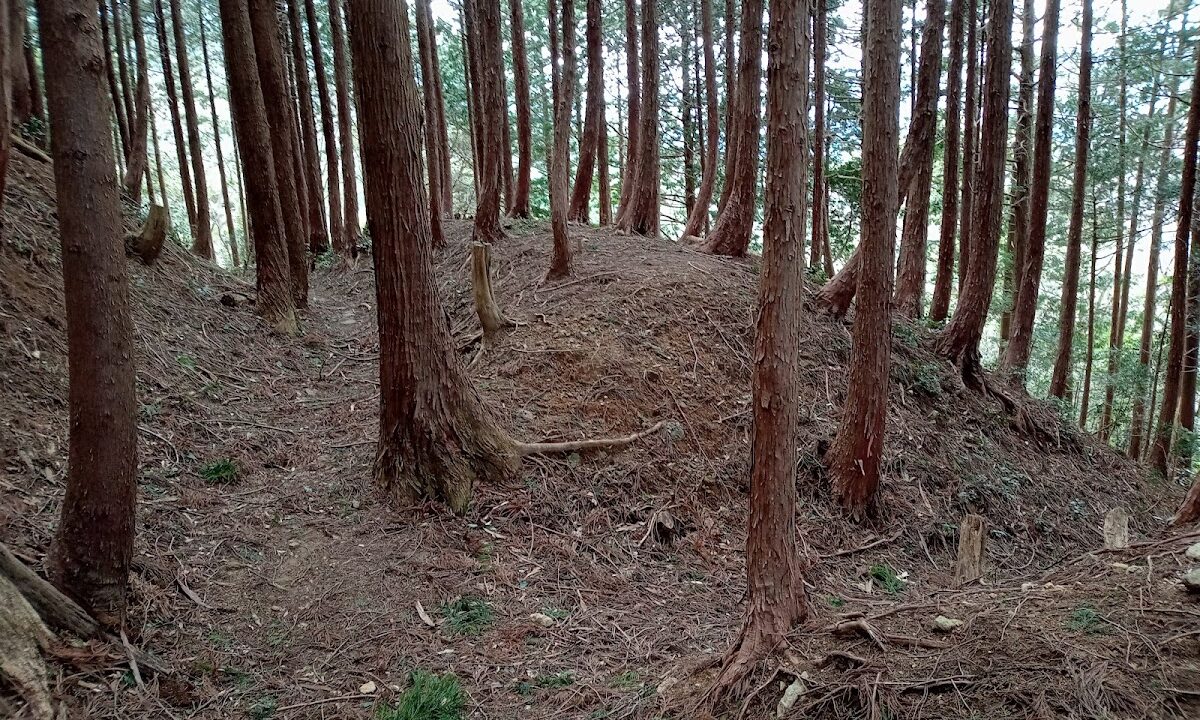
Clear traces of earthworks remain at the castle site today. Earthworks are defensive structures built by piling up earth, preventing enemy intrusion and serving to demarcate the enclosures.
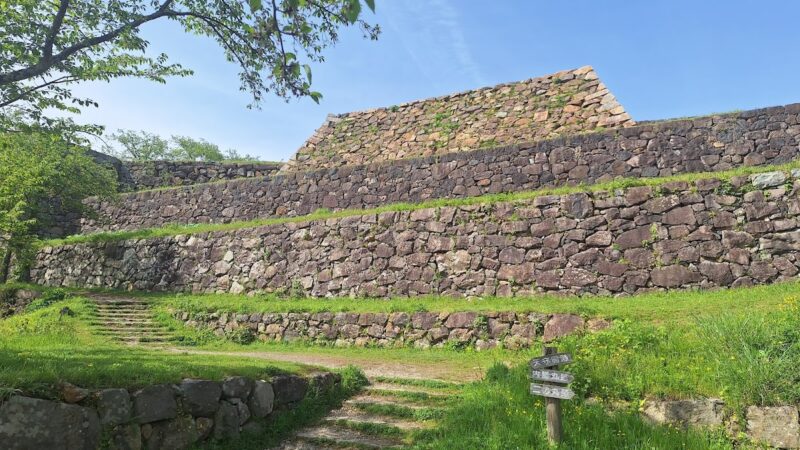
Cut slopes are defensive structures created by artificially cutting and steepening the slopes. By modifying the natural terrain, they had the effect of making it difficult for enemies to climb. The steep cliffs of Kushina Castle are still clearly visible today, demonstrating the high level of castle construction technology of the time.
Characteristic Arrangement of Horizontal and Vertical Moats
A notable feature of Kushina Castle is the presence of horizontal and vertical moats, which are not found in surrounding mountain castles.
Horizontal moats are moats dug horizontally along contour lines, serving to prevent enemy lateral movement. This is a relatively rare defensive feature in mountain castles, indicating the advanced construction technology of Kushina Castle.
Vertical moats are moats dug vertically along slopes, effectively cutting off enemy climbing routes. They also functioned as rainwater drainage channels.
The presence of these moats suggests that Kushina Castle was not a simple mountain castle, but a highly planned and sophisticated defensive structure.
Highlights and Current Status of Kushina Castle
Remains of the Main Enclosure
The greatest highlight when visiting the castle site is the group of remains in the main enclosure. This is where the remains of a large foundation stone building were discovered, allowing you to truly appreciate the central part of the castle.
The recessed terrain demarcated by earthworks is thought to be the trace of a building that once stood there. By walking around and imagining the arrangement of the foundation stones revealed by archaeological excavations, you can envision the appearance of a castle from the Sengoku period.
Observation Points for Defensive Structures
At Kushina Castle, you can actually observe the following defensive structures:
Earthworks: The earthworks that remain clearly visible around the main enclosure allow you to estimate the scale of the castle at the time from their height and width.
Cut Slopes: The artificially carved steep slopes are still clearly visible today, allowing you to appreciate their high defensive function.
Horizontal and Vertical Moats: You can observe the distinctive arrangement of moats not found in surrounding mountain castles. In particular, parts of the moat are well-preserved.
These remains serve as valuable teaching materials for learning about castle construction techniques of the Sengoku period.
Views and Surrounding Environment
From Kushina Castle, a mountain castle, you can enjoy a panoramic view of the surrounding area. This view was a major factor in its value as a military base. On a clear day, you can see a wide area of the Inaba region’s topography, helping you understand why the castle was built in this location.
Positioning in the Inaba Province Castle Network
Relationship with Tottori Castle
Tottori Castle, the central castle of Inaba Province, is famous for Hashiba Hideyoshi’s “starvation siege of Tottori.” Kushina Castle played a part in the Inaba castle network centered around Tottori Castle.
During the Inaba campaign of 1580, Hideyoshi’s army successively captured the surrounding subsidiary castles before besieging Tottori Castle. Kushina Castle was one of the castles that fell during this process, and it is believed to have contributed to the construction of the siege network surrounding Tottori Castle.
Connection to Kano Castle
Kano Castle, the base of Kamei Korenori, who captured Kushina Castle, was an important strategic point in eastern Inaba Province. The distance and relative location of Kano Castle to Kushina Castle are crucial for understanding military operations at the time.
Kamei Korenori used Kano Castle as his base to pacify eastern Inaba Province, and the capture of Kushina Castle was a significant achievement in that process.
Surrounding Mountain Castles
Besides Kushina Castle, many other mountain castles exist within Tottori City:
- Fuse Tenjin-yama Castle: An important stronghold close to the Inaba Provincial Governor’s Office
- Kageishi Castle: A castle of a powerful local lord in eastern Inaba
- Bokoo Castle: Functioned as a branch castle of Tottori Castle
- Katsuyama Castle: A strategic point overlooking the Tottori Plain
Visiting these castles along with Kushina Castle will provide a deeper understanding of the castle system of Inaba Province.
Access and Visiting Information
Location
Kushina Castle ruins are located within Tottori City, Tottori Prefecture. For specific location information, it is recommended to check with the Tottori City Board of Education or the Tottori Prefectural Buried Cultural Properties Center before visiting.
Transportation Access
Public Transportation: You will need to use a bus or taxi from Tottori Station. Since it is a mountain castle, caution is required when accessing the castle entrance.
Private Car: Accessible by car from Tottori City, but parking space may be limited. We recommend gathering information in advance.
Precautions for Visiting the Castle
The following preparations are necessary for visiting the mountain castle:
- Clothing: Comfortable clothing and non-slip shoes (trekking shoes recommended)
- Equipment: Drinking water, insect repellent, towel
- Season: Be aware of the heat and insects in summer; consider the possibility of snow in winter
- Time: Visit with ample time to spare
Please be careful not to damage the earthworks or cliffs to protect the remains.
Research and Future Prospects of Kushina Castle
Initiatives by the Tottori Prefectural Board of Education
The Tottori Prefectural Board of Education recognizes the importance of the Kushina Castle ruins and is conducting ongoing research. Since the discovery of large foundation stone building remains in 2020, more detailed investigations are planned, and further discoveries are expected.
The survey results are published periodically on Tori-Net (Tottori Prefecture’s official website) and other platforms, allowing the general public to access the latest information.
Outreach Sessions and Public Awareness Activities
Tottori Prefecture is conducting outreach activities, such as outreach sessions, to widely inform residents about the survey results of the Kushina Castle ruins. At these events, experts can directly explain the details of the excavation and the unearthed artifacts.
The site is being considered for use as a regional historical heritage site and a tourist resource, and future development plans are attracting attention.
Expectations for Historic Site Designation
Following the significant discovery of the large foundation stone building remains, the possibility of future historic site designation is being considered. While Tottori Castle is a nationally designated historic site among castles in Tottori Prefecture, Kushina Castle also deserves consideration for designation as a prefectural historic site or similar.
Historic site designation is expected to strengthen the protection of the remains and accelerate development.
Learning about the History of Inaba
Inaba Province in the Sengoku Period
Inaba Province is the region corresponding to the eastern part of present-day Tottori Prefecture. During the Sengoku period, various forces such as the Yamana, Amago, and Mori clans vied for supremacy. A local samurai class, known as the “local samurai,” also maintained its own power, and Yamana Danjo of Kushina Castle was one such figure.
Inaba Province was a strategically important region, a key point connecting Kyoto and the San’in region. Therefore, Oda Nobunaga ordered Hashiba Hideyoshi to conquer Inaba.
The Overall Picture of Hashiba Hideyoshi’s Inaba Campaign
The 1580 campaign against Inaba was a crucial operation for Hideyoshi in his pacification of the Chugoku region. In the campaign centered around Tottori Castle, the strategy was to first capture the surrounding subsidiary castles and isolate Tottori Castle.
The capture of Kushina Castle was part of this strategy, and it fell thanks to the efforts of Kamei Korenori. After a long siege, Tottori Castle surrendered, and Inaba Province came under Hideyoshi’s control.
This battle marked a crucial step in Hideyoshi’s path to unifying Japan.
Inaba Province After the Edo Period
During the Edo period, Inaba Province was ruled by the Ikeda clan as the Tottori Domain. The Tottori Domain was a large domain with a 320,000 koku (unit of rice production) yield, and Tottori Castle served as its residence. Mountain castles like Kushina Castle were abandoned and forgotten during the peaceful era.
However, recent advances in castle research have led to a renewed recognition of the historical value of these mountain castles. The excavation of Kushina Castle is part of this trend.
Kushina Castle for Castle Enthusiasts
Attractiveness to Mountain Castle Enthusiasts
Kushina Castle is a very attractive castle site for mountain castle enthusiasts. The reasons are:
- Well-preserved remains: Earthworks, cliffs, and moats are clearly visible.
- Unique defensive features: The presence of horizontal and vertical moats, which are not found in surrounding mountain castles.
- Latest excavation findings: A groundbreaking discovery of the remains of a large foundation stone building.
- Historical context: A clear historical context: Hideyoshi’s invasion of Inaba.
These factors combine to make this castle site highly valuable both as a subject of castle research and as a destination for castle enthusiasts.
Photography Tips
Photography tips when visiting Kushina Castle:
- Main Enclosure Earthwork: A composition that emphasizes the clearly remaining cross-section and height of the earthwork.
- Cut Slope: Capturing the impressive scale of the artificially carved steep slope.
- Horizontal Moat: The appearance of the moat extending along the contour lines.
- View: The view of Inaba from the main enclosure.
Since the scenery changes with the seasons, visiting multiple times to record the seasonal changes is one way to enjoy the castle.
Combining with Other Inaba Castles
When visiting Kushina Castle, we recommend combining it with the following castles:
Example 1-Day Course:
- Morning: Tottori Castle (National Historic Site, One of Japan’s 100 Famous Castles)
- Afternoon: Kushina Castle and Fuse Tenjin-yama Castle
Example 2-Day Course:
- Day 1: Tottori Castle, Kawara Castle (Observation Deck & Museum)
- Day 2: Kano Castle, Kushina Castle, Kageishi Castle
By visiting multiple castles in this way, you can gain a three-dimensional understanding of the castle system in Inaba Province.
Connection with the Local Community
Local Awareness and Preservation Activities
For a long time, Kushina Castle was a castle ruin whose details were not well known even locally, but recent archaeological excavations have increased its profile. Preservation activities by local residents and cooperation from history enthusiast groups are also underway.
Efforts are underway to pass on this historical heritage to future generations.
Potential as a Tourism Resource
While Tottori Prefecture is famous for its Tottori Sand Dunes, castles are also important historical and cultural resources. Kushina Castle possesses:
- The novelty of being the first large-scale foundation stone building site in Tottori Prefecture
- The historical romance of the Sengoku period
- The appeal of mountain castle trekking
These elements hold the potential for tourism promotion.
Educational Use
Kushina Castle can also be used as teaching material for local history education. When elementary and junior high school students learn about local history, visiting the castle ruins and observing the remains provides learning opportunities that cannot be obtained from textbooks alone.
By making the excavation process public, it is also expected to increase interest in archaeology.
Summary: Historical Significance of Kushina Castle
Kushina Castle, located in Tottori City, Tottori Prefecture, is a Sengoku period mountain castle with multiple important significances. Historical Significance:
- Conveys local history as the residence of Yamana Danjo, a samurai of Inaba Province.
- The stage of Hashiba Hideyoshi’s invasion of Inaba (1580).
- A concrete historical fact: its capture by Kamei Korenori, lord of Kano Castle.
Archaeological Significance:
- Discovery of Tottori Prefecture’s first large-scale foundation stone building remains in 2020.
- Existence of horizontal and vertical moats not found in surrounding mountain castles.
- Valuable as an example of a palace-like building in a mountain castle.
Cultural Property Significance:
- Well-preserved remains such as earthworks and cliffs.
- A subject for ongoing research and investigation.
- Potential for future designation as a historical site.
Tourism and Educational Significance:
- Important for understanding the Inaba castle network.
- A teaching material for local history education.
- A destination for mountain castle trekking.
Kushina Castle is still under investigation and research, and further discoveries are expected in the future. It is an indispensable place for understanding the history of Inaba and for comprehending castles of the Sengoku period. When you visit Tottori, be sure to take a look at this mountain castle full of historical romance.