Complete Guide to Masugatayama Castle (Ome City, Tokyo) | A Thorough Explanation of the Mita Clan’s Mountain Castle Remains, Access, and Highlights
What is Masugatayama Castle?
Masugatayama Castle is a medieval mountain castle located in the Futamatao district of Ome City, Tokyo. Built near the summit of Mount Masugata (376 meters above sea level), it functioned as an important base for the Mita clan, local lords who ruled the Ome region. Currently, it is part of the Ome Hills hiking course and is known as a historical spot visited by mountain climbing enthusiasts and castle fans.
Masugatayama Castle is a mountain castle closely related to Karakai Castle, located to the north, and is believed to have functioned as one of the defensive bases against the invasion of the Later Hojo clan during the “Battle of Karakai” in the Eiroku era (1558-1570). The castle’s name is said to originate from the fact that the castle’s layout was close to a square (masugata).
Historical Background of Masugatayama Castle
While there are no clear records of when Masugatayama Castle was built, it is estimated to have been constructed by the Mita clan, who were based at Karagaki Castle, in the early Eiroku period (around 1560) or earlier. The Mita clan were local lords who controlled the Ome region and strategically positioned multiple castles to control key locations along the Tama River basin.
Masugatayama Castle is located approximately 1 kilometer south of Karagaki Castle, and the two castles are connected by a ridge. This geographical arrangement suggests that Masugatayama Castle served as a subsidiary or auxiliary castle of Karagaki Castle, playing a role in the defense network. It is believed to have played a particularly important role in monitoring and defending against enemy incursions from the Tama River direction.
Around 1563 (Eiroku 6), with the expansion of the Later Hojo clan’s power, the Mita clan came under attack from Hojo Ujiteru (lord of Hachioji Castle). This is known as the “Battle of Karagaki.” In this battle, the Mita clan, led by Mita Tsunahide, resisted from their bases at Karagaki Castle and Masugatayama Castle, but were ultimately defeated, and the Mita clan was destroyed. It is believed that Masugatayama Castle was also abandoned after this battle.
Layout and Structure of Masugatayama Castle
Arrangement of the Main Enclosure and Baileys
The layout of Masugatayama Castle is centered around the mountaintop at an elevation of 376 meters. While the remaining structures that can be confirmed today are limited, it is presumed that multiple baileys (kuruwa) were arranged around the main enclosure. The main enclosure is a relatively flat, leveled area, approximately 30 meters east-west and 20 meters north-south.
Evidence of small lower baileys can be seen around the main enclosure, and the elevation changes and topographical variations suggest the establishment of multiple defensive lines. However, due to years of weathering and vegetation, there are few clearly visible remains.
Moats and Vertical Moats
A notable defensive feature of Masugatayama Castle is the moat (horikiri). Moats have been identified on both the north and south sides of the main enclosure, a clever design to prevent enemy intrusion by dividing the ridge. The northern moat, in particular, remains relatively clear, measuring approximately 3 meters deep and 5 meters wide.
Furthermore, traces of vertical moats (tatebori) can be found on the slopes. Vertical moats are trenches dug vertically into the slopes, hindering lateral movement of enemies and also functioning as rainwater drainage channels. While the vertical moats at Masugatayama Castle are weathered, they can be found in multiple locations with careful observation.
Defense Utilizing the Natural Topography of the Rocky Mountains
The area around Masugatayama is characterized by many rocky mountains and steep terrain. Masugatayama Castle was built by skillfully utilizing these natural strongholds. The eastern and western slopes, in particular, were steep and functioned as natural defensive walls. Access to the castle was restricted to a limited ridge path, making it a disadvantageous terrain for attackers.
Many areas of bedrock are exposed, suggesting they may have been processed as fortified cliffs. Even today, large rocks are scattered around the main enclosure, giving a glimpse of its medieval castle appearance.
Highlights and Remains of Masugata-yama Castle
Flat Area of the Main Enclosure
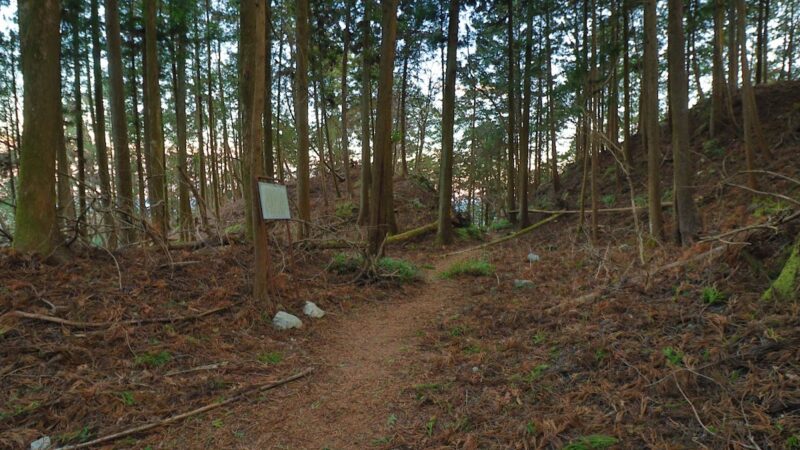
The greatest highlight of Masugata-yama Castle is the flat area of the main enclosure remaining at the mountaintop. Although currently covered with trees, a clearly artificially leveled surface stretches out before you. Standing here, you can survey the surrounding terrain and imagine the former lord monitoring his territory from this spot.
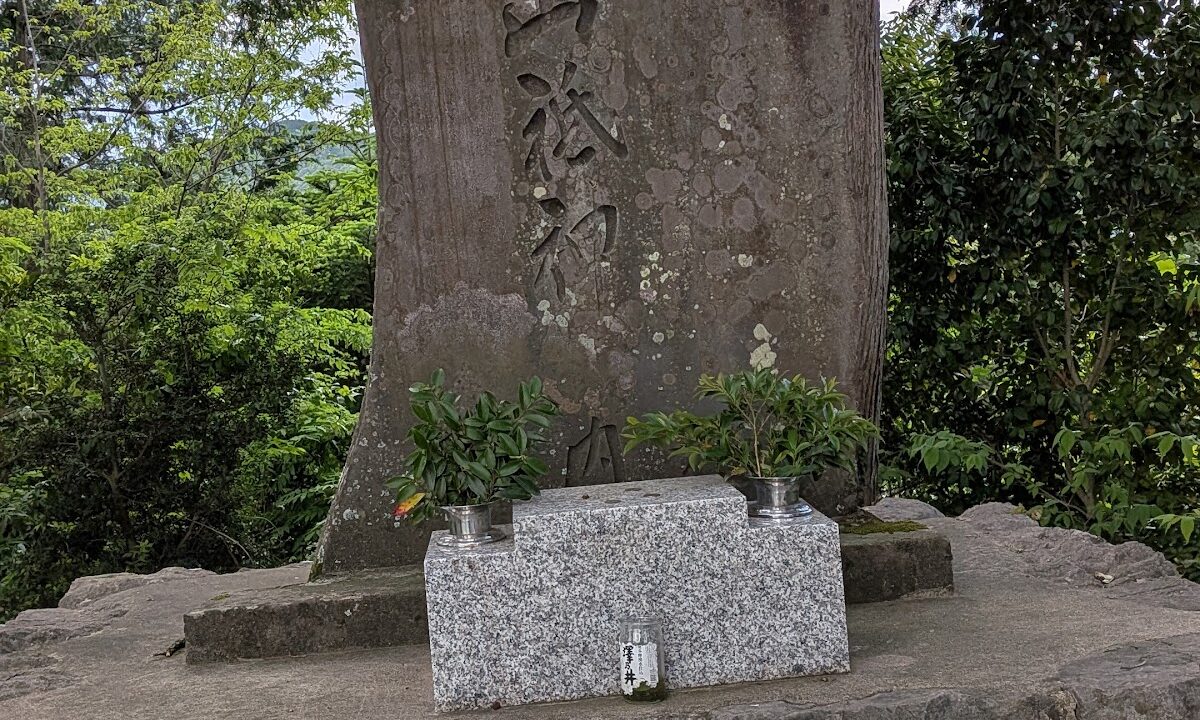
A sign indicating “Masugata-yama Castle Ruins” is installed on the flat area, clearly marking it as a castle site. It is also used as a rest stop for hikers, and benches are sometimes provided.
Remains of the Moat
As mentioned earlier, moats remain on the north and south sides of the main enclosure. The northern moat, in particular, is relatively well-preserved, making it a valuable relic that allows one to experience the defensive structure of a medieval mountain castle firsthand. Standing at the bottom of the moat and looking up at the cliffs on both sides, one can truly appreciate the effectiveness of this defensive structure.
The moat completely cuts off the ridge, demonstrating its powerful barrier against enemy advances. Water sometimes accumulates in the moat after rain, confirming its drainage function as well.
Ridge Path to Momiyama
Following the ridge north from Masugatayama Castle leads to Momiyama (elevation 418 meters). This ridge path was an important communication route even in the medieval period, and was part of the route connecting Masugatayama Castle and Karagaki Castle. Small leveled areas and elevation changes are scattered along the ridge path, suggesting the possibility of watchtowers and communication posts being located there.
From Momiyama, the trail continues to Karagakiyama (elevation 457 meters) and leads to Karagaki Castle. This series of ridges forms the backbone of the Sanda clan’s castle network and remains a popular hiking route today.
Surrounding Views
The view from Masugatayama Castle is limited by tree growth, but during winter and other times when the leaves have fallen, the surrounding terrain can be seen. There are particularly open spots towards the Tama River, allowing one to imagine the former lord monitoring the river.
On clear days, one can see the city of Ome and even the distant Chichibu Mountains. It is believed that during the Sengoku period, enemy movements were monitored from this location, and information was transmitted via smoke signals.
Access to Masugatayama Castle
Access by Public Transportation
The most convenient way to reach Masugatayama Castle is by using the JR Ome Line. The nearest station is Futamatao Station. It’s about a 15-minute walk from the station to the trailhead, and then about a 30-minute hike to the castle ruins.
Route from JR Futamatao Station:
- Exit the north exit of Futamatao Station and head north along the road in front of the station.
- Go through the residential area and head towards the Izumizoin Cemetery.
- The trailhead is on the west side of the Izumizoin Cemetery (there is a signpost).
- After climbing the mountain trail for about 30 minutes, you will arrive at the Masugatayama Castle ruins.
Near the station is Kaizenji Temple, the family temple of the Mita clan. Visiting it before climbing the castle will deepen your understanding of the historical background. Kaizenji Temple has historical sites and information boards related to the Mita clan.
Access by Car
If accessing by car, it’s about 20-25 minutes from the Hinode IC or Ome IC on the Ken-O Expressway (Metropolitan Inter-City Expressway). However, there is no dedicated parking lot near the trailhead, so you will need to use public parking spaces or coin-operated parking lots around Futamatao Station.
Driving Route:
- Approximately 23 minutes from Ken-O Expressway Hinode IC via National Route 411
- Approximately 23 minutes from Ken-O Expressway Ome IC via Ome Kaido and National Route 411
Due to the difficulty in securing parking, the use of public transportation is recommended. Especially on holidays, surrounding roads can be congested, so it is necessary to plan with ample time.
Hiking Routes and Estimated Time
The main hiking routes to Masugatayama Castle are as follows:
Izumizoin Course (Standard Route):
- Trailhead: West side of Izumizoin Cemetery
- Estimated Time: Approximately 30 minutes uphill, approximately 20 minutes downhill
- Difficulty: Beginner to Intermediate
- Features: The most common route, with signposts installed.
Via Ome Hills Hiking Course:
- From Higashi-Ome Station, via Ome Forest, enter the Ome Hills and follow the ridge to Masugatayama Castle.
- Estimated Time: Approximately 2-3 hours from Higashi-Ome Station
- Difficulty: Intermediate
- Features: Enjoy a long-distance hike while visiting.
Via Momiyama and Karagaki Castle:
- From Masugatayama Castle, via Momiyama to Karagaki Castle, or vice versa.
- Estimated Time: Approximately 1 hour from Masugatayama Castle to Karagaki Castle
- Difficulty: Intermediate to Advanced
- Features: Experience the castle network of the Mita clan
While the hiking trails are well-maintained, there are steep slopes and rocky areas characteristic of mountain castles, so appropriate equipment (trekking shoes, gloves, etc.) is necessary. Particular caution is needed after rain, as the trails become slippery.
Relationship between Masugata-yama Castle and Karagaki Castle
The Mita Clan’s Castle Network
Understanding Masugata-yama Castle is crucial to understanding its relationship with Karagaki Castle. Karagaki Castle was the main castle of the Mita clan, built on Karagaki Mountain at an altitude of 450 meters, while Masugata-yama Castle functioned as its subsidiary castle. The two castles are approximately 1 kilometer apart in a straight line and are connected by a ridge, forming an integrated defensive system.
As local lords controlling the Ome region, the Mita clan defended their territory by strategically placing multiple castles. With Karagaki Castle at its center, Masugata-yama Castle, Hinatawada Castle, and others cooperated to establish a system for monitoring and controlling transportation routes in the Tama River basin.
The Battle of Karagaki and the Fate of the Two Castles
Around 1563 (Eiroku 6), Hojo Ujiteru of the Later Hojo clan began his invasion of the Ome region. This battle is known as the “Battle of Karagaki.” Hojo Ujiteru was expanding his control over the Tama region from his base at Hachioji Castle, and the Mita clan was one of the local lords who resisted to the end.
In the Battle of Karagaki, the Mita clan, led by Mita Tsunahide, defended Karagaki Castle as the main battlefield, but Masugatayama Castle is also thought to have functioned as an important defensive base. However, the Mita clan was defeated by the overwhelming forces of the Hojo clan, Tsunahide was killed in battle, and the Mita clan was annihilated.
After this battle, Karagaki Castle and Masugatayama Castle were abandoned and disappeared from the historical stage. The remains that remain at the castle sites today are valuable historical relics that convey the memory of this fierce battle.
Recommended Route for Visiting Both Castles
If you wish to visit both Masugatayama Castle and Karagaki Castle, the following route is recommended:
- Start from JR Futamatao Station
- Visit Kaizenji Temple (the family temple of the Sanda clan)
- From the trailhead west of Senzoin Cemetery to Masugatayama Castle (approx. 30 minutes)
- Visit the ruins of Masugatayama Castle (approx. 30 minutes)
- Follow the ridge to Momiyama (approx. 20 minutes)
- From Momiyama to Karagaki Castle (approx. 40 minutes)
- Visit the ruins of Karagaki Castle (approx. 45 minutes)
- Descend and return to Futamatao Station (approx. 40 minutes)
The total time required is approximately 4-5 hours, making it a hiking course suitable for intermediate hikers. Visiting both castles will allow you to gain a deeper understanding of the strategic layout of the Sanda clan’s castles and the realities of mountain castles during the Sengoku period.
Nearby Tourist Attractions and Related Historical Sites
Kaizenji Temple (Mita Clan’s Family Temple)
Kaizenji Temple is a Soto Zen Buddhist temple known as the family temple of the Mita clan. The temple grounds contain historical sites and information boards related to the Mita clan, allowing visitors to learn about the Battle of Karagaki and the history of the Mita clan. It’s a must-visit spot when visiting Masugatayama Castle.
The temple houses the graves of the Mita family, including Mita Tsunahide, allowing visitors to remember the warriors who perished during the Sengoku period. Documents and legends related to the Battle of Karagaki are also preserved, making it an important place for understanding local history.
Ome Hills Hiking Course
Masugatayama Castle is located as part of the Ome Hills Hiking Course. This course is popular as a hiking route where you can enjoy rich nature despite being close to central Tokyo, and observe seasonal plants and wild birds.
The course features multiple viewpoints and rest areas, and offers a variety of routes suitable for beginners to advanced hikers. Combining a visit to Masugatayama Castle with a hike in the Ome Hills allows you to enjoy both historical exploration and nature walks.
Hinatawada Castle Ruins
Hinatawada Castle is a castle of the Mita clan located south of Masugatayama Castle, along the Tama River. It has characteristics of a flatland castle and a different layout from Masugatayama Castle and Karagaki Castle. It is an important site for understanding the Mita clan’s castle network, and a visit to both is recommended if time permits.
Ome City Local History Museum
This museum allows you to learn about the history and culture of Ome City, and also features exhibits on the Mita clan and the Battle of Karagaki. Visiting before visiting Masugatayama Castle will deepen your understanding of the historical background and make your castle ruins visit more fulfilling.
Precautions and Etiquette for Visiting Masugatayama Castle
Equipment and Clothing
Appropriate equipment is necessary for climbing Masugatayama Castle:
- Shoes: Trekking shoes or hiking boots (with non-slip soles)
- Clothing: Comfortable clothing, layered according to the season
- Items to Bring: Drinking water, snacks, map, compass, mobile phone, first-aid kit
- Recommended Equipment: Gloves, hat, rain gear, headlamp (just in case)
The mountain trail is well-maintained, but there are rocky areas and steep slopes, so please avoid climbing in sneakers or sandals.
Safety Precautions
- Avoid climbing alone; climb in groups whenever possible.
- Be aware of sudden changes in weather; be especially careful during and after rain.
- Always descend before sunset (be especially careful in winter as sunset is earlier).
- Carry a bell or similar device as you may encounter wild animals such as bears and wild boars.
- Inform your family or others of your climbing plans in advance, as there are areas with poor cell phone reception.
Etiquette for Historical Site Preservation
Masugatayama Castle Ruins are a valuable historical heritage site. Please observe the following manners:
- Do not damage the ruins or take away stones or soil.
- Always take your trash with you.
- Collecting plants or capturing animals is prohibited.
- Using fire is strictly prohibited.
- Refrain from entering areas other than the designated hiking trails.
- Avoid actions that may disturb other hikers, such as shouting.
Best Time to Visit
Masugatayama Castle is accessible year-round, but each season has its own unique characteristics:
- Spring (March-May): Beautiful fresh greenery and mild weather. However, those with pollen allergies should be cautious.
- Summer (June-August): Lush greenery and cool forest walks. Insect repellent is necessary.
- Autumn (September-November): Beautiful autumn foliage, the most popular season. Comfortable temperatures.
- Winter (December-February): Leaves have fallen, making the ruins easier to see, and the views are excellent. Warm clothing is necessary.
Spring and autumn are especially recommended for beginners. In summer, be careful of heatstroke; in winter, be careful of freezing temperatures and snow.
The Charm of Masugata-yama Castle and the Significance of Visiting
An Authentic Mountain Castle You Can Experience in Tokyo
The greatest charm of Masugata-yama Castle is that you can experience the remains of an authentic medieval mountain castle in a location close to central Tokyo. While there are many castle ruins in Tokyo, few mountain castles have relatively well-preserved remains, making Masugata-yama Castle a valuable example.
By actually walking through the remains such as moats and baileys and experiencing the ingenuity of defensive structures from the Sengoku period, you can touch upon the realities of history that you can’t learn from textbooks. You can also understand how the steep terrain and rocky mountains contributed to the castle’s defensive capabilities.
Learning About the History of the Mita Clan
Visiting Masugata-yama Castle is also an opportunity to learn about the history of the Mita clan, a local lord. During the Sengoku period, not only daimyo but also local lords in various regions protected their territories and lived while being tossed about by the waves of the times. The Mita clan is a typical example; although they were ultimately destroyed by the Later Hojo clan, their history of resistance is still recounted today as a part of the region’s identity.
Visiting related historical sites such as Kaizenji Temple, along with the castle ruins themselves, deepens your understanding of the region’s history and culture beyond a simple castle visit.
A Fusion of Hiking and Historical Exploration
Masugatayama Castle is a rare spot where you can enjoy hiking and historical exploration simultaneously. Walking through the rich natural beauty of the Ome Hills, you can visit the ruins of a medieval mountain castle and extend your trip to nearby Momiyama and Karagaki Castle for a fulfilling day.
Those confident in their physical fitness can undertake a more challenging hike, starting from Higashi-Ome Station, via the Ome Hills hiking course to Masugatayama Castle, and continuing on to Karagaki Castle. Conversely, those who prefer a lighter stroll can choose a shorter course visiting only Masugatayama Castle from Futamatao Station.
The Joy of Photography and Documentation
Masugatayama Castle and its surroundings are attractive subjects for photography. There are various subjects to photograph, including the remains, the surrounding nature, and the views. The views are especially spectacular during the autumn foliage season and on clear winter days.
Sharing your visit records on social media and blogs allows you to connect with people who share the same interests. Posting your records on community sites such as Kojodan and Yamareco can also be helpful to other visitors.
Summary: The Value of Visiting Masugatayama Castle
Masugatayama Castle in Ome City, Tokyo, is a medieval mountain castle built on a 376-meter-high mountaintop. It functioned as an important base for the Mita clan. It played a crucial role in the “Battle of Karagaki” during the Eiroku era as part of a defensive network linked with Karagaki Castle.
Currently, it is part of the Ome Hills hiking course, and remains such as moats and baileys can be seen. Accessible on foot from JR Futamatao Station, it takes approximately 30 minutes to reach the castle from the trailhead west of Senzoin Cemetery. The surrounding area boasts numerous related historical sites, including Kaizenji Temple, Karagaki Castle, and Momiyama Mountain, making it a perfect place for a fulfilling day combining historical exploration and hiking.
As a rare spot in Tokyo where you can experience the remains of an authentic mountain castle, it’s recommended not only for castle enthusiasts but also for history buffs and hiking lovers. With appropriate equipment and preparation, why not visit Masugatayama Castle, where the history of the Sengoku period still breathes?