Oomaru Castle, Inagi City, Tokyo | The Complete Picture of a Medieval Mountain Castle Overlooking the Tama River
Oomaru Castle, formerly located in Oomaru, Inagi City, Tokyo, is an important mountain castle site that tells the story of the medieval history of the Tama River basin. Although it is now a residential area of Tama New Town, archaeological excavations have revealed the castle’s structure and unearthed artifacts, shedding light on the lives of the samurai and its role as a strategic base. This article provides a comprehensive explanation of Oomaru Castle, from its historical background to the details of the excavations and its relationship to surrounding medieval castles.
Basic Information on Oomaru Castle
Oomaru Castle was a medieval castle located in Oomaru, Inagi City, Tokyo. Its exact location is in the current Tama New Town area, on a small hill formerly known locally as “Shiroyama” (Castle Mountain).
Location and Former Province
- Location: Daimaru, Inagi City, Tokyo
- Former Province: Musashi Province
- Postal Code: 206-0801
- Nearest Station: Minami-Tama Station, JR Nambu Line (approx. 5-minute walk)
- Current Status: Developed as a residential area; all historical remains have disappeared.
The Daimaru area is located in the northwestern part of Inagi City, with the Tama River flowing to the north and the Tama Hills to the west. This geographical condition is one of the reasons why it became a strategically important base in the Middle Ages.
Classification and Structure
- Classification: Mountain Castle
- Construction Period: Early 14th Century (Early Muromachi Period, Nanboku-cho Period)
- Builder: Unknown
- Lord: Unknown
- Renovator: Unknown
- Keep Structure: None (As it is a medieval castle, there is no keep)
- Remains: Lost (Only archaeological records remain)
Oomaru Castle is a typical medieval mountain castle, a defensive structure that utilized the natural terrain. It is thought that there were no structures like a keep, typical of early modern castles, and that the defenses mainly consisted of earthworks and moats.
Historical Background and Overview of Oomaru Castle
Historical Background of Construction
Oomaru Castle was built in the early 14th century, during the turbulent period from the end of the Kamakura period to the beginning of the Muromachi period. This period, from Emperor Go-Daigo’s Kenmu Restoration to the Nanboku-cho War, was a particularly chaotic time in Japanese history. In Musashi Province, the forces of Nitta Yoshisada and Ashikaga Takauji were fiercely opposed, and the Tama River basin became a crucial military border.
The Tama River at that time served as a natural defensive line dividing Musashi Province into north and south, and river crossing points were strategically extremely important. Daimaru Castle was located on a hill overlooking an important river crossing point known as “Koremasa no Watashi,” and it is believed to have played a role in monitoring and controlling this crossing point.
Medieval Castles in the Tama River Basin
Daimaru Castle was not an isolated castle, but part of a network of medieval castles scattered throughout the Tama River basin. The following castles existed in the surrounding area:
- Sekido Castle: A castle located in Sekido, Tama City, on the opposite bank of the Tama River. A crucial strategic point controlling the Kamakura Road:
- Takayasu-ji Castle: A castle located in Fuchu City. A defensive line on the north bank of the Tama River.
- Ozawa Castle: Another castle site in Inagi City.
It is presumed that these castles cooperated with each other, forming a defense network along the Tama River basin. Daimaru Castle likely functioned as a surveillance post on the south bank within this network.
The Role and Strategic Importance of the Castle
The main roles of Oomaru Castle are thought to have been as follows:
- Monitoring the River Crossing Point: Monitoring and controlling river crossings on the Tama River from a position overlooking the Koremasa ferry crossing.
- Defense of the Kamakura Road: Defending the important road leading from Kamakura to northern Musashi Province.
- Information Transmission Relay Point: A base in the information transmission network using beacons and other means.
- Center for Regional Control: The residence of a local lord who controlled the surrounding area.
The Tama River was a major transportation route at the time and was also important as a route for transporting goods. Oomaru Castle was a castle that controlled such an economically and militarily important point.
Details and Results of the Excavation
Background of the Investigation
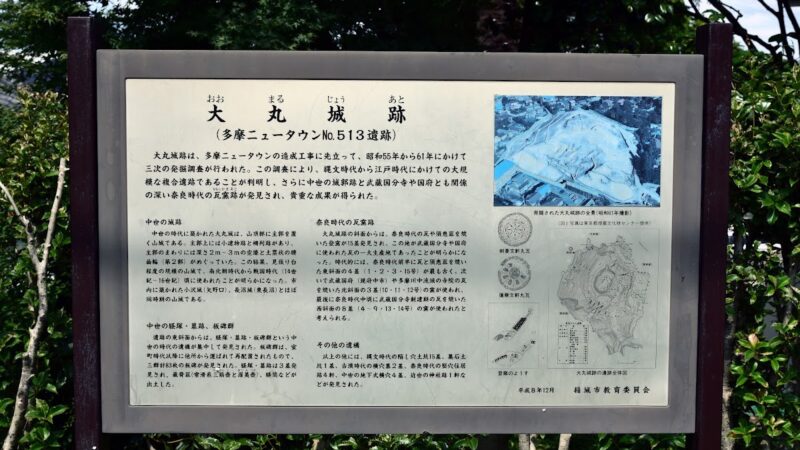
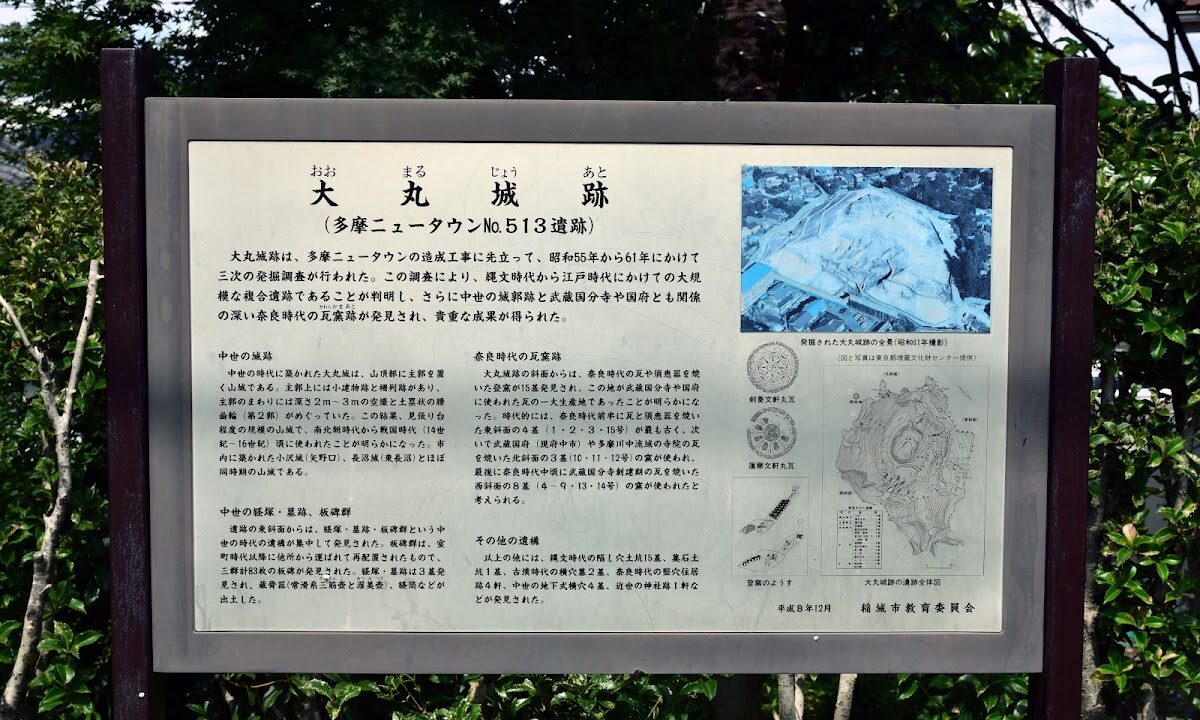
The excavation of Oomaru Castle was conducted as a preliminary survey in conjunction with the development of Tama New Town. From 1980 (Showa 55) to 1986 (Showa 61), a large-scale survey was conducted by the Tokyo Metropolitan Archaeological Center.
During the construction of the Daimaru district, a small hill known as “Shiroyama” was leveled, and the remains of a medieval castle were discovered. This survey was conducted as part of the Daimaru Site (Tama New Town Site No. 513) and was a comprehensive investigation including not only the castle remains but also the remains of surrounding settlements.
Discovered Remains
The following remains were confirmed through excavation:
Defensive Structures
- Horikiri: A defensive ditch dug to cut across a ridge
- Dorui: Traces of a defensive wall made of piled-up earth
- Kuruwa: A flat, leveled enclosure. Multiple baileys were identified.
- Vertical moat: A defensive ditch dug along the slope.
These remains reveal that Oomaru Castle was not merely a lookout post, but a full-fledged mountain castle with certain defensive capabilities.
Building remains
Traces of post holes and foundation stones were discovered within the baileys, confirming the existence of wooden structures. It is presumed that these were facilities such as the lord’s residence, soldiers’ quarters, and warehouses.
Excavated artifacts and dating
The excavation yielded numerous artifacts, providing important clues to the castle’s age and character:
Ceramics
- Seto ware: A representative Japanese pottery of the medieval period. Everyday tableware such as bowls and plates.
- Tokoname ware: Storage containers such as jars and pots. Indicates the stockpiling of supplies.
- Chinese celadon: A high-quality item. Indicating the castle lord’s economic power and status
Based on the style of these ceramics, the castle is estimated to have been in use from the first half to the mid-14th century. Chronological research on Seto ware, in particular, has made more precise dating possible.
Weapons and Armor
- Iron Arrowheads: Iron arrowheads. Traces of battle.
- Small Knives: Small knives. Also used as everyday tools.
- Nails: Iron nails used in construction.
The discovery of weapons confirms that this castle actually functioned as a military base.
Other Artifacts
- Earthenware Cups: Unglazed earthenware. Used in rituals and daily life.
- Whetstones: Stones used for sharpening blades. Traces of Daily Life
- Carbonized Grain: Indicates food storage
Castle Structure Revealed by the Investigation
Based on the results of the excavation, it is believed that Oomaru Castle had the following structure:
- Main Enclosure: The central enclosure located at the highest point. It is presumed to have been the residence of the castle lord.
- Second Enclosure: An enclosure surrounding the main enclosure. It served both defensive and residential functions.
- Demarcation by Moats: Each enclosure was clearly separated by moats.
- Flanking Defense by Vertical Moats: A defensive structure to prepare for attacks from slopes.
- Earthwork Wall: A defensive line created by earthworks surrounding the edges of the enclosures.
The castle’s size is medium for a medieval mountain castle, and it is estimated to have been large enough to accommodate several dozen to one hundred people at any given time.
Current Information on the Daimaru Castle Ruins and Surrounding Area
Current Situation
Unfortunately, the remains of Daimaru Castle have completely disappeared due to the development of Tama New Town. Currently, the castle site has been developed into a residential area, and it is impossible to see any trace of the former castle hill.
However, an explanatory sign has been installed near the site where the castle once stood, allowing visitors to learn about the castle’s history. The sign is located in a residential area along Shiroyama Street and is accessible in about 5 minutes on foot from Minami-Tama Station.
Location and Content of the Explanatory Sign
The explanatory sign is located on the opposite side of Daimaru Park, in the residential area. From this sign, you can get a sense of the topography overlooking the Tama River from the hill where the castle once stood. The sign contains the following information:
- Historical Background of Daimaru Castle
- Overview of the Excavation Survey
- Introduction of Excavated Artifacts
- Relationship with Surrounding Medieval Castles
Visiting the site in person allows you to experience firsthand why this location was chosen as a strategic base, considering its position relative to the Tama River and its elevated location overlooking the surrounding area.
Exhibition at the Tokyo Metropolitan Buried Cultural Properties Center
For those who want to learn more about Daimaru Castle, we recommend visiting the Tokyo Metropolitan Buried Cultural Properties Center near Tama Center Station. This center features:
- Daimaru Castle Diorama: A three-dimensional model of the castle reconstructed based on the results of archaeological excavations.
- Exhibit of Excavated Artifacts: Ceramics and weapons actually excavated from Daimaru Castle.
- Excavation Records: Photographs, drawings, and reports from the excavation.
- Medieval History of the Tama Region: Explanations of the medieval castles in the Tama River basin, including Daimaru Castle.
The diorama is particularly impressive and ideal for understanding the overall structure of the castle. You may also have the opportunity to hear explanations from expert curators.
Tokyo Metropolitan Buried Cultural Properties Center
- Address: 1-14-2 Ochiai, Tama City, Tokyo
- Access: 5-minute walk from Tama Center Station on the Keio Line, Odakyu Line, and Tama Monorail
- Opening Hours: 9:30-17:00 (Closed Mondays, or the following day if Monday is a public holiday)
- Admission Fee: Free
Access Methods
Access to Daimaru Castle Ruins (Location of the Information Board):
Access by Train
- JR Nambu Line Minami-Tama Station: Approximately 5-minute walk from the South Exit
- Proceed west along Shiroyama Street from the station; the information board is located in a residential area.
Access by Car
- Approximately 10 minutes from Inagi IC on the Chuo Expressway
- Parking: Coin parking available nearby (No parking at Daimaru Park)
Nearby Attractions
Nearby spots you can visit when visiting Daimaru Castle Ruins:
Daimaru Park
A park located near the castle ruins. It has been developed as a place of relaxation for local residents.
Tamagawa Riverbed
The Tamagawa Riverbed, which could be overlooked from the castle. Currently, cycling paths and walking trails have been developed, allowing visitors to walk while imagining the topography of the time.
Yomiuri Land
An amusement park spanning Inagi City and Kawasaki City. Approximately 15 minutes by car from the Daimaru area.
Inagi City Local History Museum
A museum where you can learn about the history of Inagi City. It also houses materials related to Daimaru Castle.
Daimaru Castle and the Medieval History of the Tama Region
The Tamagawa River Basin during the Nanboku-cho Period
The first half of the 14th century, when Daimaru Castle was built, was precisely the turbulent period of the Nanboku-cho period. After the fall of the Kamakura Shogunate in 1333, Emperor Go-Daigo’s Kenmu Restoration began, but it collapsed in just three years. When Ashikaga Takauji enthroned Emperor Kōmyō and established the Muromachi Shogunate, a civil war lasting approximately 60 years ensued between him and Emperor Go-Daigo (Southern Court), who had fled to Yoshino.
The Tama River basin was the front line where the forces of the Southern Court and the Northern Court (Muromachi Shogunate) were evenly matched. In particular, the following battles took place in the surrounding area:
- Battle of Bubaigawara, 1333: Nitta Yoshisada clashed with the Hōjō army on his way to attack Kamakura.
- Battle of Musashino, 1352: The Nitta brothers, Yoshioki and Yoshimune, of the Southern Court, fought against the Ashikaga forces in the Tama River basin.
In this era of warfare, the strategic importance of Ōmaru Castle, which controlled the crossing point of the Tama River, was extremely high.
Local Lords and Castles
The builder and lord of Oomaru Castle are unknown as they are not recorded in historical documents, but it is likely that it was built by a local lord of the Tama region. From the Kamakura period to the Muromachi period, many local lords existed in Musashi Province, each with their own small castles and residences.
It is presumed that Oomaru Castle was built by one of these local lords as a base to protect their territory and to fight on either the Southern or Northern Court side during wartime. Judging from the size of the castle, it is thought to have been a base for a small to medium-sized samurai group leading several dozen to a hundred cavalrymen.
Date of Castle Abandonment
The exact date of Oomaru Castle’s abandonment is unclear, but based on the dating of excavated artifacts, it is highly likely that it ceased use around the mid-14th century. It is thought that its role as a castle ended when the turmoil of the Northern and Southern Courts period subsided and military tensions in the region eased.
Subsequently, the castle ruins remained in the local memory as the place name “Shiroyama” (Castle Mountain), and this name persisted until the development of Tama New Town in the Showa era.
Significance of the Daimaru Castle Research
Tama New Town Development and Buried Cultural Properties
The excavation of Daimaru Castle is an important case study for considering the relationship between large-scale development during the period of rapid economic growth and the protection of buried cultural properties. The development of Tama New Town created vast hilly areas, resulting in the loss of many archaeological sites.
However, at the same time, the excavation surveys conducted prior to development revealed many previously unknown historical facts. Daimaru Castle is one such example; without the survey, it may have disappeared without its existence ever being known.
Contribution to Medieval Castle Research
The excavation of Daimaru Castle has provided important data for the study of medieval castles, particularly 14th-century mountain castles:
- Elucidation of Castle Construction Techniques: Specific examples of mountain castle construction techniques from the first half of the 14th century
- Elucidation of Living Conditions: The living standards and culture of the people who lived in the castle were revealed from the excavated artifacts
- Elucidation of Local History: Contributing to the elucidation of the medieval history of the Tama region, particularly the Nanboku-cho period
- Research on Castle Networks: Elucidating the regional defense system from the relationship with surrounding castles
In particular, the detailed record of the castle’s structure through the excavation serves as an important model case for research methods on castles that no longer exist.
Regional Identity and History Education
Daimaru Castle is also used in local history education as part of Inagi City’s historical identity. In elementary and junior high schools in the city, Daimaru Castle is used as a teaching material for children to learn about local history.
Furthermore, the exhibition at the Tokyo Metropolitan Buried Cultural Properties Center is a valuable resource for deepening understanding of the medieval history of the entire Tama region and is used by many researchers and history enthusiasts.
Reference Books and Related Materials
For those who wish to learn more about Daimaru Castle, here are some major references:
Excavation Report
- “Tama New Town Site No. 513 (Daimaru Site)” Tokyo Metropolitan Buried Cultural Properties Center Survey Report
- A detailed record of the excavation. Includes specialized information such as drawings, photographs, and lists of excavated artifacts.
Books for the General Public
- “Castles of Tokyo” series (various publishers)
- Daimaru Castle is sometimes featured in books introducing castles within Tokyo.
- “Medieval Castles of Tama”
- A comprehensive introduction to medieval castles in the Tama region. Understanding the Position of Daimaru Castle
Papers and Research Materials
- Daimaru Castle-related papers published in various archaeological and historical academic journals
- Available for viewing at university libraries and specialized libraries
Online Resources
- Tokyo Metropolitan Buried Cultural Properties Center official website
- Exhibition information and publication guides
- Inagi City official website
- City history and cultural property information
- National Diet Library Digital Collection
- Old geographical records and local history materials have been digitized
Summary
Daimaru Castle, located in Daimaru, Inagi City, Tokyo, was a mountain castle built in the first half of the 14th century during a period of turmoil as a strategic base to monitor the crossing point of the Tama River. Although the remains have been lost due to the development of Tama New Town, its structure and historical role were recorded in detail through archaeological excavations in the 1980s.
The Tama River basin in the Middle Ages was the front line of fierce conflict between the Southern and Northern Courts, and Daimaru Castle played an important role within this context. The pottery and weapons unearthed during the excavation are invaluable historical materials that convey the lifestyle and culture of the samurai of that time.
While the castle ruins themselves cannot be seen, you can imagine the appearance of Daimaru Castle through the on-site information boards and the diorama at the Tokyo Metropolitan Buried Cultural Properties Center. Its location on a hill overlooking the Tama River remains unchanged, giving a tangible sense of its former strategic importance.
Research on Daimaru Castle offers one answer to the challenge of how to document and pass on lost castles to future generations. From the perspective of balancing development and cultural property preservation, and the transmission of the region’s historical identity, Daimaru Castle will continue to be studied as an important case study.
If you have the opportunity to visit Inagi City, be sure to visit the information boards at the castle ruins from Minami-Tama Station, and while gazing at the flow of the Tama River, reflect on the scenery that medieval samurai saw from this place. Then, visiting the diorama and excavated artifacts at the Tokyo Metropolitan Buried Cultural Properties Center in Tama Center will allow you to understand the castle’s history more deeply.