Complete Guide to Shibuya Castle: A Thorough Explanation of the Heian Period Castle Ruins in Shibuya, Tokyo
Did you know that an ancient castle called “Shibuya Castle” once stood near Shibuya Station, known as a hub of youth culture in the heart of Shibuya, Tokyo? In the very center of this modern metropolis, a historical site where a powerful samurai from Musashi Province resided from the Heian period to the Sengoku period still stands quietly.
This article provides a thorough explanation of Shibuya Castle’s history, the story of its lords, the Shibuya clan and Konnomaru, the current state of the ruins, and how to access it for a visit.
What is Shibuya Castle?: Basic Information and Overview
Shibuya Castle (Shibuya-jō) was a Japanese castle located in Shibuya 3-chome, Shibuya-ku, Tokyo. Also known as Konnomaru Castle (Konnomaru-jō), it functioned as the residence of the Shibuya clan, who ruled this area from the late Heian period to the Sengoku period.
Basic Data on Shibuya Castle
- Location: 3-5-12 Shibuya, Shibuya-ku, Tokyo (present-day Konno Hachimangu Shrine)
- Alternate Name: Konnomaru Castle
- Castle Structure: Hilltop castle (castle utilizing a hilly area)
- Construction Date: Believed to be around 1092 (Kanji 6)
- Builder: Kawasaki Motoie (ancestor of the Shibuya clan)
- Main Lords: Shibuya clan (Shibuya Shigekuni, Shibuya Konnomaru, etc.)
- Year of Abandonment: Around 1524 (Daiei 4)
- Elevation: Approximately 26 meters
- Relative Height: Approximately 5 meters
- Remains: Almost completely gone (some stones from Shibuya Castle still exist)
- Reconstructed Structures: None
- Cultural Property Designation: None
- Former Province Name: Musashi Province
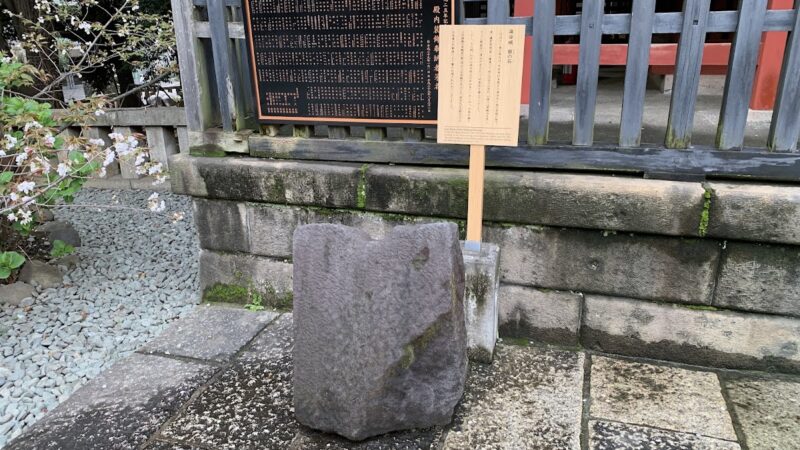
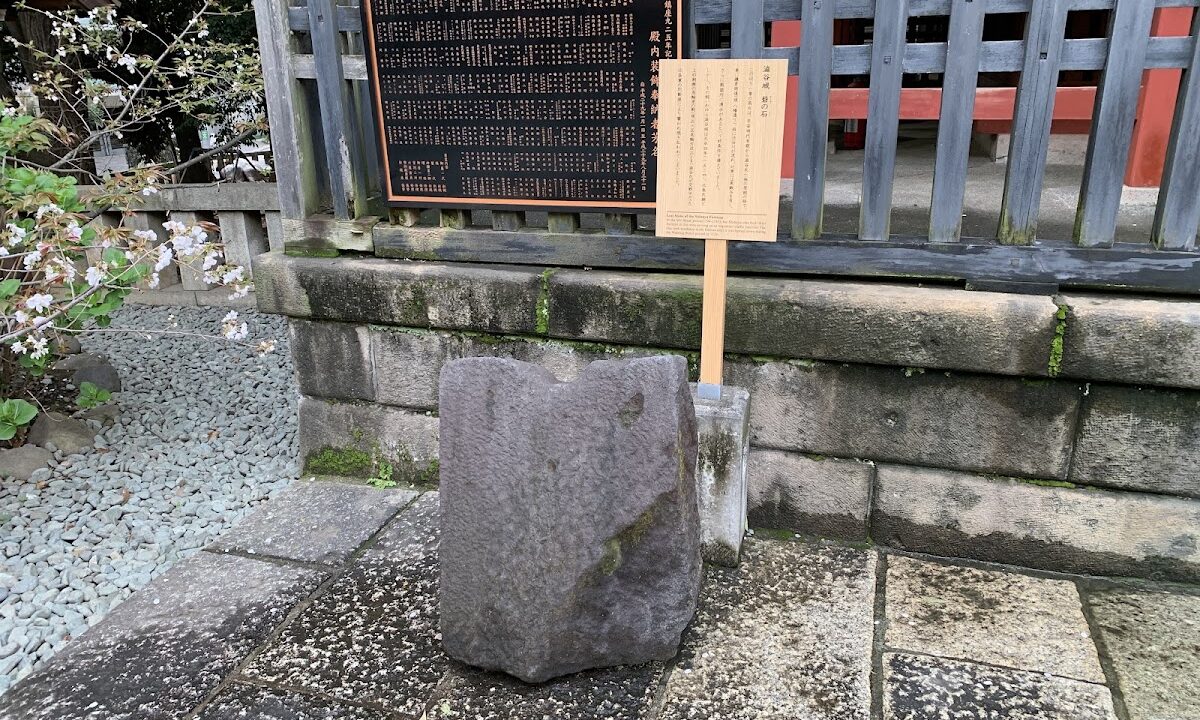
Currently, the Konno Hachimangu Shrine stands on the castle site. While very few remnants of the original castle remain, a stone preserved within the shrine grounds as the “Shibuya Castle Stone” is the only physical trace left.
History of Shibuya Castle: From the Heian Period to the Sengoku Period
Late Heian Period: The Establishment of the Shibuya Clan and the Construction of the Castle
The history of Shibuya Castle dates back to the late Heian period. It is believed to have begun when Kawasaki Motoie, a member of the Chichibu Taira clan, acquired this land and developed “Shibuya Manor.” Motoie is said to have distinguished himself in the Later Three Years’ War (1083-1087) under Minamoto no Yoshiie, and was granted this land as a reward.
Motoie established his residence around 1092 (Kanji 6), which became the origin of Shibuya Castle. Motoie adopted the name “Shibuya” after the place name Shibuya, and thereafter, this family expanded its power with Shibuya as its base.
The Development of the Shibuya Clan and its Position in Musashi Province
As a powerful branch of the Chichibu Taira clan, the Shibuya clan gained significant influence in southern Musashi Province. They particularly expanded their territories into Sagami and Izu Provinces, and during the Kamakura period, they served the shogunate as gokenin (vassals).
Branches of the Shibuya clan spread throughout the country, and those who migrated to Satsuma Province (present-day Kagoshima Prefecture) became the “Togo clan,” forming a powerful samurai group in Kyushu. Thus, Shibuya Castle held a crucial position as the base of the Shibuya clan, which exerted influence throughout Japan.
The Legend of Konnomaru: Its Connection to Minamoto no Yoshitomo
The most famous story in the history of Shibuya Castle is that of Shibuya Konnomaru. Konnomaru was born the son of Shibuya Shigekuni and is said to have excelled in martial arts from a young age.
During the late Heian period, when Minamoto no Yoshitomo, the leader of the Minamoto clan, expanded his power in the Kanto region, the Shibuya clan followed the Minamoto. Kanamaru served Minamoto no Yoshitomo and is said to have distinguished himself in numerous battles as a loyal retainer.
Particularly famous is his exploits in the Hogen Rebellion (1156). Kanamaru accompanied Yoshitomo to Kyoto and fought on the side of Emperor Go-Shirakawa. He later followed Yoshitomo again in the Heiji Rebellion (1159-1160), but the Minamoto were defeated by the Taira clan in this battle.
When Yoshitomo fled to the eastern provinces, Kanamaru fought bravely to protect his lord, but Yoshitomo lost his life in Owari Province (present-day Aichi Prefecture) due to betrayal by his retainers. It is said that Kanamaru then became a monk to pray for Yoshitomo’s soul and traveled throughout the country.
This story of Kin’ōmaru’s loyalty was passed down through generations and became the origin of the alternative name for Shibuya Castle, “Kin’ōmaru Castle.”
Kamakura and Muromachi Periods: The Prosperity of the Shibuya Clan
When the Kamakura Shogunate was established, the Shibuya clan served the shogunate as retainers. Due to their service in supporting Minamoto no Yoritomo’s uprising, the Shibuya clan was granted their territory within Musashi Province and continued to rule from Shibuya Castle.
Even into the Muromachi period, the Shibuya clan served the Uesugi clan, the Kanto Kanrei (governor of the Kanto region), and continued to be a powerful samurai family in Musashi Province. It is believed that Shibuya Castle during this period was not merely a residence, but a fortress with a certain degree of defensive capability.
Sengoku Period: The Invasion of the Hojo Clan and the End of Shibuya Castle
With the start of the Sengoku period, the situation in the Kanto region changed dramatically due to the expansion of the Later Hojo clan’s power. Hojo Ujitsuna, based in Odawara, launched an invasion of Musashi Province and attacked Shibuya Castle around 1524 (Daiei 4).
At this time, Shibuya Castle was attacked by the Hojo forces and is said to have fallen. It is said that some members of the Shibuya clan either submitted to the Hojo clan or fell into ruin, but the details are unclear.
In any case, it is believed that this attack by the Hojo clan during the Daiei era caused Shibuya Castle to lose its function as a fortress, and it was subsequently abandoned. Since then, this site has been maintained as the grounds of Konno Hachimangu Shrine, which is associated with the Shibuya clan.
Structure and Location of Shibuya Castle
A Hilltop Castle Utilizing the Topography
Shibuya Castle is a hilltop castle built on a high ground in a valley formed by the Shibuya River, at the eastern edge of the Musashino Plateau. At an elevation of approximately 26 meters, with a relative height difference of about 5 meters from the surrounding lowlands, Shibuya Castle, though small in scale, was a defensive structure that skillfully utilized the terrain.
The north and east sides of the castle were low-lying wetlands where the Shibuya River and its tributaries flowed, serving as natural moats. While the south and west sides were plateaus, it is presumed that artificial moats and earthworks were constructed on these sides.
Abundant Spring Water and Moats
The place name Shibuya is also written as “Shioya” or “Shibuya,” and there are various theories about its origin, but one theory suggests it derives from wetlands or valley topography. In fact, this area is part of the spring water zone of the Musashino Plateau, with many water sources.
It is said that there were several springs within the grounds of Shibuya Castle, and it is believed that a moat was constructed utilizing this abundant water source. Securing water was a crucial element for medieval castles, and Shibuya Castle possessed excellent locational advantages in this respect.
Castle Scale and Structure
Unfortunately, no detailed maps or historical documents showing the structure of Shibuya Castle remain. However, it is presumed that, as a samurai residence from the Heian to Kamakura periods, it had a relatively simple structure: a square-shaped building surrounded by earthworks and a moat.
During the Sengoku period, it is possible that defensive functions were strengthened, and multiple baileys, earthworks, and moats were added, but concrete evidence is scarce.
The current grounds of Konno Hachimangu Shrine are approximately 2,000 square meters, and it is thought that the main part of the castle was contained within this area. Based on the surrounding topography and road layout, the castle area may have been somewhat larger.
Evaluation and Controversy as a Castle
In recent years, there has been debate among castle researchers regarding whether Shibuya Castle should be recognized as a “castle.” Some researchers specializing in medieval castles in the Kanto region argue that, given Shibuya Castle’s location and structure, it should be classified not as a full-fledged “castle,” but rather as a samurai “residence” or “mansion.”
The following points have been raised as reasons for this:
- Location Issues: The elevation difference with the surrounding area is small, and the terrain is not rugged enough to be suitable for defense.
- Scale Issues: It is small as a castle, and there are no traces of large-scale military facilities.
- Historical Context: Local samurai from the Heian to Kamakura periods did not necessarily build their residences as castles.
However, it is passed down in legends and local history as “Shibuya Castle,” and it is highly probable that it functioned as a castle with a certain degree of defensive capability, at least during the Sengoku period.
Current Shibuya Castle Site: Konno Hachimangu Shrine
History of Konno Hachimangu Shrine
Currently, Konno Hachimangu Shrine stands on the site of Shibuya Castle. This shrine is said to have been founded in the late Heian period as the tutelary shrine of the Shibuya clan.
According to shrine tradition, the shrine’s origins date back to 1092 (Kanji 6), when Kawasaki Motoie built Shibuya Castle and enshrined Hachiman, the tutelary deity of the Minamoto clan. Later, it came to be known as “Konno Hachimangu” after the fame of Shibuya Kinnomaru.
During the Edo period, it received reverence from the Tokugawa shogunate and support for the construction of the shrine buildings. The current shrine building was constructed in 1612 (Keicho 17) and is designated as a tangible cultural property of Tokyo.
Traces of Shibuya Castle Remaining on the Shrine Grounds
Several remains and historical sites related to Shibuya Castle remain on the grounds of Konno Hachimangu.
The Stone of Shibuya Castle Fortress
The most important remains are the “Stone of Shibuya Castle” preserved on the shrine grounds. This massive stone is said to have been used as part of the defensive structure of Shibuya Castle and is currently on display with an explanatory plaque.
The stone measures approximately 1 meter in height and 1.5 meters in width, and appears to be a natural stone. While the widespread use of stone walls in medieval castles began in the late Sengoku period, this stone may have been used to reinforce earthworks or placed beside the castle gate.
Konnomaru Mikage-do Hall
Within the temple grounds is the Mikage-do Hall, dedicated to Shibuya Konnomaru. A wooden statue of Konnomaru is enshrined here, and it is sometimes specially displayed during the annual festival in September.
Tamatsukuri Inari Shrine
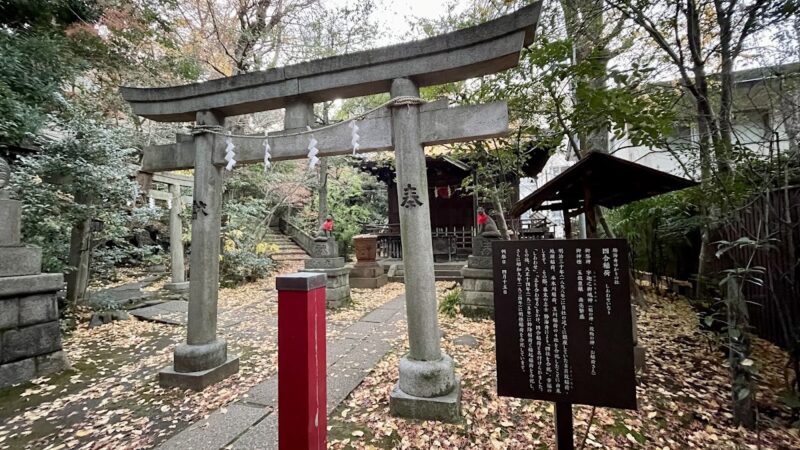
In a corner of the temple grounds is the Tamatsukuri Inari Shrine, also considered a shrine associated with the Shibuya clan. It is believed to enshrine the Inari deity worshipped by the Shibuya clan.
Surrounding Topography and Traces
Walking around Konno Hachimangu Shrine, one can still sense the topography of the past.
The road in front of the shrine is said to be the former course of a tributary of the Shibuya River, a small stream that also served as a moat. Although now covered by an underground culvert, the difference in elevation of the road allows us to imagine the existence of the waterway.
The north and east sides of the shrine are still slightly lower in elevation, allowing us to confirm the former valley topography. The topography that gave rise to the name Shibuya remains even within the city.
Featured on NHK’s “Buratamori”
Shibuya Castle was featured in the Shibuya episode (aired in 2015) of NHK’s popular program “Buratamori.” In the program, Tamori visited Konno Hachimangu Shrine and explained the relationship between Shibuya’s topography and Shibuya Castle.
Since this broadcast, interest in Shibuya Castle has increased, and many history buffs and castle enthusiasts have visited Konno Hachimangu Shrine.
Highlights and Visiting Guide to Shibuya Castle
Highlights as a Castle
Shibuya Castle has very few remaining structures, which may be disappointing for castle enthusiasts. However, paying attention to the following points will allow you to enjoy it more deeply.
1. Observing the Topography
While walking around the grounds and surrounding area of Konno Hachimangu Shrine, pay attention to the elevation changes and changes in the terrain. Even slight undulations can help you imagine the location of the former castle.
2. Stones of Shibuya Castle
The “Stones of Shibuya Castle,” the only remaining physical structure, are a must-see. Observing them while considering how stones were used in medieval castles will be fascinating.
3. Historical Buildings of Konno Hachimangu Shrine
The shrine buildings, constructed in the early Edo period, are designated as tangible cultural properties of Tokyo. While not directly related to Shibuya Castle, they offer a glimpse into the continuous history of the Shibuya clan’s tutelary shrine.
4. The Legend of Konnomaru
You can learn about the story of Konnomaru at the explanatory signs and in the Mikage-do hall within the shrine grounds. The story of the loyalty of this samurai who lived during the Genpei War continues to inspire many people.
Estimated Visiting Time
The grounds of Konno Hachimangu Shrine are not large, so a quick tour will take about 15-20 minutes. If you want to learn about the history and observe the surrounding topography in detail, it’s best to allow 30-40 minutes.
Points to Note When Visiting
- Konno Hachimangu Shrine is an active shrine. Please be considerate of other visitors.
- Photography is permitted within the grounds, but there are areas where photography is prohibited, such as inside the shrine buildings.
- Since very few remains of the original structure are left, please do not have excessive expectations.
- The surrounding area is a mix of residential and commercial areas, so please be mindful of noise.
Access: How to get to Shibuya Castle Ruins (Konno Hachimangu Shrine)
Access by Train
Shibuya Castle Ruins (Konno Hachimangu Shrine) is within walking distance of Shibuya Station, making access very convenient.
From Shibuya Station
Nearest Station: Shibuya Station (various lines)
- JR Yamanote Line, Saikyo Line, Shonan Shinjuku Line
- Tokyo Metro Ginza Line, Hanzomon Line, Fukutoshin Line
- Tokyu Toyoko Line, Den-en-toshi Line
- Keio Inokashira Line
Travel Time: Approximately 5-7 minutes on foot
Route:
- Exit Shibuya Station’s Hachiko Exit
- Proceed along Bunkamura Street (towards Bunkamura)
- Continue straight with Tokyu Department Store Main Branch on your right
- Continue straight past the Dogenzaka-shita intersection
- After approximately 300 meters, you will see the torii gate of Konno Hachimangu Shrine on your right.
Shibuya Station has a complex structure, but once you are above ground, there are plenty of signs, so you are unlikely to get lost.
Access by Car
Parking
Konno Hachimangu Shrine has a parking lot for visitors, but the number of spaces is limited. Due to heavy traffic and crowded parking lots in central Shibuya, we recommend using public transportation.
If you must visit by car, you will need to use nearby coin-operated parking lots. However, parking fees in the Shibuya area are expensive (approximately 400-600 yen for 30 minutes).
Access from Major Roads
- Approximately 5 minutes from the Shibuya Exit of the Metropolitan Expressway Route 3 Shibuya Line
- From National Route 246 (Aoyama-dori) towards Shibuya
Address and Contact Information
Konno Hachimangu Shrine
- Address: 3-5-12 Shibuya, Shibuya-ku, Tokyo 150-0002
- Phone: 03-3407-1811
- Opening Hours: Grounds are freely accessible (Shrine office is usually open from 9:00 to 17:00)
- Admission Fee: Free
Nearby Tourist Attractions
When visiting the Shibuya Castle Ruins, you can also enjoy nearby tourist attractions.
Shibuya Scramble Crossing
A world-famous symbol of Shibuya. About a 5-minute walk from Konno Hachimangu Shrine.
Shibuya Center Gai/Dogenzaka
The heart of youth culture. Enjoy shopping and dining.
Kokugakuin University Museum
About a 10-minute walk from Konno Hachimangu Shrine. Features exhibits on Japanese history and archaeology, allowing you to learn about Shibuya’s ancient and medieval history (free admission).
Yoyogi Park
About a 15-minute walk from Shibuya Station. A vast urban park, perfect for strolls and picnics.
Relationship between Shibuya Castle and the Place Name Shibuya
The place name Shibuya has deep ties to Shibuya Castle and the Shibuya clan.
Origin of the Place Name
There are several theories regarding the origin of the place name “Shibuya.”
- Shioya Theory: This theory suggests that there was once a valley in this area where salt was produced.
- Wetland Theory: This theory suggests that the name originates from the wetlands around the Shibuya River.
- Shibuya Clan Theory: This theory suggests that the name of the place came from the Shibuya clan, who ruled this area.
In reality, the place name “Shibuya” existed before the Shibuya clan ruled this area, and it is believed that the Shibuya clan adopted this place name as their surname. In other words, it was a case of “place name → clan name.”
However, because the Shibuya clan ruled this area for a long period, the image of “Shibuya = the base of the Shibuya clan” became established, and it can be said that the place name and clan name mutually influenced each other.
Modern Shibuya and Historical Heritage
Modern Shibuya is known worldwide as a center of youth culture, fashion, music, and IT business. However, it is not widely known that historical heritage dating back to the Heian period is quietly preserved in a corner of this bustling city.
Shibuya Castle Ruins can be said to be a rare example of modern city and history coexisting. Amidst ongoing urban development, the continued preservation of Konno Hachimangu Shrine demonstrates the local people’s respect for history.
The Later Shibuya Clan: A Family Spread Across Japan
What became of the Shibuya clan, who were based at Shibuya Castle?
Expansion into Sagami and Izu
The Shibuya clan held territories not only in Musashi Province but also in Sagami Province (present-day Kanagawa Prefecture) and Izu Province (present-day Shizuoka Prefecture). During the Kamakura period, they served as jitō (land stewards) in these regions, expanding their influence.
Migration to Kyushu: The Establishment of the Tōgō Clan
During the Kamakura period, a branch of the Shibuya clan migrated to Satsuma Province (present-day Kagoshima Prefecture) and adopted the name “Tōgō.” The Tōgō clan became a powerful samurai group in Satsuma and served the Shimazu clan.
Tōgō Heihachirō, a famous general of the late Edo period, is considered a descendant of this Tōgō clan. In other words, the roots of Admiral Togo, who distinguished himself in the Battle of Tsushima, lie with the Shibuya clan of Shibuya Castle.
The Shibuya Clan After the Sengoku Period
After Shibuya Castle fell during the Sengoku period, the whereabouts of the Shibuya clan of Musashi Province are unclear. Some may have become subordinate to the Hojo clan and survived as vassals of the Later Hojo. It is also thought that another branch of the family migrated to other regions.
During the Edo period, there were hatamoto and gokenin who bore the name Shibuya, but their direct lineage to the Shibuya clan who ruled Shibuya Castle is unknown.
Resources and Materials for Learning About Shibuya Castle
Related Books
For those who wish to learn more about Shibuya Castle, the following books are helpful.
- “Medieval Castles and Residences in Tokyo” (Tokyo Metropolitan Board of Education)
- “Research on Musashi Samurai Groups” (Various historical research books)
- “History of Shibuya Ward” (Shibuya Ward Board of Education)
- “Walking the Castles of Edo-Tokyo” (Various castle guidebooks)
Museums and Archives
- Kokugakuin University Museum: Exhibits on the ancient and medieval history of Shibuya
- Shibuya Ward Local History Museum and Literature Museum: You can learn about the general history of Shibuya
Online Resources
- Kojodan (Castle Information Site)
- Nippon Castle Tour (Castle App/Website)
- Shirobito (Castle Community Site)
These sites allow you to see reviews and photos from people who have actually visited Shibuya Castle.
Evaluation by Castle Enthusiasts
How is Shibuya Castle evaluated among castle enthusiasts?
Evaluation on Kojodan
On the castle information site “Kojodan,” over 400 castle owners (registered users) have visited Shibuya Castle. The average rating is ★★☆☆☆ (2.13 points), which is not particularly high. The average visit time is approximately 17 minutes.
The main reason for the low rating is likely the lack of remaining structures. For castle enthusiasts, seeing remnants such as stone walls, earthworks, and moats is a major draw, but this is not the case at Shibuya Castle.
However, there are many positive comments such as “a castle ruin easily accessible in the city center,” “great historical significance,” and “the legend of Kin’ōmaru is intriguing.”
Value of Visit
While you might be disappointed if you visit solely for the purpose of seeing remnants, Shibuya Castle is well worth visiting from the following perspectives:
- Learn about the history of samurai dating back to the Heian period
- Enjoy the contrast between a modern metropolis and a medieval castle ruin
- Learn about the origins of the name Shibuya
- Experience the legend of Kin’ōmaru
- Enjoy a historical stroll while sightseeing in Shibuya
It might be more appropriate to visit as a “historical stroll” rather than a “castle ruins tour.”
Summary: The Historical Significance of Shibuya Castle
Although very few remains of Shibuya Castle exist, it is a castle site of significant importance in the history of medieval Japan.
Historical Significance
- Base of the Musashi Samurai: As the base of the Shibuya clan, a powerful branch of the Chichibu Taira clan, it had a major influence on the history of Musashi Province.
- Connection to the Genpei War: Through the story of Kanamaru, it conveys the era of the Genpei War to the present day.
- Origin of the Place Name: It is deeply connected to the modern place name “Shibuya.”
- Influence Nationwide: Descendants of the Shibuya clan spread throughout Japan and were active in various regions.
Value in the Modern Era
Modern Shibuya is known as a city at the forefront of youth culture and technology. However, the fact that a castle site with a thousand years of history quietly stands in a corner of this bustling city symbolizes the multi-layered history of the city of Tokyo.
Visiting the Shibuya Castle ruins will be a valuable experience that connects the present with history. When enjoying shopping and dining in Shibuya, why not stop by Konno Hachimangu Shrine and reflect on the samurai of the Heian period?
Shibuya Castle, which actually existed in the heart of this metropolis, still speaks volumes about its history to us today.