The History of Ashiro Castle Ruins and its Strategic Importance in Miyoshi District – A Medieval Mountain Castle in Higashi-Miyoshi Town, Tokushima Prefecture
What is Ashiro Castle?
Ashiro Castle is a medieval mountain castle located in Ashiro, Higashi-Miyoshi Town, Miyoshi District, Tokushima Prefecture. Built in the area known as “Shiro” at the foot of a mountain approximately 200 meters above sea level, north of Ashiro Hachiman Shrine, this castle functioned as an important base in Miyoshi District for the Miyoshi clan, who wielded great power in the Kinai region during the Sengoku period.
The “Castle Ruins Record” states, “Of the 128 castles in Awa Province, 28 were main castles, and Ashiro Castle was one of them,” indicating its position as one of the major castles in Awa Province. Currently, the remains of the mountain castle are a valuable cultural asset that conveys the history of the region.
Geographical Location and Strategic Importance of Ashidai Castle
Location in Miyoshi District
Ashidai Castle is located in the northwestern part of Tokushima Prefecture, on the north bank of the middle reaches of the Yoshino River. In current administrative divisions, it belongs to Ashidai, Higashi-Miyoshi Town, Miyoshi District, and is located near the center of the former Miyoshi Town. Historically, this area was the core of Miyoshi District, and was one of the central locations of Miyoshi District, which separated from Mima District in 860 AD.
Topographical Features as a Fortress
Ashidai Castle’s location provided ideal conditions for a military base. To the east, it was situated on high ground overlooking Mino Town in Miyoshi City and the Mikamo district of Higashi-Miyoshi Town, with a steep slope making enemy intrusion difficult. To the west was Yutani, which formed a natural moat, enhancing its defensive capabilities. Furthermore, it was blessed with a good water supply, creating an environment suitable for prolonged sieges.
To the north lay the steep terrain of the Asan Mountains, with a narrow path leading through Miyadani to Kagawa Prefecture. This geographical location was a crucial transportation hub connecting Awa and Sanuki Provinces, and is believed to have played a vital role in information exchange and military cooperation between the two provinces.
History of the Miyoshi Clan and Ashidai Castle
Origins of the Miyoshi Clan and Miyoshi County
The Miyoshi clan was a samurai family originating from Miyoshi County in Awa Province. They built a powerful force, primarily in the Kinai region, from the mid- to late-Sengoku period. Considered a branch of the Ogasawara clan, they rose to prominence as vassals of the Hosokawa clan, the Awa provincial governor, eventually gaining power surpassing that of their lord.
During the time when the Miyoshi clan was based in Miyoshi County, Ashidai Castle functioned as an important military base within the county. Located in a position overlooking the entire Miyoshi County, it is presumed to have been a strategic base for maintaining control over the county.
Positioning within the Castle System of Awa Province
The “128 Castles of Awa” recorded in the “Castle Ruins Record” refers to the numerous castles that existed in Awa Province. Among these, the “28 Main Castles” were distinguished as particularly important fortresses, and Ashidai Castle is counted among these main castles.
This record indicates that Ashidai Castle was recognized not merely as a subsidiary castle or fort, but as a major castle playing a central role in regional control. It is thought to have been an important facility supporting the power base of the Miyoshi clan in Miyoshi County.
Ashidai Castle in the Sengoku Period
Even during the Sengoku period, when the Miyoshi clan advanced into the Kinai region and Miyoshi Nagayoshi wielded power around Kyoto, Ashidai Castle is believed to have been maintained as one of the main bases in Awa. It played an important role as a rear base supporting activities in the Kinai region and as a military facility for maintaining control within Awa Province.
Remains and Structure of Ashidai Castle
Layout of the Main Enclosure
It has been confirmed that Ashidai Castle consisted of multiple enclosures, including the main enclosure (Ichikuru), the second enclosure (Nikuruwa), and the third enclosure (Sankuruwa). These enclosures can be viewed from the south and east, exhibiting a typical structure of a medieval mountain castle.
The main enclosure is located at the highest point of the mountain, offering panoramic views of the surrounding area. From here, one can see the Mino-cho area of Miyoshi City to the east and the plains along the Yoshino River to the south, indicating that it served as both a surveillance and command center.
Characteristics of Defensive Facilities
To the west of the castle, a valley called Yutani functioned as a natural moat. This topographical feature created a defensive system that made attacks from the west difficult. Furthermore, the steep slopes were utilized as natural barriers, achieving high defensive capabilities while minimizing artificial construction.
Ancient Roads and Transportation Routes
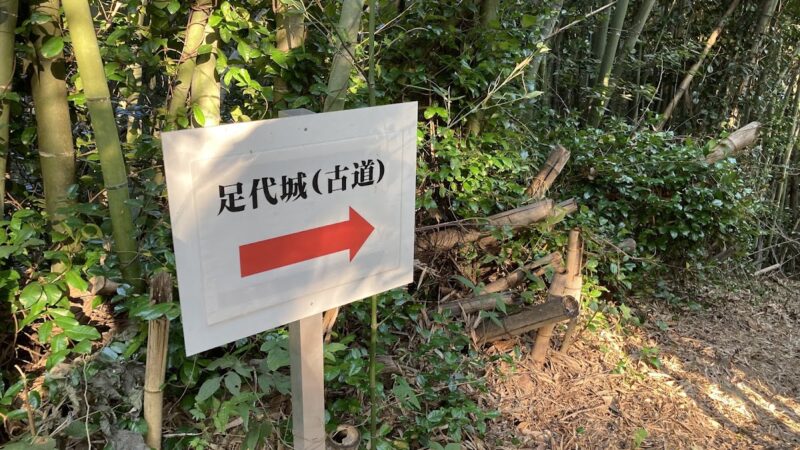
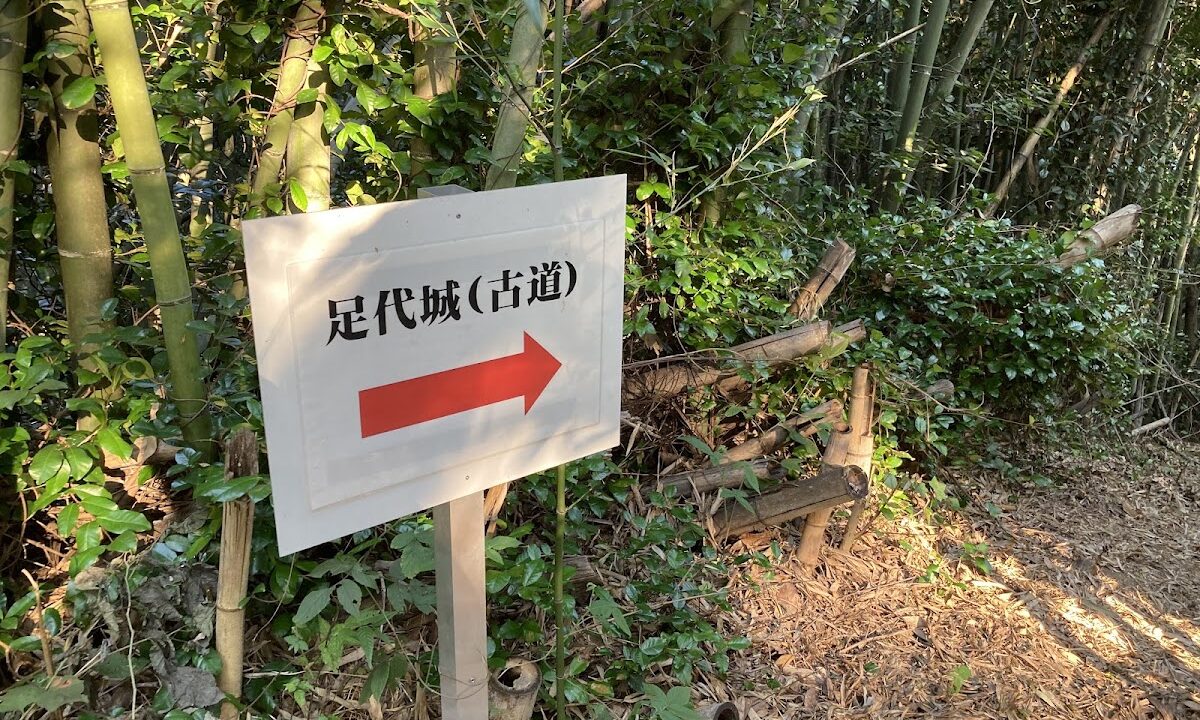
Signs for “ancient roads” remain around the castle ruins, allowing visitors to trace the remnants of former transportation routes. The narrow northern path led through Miyadani to Kagawa Prefecture, serving as an important communication route connecting Awa and Sanuki. Controlling such transportation routes held significant military and economic importance.
History of Ashidai Village and Ashidai Castle
Ashidai Village in the Early Modern Period
During the Edo period, Ashidai Village was part of the Awa Tokushima Domain. The name of Ashidai Village is recorded in the “Old Land and Old Territory Survey Records,” indicating its continued existence as part of the Tokushima Domain until the early Meiji period. Although Ashidai Castle had already been abandoned by this time, the place name “Aza Shiro” remained, preserving the memory of the castle ruins.
The Tenpo Riots
On January 4, 1843 (Tenpo 14), a large-scale riot occurred in Miyoshi District. The unrest that began in Yamashirodani Village escalated from dissatisfaction with land tax and tobacco administration to a movement to destroy the village headman’s house, spreading to Kamoyama Village, Nakasho Village, Nishisho Village, Inouchidani Village, Ikawa Village, and finally to Ashidai Village.
This incident expanded not only to Miyoshi District but also to Mima District, Awa District, and Oe District, affecting a wide area within the Tokushima Domain. Ashidai Village’s involvement in this unrest illustrates the severity of the poverty and discontent in rural society at the time.
Ashidai in the Modern Era
After the Meiji era, Ashidai Village underwent a modern reorganization of administrative divisions. On March 21, 1955, Ashidai Village merged with Hiruma Town to form Miyoshi Town. Furthermore, on March 1, 2006, Miyoshi Town merged with Mikamo Town to become Higashi-Miyoshi Town, which remains to this day.
During this time, the Ashidai Castle ruins were preserved as a local historical heritage site and designated as a cultural property of Higashi-Miyoshi Town.
Ashidai Hachiman Shrine and the Nagi Forest
History of Ashidai Hachiman Shrine
Just south of the Ashidai Castle ruins stands the Ashidai Hachiman Shrine. This shrine has a long history as a center of local faith and is thought to have had a deep connection with Ashidai Castle. It played an important role as the guardian deity of the castle and as a spiritual center for the local residents.
The Nagi Forest, a Natural Monument
Within the grounds of the Ashidai Hachiman Shrine is a nagi forest, a natural monument designated by Tokushima Prefecture. More than 20 nagi trees, including some with trunk circumferences of over 4 meters, grow together in a cluster and are protected as a scientifically valuable vegetation.
The nagi is an evergreen tree with oval-shaped leaves and small, pale yellow flowers in summer. This tree has been considered sacred since ancient times and is often planted on the grounds of shrines. The Nagi forest at Ashidai Hachiman Shrine is a cultural asset of value in both its local history and natural context.
Historical Changes in Miyoshi District
Establishment of Miyoshi District
Miyoshi District was established in 860 (Jōgan 2), separating from Mima District. The Mino, Minawa, and Mitsu districts of Mima District became independent and formed the new district. It is believed that the district name “Miyoshi” was given because the character “三” (san, meaning three) was common to all three districts.
Miyoshi District in the Middle Ages
In the Middle Ages, Miyoshi District was one of the important regions of Awa Province. In particular, the Miyoshi clan expanded their power from this area, making it a historically significant region. Numerous castles, including Ashidai Castle, were built, and it functioned as a military base during the Sengoku period (Warring States period).
Miyoshi District from the Early Modern Period Onward
During the Edo period, the entire Miyoshi District became part of the Awa Tokushima Domain. The “Old Land Survey Records” from the early Meiji period list numerous villages, including Shimizu Village, Seiryoku Village, Kamonomiya Village, Shibafu Village, Tachinoyama Village, Tachino Village, and Ashidai Village.
With the implementation of the town and village system after the Meiji Restoration, mergers and reorganizations occurred repeatedly within Miyoshi County. During the large-scale municipal mergers of the 1950s, many villages merged to form towns. In 2006, the western part of Miyoshi County became Miyoshi City, while the eastern part remained as Higashi-Miyoshi Town. Currently, Higashi-Miyoshi Town is the only remaining part of Miyoshi County.
Current Status of Ashidai Castle Ruins
Protection as a Cultural Property
The Ashidai Castle Ruins are designated and protected as a cultural property of Higashi-Miyoshi Town. They are also featured on the Higashi-Miyoshi Town official website as “Higashi-Miyoshi Town’s Cultural Property: Ashidai Castle Ruins,” and are cherished as a local historical heritage.
Visiting the Castle Ruins
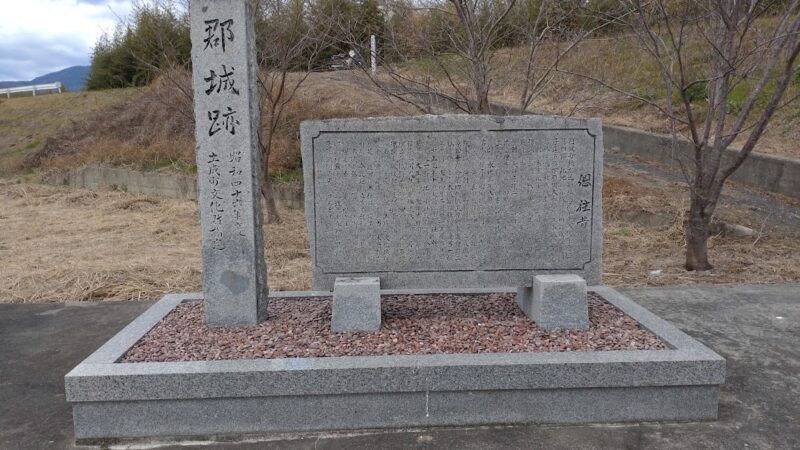
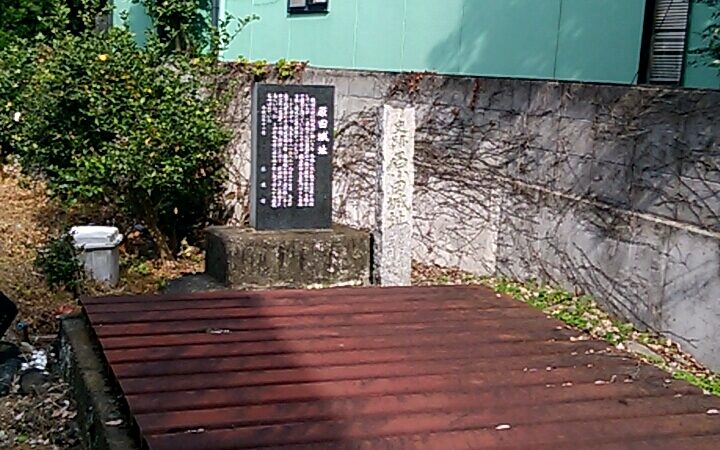
Currently, the Ashidai Castle ruins are open to visitors. A monument and information boards have been installed, conveying the castle’s history to visitors. The main enclosure can be reached by climbing through cultivated fields, allowing visitors to actually observe the layout of the baileys and the topographical features.
The view from the castle ruins is magnificent, offering a panoramic view of Mino Town to the east and the plains of the Yoshino River basin to the south. This view clearly demonstrates the excellent position Ashidai Castle was built in for surveillance and defense.
Signs and Remains
Signs indicating place names such as “Oshigome” and “Monomi no Hashi” (a lookout point), as well as a sign for “Ashidai Castle (Old Road),” are installed around the castle ruins. These signs allow visitors to understand the castle’s structure and function while exploring.
Ashidai Castle and Surrounding Castles
Miyoshi County Castle Network
In addition to Ashidai Castle, numerous other castles existed within Miyoshi County. These castles cooperated with each other to defend and control the region, forming the power base of the Miyoshi clan. On the mountainous northern bank of the Yoshino River, multiple castles were strategically positioned along the ridges, creating a system that facilitated information transmission and military coordination.
Castle Culture of Awa Province
Awa Province was home to numerous castles, known as the “128 Castles of Awa.” These castles were primarily mountain castles, characterized by defensive structures that utilized the steep terrain. Ashidai Castle is a typical example of this Awa castle culture, showcasing a layout that skillfully utilizes the terrain.
The Miyoshi Clan’s Expansion into the Kinai Region and Ashidai Castle
The Relationship Between Miyoshi Nagayoshi and Awa
Miyoshi Nagayoshi, who built the Miyoshi clan’s golden age, wielded power in the Kinai region that surpassed even the Muromachi Shogunate. However, the foundation of his power lay in a solid base of influence within Awa Province. Castles in Miyoshi County, including Ashidai Castle, played a crucial role as rear bases supporting his activities in the Kinai region.
The Role of the Awa Clan
When the Miyoshi clan was active in the Kinai region, many samurai groups were mobilized from Awa Province. These “Awa Clan” formed the core of the Miyoshi clan’s military power, and castles within Awa Province served as their bases. Ashiro Castle may have been one of the Awa Clan’s strongholds.
Access and Visiting Information for Ashiro Castle Ruins
Location
Ashiro Castle Ruins are located in Ashiro, Higashi-Miyoshi-cho, Miyoshi-gun, Tokushima Prefecture, north of Ashiro Hachiman Shrine. The postal code is 771-2502.
Transportation Access
When using public transportation, the nearest station is Awa-Kamo Station on the JR Tokushima Line. From the station, you can access the Ashiro area on foot or by taxi. By car, you can access it via National Route 192 from the Ikawa-Ikeda Interchange on the Tokushima Expressway.
Notes for Visitors
Ashiro Castle Ruins is a mountain castle, and the path to the castle has a steep slope. When visiting, we recommend wearing comfortable clothing and shoes. Please also follow the signs and cooperate in protecting the historical remains.
Historical Tourism in Higashi-Miyoshi Town
Establishment of Higashi-Miyoshi Town
Higashi-Miyoshi Town was formed on March 1, 2006, through the merger of Miyoshi Town and Mikamo Town. As a town with rich nature and historical culture on the north bank of the Yoshino River, it is actively promoting tourism.
Nearby Tourist Spots
Around the Ashidai Castle ruins, there are the Nagi forest of Ashidai Hachiman Shrine, the beautiful scenery of the Yoshino River, and facilities that convey the region’s traditional culture. You can enjoy the rich natural environment while learning about the history of Miyoshi County.
Summary
Ashidai Castle is a medieval mountain castle located in Higashi-Miyoshi Town, Miyoshi County, Tokushima Prefecture, and was an important base for the Miyoshi clan, who were active in the Kinai region during the Sengoku period. As one of the 128 main castles of Awa Province, Ashidai Castle played a central role in the regional control of Miyoshi County and held a strategic position controlling a vital transportation hub connecting Awa and Sanuki Provinces.
With its defensive structures utilizing steep terrain and natural moats, a structure consisting of multiple baileys, and panoramic views, Ashidai Castle possesses the characteristics of a medieval mountain castle and is a valuable historical heritage site that conveys the castle-building techniques and strategic thinking of the time.
Currently, it is protected as a cultural property of Higashi-Miyoshi Town and is open to visitors. The view from the castle ruins is magnificent, allowing visitors to imagine the time when the Miyoshi clan ruled Miyoshi County from this land. For those interested in the history of Miyoshi County or medieval mountain castles, Ashidai Castle ruins are a place well worth visiting.