History and Remains of Kashima Castle (Kaiyo-cho, Kaifu-gun, Tokushima Prefecture) | The Asakawa Clan’s Residence and the Chosokabe Invasion
Kashima Castle is a Sengoku period mountain castle located in Kashima, Asakawa, Kaiyo-cho, Kaifu-gun, Tokushima Prefecture. Known as the residence of the Asakawa clan, who ruled the Kaifu region in southern Awa Province, it holds an important position in local history as a castle that experienced a historical turning point: Chosokabe Motochika’s invasion of Awa. Even today, remains such as baileys can be seen, and with the installation of stone monuments and information boards, it is a historical site worth visiting for history enthusiasts and castle fans.
Basic Information on Kashima Castle
Location
Kashima Castle is located in Kashima, Asakawa, Kaiyo-cho, Kaifu-gun, Tokushima Prefecture. Kaiyo-cho is located in the southern part of Tokushima Prefecture, facing the Pacific Ocean, and was formerly part of Kaifu-gun, Awa Province. The Kashima area is part of the Asakawa region, and a settlement still exists there today. To access the castle ruins, upon entering the Kashima settlement, you will find a sign indicating “Kashima Castle Ruins Tsunami Evacuation Area.” Following these directions, you can drive close to the castle ruins.
Former Provincial Name
Kashima Castle belonged to Awa Province. Awa Province was the former province encompassing the entirety of present-day Tokushima Prefecture. It had geographically and culturally distinct characteristics between the northern region, centered on the Yoshino River basin, and the southern region, including Kaifu District. Kaifu District was located at the southern tip of Awa Province, near the border with Tosa Province, and developed as a region where maritime transport and fishing flourished.
Common Name/Alternate Name
Kashima Castle is sometimes called “Asakawa Castle.” This name originates from the name of the castle’s lord, the Asakawa clan, indicating their significant influence in the region. The Asakawa clan was a powerful local family in the Kaifu region, controlling the surrounding area from Kashima Castle.
Classification/Structure
Kashima Castle is classified as a hill castle. The castle is built on a hill with an elevation difference of approximately 50 meters, and the elevation is also about 50 meters above sea level. The castle’s structure features a central enclosure surrounded by multiple baileys, a typical form for a local powerful family’s castle during the Sengoku period (Warring States period). It is characterized by defensive facilities that skillfully utilize the terrain, suggesting an effective defensive system was constructed within the limited landscape.
Keep Structure
Kashima Castle did not have a keep (tenshu). As a castle of a local powerful family during the Sengoku period, it is thought to have had a practical structure that combined residential and defensive functions. It is characterized by an emphasis on practical defensive facilities rather than symbolic structures like a keep.
History of Kashima Castle
Builder and Construction Year
The builder of Kashima Castle was Asakawa Hyogo-no-kami Aritoki. The construction year is believed to be during the Genki era (1570-1573). This period marked the rise of Oda Nobunaga and the most intense period of the Sengoku period throughout Japan. In Shikoku, it was also the time when the Chosokabe clan of Tosa Province began to expand their power.
Asakawa Aritatsu, a powerful local lord in the Amabe region, built a castle in Kashima to solidify his control over the area. The Amabe region was a strategically important location for maritime trade and, being close to the border with Tosa Province, also held a military significance.
Main Lords
The main lords of Kashima Castle were the Asakawa clan. The Asakawa clan was a powerful local family that had ruled this region for generations and was one of the most influential forces in the Amabe region. The castle was built during the time of Asakawa Aritatsu and functioned as the Asakawa clan’s base.
The Asakawa clan held considerable power in the Amabe region of southern Awa Province, comparable to other local lords such as the Amabe and Mugi clans. It is believed that they maintained their own unique system of rule while relying on maritime trade and fishing as their economic base.
Main Renovators
Regarding Kashima Castle, there are no clear records of the main renovators. Because the period from its construction to its fall was relatively short, there is no evidence of large-scale renovations.
Chosokabe Motochika’s Invasion of Awa and the Fall of Kashima Castle
The most important event in the history of Kashima Castle is Chosokabe Motochika’s invasion of Awa Province in 1575 (Tensho 3). Having unified Tosa Province, Chosokabe Motochika began his invasion of Awa Province with the aim of unifying Shikoku.
The Chosokabe army invaded from the southern part of Awa Province, successively capturing castles in the Kaifu region. Kashima Castle was also targeted in this invasion, and although the Asakawa clan resisted, it ultimately fell. It is believed that this battle led to the decline of the Asakawa clan’s power, and Kashima Castle was abandoned.
The Chōsokabe clan’s invasion of Awa Province marked a crucial turning point in the Sengoku period history of Shikoku. Local powerful families, previously independent, successively fell under the control of the Chōsokabe clan. The fall of Kashima Castle was part of this major historical trend.
Year of Abandonment
While the exact year of Kashima Castle’s abandonment is not clearly recorded, it is believed to have been abandoned shortly after its capture by Chōsokabe Motochika in 1575 (Tenshō 3). After its fall, it lost its function as a castle and was never rebuilt.
Remains and Current State of Kashima Castle
Remains
The current site of Kashima Castle clearly shows the remains of the kuruwa (enclosures). The basic structure of the castle’s layout, centered around the main enclosure, can be discerned from the topography, allowing us to imagine the appearance of a Sengoku period castle.
A kuruwa is the basic defensive unit of a castle, a flattened, leveled section. At Kashima Castle, multiple kuruwa were arranged in terraces, indicating that a defensive system utilizing the terrain was constructed. While some remains such as earthworks and moats are unclear due to years of weathering, the original structure can be inferred from observation of the topography.
Stone Monument and Information Board
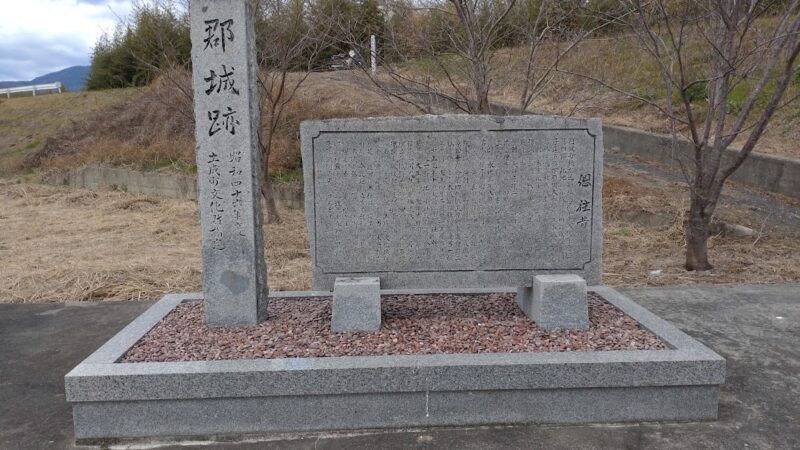
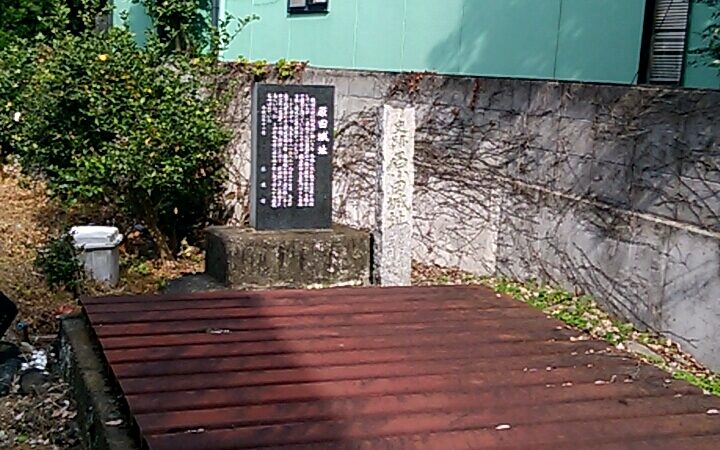
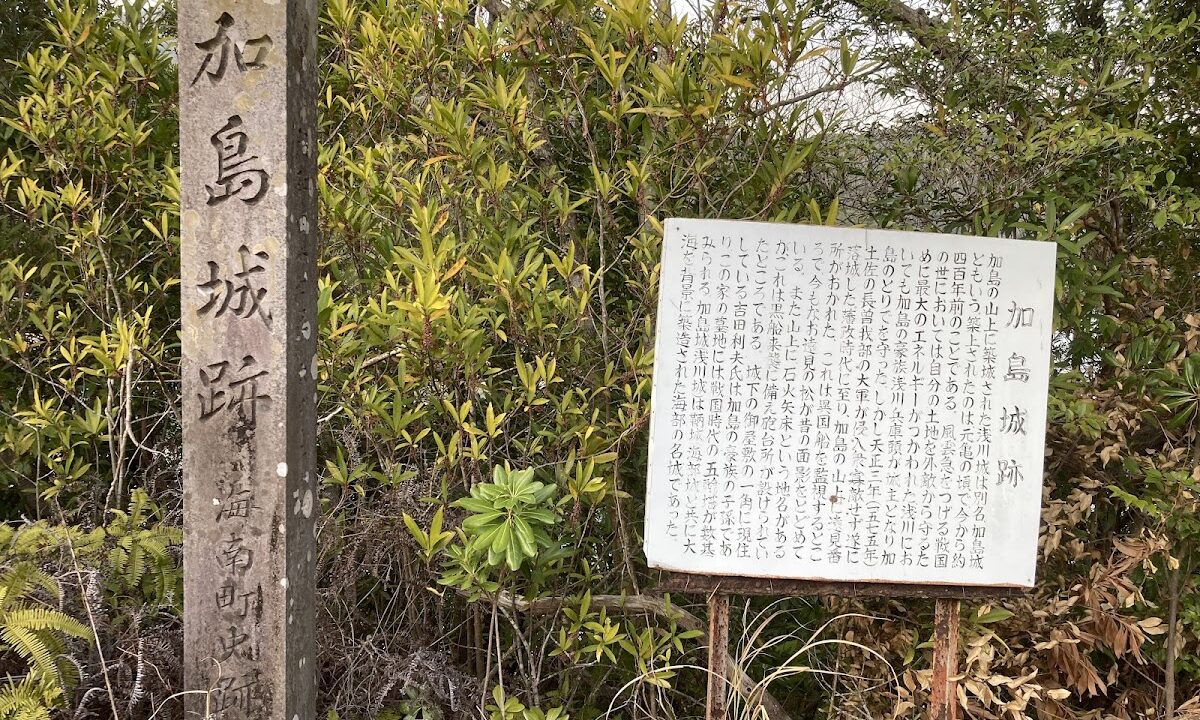
A stone monument and information board have been installed at the Kashima Castle ruins. The monument is inscribed with “Kashima Castle Ruins,” indicating that this is a historical castle site. The information board contains basic information about the history of Kashima Castle and the Asakawa clan, helping visitors understand the castle’s history.
Furthermore, a sign indicating “Kashima Castle Ruins Tsunami Evacuation Site” has also been installed, and it now serves as a disaster prevention facility. Because it is located near the sea, it is designated as an evacuation site in the event of a tsunami, making it a place that combines historical value with modern practicality.
Designated Cultural Property
Currently, the Kashima Castle Ruins are not designated as a cultural property by the national, prefectural, or municipal governments. However, it is recognized locally as an important historical site that conveys the history of the region.
Reconstructed Structures
There are no reconstructed structures at the Kashima Castle Ruins. Aside from the stone monument and explanatory sign, no artificial structures have been erected, and the remains are preserved in their natural state. This allows visitors to experience the atmosphere of a Sengoku period castle ruin firsthand.
Access and Visiting Kashima Castle
Access Method
Access to Kashima Castle Ruins is most convenient by car. Entering the Kashima settlement from the Asakawa district of Kaiyo Town, you will find a sign for “Kashima Castle Ruins Tsunami Evacuation Area.” Follow the directions. You can drive almost all the way from the sign to the castle ruins, making it relatively easy to visit.
If using public transportation, the nearest stations are Kaifu Station or Awa-Kainan Station on the JR Mugi Line, but the castle is a considerable distance from these stations, so you should consider using a taxi or rental car.
Points to Note During Your Visit
When visiting Kashima Castle Ruins, it is recommended to first review the castle’s history at the stone monument and explanatory sign. Afterward, you can observe the remains of the baileys and imagine how a Sengoku period castle was constructed.
From the main enclosure, you can overlook the surrounding terrain and understand why the castle was built in this location and what its strategic value was. Given its proximity to the sea, it is presumed to have also served the roles of monitoring maritime traffic and defending against sea incursions.
When visiting, wear comfortable shoes and clothing, and depending on the season, insect repellent may be necessary. Since the remains are preserved in a natural environment, it is important to view them safely.
Relationship with other castles in Kaifu County
Relationship with Kaifu Castle
Kaifu Castle is located approximately 4.8 kilometers from Kashima Castle. Kaifu Castle is believed to have been built around 1571 by Kaifu Sakon-no-Shogen Tomomitsu, and existed at roughly the same time as Kashima Castle.
The Kaifu and Asakawa clans were both powerful local families in the Kaifu region, and it is thought that they sometimes cooperated and sometimes clashed. Both castles held important positions in the power dynamics surrounding the control of the Amabe region, and they shared the same fate during the invasion by Chosokabe Motochika.
Relationship with Mugi Castle
Mugi Castle is located approximately 10.3 kilometers northeast of Kashima Castle. Mugi Castle was also an important fortress in the Amabe region and was the residence of the Mugi clan. The Mugi clan was a powerful local family in the northern part of Amabe County and had a geographically close relationship with the Asakawa clan.
These castles illustrate the power distribution of local powerful families in the Amabe region. While each had its own territory, it is thought that they may have cooperated against external threats.
Relationship with Hiwasa Castle
Hiwasa Castle is located approximately 22.3 kilometers north of Kashima Castle. Hiwasa Castle was located in the northern part of Amabe County and was a larger fortress. Hiwasa Castle was also targeted during Chosokabe Motochika’s invasion of Awa Province, playing a crucial role in the process by which the entire Kaifu region came under the control of the Chosokabe clan.
Historical Significance of Kashima Castle
As a Castle of a Local Powerful Family
Kashima Castle is important as a typical example of a castle of a local powerful family during the Sengoku period. Although smaller in scale compared to castles of daimyo (feudal lords), it possessed the necessary functions for a base of regional control. It demonstrates the wisdom of skillfully utilizing the terrain to construct a defensive system within limited resources.
Local powerful families like the Asakawa clan, positioned between daimyo and farmers, played an important role in their local communities. Kashima Castle was the center of life and power for such local powerful families, and a political, economic, and military hub for the region.
Its Place in the Chosokabe Clan’s Unification of Shikoku
The fall of Kashima Castle was one event in the process of Chosokabe Motochika’s unification of Shikoku. After unifying Tosa Province, the Chosokabe clan expanded their power into Awa, Sanuki, and Iyo Provinces. The first step in this expansion was their invasion of the Kaifu region in southern Awa Province.
The capture of castles in the Kaifu region, including Kashima Castle, became a crucial foothold for the Chosokabe clan in their quest to control all of Awa Province. The fall of these castles brought southern Awa Province under their control, enabling their subsequent expansion into northern Awa.
Importance in the History of the Kaifu Region
Kashima Castle is an indispensable historical site for understanding the Sengoku period history of the Kaifu region. This region possesses a unique history and culture within Awa Province, and its economy was based on maritime transport and fishing.
Local powerful families, such as the Asakawa clan, maintained their power by leveraging these regional characteristics. The history of Kashima Castle tells the story of the turmoil of the Sengoku period experienced by the Kaifu region and the rise and fall of local powerful families.
The Value of Kashima Castle Ruins in the Modern Era
As a Site for Historical Education
Kashima Castle Ruins is a valuable educational resource for learning about local history. With explanatory signs and monuments in place, visitors can learn about the history of the Sengoku period and the structure of the castle. It also has the potential to be used as a site for learning local history in local schools.
Visiting the castle ruins and observing the remains allows for a more tangible understanding of history than can be obtained from textbooks and other materials alone. This is especially important for younger generations as an opportunity to engage with local history.
Role as a Disaster Prevention Facility
Currently, Kashima Castle Ruins are designated as a tsunami evacuation site. Because it is located near the sea, the castle ruins, situated on high ground, function as an evacuation site in the event of a tsunami. This is a good example of how a historical site can be useful for modern disaster prevention.
By combining historical and practical value, it is expected that the site will become a familiar presence for local residents, promoting its preservation and utilization.
Potential as a Tourism Resource
Kaiyo Town, located in southern Tokushima Prefecture, is known for its beautiful coastline and natural scenery. The Kashima Castle ruins can be combined with this natural tourism to add elements of historical and cultural tourism.
For castle enthusiasts and history buffs, the Kashima Castle ruins are a historical site worth visiting. Visiting it along with nearby castles such as Kaifu Castle and Mugi Castle allows for a comprehensive understanding of the Sengoku period history of the Kaifu region. Positioning it as part of a tourist route could contribute to the promotion of local tourism.
Summary
Kashima Castle is a Sengoku period castle located in Kaiyo Town, Kaifu District, Tokushima Prefecture. It was built as the residence of the local powerful Asakawa clan. It was constructed by Asakawa Aritatsu during the Genki era (1570-1573) and fell in 1575 (Tensho 3) during Chosokabe Motochika’s invasion of Awa Province.
Remains such as baileys still exist today, and a stone monument and explanatory plaque have been erected. Furthermore, it is designated as a tsunami evacuation site, making it a place that combines historical value with modern practicality.
The history of Kashima Castle reflects the lives of local powerful families during the Sengoku period and the local developments within the larger historical context of the Chosokabe clan’s unification of Shikoku. It is an important historical site for understanding the history of the Kaifu region, and its preservation and utilization are expected to continue.
For castle enthusiasts, history buffs, and anyone interested in local history, Kashima Castle ruins are a worthwhile place to visit. As a valuable historical site where one can feel the spirit of the Sengoku period and reflect on the region’s history, it will undoubtedly continue to be carefully protected.