Takasa Castle (Unnan City, Shimane Prefecture) Complete Guide | A Thorough Explanation of the Amago Clan’s Fortifications, Layout, and History
Located in Ninnaji, Kamo-cho, Unnan City, Shimane Prefecture, Takasa Castle is a mountain castle known as an important base for the Amago clan, who ruled Izumo Province during the Sengoku period. Also known as Daisai Castle, it was a strategic point counted among the “Amago Clan’s Ten Fortifications.” Built on the summit of Mount Takasa, approximately 400 meters above sea level, this castle features a layout that makes maximum use of the rugged terrain, and remnants such as moats and ridged trenches remain well-preserved today.
This article comprehensively explains everything that castle enthusiasts and history buffs want to know, from the historical background of Takasa Castle to its structure, highlights, and access methods.
Overview and Basic Information of Takama Castle
Basic Castle Data
Takama Castle is a mountain castle built on Mount Takama (approximately 400m above sea level) in Ninnaji, Kamo-cho, Unnan City, Shimane Prefecture. The relative height is approximately 200m, and it can be accessed via a hiking trail from the southern foot of the mountain.
- Location: Niwaji, Kamo-cho, Unnan City, Shimane Prefecture (Takamayama)
- Other Names: Daisaijo, Kosajo
- Castle Structure: Mountain Castle
- Construction Period: Estimated to be around the Tenbun era (1532-1555)
- Builder: Kurakake clan
- Main Lords: Kurakake clan, Onishi clan
- Year of Abandonment: Around Eiroku 9 (1566)
- Remains: Enclosures, moats, ridged vertical moats, earthwork remains
- Designated Cultural Property: Not designated
Geographical Location and Strategic Importance
Takama Castle is located in the southern part of Izumo Province, in the center of present-day Unnan City, overlooking a key transportation hub connecting the Izumo Plain and the mountainous areas. This geographical location is why Takama Castle was an important base for the Amago clan.
The nearest station is Kamo-Naka Station on the JR Kisuki Line, and the castle is located approximately 3 kilometers south of the station. Other castles related to the Amago clan are scattered throughout the surrounding area, illustrating the Amago clan’s sphere of influence in Izumo Province.
History of Takama Castle | From the Kurakake Clan to the Onishi Clan
Takama Castle as one of the Amago Ten Castles
Takama Castle, as one of the Amago Ten Castles, was an important castle that formed part of the defense network of the Amago clan, who ruled Izumo Province. The Amago Ten Castles refer to the ten branch castles positioned to protect Gassan-Toda Castle (present-day Yasugi City), the Amago clan’s base.
During the Tenbun era, the Amago clan, expanding their power in Izumo Province, placed their senior retainers at strategic locations throughout the region to strengthen their control over their territory. Takama Castle was developed as part of this effort, and initially, the Kurakake Clan served as its lord.
The Kurakake Clan Era
The Kurakake clan was a family known as important retainers of the Amago clan, and they governed the surrounding area from their base at Takama Castle. While detailed historical records of the Kurakake clan are limited, it is confirmed that they resided at Takama Castle from the Tenbun era to the Eiroku era.
The Kurakake clan, as a powerful local lord, played a role in supporting the Amago clan’s rule over Izumo Province. The castle’s layout reveals the high level of mountain castle construction technology of the time, reflecting a design philosophy that prioritized defense.
The Change to the Onishi Clan and the Name of Onishi Castle
From the late Tenbun era to the Eiroku era, the lord of Takama Castle changed from the Kurakake clan to the Onishi clan. There are various theories regarding the circumstances of this change, but it is believed to have been part of a power reorganization within the Amago clan.
The Onishi clan were also influential retainers of the Amago clan, and Onishi Jubei Takayoshi in particular is known as the castle lord. Because the Onishi clan became the castle lord, Takama Castle also came to be called Onishi Castle.
The Fall of the Amago Clan and the End of Takama Castle
In 1566 (Eiroku 9), the Amago clan, who were vying for supremacy in the Chugoku region, were defeated in battle against the Mori clan of Aki Province (present-day Hiroshima Prefecture), and their base, Gassan-Toda Castle, fell. Amago Yoshihisa, the head of the Amago clan, surrendered and was imprisoned in Aki.
It is believed that Takama Castle was abandoned following the fall of the Amago clan. Once the Mori clan established control over Izumo Province, many of the Amago’s ten castles lost their strategic importance, and Takama Castle also ended its historical role.
The subsequent history of the Onishi clan, including Onishi Jubei Takayoshi, is unclear, but it is presumed that they disappeared from the historical stage with the fall of the Amago clan.
Layout and Structure of Takama Castle
Characteristics of the Layout Utilizing the Topography
The most distinctive feature of Takama Castle is its layout that makes maximum use of the elevation difference. By utilizing the steep terrain with a relative height of approximately 200 meters, it secured an overwhelming defensive advantage against attackers.
The main enclosure (honmaru), the central part of the castle, is relatively small, but this is due to the topographical constraints of the mountaintop. By efficiently utilizing the limited flat land and arranging multiple enclosures in a stepped pattern, the defensive capabilities were enhanced.
Structure of the Main Enclosure (Honmaru)
The main enclosure is located at the summit of Mount Takama and forms the central space of the castle. Even today, the flat shape of the enclosure can be confirmed, but no clear remains such as earthworks or stone walls have been found. This indicates that Takama Castle was an earthen mountain castle.
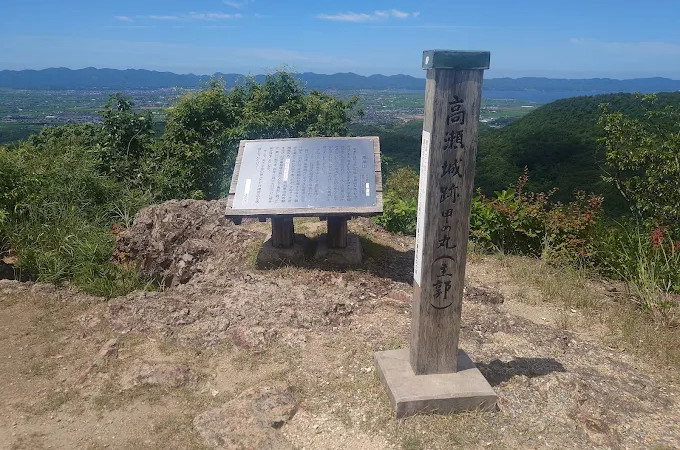
The main enclosure offers excellent views of the surrounding area, overlooking the Izumo Plain and the surrounding mountains. This clear view likely served as a lookout post for detecting enemy movements early.
Moats and Double Moats
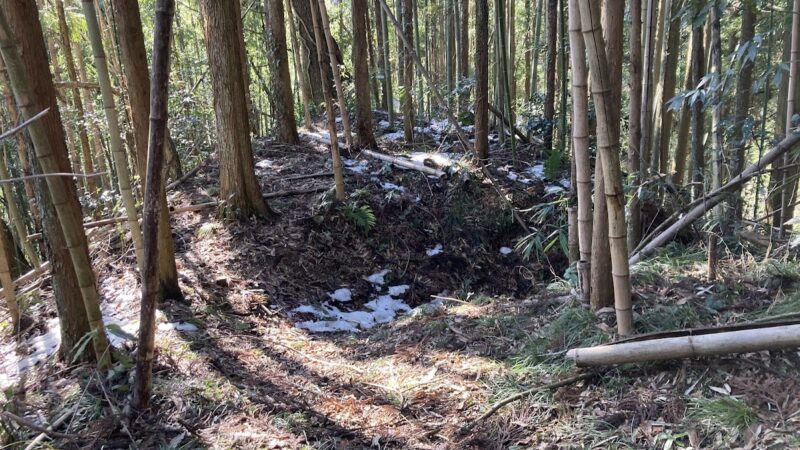
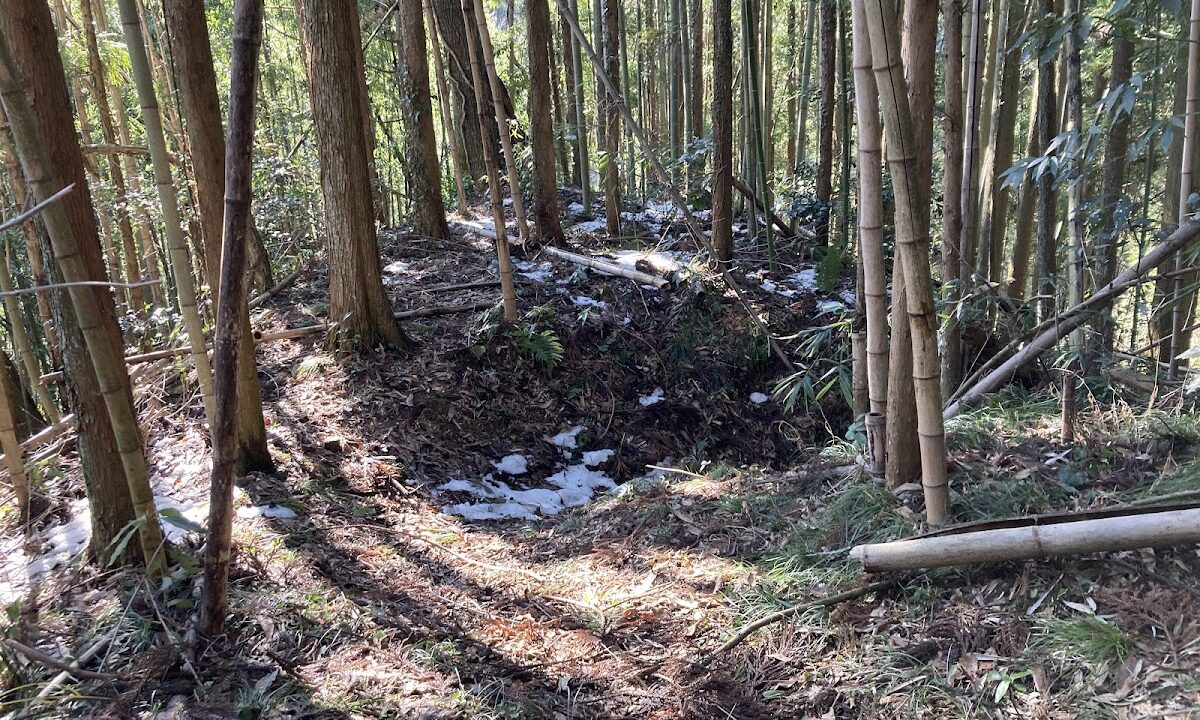
A notable feature of Takama Castle’s defensive structures is the presence of moats. A clear moat can be seen to the northeast of the main enclosure, and a double moat structure is also visible in some areas.
A moat is a dry moat dug to cut across a ridge, serving as an important defensive structure to prevent enemy intrusion. A double moat is a technique that creates a stronger defensive line by arranging two moats, a structure commonly found in mountain castles of the Sengoku period.
The moats at Takama Castle still retain their depth and width, demonstrating the high level of castle-building technology of the time.
Arrangement of Ridge-Shaped Vertical Moats
Another important structure at Takama Castle is the ridge-shaped vertical moat. This is a defensive structure that involves digging multiple parallel vertical trenches on a slope, making it difficult for the enemy to move laterally and effectively dividing enemies climbing the slope.
These ridged vertical trenches are a technique seen in mountain castles from the late Sengoku period, and can be confirmed in multiple locations on the slope at Takama Castle. The existence of these remains indicates that Takama Castle was not merely a local lord’s residence, but a full-fledged military base utilizing advanced castle construction techniques.
Arrangement of Enclosures and Gates
Multiple enclosures are arranged in a stepped pattern around the main enclosure. Each enclosure is separated by elevation differences, creating a structure where even if the enemy captures one enclosure, they can defend the next.
However, no clear remains of a gate (koguchi) have been confirmed. This could be due to weathering over many years or overgrown vegetation obscuring the view, or it could be that the structure was originally simple.
Condition of Stone Walls and Earthworks
No clear stone walls have been confirmed at Takama Castle. This is because Takama Castle was a mountain castle primarily constructed of earth. In the Izumo region during the Sengoku period, castles using stone walls were limited; most featured defensive structures combining earthworks and moats.
Regarding earthworks, while clear remains are scarce, some low, earthwork-like elevations can be observed around the edges of certain enclosures. However, it is difficult to determine whether these are original earthworks or later changes in topography.
Highlights and Charms of Takama Castle
Well-Preserved Moat Remains
The most noteworthy feature for castle enthusiasts visiting Takama Castle is the well-preserved moat. The moat northeast of the main enclosure is clearly defined in both depth and width, conveying the appearance of the defensive structure from that time.
The structure of a double moat can also be observed, making it a valuable remains for learning about Sengoku period castle construction techniques firsthand. Standing at the bottom of the moat, one can appreciate the height of the cliffs on both sides, experiencing firsthand how difficult this defensive structure was for attackers. ### Observation of the Ridge-Shaped Vertical Moats
The ridge-shaped vertical moats arranged on the slope are not to be missed. The sight of multiple vertical moats dug in parallel is an impressive sight that can only be truly appreciated on-site.
While some parts of the ridge-shaped vertical moats are covered with vegetation, they can be clearly identified with careful observation. The remains are particularly easy to see during the winter when the leaves have fallen, so choosing the right time of year for your visit will allow for a more fulfilling observation.
View from the Mountaintop
From the mountaintop where the main enclosure is located, you can see the city of Unnan and the surrounding mountains. On clear days, you can also enjoy views towards the Izumo Plain, giving you a real sense of how Takama Castle functioned as a surveillance base in this region.
Quiet Atmosphere of a Mountain Castle
Takama Castle is not a tourist destination, and the number of visitors is limited. Therefore, its charm lies in the opportunity to carefully observe the remains while feeling the atmosphere of the Sengoku period in a quiet mountain setting.
With minimal maintenance and preserving its natural state, this is a place where you can truly experience the joys of exploring castle ruins.
Access and Visiting Information for Takama Castle
Access by Public Transportation
By Train:
- Get off at Kamo-naka Station on the JR Kisuki Line
- Approximately 3 kilometers from the station to the trailhead by foot or taxi
- Approximately 30-40 minutes on foot from the trailhead to the summit
While access by public transportation is possible, the distance from the station to the trailhead requires travel by taxi or on foot. Since the number of trains is limited, it is recommended to check the timetable in advance.
Access by Car
By Car:
- Approximately 15 minutes from Unnan-Yoshida IC on the San’in Expressway
- Approximately 40 minutes from central Matsue City via National Route 54
- There are several parking spaces near the trailhead
Access by car is the most convenient. The trailhead is located on the southern slope, and signposts are installed along the road, making it relatively easy to find. ### Trailhead and Ascent Route
The trailhead is located at the southern foot of Takama Castle, and there is a signpost along the road. The trail is well-maintained, but because there are steep slopes typical of mountain castles, appropriate hiking attire and shoes are necessary.
- Estimated Time: Approximately 30-40 minutes one way from the trailhead to the summit
- Difficulty: Moderate (steep slopes included)
- Recommended Equipment: Trekking shoes, drinking water, towel, insect repellent (summer)
Precautions for Visiting
- Protection of Remains: Be careful not to damage the remains such as trenches and ridged trenches.
- Safety Management: There are steep slopes and areas with poor footing, so proceed with caution.
- Season Selection: In summer, vegetation grows thick and the remains are difficult to see, so visiting from autumn to spring is recommended.
- Items to Carry: Drinking water, map, and mobile phone are essential.
- Weather Check: Footing becomes slippery in rainy weather, so visiting on a sunny day is recommended.
Estimated Visiting Time
Please allow 2-3 hours for the round trip from the trailhead and the visit to the castle ruins. If you wish to carefully observe the remains, we recommend allocating more time.
Related Historical Sites and Tourist Spots in the Unnan City Area
Nearby Castles
When visiting Takama Castle, we recommend also visiting other castles in the Unnan City area.
Mitoya Castle: Located in Mitoya-cho, Unnan City, this castle was also an important base related to the Amago clan. Known as the residence of the Mitoya clan, it retains the remains of a Sengoku period mountain castle, similar to Takama Castle.
Shin-yama Castle: Located in Daito-cho, Unnan City, this mountain castle was the residence of the Misawa clan, a powerful local lord of Izumo Province.
Tourist Spots in Unnan City
Ryuzu-ga-taki Waterfall: A famous waterfall selected as one of Japan’s Top 100 Waterfalls, located in Kakeai-cho, Unnan City. The waterfall, cascading down from a height of approximately 40 meters, is breathtaking.
Tanabe Family Storehouses: A group of historical buildings located in Yoshida-cho, Unnan City, preserving storehouses from the Edo to Meiji periods.
Kamo-Iwakura Site: A site where a large number of Yayoi period bronze bells were unearthed, known as an important discovery in the history of Japanese archaeology.
Access to Unnan City
Unnan City is located in the eastern part of Shimane Prefecture, in the southern part of the Izumo region.
- From Matsue City: Approximately 40 minutes by car, approximately 1 hour by JR Kisuki Line
- From Izumo City: Approximately 50 minutes by car
- From Hiroshima City: Approximately 2 hours 30 minutes by car (via Chugoku Expressway and Matsue Expressway)
Unnan City Hall is located in Satokata, Kisuki-cho, where tourist information is available. The Unnan City Tourism Association website, “Unnan Tabi Net,” provides information on tourist spots and events.
Research and Materials on Takama Castle
Existence of Castle Layout Maps
Regarding Takama Castle, castle layout maps have been created by castle researchers and are available on websites such as “Castle Wanderings.” These maps are two-dimensional representations of the castle’s structure, showing the arrangement of baileys, the location of moats, and the direction of vertical moats.
Checking the layout map before visiting will deepen your understanding of the remains at the site and allow for a more fulfilling exploration.
Literary Materials
Detailed literary materials on Takama Castle are limited, but information can be obtained from the following sources:
- “Report on the Distribution Survey of Medieval Castle Sites in Shimane Prefecture” (Shimane Prefectural Board of Education)
- “Comprehensive Survey of Japanese Castles 14: Hiroshima, Okayama, Shimane” (Shin Jinbutsu Oraisha)
- Local Historical Materials
For information on the history of the Amago clan and the Amago Ten Flags, specialized books on the Amago clan are also helpful.
Future Preservation and Utilization
Currently, Takama Castle is not undergoing any special maintenance or preservation measures, but well-preserved remains remain. Appropriate preservation and utilization as a regional historical asset are expected in the future.
Unnan City is working to protect cultural properties, and the Shimane Prefectural Board of Education’s Cultural Properties Division also provides information on Unnan City’s cultural properties. There is a possibility that Takama Castle may be designated as a city-designated cultural property in the future.
Summary | Historical Value and Charm of Takama Castle
Located on Mount Takama in Unnan City, Shimane Prefecture, Takama Castle (Onishi Castle) is an important historical site that tells the story of the Amago clan’s power in Izumo Province during the Sengoku period. As one of the Amago’s ten castles, it served as the residence of the Kurakake and Onishi clans and functioned as a defensive base in southern Izumo.
The castle’s layout is a typical example of a Sengoku mountain castle, making maximum use of the rugged terrain, and remains such as moats, double moats, and ridged vertical moats are well-preserved. Although no stone walls or clearly defined earthworks can be found, this earthen mountain castle is a valuable example of the castle-building techniques of the time.
As a quiet mountain castle that hasn’t been commercialized for tourism, it’s a place where castle enthusiasts and history buffs can carefully observe the remains and feel the atmosphere of the Sengoku period. When you visit Unnan City, why not take a trip to Takama Castle and reflect on the Sengoku history of Izumo?
Access is about a 30-40 minute walk from the trailhead at the southern foot of the mountain. With appropriate equipment and preparation, you can enjoy exploring this historically romantic mountain castle. Visiting it along with related historical sites such as Mitoya Castle in the surrounding area will give you a deeper understanding of the history of the Amago clan and the Sengoku period in Izumo.