Complete Guide to Nanao Castle (Masuda City, Shimane Prefecture) | The Masuda Clan’s Residence and Highlights of a National Historic Site
Located in Nanao-cho, Masuda City, Shimane Prefecture, Nanao Castle is a mountain castle that flourished as the residence of the Masuda clan, a leading samurai group of medieval Iwami Province. From the main keep, built on a summit 118m above sea level, you can enjoy a panoramic view of the Masuda Plain and the Sea of Japan. The remains of this large-scale mountain castle, stretching over 600m in length, still remain today. This article provides a detailed introduction to Nanao Castle, including its history, structure, highlights, and access information.
What is Nanao Castle? | A Mountain Castle that Flourished as the Masuda Clan’s Base
Nanao Castle (Nanao-jo) was a Japanese castle located in Nanao-cho, Masuda City, Shimane Prefecture, and is known as the residence of successive generations of the Masuda clan. The castle ruins, along with the Miyake Godoi ruins in Miyake-cho, Masuda City, are designated as a national historic site as the “Masuda Clan Castle Site,” and are important cultural assets that convey the history of medieval Iwami Province to the present day.
The Relationship Between the Masuda Clan and Nanao Castle
The Masuda clan was a leading samurai group in Iwami Province, ruling the Masuda region from the Kamakura period to the Sengoku period. Nanao Castle functioned as a military base for the Masuda clan, while Miyake-Odoi, located across the Masuda River, served as their residence. This integrated castle and residence structure is highly regarded as a typical example of a medieval samurai base.
History of Nanao Castle | From Kenkyu 3 to the Sengoku Period
Construction Period: Built by Mikamoto Kanetaka (1192)
Nanao Castle is believed to have been built in Kenkyu 3 (1192). Mikamoto Kanetaka, considered the ancestor of the Masuda clan, was granted this land by Minamoto no Yoritomo for his achievements in the Battle of Dan-no-ura, and built the castle there. Kanetaka adopted the name Masuda in this area, and it remained the Masuda clan’s base for approximately 400 years.
Sengoku Period: Masuda Fujikane and the Castle’s Renovation (1556)
In 1556 (Kōji 2), Masuda Fujikane extensively renovated Nanao Castle. This period was a turbulent time in the Chūgoku region, with the fall of the Ōuchi clan and the conflict between Sue Harukata and Mōri Motonari. Masuda Fujikane initially sided with Sue Harukata, but was attacked by the forces of Mōri Motonari and Yoshimi Masayori.
Submission to the Mōri Clan
After being attacked by the Mōri army, Masuda Fujikane, at the urging of Kikkawa Motoharu, decided to submit to the Mōri clan. This saved Nanao Castle from destruction, and the Masuda clan continued to exist under the Mōri’s control. This historical turning point dramatically altered the fate of Nanao Castle and the Masuda clan.
After the Edo Period
During the Edo period, the Masuda clan served the Sakazaki clan, who became the lords of the Tsuwano Domain, and later the Kamei clan, and Nanao Castle ceased to serve its original purpose. However, the castle ruins were carefully preserved as a historical symbol of the region, and remain so to this day.
Structure of Nanao Castle | A Large Mountain Castle Without Stone Walls
Overall Structure and Scale
Nanao Castle was built on a mountain extending north from the south bank of the Masuda River. The main enclosure (honmaru) is located at an altitude of approximately 120m, with baileys arranged on the east and west ridges extending northward from there. Its total length exceeds 600m, making it a large-scale medieval mountain castle.
Reasons for the Lack of Stone Walls
A major characteristic of Nanao Castle is the absence of stone walls, despite its large size. This is thought to be due to its construction during the medieval period, and the fact that, as is characteristic of mountain castles in Iwami Province, defensive structures primarily consisting of earthworks and trenches were employed. Earthen castles, without stone walls, are valuable historical remains that demonstrate the castle-building techniques and regional characteristics of the time.
Major Remains
Main Enclosure (Honmaru)
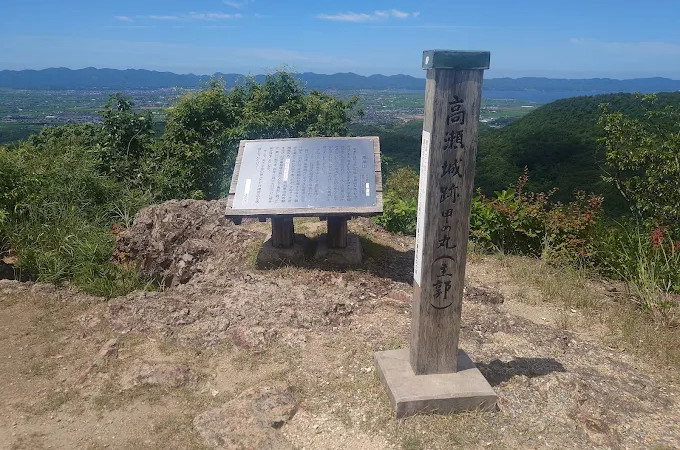
Located on the summit at an altitude of 118m, the Honmaru (main enclosure) is the central part of Nanao Castle. From here, one can see the Masuda Plain and the Sea of Japan, indicating its importance as a military stronghold.
Main Gate (Otemon) Site
The remains of the Otemon (main gate), which served as the castle’s main entrance, are still visible. The Otemon was an important facility that indicated the castle’s status and symbolized the authority of the Masuda clan.
Outer Gate (Sōmon) Site
The remains of the Sōmon (outer gate), which served as the entrance to the castle, can also be confirmed. The flow of movement from the Sōmon to the Otemon and then to the Honmaru shows a typical structure of a medieval mountain castle.
Enclosure Groups
Multiple enclosures (flat areas) are arranged along the east-west ridges, and are thought to have functioned as defensive facilities and troop garrisons.
Relationship with Miyake-Odoi | Integrated Castle and Residence Structure
What is Miyake-Odoi?
Miyake-Odoi is the site of a residence located in Miyake-cho, Masuda City, across the Masuda River from Nanao Castle. It is believed to be the place where the Masuda clan lived and conducted their daily affairs. While Nanao Castle served as a military base, Miyake-Odoi played a different role, serving as a living quarters during peacetime.
Integrated Operation of Castle and Residence
Medieval samurai groups typically lived in residences on the plains during peacetime and fortified themselves in mountain castles during wartime. The relationship between Nanao Castle and Miyake-Odoi is an important example of this. The two facilities were situated on either side of the Masuda River, a natural moat, creating a mutually complementary structure.
National Historic Site “Masuda Clan Castle Site”
The Nanao Castle site and the Miyake Godoi site are designated as a national historic site under the name “Masuda Clan Castle Site.” This designation recognizes the historical value of the castle site as a complete set, not as a single castle. It is highly valued academically as a valuable archaeological site that allows us to understand the overall structure of a medieval samurai group’s base.
Highlights of Nanao Castle | Checkpoints for Visitors
Spectacular View from the Main Enclosure
The greatest highlight of Nanao Castle is the view from the main enclosure. From the summit at an altitude of 118m, you can enjoy a panoramic view of the rural landscape of the Masuda Plain and the blue expanse of the Sea of Japan. On a clear day, you can see the entire city of Masuda, giving you a real sense of why this location was chosen as a military base.
Observation of Remains
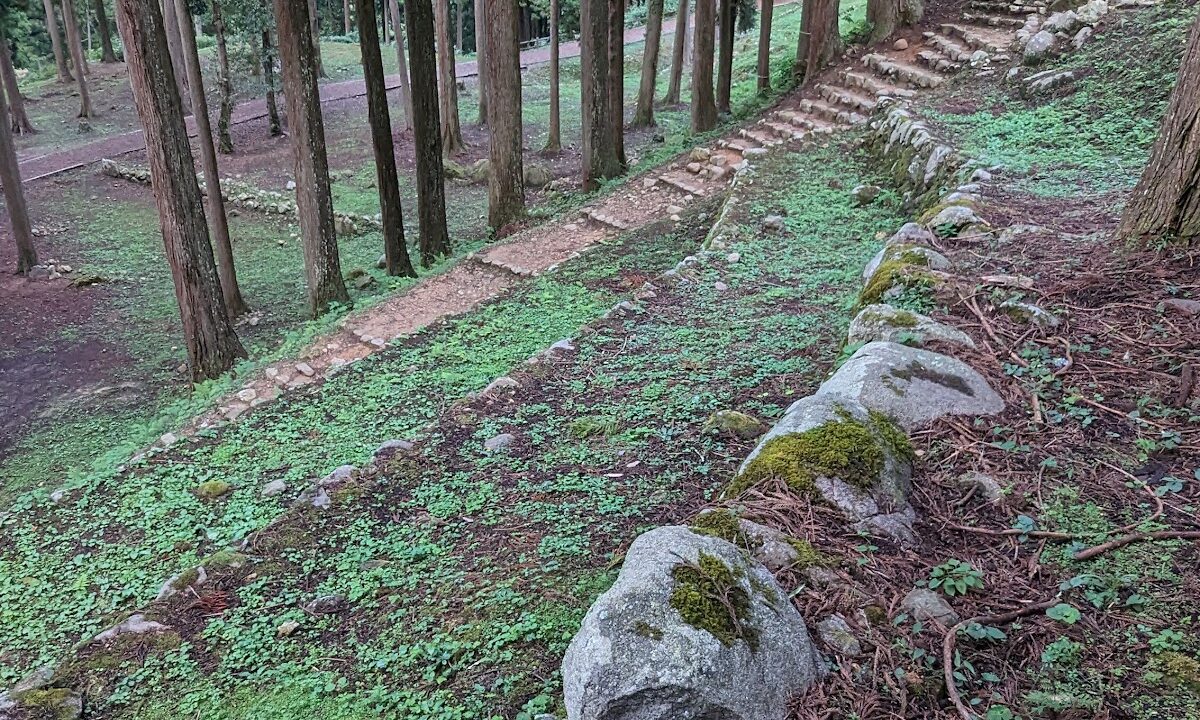
Although there are no stone walls, you can observe typical remains of a medieval mountain castle, such as earthworks, moats, and the remains of baileys. In particular, the defensive structures that skillfully utilize the natural terrain speak to the high level of castle-building technology of the time.
Ascent Route
There are several routes to Nanao Castle, but the route via the Otemon Gate ruins is the historically official route. Following the path taken by the samurai of that time allows you to feel the history more deeply.
Nearby Historical Spots
Ikōji Temple
Ikōji Temple, a temple associated with the Masuda clan, is located close to Nanao Castle. As the Masuda clan’s family temple, it preserves many valuable cultural assets.
Historical Heritage of Masuda City
Many cultural assets related to the Masuda clan remain in Masuda City, and visiting them together with Nanao Castle will allow you to understand the history of the Masuda clan more deeply.
Access Information | How to Get to Nanao Castle
Access by Public Transportation
From JR Masuda Station
- Bus: Approximately 10 minutes by bus from Masuda Station
- Route: Banryuko Line, etc.
- Bus Stop: Get off at Masuda Honmachi or the bus stop closest to Nanao Castle Ruins
- Walking from the bus stop: Approximately 15 minutes
Masuda Station is a major station on the San’in Main Line and is accessible from Hiroshima and Yamaguchi. The Masuda City Tourism Association is located inside the station, where you can obtain detailed tourist information.
Access by Car
From Hamada Expressway
- Approximately 60 minutes from Hamada IC on the Hamada Expressway via National Route 9
- Parking: Parking spaces available around the castle ruins (limited number of spaces)
From Hiroshima
- Via National Route 191 and National Route 9
- Estimated time: Approximately 2 hours
Visiting the Castle on Foot
It takes approximately 20-30 minutes on foot from the parking lot or nearest bus stop to the main keep ruins. Since it is a mountain path, we recommend wearing comfortable shoes.
Map | Location of Nanao Castle and Surrounding Facilities
Nanao Castle is located adjacent to the urban area of Masuda City, built on a hilly area on the south bank of the Masuda River.
Distance to Major Facilities
- JR Masuda Station: Approximately 2km
- Miyake Godoi Ruins: Across the Masuda River (approximately 500m)
- Ikōji Temple: Approximately 1.5km
- Masuda City Tourism Association: Inside Masuda Station
Detailed maps can be found on the Masuda City Tourism Association’s official website or by searching for “Nanao Castle Ruins” or “Nanao-machi, Masuda City” on various map apps.
Visiting Guide | Points to Enjoy Nanao Castle
Best Season for Visiting
Spring (March-May)
The season of fresh greenery and mild weather makes it ideal for visiting the castle. The surrounding scenery is also beautiful during cherry blossom season.
Autumn (October-November)
The autumn foliage season enhances the atmosphere of the mountain castle. The temperature is also suitable for visiting the castle.
Summer/Winter Precautions
Summer requires precautions against the heat, and winter requires precautions against the cold. Especially in summer, don’t forget to stay hydrated. ### Estimated Time Required
- Castle visit only: Approximately 1 hour
- Thorough exploration: Approximately 2 hours
- Visiting Miyake-Odoi and the castle together: Approximately 3 hours
- Visiting historical sites in Masuda City: Half a day to a full day
Checklist of things to bring
- Comfortable walking shoes (trekking shoes recommended)
- Drinking water
- Hat (for sun protection)
- Camera (for taking photos of scenic views)
- Insect repellent (in summer)
- Rain gear (in case of unstable weather)
Photo Spots
Panoramic view from the main keep ruins
A spectacular viewpoint offering panoramic views of the Masuda Plain and the Sea of Japan. The morning light is especially beautiful.
Main Gate Ruins
Allows for photography with historical remains as a backdrop.
Views from the baileys
The views of Masuda city from each bailey are also captivating.
Masuda City Tourist Information | Spots to Visit Alongside Nanao Castle
Ikōji Temple
This is the family temple of the Masuda clan, and it preserves valuable cultural assets, including nationally designated Important Cultural Properties. The garden, said to have been created by Sesshū, is also a highlight.
Manpukuji Temple
This temple is also associated with the Masuda clan and is an important spot for understanding their history.
Masuda City Historical and Folk Museum
Detailed materials on the Masuda clan and Nanao Castle are on display, and visiting before or after your visit will deepen your understanding.
Masuda City Tourism Association
Located inside JR Masuda Station, you can obtain the latest tourist information, brochures, maps, etc. Staff can also provide detailed access information and event information.
Value of the Masuda Clan Castle Site | Significance of National Historic Site Designation
Important Resource for Medieval Samurai Research
The Masuda Clan Castle Site (Nanao Castle and Miyake-Odoi) is an extremely important historical site for understanding the structure of medieval samurai strongholds. The example of a castle (military facility) and residence (living facilities) remaining as a single entity is rare nationwide and is highly valued for its academic significance.
Conveying the History of Iwami Province
Iwami Province was a region that fostered a unique samurai culture during the medieval period. The Masuda clan was a representative samurai group, and Nanao Castle is an important cultural asset that conveys its history to the present day.
Preservation and Utilization
With its designation as a National Historic Site, the Nanao Castle site is appropriately preserved and managed. At the same time, it is utilized for local history education and as a tourist resource, making it an important cultural asset of Masuda City.
The Charm of Nanao Castle | Why You Should Visit
Experience Historical Romance
Nanao Castle, built approximately 800 years ago, experienced the turbulent times of the Sengoku period (Warring States period). Visiting its remains allows you to feel the historical romance of the medieval and Sengoku periods firsthand.
Enjoy Breathtaking Views
The view from the main keep ruins is not only historically valuable but also simply a magnificent sight. The beautiful scenery of the Masuda Plain and the Sea of Japan captivates visitors.
A Place of Learning
Nanao Castle offers a wealth of learning opportunities, including the structure of a medieval mountain castle, construction techniques that did not utilize stone walls, and the fact that the castle served as a samurai headquarters. It is valuable not only for history enthusiasts but also as an educational site.
A Quiet Environment
Unlike popular tourist destinations, it is not crowded, allowing you to immerse yourself in history at your own pace. Reflecting in a quiet environment is one of the pleasures of visiting Nanao Castle.
Summary | Nanao Castle: A Historical Heritage Site Proud of Masuda City
Nanao Castle in Masuda City, Shimane Prefecture, is a mountain castle with a history of approximately 400 years, serving as the residence of successive generations of the Masuda clan. From the main keep site, at an altitude of 118m, you can enjoy a panoramic view of the Masuda Plain and the Sea of Japan. Large-scale remains, stretching over 600m in length, still exist. As a typical example of a medieval mountain castle without stone walls, and as a castle site integrated with the Miyake-Odoi (earthen fortifications), it is a valuable cultural asset designated as a national historic site.
It is accessible by bus and on foot from JR Masuda Station, and there are many other historical sites related to the Masuda clan, such as Ikōji Temple, scattered around the area. It’s a recommended spot not only for history buffs, but also for those seeking spectacular views and those who want to experience history in a quiet environment.
When visiting Masuda City, be sure to visit the Nanao Castle ruins and experience the history and culture of medieval Iwami Province. The Masuda City Tourism Association provides detailed tourist information, so gathering information beforehand will make your experience even more fulfilling.