Hyakusaiji Castle (Shiga Prefecture) Complete Guide: A Thorough Explanation of the Remains and History of the Fortified Temple
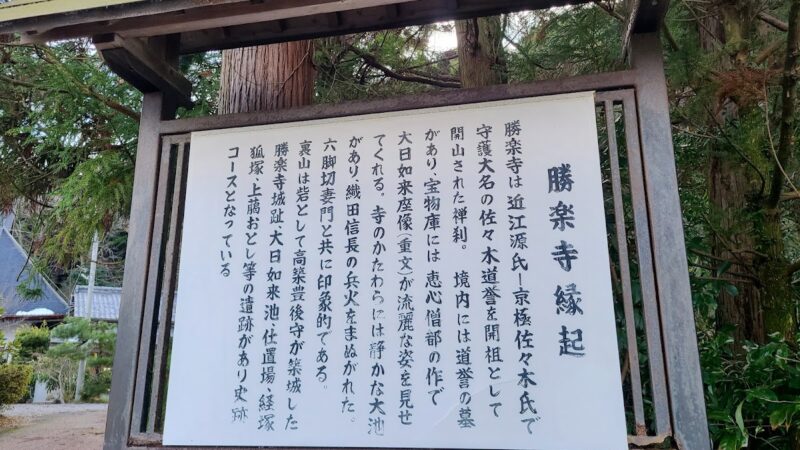
Hyakusaiji Castle is a fortified temple located in Higashiomi City, Shiga Prefecture. It has a unique history, having been fortified by the Rokkaku clan during the Sengoku period (Warring States period) while Hyakusaiji Temple, one of the oldest temples in Omi Province, is said to have been founded by Prince Shotoku. Even today, the long earthen ramparts, dry moats, and stone walls remaining around the main gate convey the appearance of the temple, which also functioned as a military base.
History of Hyakusaiji Castle
Founding by Prince Shotoku and the Ancient Hyakusaiji Temple
Hyakusaiji Temple is said to have been founded in 606 AD (Suiko 14th year) by Prince Shotoku on the mountainside of Oshitateyama (elevation 771.8m) for the people of Baekje. It is said to have been built in imitation of the “Ryūun-sa” temple in the Baekje Kingdom, and its principal image, the “Ueki Kannon,” is traditionally believed to be one of two statues made from the same tree as the principal image of Ryūun-sa in Korea.
Developing as a Tendai sect temple, Baekje-ji established itself as a Tendai branch temple by the end of the Heian period, becoming an important center of Buddhism in Ōmi Province. Along with Kongōrin-ji and Seimyō-ji, it is counted as one of the “Three Mountains of Kotō” and is known as a pilgrimage site for the Ōmi Saigoku Pilgrimage, Shinto-Buddhist pilgrimages, and the Hyakuji Pilgrimage.
Expansion of the Temple and Fortification in the Middle Ages
In the Middle Ages, Baekje-ji underwent remarkable development. Four valleys—Kitadani, Higashidani, Nishidani, and Minamidani—formed within its grounds, and at its peak, it became a major religious city with over 300 sub-temples and more than 1,000 monks. Its surrounding temple lands formed its economic base, and its scale and prosperity were such that the Portuguese missionary Luís Fróis recorded it as “a paradise on earth.” Such a religious city, inhabited by a large population, simultaneously created a need for self-defense. After its destruction by fire in 1503, reconstruction of the temple complex progressed, and defensive facilities were constructed within the grounds to prepare for war. This coincided with the Rokkaku clan’s desire to develop military bases within the province, and Hyakusaiji Temple, while primarily a temple, began to function as a fortress.
Relationship with the Rokkaku Clan and Militarization
During the Sengoku period (Warring States period), Hyakusaiji Temple forged a close relationship with the Rokkaku clan. The Rokkaku clan, as the powerful governors of Omi Province, supported the fortification of Hyakusaiji Temple. Defensive facilities such as moats and earthworks were built, transforming the temple into a “mountain castle” covered in imposing stone walls.
Hyakusaiji Temple’s location was also militarily important. Taking advantage of its topography on the slopes of Mount Oshitate, it offered a panoramic view of the surrounding area, functioning as a strategically important point in eastern Omi Province.
The Burning of the Temple by Oda Nobunaga
In April of Genki 4 (1573), Hyakusaiji Temple faced its greatest crisis. Rokkaku Jōtei (Yoshisuke), who had been resisting Oda Nobunaga, holed up in Namazue Castle, located near Hyakusaiji Temple. During this time, Hyakusaiji Temple supported the Rokkaku clan, supplying them with provisions and sheltering the wives and children of the Rokkaku soldiers.
Enraged by this, Oda Nobunaga launched an attack on Hyakusaiji Temple on April 11th of the same year. Nobunaga’s army carried out a thorough burning, completely destroying the magnificent temple with its nearly 1000-year history. Many valuable buildings and cultural artifacts were lost as a result of this burning.
Restoration by Tokugawa Ieyasu and the Edo Period and Beyond
After Oda Nobunaga’s burning, Hyakusaiji Temple, which had fallen into ruin, was restored by Tokugawa Ieyasu during the Edo period. With Ieyasu’s support, the reconstruction of the temple complex progressed, but it never reached the scale of its former size, which housed 1,000 people, resulting in a smaller-scale restoration.
The current Hyakusaiji Temple, centered around buildings rebuilt during the Edo period, forms a unique landscape that retains the remains of a castle from the Sengoku period. The temple grounds are designated a national historic site, recognizing its historical value.
Structure and Remains of Hyakusaiji Castle
Defensive Facilities Around the Main Gate
The most prominent remains of Hyakusaiji Castle are the long earthen ramparts and dry moats remaining on either side of the main gate. While the main gate served as the entrance to the temple, it also functioned as a castle entrance.
The earthen ramparts extending on both sides of the main gate reach several meters in height, demonstrating the high level of defensive awareness at the time. The dry moats dug along the ramparts are also clearly visible, revealing various ingenious measures taken to prevent enemy intrusion. These remains are still preserved in relatively good condition today, making them valuable historical materials that convey the appearance of Baekjeji Temple as a fortified temple.
Characteristics of the Stone Walls
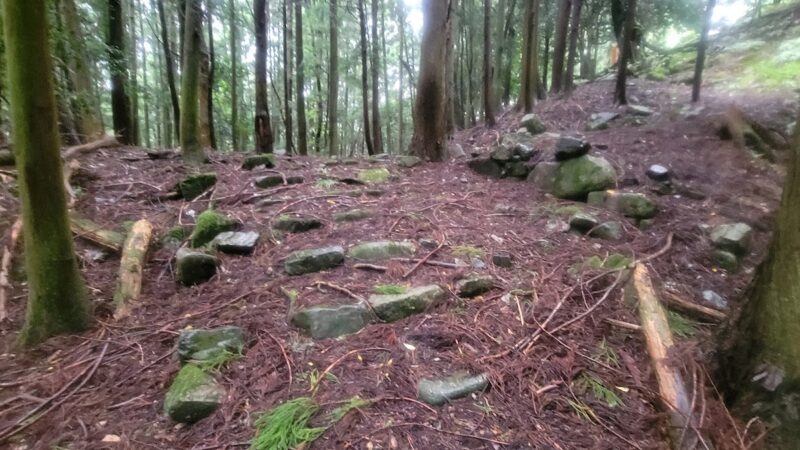
One of the characteristics of Baekjeji Castle is its imposing stone walls. These stone walls, reminiscent of a mountain castle, can be seen throughout the temple grounds, giving the impression of visiting a mountain castle rather than a temple.
The construction method of the stone walls reflects the techniques of the Sengoku period, primarily using the nozurazumi method, which utilizes natural stones. These stone walls were positioned to enhance defensive capabilities while taking advantage of the steep terrain. In particular, solid stone walls were built along the approach to the temple and around the main buildings, indicating an emphasis on its function as a castle.
Arrangement and Layout of the Four Valleys
In the medieval period, Baekjeji Temple had four valleys: Kitadani (North Valley), Higashidani (East Valley), Nishidani (West Valley), and Minamidani (South Valley), each with numerous sub-temples. This arrangement was not merely the placement of religious facilities, but also a layout designed with defense in mind.
Each valley was strategically positioned to utilize the natural terrain, and they interconnected to form a single, unified fortified city. While most of the original buildings are gone today, the topography and remains allow us to infer the original layout.
Location as a Mountain Castle
Kyokusaiji Castle is located on the slopes of Oshitateyama Mountain, at an altitude of approximately 300 meters. This location offered significant defensive advantages. From its high vantage point, the surrounding plains could be overlooked, allowing for early detection of enemy movements.
Furthermore, by utilizing the mountainous terrain to construct defensive lines, effective defense was possible even with a small force. The steep slopes acted as natural barriers, making it a fortress that was difficult for attackers to conquer.
Highlights of Kyokusaiji Castle
Main Hall and Niomon Gate
The current main hall was rebuilt during the Edo period and houses the principal image, the Eleven-Faced Kannon. The interior is enveloped in a tranquil atmosphere, creating a space that evokes a long history.
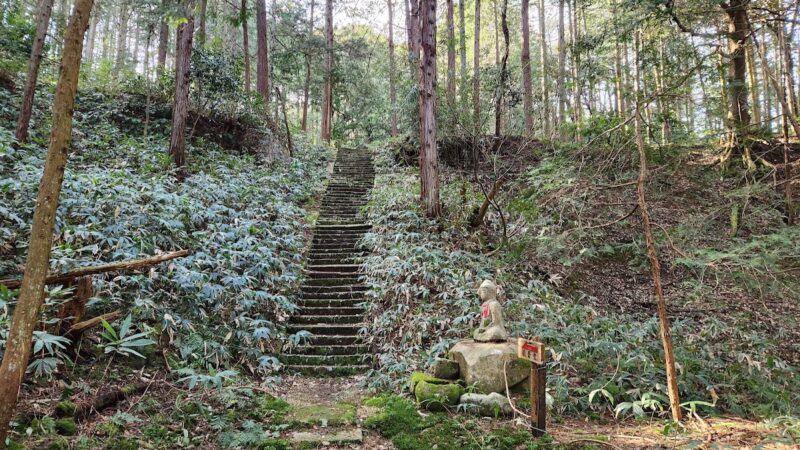
The Niomon Gate is also a highlight. Powerful Nio statues welcome visitors, marking the beginning of a sacred area. Stone walls and steps remain around the Niomon Gate, creating a unique landscape where temple and castle elements blend seamlessly.
Remains of Earthworks and Dry Moats
The earthworks and dry moats remaining around the main gate are must-see remains for anyone visiting Hyakusaiji Castle. The extensive earthworks demonstrate the advanced civil engineering techniques of the time and speak to the serious efforts made to protect the temple.
Walking along the dry moat, one is struck by its depth and width. Excavating a moat of this scale must have required considerable effort, revealing Hyakusaiji Temple’s economic strength and organizational capabilities.
Stone Walls
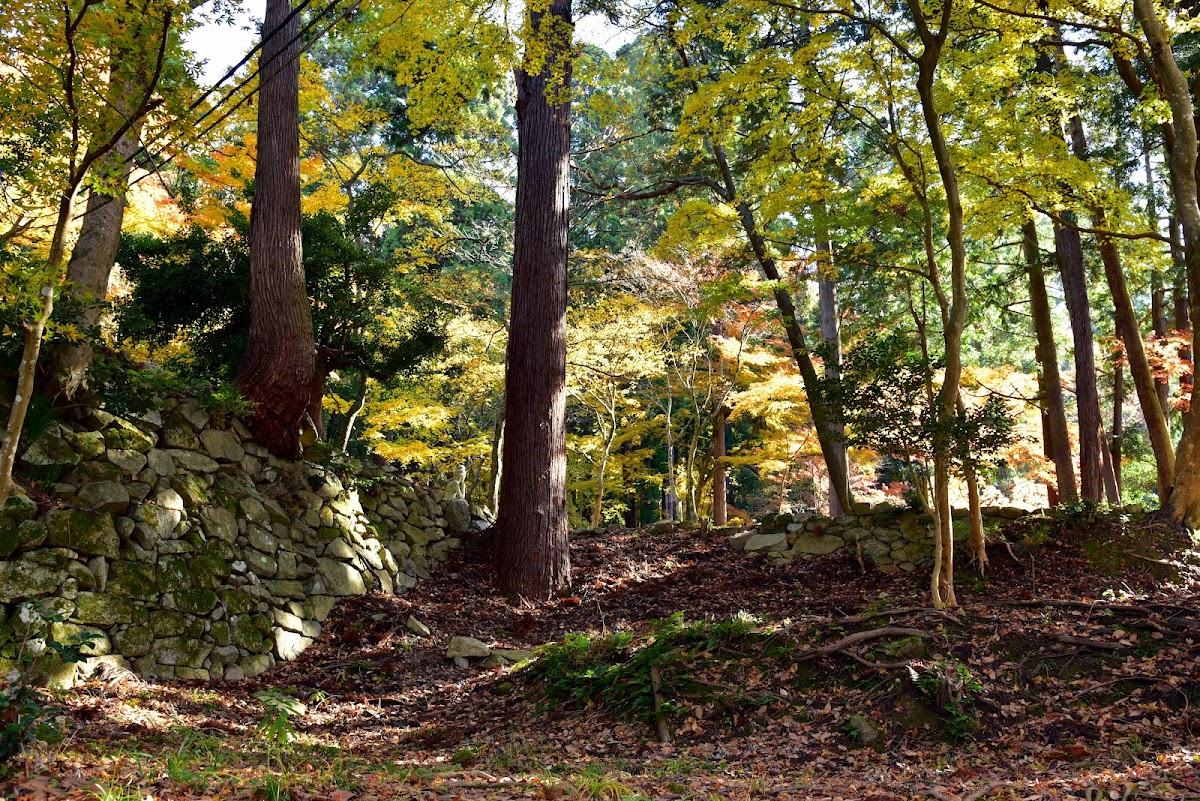
The stone walls remaining throughout the temple grounds each have their own unique characteristics. The stone walls along the approach to the temple are relatively neatly constructed, serving to protect the main pathways. On the other hand, the stone walls in the back and along the valleys are arranged in a more natural form, forming a flexible defensive line adapted to the terrain.
Observing the stone walls reveals traces of rebuilding and differences in construction techniques across different eras, making them a fascinating subject from the perspective of castle archaeology.
Observation Spot
From the grounds of Hyakusaiji Temple, there is an observation spot offering panoramic views of Lake Biwa and the Omi Plain. On clear days, you can even see as far as Mount Hiei, giving you a real sense of why this area was once a strategically important location.
This view is one of the reasons why the temple was called “paradise on earth,” making it a special place where the beauty of nature and the romance of history intersect.
Famous Autumn Foliage Spot
Hyakusaiji Temple is known as a famous spot for autumn foliage, selected as one of “Japan’s Top 100 Autumn Foliage Spots.” In autumn, the temple grounds are dyed in red and yellow, attracting many tourists. During the autumn foliage season, you can enjoy a spectacular view where historical remains and the beauty of nature harmonize.
The autumn foliage, especially along the approach to the temple and in the gardens, is magnificent. The leaves adorning the castle ruins, such as the stone walls and earthworks, create a unique landscape not seen at other temples.
Relationship between Kudara-ji Castle and Namazue Castle
Overview of Namazue Castle
Namazue Castle was a castle of the Rokkaku clan located near Kudara-ji Temple. It came to the forefront of history in 1573, when Rokkaku Jōtei, pursued by Oda Nobunaga, took refuge in this castle.
Namazue Castle is a hilltop castle, geographically different from Kudara-ji Castle, but the two were closely related. It is believed that Kudara-ji Castle and Namazue Castle mutually supported each other within the Rokkaku clan’s military network.
Support for Namazue Castle by Kudara-ji Temple
During the siege of Namazue Castle in 1573, Kudara-ji Temple actively supported Namazue Castle. The temple provided military support that went beyond the scope of a mere religious institution, including the delivery of provisions and the protection of families of the Rokkaku army.
This support demonstrates the strong ties between Kudara-ji Temple and the Rokkaku clan, and simultaneously proves that Kudara-ji Temple was not merely a temple, but a fortress integrated into the Rokkaku clan’s military system.
Background to Nobunaga’s Burning
The reason Oda Nobunaga burned down Kudara-ji Temple was precisely because of this support for Namazue Castle. For Nobunaga, the Rokkaku clan was an obstacle to the pacification of Omi Province, and Kudara-ji Temple, a supporting force, was also considered an enemy.
As seen in his burning of Enryaku-ji Temple on Mount Hiei, Nobunaga adopted a policy of ruthless attacks against opposing religious forces. The burning of Kudara-ji Temple can be seen as an extension of this policy.
Current Kudara-ji Temple and Tourist Information
Visiting the Temple Grounds
Currently, Kudara-ji Temple continues its religious activities as a Tendai sect temple, while also being open to the public as a historical site. Visiting the temple grounds requires a fee, and visiting hours are usually from 8:00 AM to 5:00 PM (subject to seasonal variations).
The temple grounds are vast, and a leisurely visit takes approximately 1 to 2 hours. Since there are many stone steps and slopes, comfortable walking shoes are recommended.
Special Visits During the Autumn Foliage Season
During the autumn foliage season (mid-November to early December), special visits may be held. During this time, the temple is bustling with tourists, and areas normally closed to the public may be opened.
Avoiding the autumn foliage season allows you to fully appreciate the tranquil atmosphere of this ancient temple. If you wish to carefully observe the castle ruins, a visit during the off-season is also recommended.
Nearby Historical Sites
There are other historical sites scattered around Hyakusaiji Temple. The other two temples of the Kotō Sanzan (Three Temples of Kotō), Kongōrinji and Seimyōji, also possess castle-like features. Visiting them together will provide a deeper understanding of the characteristics of castle-like temples in Ōmi Province.
Furthermore, the ruins of Namazue Castle are also nearby, and visiting while considering its connection to Hyakusaiji Castle will deepen your historical understanding.
Access
Access by Public Transportation
The nearest stations to Hyakusaiji Temple are JR Biwako Line’s “Notogawa Station” or Ohmi Railway’s “Yokaichi Station.”
From Notogawa Station, take the Ohmi Bus bound for “Hyakusaiji Honmachi” and get off at the “Hyakusaiji Honmachi” bus stop. From there, it’s about a 20-minute walk. A similar bus route is available from Yokaichi Station. However, since the number of buses is limited, it is recommended to check the timetable in advance.
During the autumn foliage season, extra buses may operate, making access slightly more convenient.
Access by Car
By car, it’s about 15 minutes from the Meishin Expressway’s “Koto Sanzan Smart IC” or about 20 minutes from the “Yokaichi IC.” A parking lot for visitors is available on the temple grounds, and regular cars can park there.
During the autumn foliage season, the parking lot gets crowded, so visiting earlier in the day is recommended. Also, since the path is uphill, caution is needed regarding icy roads in winter.
Location and Contact Information
- Location: 323 Hyakusaiji-cho, Higashiomi City, Shiga Prefecture
- Phone: 0749-46-1036
- Admission Fee: Adults 600 yen, Junior High School Students 300 yen, Elementary School Students 200 yen (as of 2024)
For the latest visiting hours and fees, it is recommended to check official information before visiting.
Historical Significance of Hyakusaiji Castle
Value as a Fortified Temple
Hyakusaiji Castle is one of the representative examples of fortified temples in Japan. While many temples developed defensive facilities from the medieval period to the Sengoku period, Hyakusaiji Castle is particularly large-scale and valuable as an example of a well-preserved structure.
The transformation of temples into fortified structures stemmed from the increasing economic and military power of religious forces, as well as the unstable social conditions of the Sengoku period (Warring States period). The case of Hyakusaiji Temple serves as an important historical document that concretely illustrates this historical context.
The Rokkaku Clan and the History of Omi
The history of Hyakusaiji Castle is closely linked to the rise and fall of the Rokkaku clan, the shugo (military governor) of Omi Province. The Rokkaku clan wielded considerable power in Omi from the Nanboku-cho period to the Sengoku period, but declined with the rise of Oda Nobunaga.
The burning of Hyakusaiji Temple symbolizes the downfall of the Rokkaku clan and also marks the end of the Sengoku period in Omi. In this sense, Hyakusaiji Castle is an indispensable historical site for understanding the Sengoku history of Omi.
Nobunaga’s Religious Policies
The burning of Hyakusaiji Temple by Oda Nobunaga is also important for understanding his religious policies. Nobunaga carried out a thorough suppression of rival religious forces, including Enryaku-ji Temple on Mount Hiei, Ishiyama Hongan-ji Temple, and Kudara-ji Temple.
This was not merely religious persecution, but also had a strong aspect of eliminating military and political adversaries, and was part of Nobunaga’s unification efforts. The case of Kudara-ji Temple illustrates the reality of the Sengoku period, when religion and politics were closely intertwined.
Summary
Kudara-ji Castle (Higashiomi City, Shiga Prefecture) is a rare example of a castle-temple, a historical temple said to have been founded by Prince Shotoku, which was fortified during the Sengoku period. The remaining structures around the main gate, such as the long earthen ramparts and dry moats, and the imposing stone walls, convey to the present day its appearance as a mountain castle despite being a temple.
In 1573, during the Genki era, it was burned down by Oda Nobunaga for supporting the Rokkaku clan’s Namazue Castle, and its magnificent temple complex was lost. However, it was rebuilt by Tokugawa Ieyasu during the Edo period. Currently designated a national historical site and selected as one of Japan’s Top 100 Autumn Foliage Spots, it is a popular destination enjoyed by many.
Visiting Kudara-ji Castle allows you to experience firsthand the relationship between religious and samurai forces during the Sengoku period, the unique culture of a castle-temple, and the history of Omi Province. Seeing the remains such as stone walls and earthworks will allow you to feel the breath of history in a way that textbooks cannot.
As one of the three famous mountains of Kotō, and a must-see historical site for castle enthusiasts, Kudara-ji Castle is a representative historical heritage of Shiga Prefecture. While its vibrant autumn foliage is captivating, visiting during a quieter season to reflect on its history will also be a special experience.