Shōrakuji Castle (Inukami District, Shiga Prefecture) | A Complete Guide to the Mountain Castle and Family Temple Associated with Sasaki Dōyo
In the Shōrakuji district of Kōra Town, Inukami District, Shiga Prefecture, lies the ruins of Shōrakuji Castle, which preserves the history of the Nanboku-chō period. This castle has deep ties to Sasaki Dōyo (Kyōgoku Takauji), known as the “Basara Daimyo,” and together with Shōrakuji Temple at the foot of the mountain, it strongly retains the traces of the powerful figures of that time. This article provides a detailed introduction to the history of Shōrakuji Castle, its highlights, access methods, and surrounding cultural properties.
History and Overview of Shōrakuji Castle
Basic Castle Information
Location: 4 Shōrakuji, Kōra-chō, Inukami-gun, Shiga Prefecture
Construction Period: Ōan 1 (1368)
Builder: Takatsuki (Takatsuki) Bungo-no-kami
Elevation: 308m
Castle Type: Mountain Castle
Main Remains: Enclosures, stone walls, earthworks, moats
Shōrakuji Castle is a medieval mountain castle built on the summit of Mount Shōraku (Shōrakuji-yama). From the 308m-high summit, one can overlook the entire Inukami-gun area, making it a strategically important military location.
Construction History and Sasaki Dōyo
Sasaki Dōyo (Kyōgoku Takauji, 1296-1373), a prominent warlord of the Nanboku-chō period, was deeply involved in the construction of Shōrakuji Castle. Dōyo originally based himself in Sakata District (present-day northern Shiga Prefecture), but moved his base to the vicinity of Shōrakuji Temple in Kōra Town, Inukami District, considering the convenience of transportation for his service to the Muromachi Shogunate.
In 1368 (Ōan 1), Shōrakuji Castle was built by Takatsuki Bungo-no-kami, a retainer of Dōyo, on his orders. This castle functioned as a fortified outpost protecting Dōyo’s residence, and in times of emergency, it served as a defensive base where he could take refuge from his residence at the foot of the mountain to the castle at the summit.
About Sasaki Dōyo
Sasaki Dōyo was a samurai who was active from the late Kamakura period to the Nanboku-chō period, and is known as a “Basara Daimyo.” “Basara” refers to free-spirited behavior that is not bound by existing order or authority, and Dōyo was a prime example of this.
Dōyō, who played an active role in Ashikaga Takauji’s overthrow of the Kamakura Shogunate, prospered the Kyōgoku family after the establishment of the Muromachi Shogunate and held important positions such as head of the Samurai-dokoro (Board of Retainers). He was also known as a man of culture, deeply knowledgeable in tea ceremony and linked verse, and was one of the cultural leaders of his time.
Shōrakuji Castle in the Sengoku Period
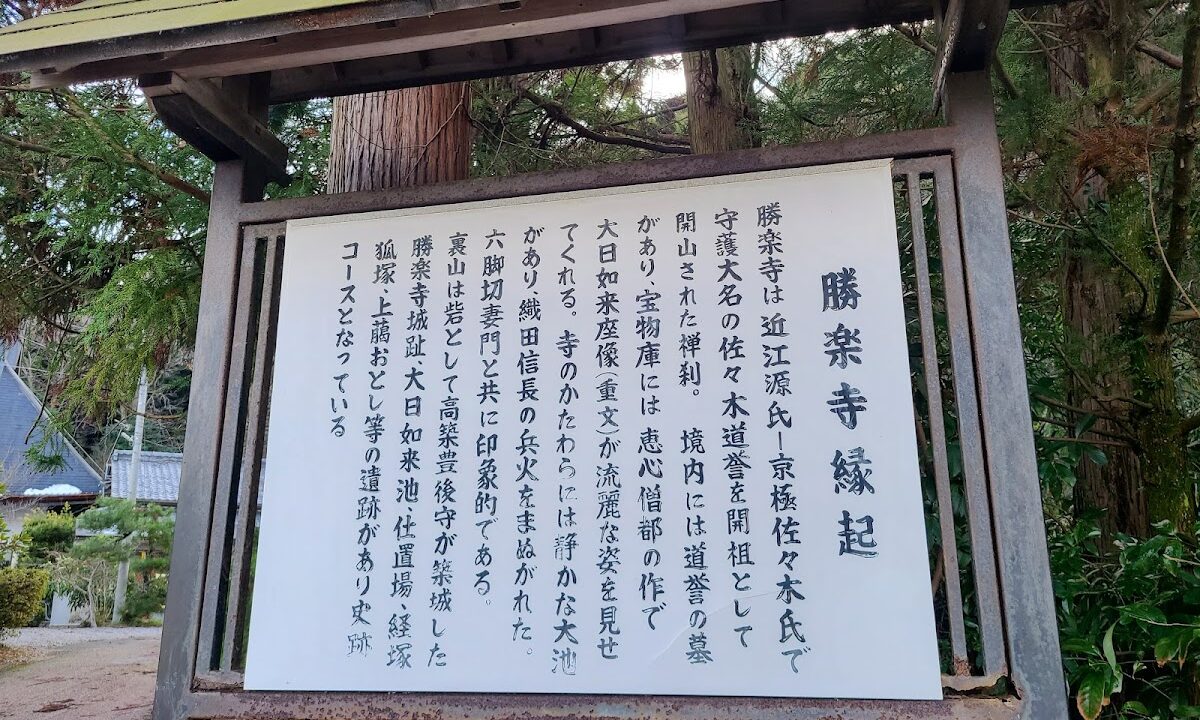
Shōrakuji Castle continued to be used even after the Nanboku-chō period, and during the Sengoku period, Taga Bungo-no-kami resided there as the castle lord. However, with the expansion of Oda Nobunaga’s power, it was burned down along with Shōrakuji Temple at the foot of the mountain during the Tenshō era (1573-1592). Many buildings, including the temple’s main hall, were destroyed, but the temple gate miraculously escaped the fire and remains in its original form to this day.
Highlights and Remains of Shōrakuji Castle
Characteristics of Castle Remains
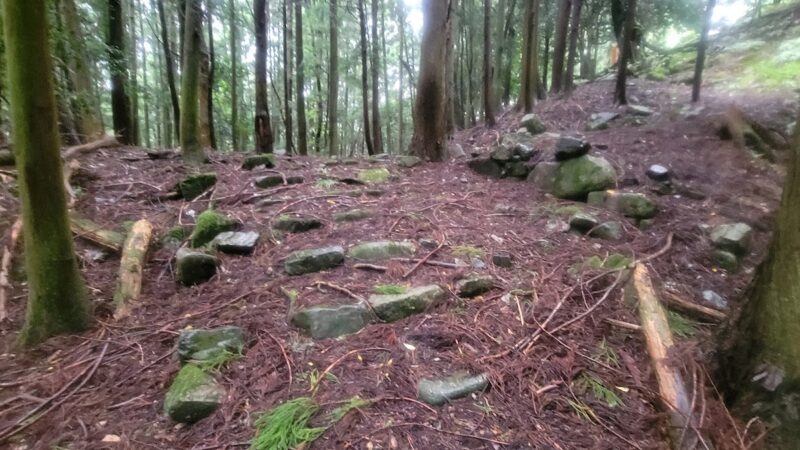
Shōrakuji Castle retains typical medieval mountain castle remains in excellent condition.
Main Enclosure (Honmaru): Located at the mountaintop, this area boasts a relatively large, flat area. This was the central part of the castle and served as a command post in times of emergency.
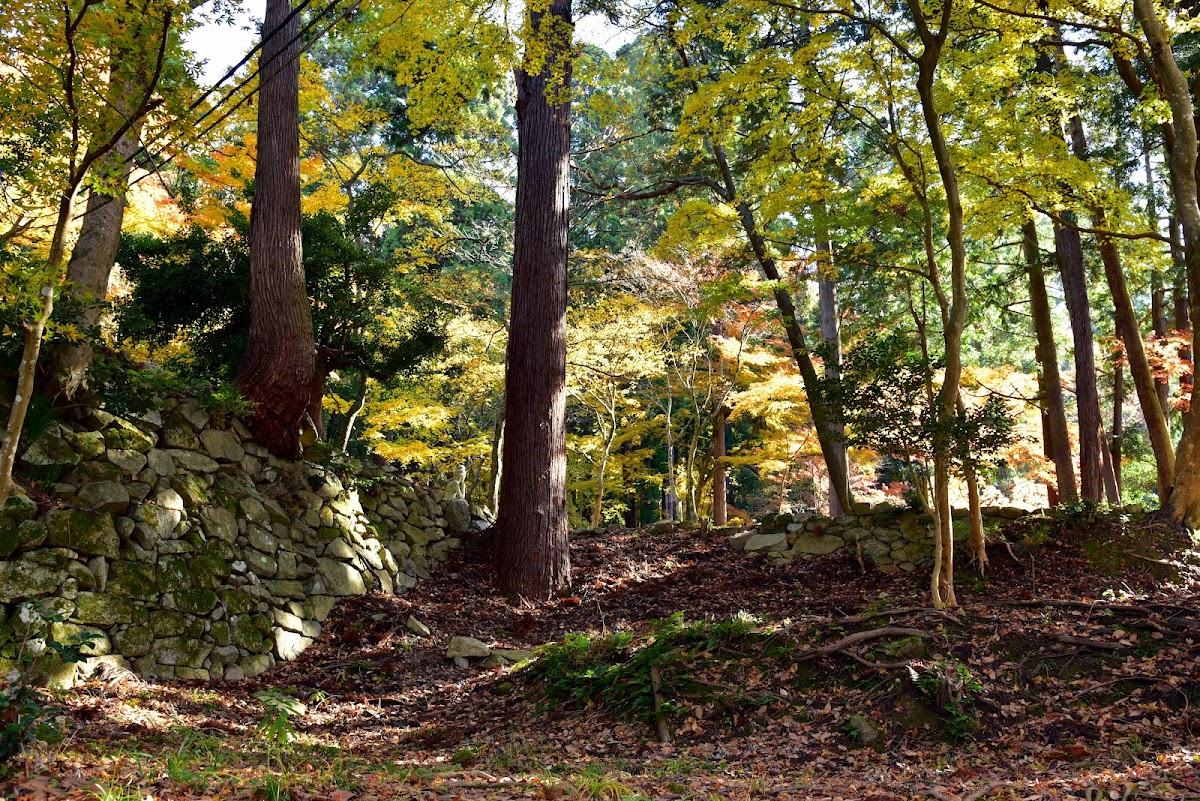
Stone Walls: Stone walls built using the “nozurazumi” (rough-stone masonry) technique remain in various locations, showcasing the stonework techniques of medieval castles. The stone walls around the main enclosure are particularly well-preserved.
Earthworks: Earthworks surround the enclosures, serving as defensive structures. While their height varies, many are clearly visible.
Moats: Multiple moats, dug to cut across the ridges, demonstrate a strategy to prevent enemy intrusion.
Enclosures (Kuruwa): Multiple enclosures are arranged in a stepped pattern around the main enclosure, utilizing the unique terrain of a mountain castle.
Access Route and Hiking Course
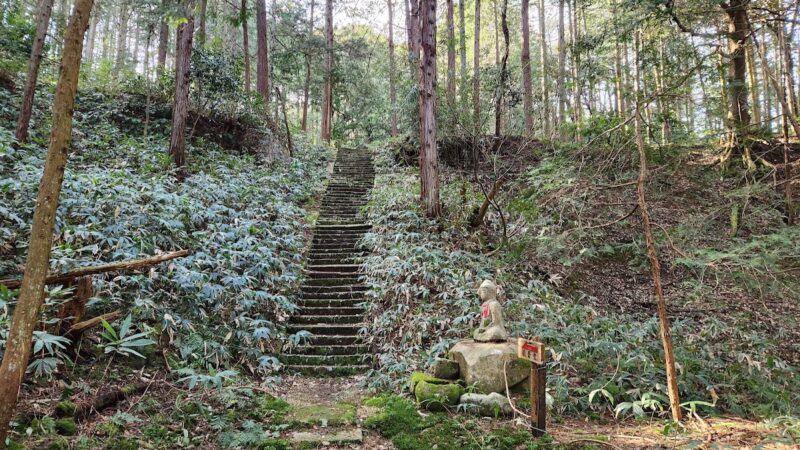
A hiking trail to the Shorakuji Castle ruins is maintained from Shorakuji Temple at the foot of the mountain and is used as a hiking course.
Estimated Time: Approximately 40 minutes on foot from the base to the summit
Difficulty: Intermediate (The trail is well-maintained, but there are some steep sections)
Recommended Equipment: Trekking shoes, drinking water, work gloves
The path to the castle is relatively clear, but as is typical of medieval mountain castles, there are some steep sections. Particular caution is needed after rain, as the ground can become slippery. From the summit, you can enjoy views of the rural landscape of Inukami County and Lake Biwa.
History and Cultural Assets of Shōraku-ji Temple (Bodai-ji Temple)
Founding and History of Shōraku-ji Temple
Location: 4 Shōraku-ji, Kōra-chō, Inukami-gun, Shiga Prefecture
Founding: 1341 (Ryakuō 4)
Founder: Unkai, Dharma successor of Eiun of Tōfuku-ji Temple
Founder: Sasaki Dōyo
Sect: Rinzai Zen, Tōfuku-ji School
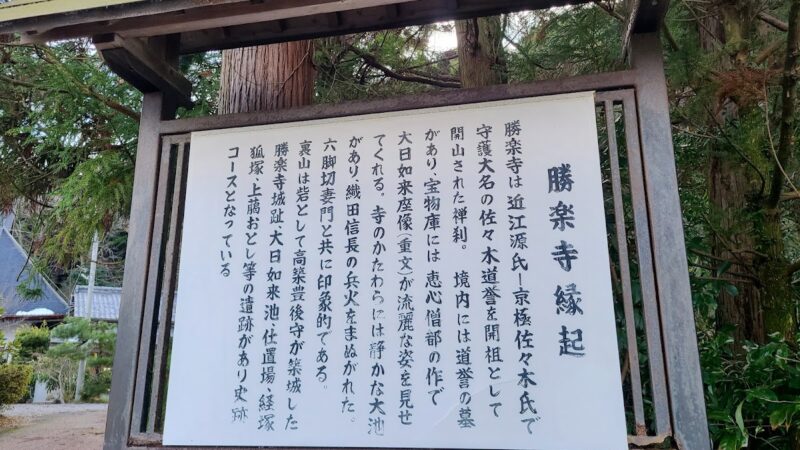
Shōraku-ji Temple is a Rinzai Zen temple founded in 1341 (Ryakuō 4) by Sasaki Dōyo as his family temple. Unkai, a disciple of the high-ranking priest Eiun of Tōfuku-ji Temple, was invited as its founding abbot, giving it the status of a Zen temple.
A stone pagoda believed to be Dōyo’s tomb remains on the temple grounds, indicating that this place was special to him.
Important Cultural Property: Seated Statue of Dainichi Nyorai
The seated statue of Dainichi Nyorai, the principal image of Shōraku-ji Temple, is designated as a National Important Cultural Property. This statue is believed to be a work from the Fujiwara period (late Heian period) and boasts exceptional sculptural beauty.
Miraculously escaping destruction during the burning of the temple by Oda Nobunaga, this statue is a precious cultural asset that has watched over the history of Shōraku-ji Temple. Its serene expression and exquisite carving techniques strongly reflect the characteristics of Buddhist art from the Heian period.
Temple Gate (Gabled)
The temple gate of Shōraku-ji Temple is a gabled building with a history of over 400 years. While the main hall and other buildings were destroyed during Oda Nobunaga’s burning, this gate alone escaped the fire.
The ancient and venerable gate, a witness to history that survived the flames of war during the Sengoku period, deeply impresses visitors. The architectural style retains characteristics of the Muromachi period, making it a valuable historical building in the region.
Relics of Sasaki Dōyo
The temple grounds preserve items related to Dōyo.
- Portrait of Dōyo: A portrait depicting Dōyo remains.
- Handwritten Plaque: A plaque believed to be in Dōyo’s own handwriting exists, demonstrating his cultural refinement.
- Tombstone: The stone pagoda on the temple grounds is said to be Dōyo’s tombstone.
These relics convey not only Dōyo’s character as a Basara daimyo (feudal lord), but also his aspect as a cultured man.
Nishiren Pond and Surrounding Environment
In front of Shōraku-ji Temple lies Nishiren Pond, where you can enjoy the beauty of nature throughout the seasons. The scenery is particularly beautiful during the cherry blossom season in spring, the fresh greenery of early summer, and the autumn foliage season.
The reflection of the temple gate and the mountain behind it on the pond’s surface creates a picturesque scene, making it a popular spot for photography enthusiasts.
Access and Visiting Information
Access by Public Transportation
Nearest Station: JR Tokaido Main Line, Kawase Station
Bus: Take the Kokoku Bus, approximately 15 minutes
Bus Stop: Get off at “Shōrakuji-guchi”
From Bus Stop to Shōrakuji Temple: Approximately 20 minutes on foot
From Shōrakuji Temple to the Summit: Approximately 40 minutes on foot
Since the number of buses from Kawase Station is limited, it is recommended to check the timetable in advance.
Access by Car
Meishin Expressway: Approximately 20 minutes from Hikone IC
Parking: Limited parking space available near Shōrakuji Temple
Due to limited parking space, using public transportation is strongly recommended.
Visitor Precautions
- Hiking: Hiking to the castle ruins is at your own risk.
- Clothing: Wear comfortable clothing and non-slip shoes.
- Season: Insect repellent is necessary in summer, and warm clothing is necessary in winter.
- Manners: Shōrakuji Temple is still a place of worship. Please visit in silence.
- Cultural Properties: Photography of cultural properties such as Buddhist statues may be prohibited. Please follow the temple’s instructions.
Nearby Tourist Attractions
Kotō Sanzan
The Kotō Sanzan (Nishimyōji, Kongōrinji, and Hyakusaiji temples) are located relatively close to Kōra Town, where Shōrakuji Castle is situated. These are known as famous spots for autumn foliage and are especially crowded with tourists in the fall.
Hikone Castle
Hikone Castle, a national treasure, is about a 30-minute drive away. This is a valuable castle with an existing keep from the early Edo period. While it’s from a different era than Shōrakuji Castle, it offers an interesting point of comparison for studying the evolution of castle architecture.
Taga Taisha Shrine
Taga Taisha Shrine, affectionately known as “O-Taga-san,” is located in Taga-cho, Inukami-gun, about a 15-minute drive from Shōrakuji Temple. It has long been revered as a deity of “longevity, matchmaking, and protection against evil.”
Historical Significance of Shōrakuji Castle
Military Base during the Nanboku-chō Period
Shōrakuji Castle was an important military base during the turbulent Nanboku-chō period. Sasaki Dōyo’s establishment of this base fulfilled two strategic requirements: convenient transportation to Kyoto and maintaining power within Ōmi Province.
Ōmi Province was a crucial point connecting Kyoto and eastern Japan, and Inukami-gun, in particular, where the Tōsandō and Hokkokukaidō roads passed, was a vital transportation hub. Shōrakuji Castle functioned as a base for controlling this region and supported the power base of the Kyōgoku clan.
Role as the Kyōgoku Clan’s Headquarters
Shōrakuji Castle and its surroundings, developed by Sasaki Dōyo, functioned as the Kyōgoku clan’s headquarters. A residence was located at the foot of the mountain, serving as a place for administrative affairs and residence during peacetime, while the castle on the mountaintop functioned as a fortified stronghold during times of conflict, adopting the typical form of a medieval “Negoya-style castle.”
Even after Dōyo’s death, the Kyōgoku clan continued to consider this area important and maintained a certain level of influence until the Sengoku period.
Position in Local History
Shōrakuji Castle is valuable among the many medieval mountain castles remaining in Shiga Prefecture because its builder and purpose are relatively clear. While many mountain castles lack detailed records, Shōrakuji Castle, linked to the prominent figure Sasaki Dōyo, is an important historical site that concretely tells the history of Ōmi Province during the Nanboku-chō period.
Sasaki Dōyo and Basara Culture
Dōyo as a Basara Daimyo
Sasaki Dōyo is known as a representative of the “Basara Daimyo.” Basara refers to free-spirited behavior unbound by existing authority and formalities, and was a cultural trend popular from the late Kamakura period to the Nanboku-chō period.
Dōyo is said to have favored extravagant clothing, hosted lavish banquets, and sometimes even behaved in a way that disregarded the authority of the imperial court and the shogunate. The *Taiheiki* records numerous instances of Dōyo’s eccentric behavior, indicating that he made a strong impression on people of his time.
A Cultural Figure
On the other hand, Dōyo was also a distinguished cultural figure. He possessed deep knowledge of tea ceremony, linked verse, and Noh theater, and as the host of cultural salons, he had a significant influence on Kyoto’s cultural scene.
In particular, in the field of the tea ceremony, he is considered a pioneering practitioner of the simple tea ceremony that later led to Wabi-cha, and is counted as one of the most important figures in the history of Japanese tea ceremony. The artifacts of Dōyo remaining at Shōraku-ji Temple convey this aspect of his cultured side.
Best Season for Visiting
Spring (March-May)
The area around Nishiren Pond is beautifully colored during cherry blossom season. The hiking trails are also refreshing with the fresh greenery, making it a suitable season for climbing the castle. However, caution is needed during the spring rain season as the ground can become slippery.
Summer (June-August)
While it is a lush green season, the high temperatures require stamina for hiking. Insect repellent is essential due to the abundance of insects. Early morning visits are recommended.
Autumn (September-November)
This is the most recommended season. The autumn foliage is beautiful, and the weather is suitable for hiking. Especially from early to mid-November, you can enjoy viewing the autumn leaves along with the surrounding Kotō Sanzan mountains.
Winter (December-February)
Due to the possibility of snowfall and icy trails, winter visits to the castle are recommended for experienced hikers. However, the snow-covered castle ruins possess a fantastical beauty.
The Significance of Visiting Shōrakuji Castle
Shōrakuji Castle is a historical site of greater value than mere castle ruins. You can trace the footsteps of Sasaki Dōyo, a unique figure who lived during the turbulent Nanboku-chō period, and experience a cultural landscape where a medieval castle and temple are integrated.
Hiking while observing the unique remains of a mountain castle is suitable not only for history buffs but also for those who want to enjoy nature. Furthermore, the cultural assets of Shōrakuji Temple, including the important cultural property, the seated statue of Dainichi Nyorai, are not to be missed for those interested in Buddhist art.
Located in the relatively quiet Inukami District, Shōrakuji Castle offers a chance to escape the hustle and bustle and reflect on history at your own pace, which is another of its charms.
Summary
Shōrakuji Castle in Kōra-chō, Inukami-gun, Shiga Prefecture, is a historically significant site associated with Sasaki Dōyo, a Basara daimyo of the Nanboku-chō period. The remaining stone walls, earthworks, and baileys on the 308m-high mountaintop retain many characteristics of a medieval mountain castle.
At Shōrakuji Temple at the foot of the mountain, valuable cultural assets remain, including a seated statue of Dainichi Nyorai (a nationally designated important cultural property) and the temple gate that survived Oda Nobunaga’s burning. Along with the beautiful scenery of Nishiren Pond, it is a place that deeply impresses visitors with its historical significance.
Accessible by bus and on foot from JR Kawase Station, and with nearby tourist attractions such as the Kotō Sanzan (Three Mountains of Kotō) and Hikone Castle, it is a historical site well worth visiting as part of a Shiga Prefecture history exploration. Especially during the autumn foliage season, you can enjoy a wonderful experience appreciating both history and nature.