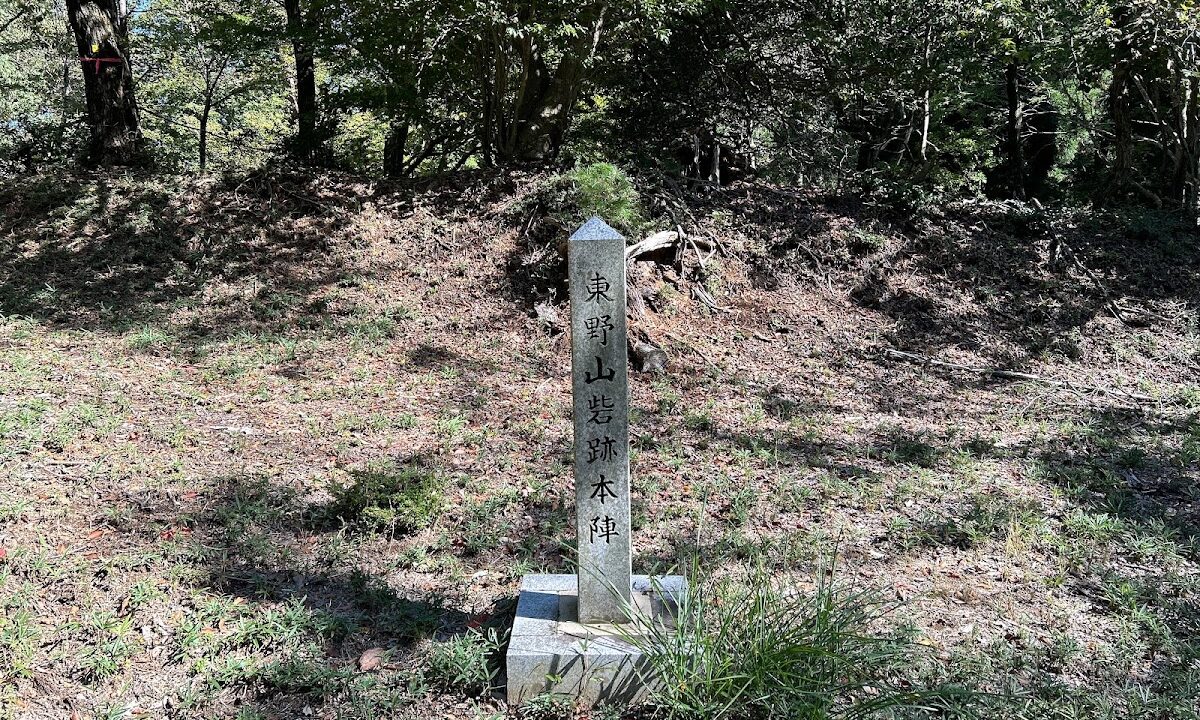
Higashinoyama Castle (Nagahama City, Shiga Prefecture) Complete Guide | The Charm of a Frontline Base and Remains from the Battle of Shizugatake
What is Higashinoyama Castle?
Higashinoyama Castle (東野山城) is a Sengoku period mountain castle located in Yogocho, Nagahama City, Shiga Prefecture. Also known as “Saneyama Castle” and “Higashinoyama Fort,” it holds a significant place in history as an important base for Hashiba Hideyoshi’s army during the Battle of Shizugatake.
Built on the summit of Jitsuyama (elevation 407 meters), northeast of Nagahama Municipal Yogo Elementary School, this castle is known as a fortified camp where Hori Kyutaro Hidemasa, a general on Hashiba’s side, established his camp during the Battle of Shizugatake in 1583. Even today, the remains of the earthworks and dry moats are well-preserved, and it is highly regarded as a culmination of Oda-style castle construction techniques.
Location and Strategic Importance of Higashinoyama Castle
Higashinoyama Castle is located southeast of Lake Yogo, built in a prime location overlooking the Hokkoku Kaido road. This location was not accidental, but based on a clear strategic intention. From this castle, situated on the front lines for the Hashiba forces, Hori Hidemasa could effectively keep Shibata Katsuie’s army in check as they advanced south along the Hokkoku Kaido.
Its elevation of 407 meters provided a panoramic view of the surrounding area, enabling early detection of enemy movements. Furthermore, by controlling a crucial transportation hub connecting Lake Yogo and Lake Biwa, it played a vital role in securing supply routes.
History of Higashinoyama Castle
As a Fortified Castle During the Higashino Clan Era
The origins of Higashinoyama Castle date back to before the Battle of Shizugatake. Originally, this area was under the control of the Kyogoku clan and was the residence of the Higashino Bizen-no-kami family. The Higashino clan had a residence called Higashino-kan at the western foot of the mountain, and Higashinoyama Castle functioned as its auxiliary fort.
An auxiliary fort is a type of castle where the clan lived in the residence at the foot of the mountain during peacetime and defended themselves in the mountaintop castle during wartime. It is believed that Higashinoyama Castle of this period was built as a defensive structure by a local powerful family to protect their territory.
The Battle of Shizugatake and Hori Hidemasa’s Renovations
In 1583 (Tensho 11), the struggle for succession to Oda Nobunaga intensified, and the conflict between Hashiba Hideyoshi and Shibata Katsuie became decisive. In the Battle of Shizugatake, Hori Kyutaro Hidemasa chose the site of Higashinoyama Castle as his encampment and carried out extensive renovations.
Hori Hidemasa (1553-1590) was a senior retainer of the Oda family, known as “Master Kyutaro,” and a warrior who enjoyed Hideyoshi’s deep trust. He rebuilt Higashinoyama Castle not merely as a military encampment, but as a fortress to prevent Shibata’s army from advancing south. This renovation dramatically improved the castle’s defensive capabilities, transforming it into a fortified camp incorporating the finest Oda-style castle construction techniques.
Role in the Battle of Shizugatake
In the Battle of Shizugatake, Higashinoyama Castle played a crucial role as the Hashiba forces’ frontline base. Hori Hidemasa used this castle as a base to continuously hold back Shibata Katsuie’s army as they attempted to advance south along the Hokkoku Kaido road.
The Shibata army was advancing south from Kitanosho (present-day Fukui City, Fukui Prefecture), aiming for Nagahama, Hideyoshi’s base. However, constantly monitored and threatened from Higashinoyama Castle restricted their military actions. Hori Hidemasa’s skillful tactics are considered to have greatly contributed to the Hashiba army’s ultimate victory.
As a result of the battle, Hashiba Hideyoshi achieved victory, solidifying his path to unifying Japan. Higashinoyama Castle played a crucial role in this historical turning point.
Higashinoyama Castle After the War
After the Battle of Shizugatake, Higashinoyama Castle ceased to function as a military encampment and was abandoned. During the Sengoku period, encampments were temporary military facilities, and it was common practice to abandon them after the fighting ended. Higashinoyama Castle was never used as a military facility again.
Structure and Layout of Higashinoyama Castle
Structure Centered Around the Main Enclosure
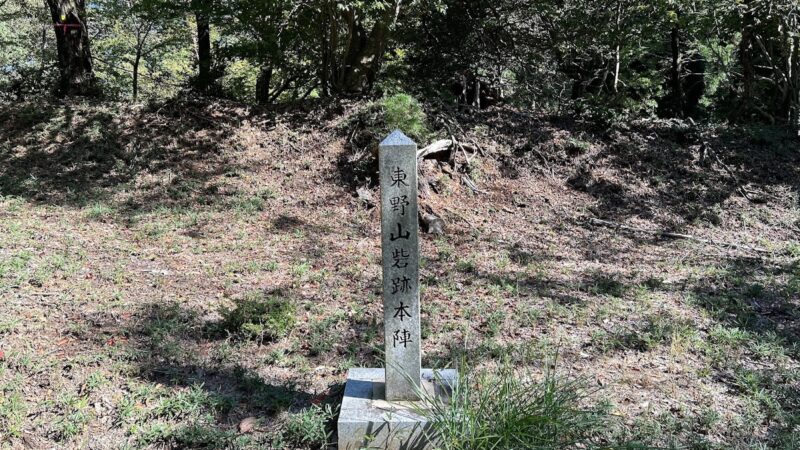
The layout of Higashinoyama Castle consists of a main enclosure (shukakurin) at its center, with a total of three enclosures located to the south and west. The main enclosure is located at the highest point on the mountaintop and forms the core of the castle.
The main enclosure measures approximately 30 meters east-west and 40 meters north-south, providing a relatively large, flat area. It is believed that the lord’s headquarters were located here, and that strategic meetings and command were conducted here. The castle features entrances (koguchi) on all four sides, allowing for rapid movement in each direction.
Arrangement and Function of the Enclosures
The southern and western enclosures surrounding the main enclosure are presumed to have had different functions. The southern enclosure overlooks the Hokkoku Kaido road and functions as a base for surveillance and defense. The western enclosure is thought to have been responsible for guarding the northern direction, where the Shibata army’s headquarters were located.
These enclosures are arranged in stages, creating a structure where the enemy would have to break through multiple lines of defense before reaching the main enclosure. This concept of multi-layered defense is one of the characteristics of Oda-style castles.
Arrangement of Dry Moats and Earthworks
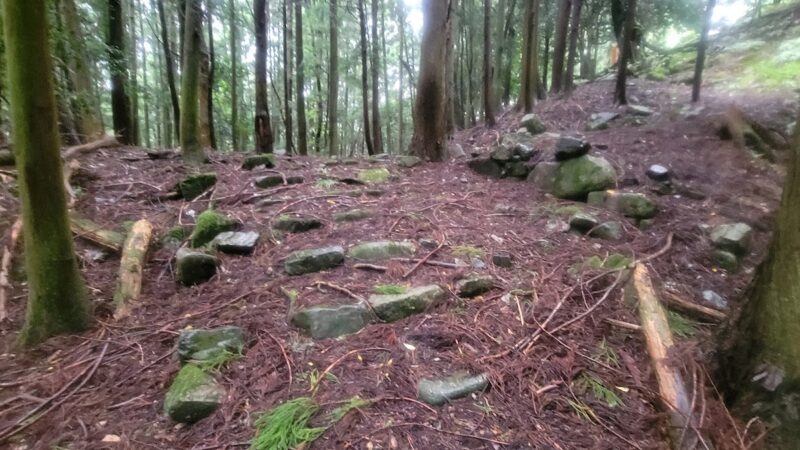
The most notable feature of Higashinoyama Castle is the dry moats and earthworks arranged around the enclosures. The dry moats serve as physical obstacles to prevent enemy intrusion, while the earthworks function as defensive positions.
The depth of the dry moats varies depending on the location, but in the deepest parts, they reach over 5 meters. The moat is wide, making it difficult to jump over. Furthermore, the bottom of the moat is not flat, but dug in a V-shape, a design intended to restrict enemy movement within the moat.
The earthen rampart is built inside the dry moat and is about 2-3 meters high. From the top of the rampart, attacks with bows and arrows and firearms could be launched, effectively repelling enemies attempting to cross the moat. This combination of dry moat and earthen rampart is thought to be a modification made by Hori Hidemasa during the Battle of Shizugatake, and is valued as a surviving example demonstrating the advanced castle-building techniques of the Oda clan.
Observation Platform and Entrance
At the northeastern end of the main enclosure, there is a raised area, presumably an observation platform. From here, one could see a wide area towards Lake Yogo and the Hokkoku Kaido road, making it an excellent position to monitor enemy movements.
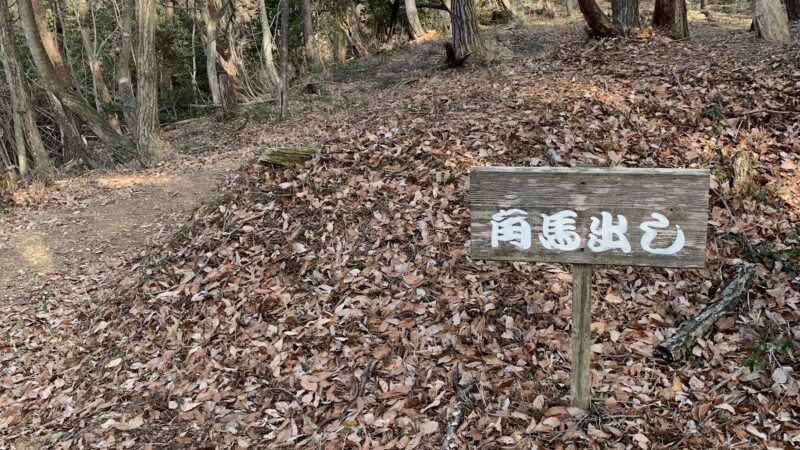
Entrance gates are located on all four sides of the main enclosure, each allowing entry and exit in different directions. The structure of the castle gate is not a simple opening; in some places, a technique called “yokoyagakari” (flanking fire) is used. This is a structure that allows for attacks from the side against enemies attempting to enter the gate, a design intended to enhance defensive capabilities.
The Culmination of Oda-style Castle Construction Techniques
Higashinoyama Castle, along with Uchinakaoyama Castle (Genba-o Castle) on the opposite bank, which belonged to Shibata Katsuie, is considered the culmination of Oda-style castle construction techniques. The castle construction techniques that developed during the time of Oda Nobunaga aimed to achieve both efficient defense and rapid construction.
The layout of Higashinoyama Castle exhibits the following characteristics of Oda-style castles:
- Straight Moats and Earthworks: A design based on straight lines rather than curves shortened construction time.
- Stage-Based Defense: A multi-layered defensive structure with multiple baileys.
- Ensuring Visibility: A layout that allows for panoramic views of the surrounding area from each bailey.
- Functional Entrance: An entrance designed for both defense and attack.
These techniques developed in major Oda castles such as Azuchi Castle and Sakamoto Castle, and were also applied to fortified camps like Higashinoyama Castle. It represents the pinnacle of practical castle design, achieving high defensive capabilities while being built in a short period.
Highlights of Higashinoyama Castle
Well-Preserved Remains
The greatest appeal of Higashinoyama Castle is that, even after more than 440 years since its construction, the remains are still remarkably well-preserved. The shape of the earthworks and the depth of the dry moats are clearly visible, allowing visitors to imagine the castle’s appearance at the time.
The dry moats around the main enclosure are particularly well-preserved, allowing visitors to experience the actual scale of a Sengoku period castle by walking along the bottom of the moats. Standing atop the earthen ramparts, you can truly understand how the castle defended against enemies attempting to cross the moats.
Stunning Views
Located on a mountaintop 407 meters above sea level, Higashinoyama Castle offers panoramic views of Lake Yogo, Lake Biwa, and the surrounding mountains. On clear days, the mountains where Genba-o Castle is located on the opposite shore are also visible, allowing visitors to understand the deployment of both armies during the Battle of Shizugatake based on the actual terrain.
The view from the observation post at the northeastern end of the main enclosure is especially breathtaking. Imagining Hori Hidemasa monitoring the movements of the Shibata army from this vantage point evokes a sense of historical romance.
A Tranquil Mountain Castle Atmosphere
Higashinoyama Castle receives relatively few visitors, allowing visitors to leisurely explore the castle ruins in a tranquil atmosphere. The tranquility of the mountain castle, surrounded by trees, is a stark contrast to the tension of the Sengoku period, making it an ideal environment for reflecting on history.
You can also enjoy the beauty of nature throughout the seasons, from the fresh greenery of spring to the vibrant autumn foliage. The ability to enjoy both exploring the castle ruins and observing nature simultaneously is a unique charm of mountain castles.
Access to Higashinoyama Castle
Access by Public Transportation
Using the JR Hokuriku Main Line
- Get off at “Yogo Station” on the JR Hokuriku Main Line
- Approximately 20 minutes on foot from the station to the trailhead
- Approximately 40-50 minutes on foot from the trailhead to the summit
Yogo Station is an unmanned station with limited train service, so it is recommended to check the timetable in advance. Head east from the station and proceed towards Yogo Elementary School to reach the trailhead.
Access by Car
Using the Hokuriku Expressway
- Approximately 15 minutes from the Kinomoto Interchange on the Hokuriku Expressway
- Parking available near Nagahama City Yogo Elementary School (confirmation required)
The trailhead is located northeast of Yogo Elementary School. Please be considerate of local residents when parking.
Hiking Route and Estimated Time
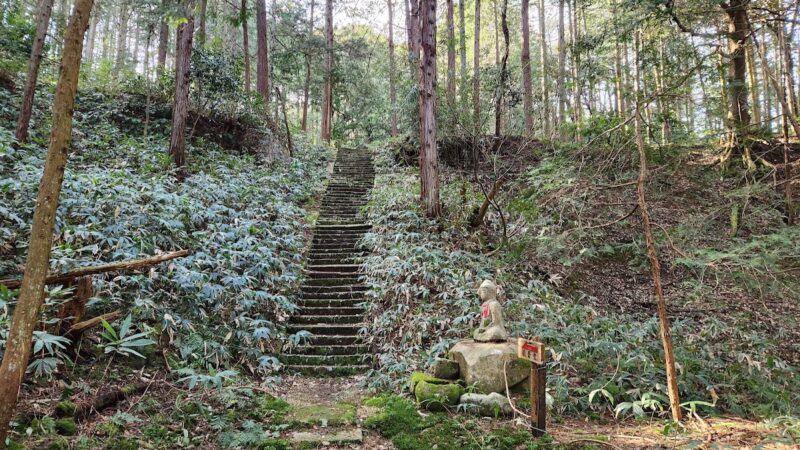
From the trailhead to the Higashinoyama Castle Ruins at the summit, the trail is relatively well-maintained. While there are some steep slopes, the difficulty level is manageable even for beginner hikers.
- Estimated Time: Approximately 40-50 minutes ascent, 30-40 minutes descent
- Elevation Difference: Approximately 300 meters
- Difficulty Level: Beginner to Intermediate
While there are guide signs along the trail, they are not numerous. It is recommended to check a map beforehand and, if possible, prepare a GPS app for hiking.
Points to Note When Visiting
- Clothing: Hiking boots or trekking shoes and comfortable clothing are essential.
- Items to Bring: Drinking water, towel, insect repellent (spring to autumn), rain gear.
- Season: Snow is possible in winter, so this is recommended for experienced hikers.
- Time: Plan with ample time to descend before sunset.
- Mobile Phone: Cell phone reception is poor in some areas near the summit.
Since the mountain castle is not a well-maintained tourist destination, visits are at your own risk. Solo hiking should be avoided; visiting with multiple people is recommended.
Nearby Tourist Attractions
Shizugatake Battlefield
If you visit Higashinoyama Castle, we recommend also visiting the Shizugatake Battlefield. There is an observation deck at the summit of Mt. Shizugatake (421 meters above sea level), where you can get an overview of the Battle of Shizugatake.
The summit of Mt. Shizugatake can be accessed by lift, and hiking is also possible. At the summit, there is a monument to the Seven Spears of Shizugatake, making it a must-see spot for history buffs.
Genba-o Castle (Uchinakaoyama Castle)
Genba-o Castle, where Shibata Katsuie’s main camp was located, is another important historical site, paired with Higashinoyama Castle. Located on the border between Fukui and Shiga prefectures, it boasts remains considered the pinnacle of Oda-style castle construction technology.
Visiting both Higashinoyama Castle and Genba-o Castle will provide a deeper understanding of the confrontation between the two armies during the Battle of Shizugatake.
Lake Yogo
Lake Yogo, also known as “Mirror Lake,” is a tranquil lake located north of Lake Biwa. A small lake with a circumference of approximately 6.4 kilometers, it offers opportunities for leisurely walks and cycling along its shores.
A mystical lake with a legend of the celestial maiden’s robe, it offers beautiful scenery throughout the seasons, with cherry blossoms in spring and vibrant autumn leaves. This is an ideal spot to visit before or after climbing Higashinoyama Castle.
Nagahama Castle and Nagahama City
In the heart of Nagahama City, Shiga Prefecture, lies Nagahama Castle, the first residence built by Hashiba Hideyoshi. The current keep was restored in 1983, and the interior is open to the public as the Nagahama Castle History Museum.
Nagahama city has many tourist attractions, such as Kurokabe Square, allowing you to enjoy a stroll through the town in conjunction with your castle visit. It’s a charming area where you can experience the atmosphere of a castle town associated with Hideyoshi.
Higashinoyama Castle and Hori Hidemasa
Hori Hidemasa, “Master Craftsman Kyutaro”
Hori Hidemasa (1553-1590) was a Sengoku period warlord who served Oda Nobunaga and Toyotomi Hideyoshi, and was known by the nickname “Master Craftsman Kyutaro.” He was discovered by Nobunaga at a young age, and his talent was highly valued.
Hidemasa was not only a skilled warrior but also possessed excellent political acumen and castle-building techniques, earning the deep trust of both Nobunaga and Hideyoshi. His command at Higashinoyama Castle is one example of his outstanding military talent.
Achievements at the Battle of Shizugatake
At the Battle of Shizugatake, Hori Hidemasa continuously held back the Shibata army from Higashinoyama Castle. His strategic role in restricting enemy movements, in addition to direct combat, greatly contributed to the Hashiba army’s victory.
Hidemasa’s tactics were not merely defensive, but sophisticated, actively depriving the enemy of their freedom through deterrence and intimidation. By continuously threatening the crucial supply route of the Hokkoku Kaido, he narrowed the Shibata army’s strategic options.
Hidemasa’s Later Life
After the Battle of Shizugatake, Hori Hidemasa became a daimyo with a domain of 180,000 koku in Kitanosho, Echizen Province, and in 1585, he became the lord of Sawayama Castle in Omi Province. However, in 1590, during the Siege of Odawara, he fell ill and died at the young age of 38.
Many historians point out that if Hidemasa had lived longer, he would have played an even more important role in the Toyotomi regime. Higashinoyama Castle is a valuable historical site that conveys the footsteps of such a great general.
Preservation and Future of Higashinoyama Castle
Value as a Historical Site
Higashinoyama Castle was an important base at the historical turning point of the Battle of Shizugatake and is a valuable remains that conveys the Oda-style castle construction techniques. However, it is not a nationally or prefecturally designated historical site, and preservation efforts are supported by the efforts of local people.
In recent years, interest in mountain castles from the Sengoku period has been growing, and little-known but excellent castles like Higashinoyama Castle are attracting attention. Appropriate preservation and utilization are needed.
Request to Visitors
When visiting Higashinoyama Castle, please cooperate with the following points.
- Do not damage the ruins: Do not cut into the earthworks or moats, or move stones.
- Take your trash home: To protect the natural environment, always take your trash home.
- Do not collect plants: Do not damage wildflowers or trees.
- No open fires: To prevent forest fires, absolutely avoid using fire.
- Respect for private property: Refrain from entering areas other than the designated hiking trails.
Each individual’s good manners contribute to preserving this valuable historical site for future generations.
Summary
Higashinoyama Castle was a fortified camp that contributed to the victory of Hashiba Hideyoshi at the Battle of Shizugatake, a crucial turning point in Japanese history. The ruins, which showcase the pinnacle of Oda-style castle construction techniques and were renovated by Hori Hidemasa, remain in excellent condition even after more than 440 years, making it a valuable site where you can experience a Sengoku period castle.
The view from the 407-meter-high summit is magnificent, offering panoramic views of Lake Yogo, Lake Biwa, and the surrounding mountains. The hiking trail is relatively well-maintained, making it accessible even for beginners, but proper equipment and preparation are essential.
Visiting related historical sites in the vicinity, such as the Shizugatake Battlefield and Genba-o Castle, will allow you to gain a deeper understanding of the overall picture of the Battle of Shizugatake. Immerse yourself in the historical romance of the Sengoku period in Nagahama City, a place closely associated with Hideyoshi.
When visiting Nagahama City in Shiga Prefecture, be sure to also visit Higashinoyama Castle and experience the view that Hori Hidemasa saw and the magnificence of Oda-style castle construction techniques.