Kashiwabara Castle (Maibara City) Complete Guide | History, Remains, and Access Explained in Detail
Kashiwabara Castle, located in Maibara City, Shiga Prefecture, is a mountain castle that still retains traces of the Sengoku period (Warring States period). It had deep connections with powerful Sengoku daimyo of Omi Province, such as the Asai and Kyogoku clans, and played an important role as a strategic point on the eastern shore of Lake Biwa. This article comprehensively covers information useful for castle enthusiasts and history buffs, from the historical background of Kashiwabara Castle, highlights of existing remains, access methods, and points to note when visiting the castle.
What is Kashiwabara Castle? | Overview of a Mountain Castle in Maibara City, Shiga Prefecture
Kashiwabara Castle is a medieval mountain castle located in the Kashiwabara district of Maibara City, Shiga Prefecture. Built on a mountaintop approximately 300 meters above sea level, it occupies a strategically important location overlooking the Hokkoku Kaido (Hokuriku Road) from the eastern shore of Lake Biwa.
Basic Information
- Location: Kashiwabara, Maibara City, Shiga Prefecture
- Castle Structure: Mountain Castle
- Construction Period: Mid-15th Century (Estimated)
- Builder: Asai or Kyogoku Clan Related Persons
- Main Lords: Retainers of the Asai and Kyogoku Clan
- Year of Abandonment: Tensho Era (circa 1573-1592)
- Remains: Enclosures, Earthworks, Moats, Stone Walls (partial)
- Designated Cultural Property: City-Designated Historic Site (Maibara City)
Kashiwabara Castle was a stage for the power struggle between the Asai and Kyogoku clans in northern Omi Province, and also functioned as a relay point connecting major strongholds such as Odani Castle (Nagahama City) and Sawayama Castle (Hikone City).
History of Kashiwabara Castle | The Asai and Kyogoku Clans and the Changing Times of the Sengoku Period
Construction and Early History
The exact construction date of Kashiwabara Castle is unclear due to a lack of historical records, but it is believed to have been built in the mid-15th century, during the late Muromachi period. It is thought to have been built by someone connected to the Kyogoku clan, who were the governors of Omi Province, or the Asai clan, their vassals.
At that time, northern Omi was under the control of the Kyogoku clan, but in reality, the Asai clan, their vassals, were expanding their power. Kashiwabara was a strategic point along the Hokkoku Kaido road, a crucial base controlling the transportation route to Mino Province (Gifu Prefecture).
Role under the Asai Clan’s Rule
In the 16th century, the Asai clan seized real power in northern Omi, and Kashiwabara Castle came under their control. Under three generations—Asai Sukemasa, Asai Hisamasa, and Asai Nagamasa—the Asai clan expanded their power from their base at Odani Castle.
Kashiwabara Castle is thought to have served the following roles as a subsidiary castle of Odani Castle:
- Monitoring the Hokkoku Kaido: Managing traffic on the important highway connecting Kyoto and the Hokuriku region.
- Eastern Defense: A defensive base against the Saito and Oda clans of Mino Province.
- Logistical Base: A relay and supply point for military supplies.
- Regional Administration: A base for local control around Kashiwabara.
It is presumed that the castle lord of Kashiwabara Castle was appointed from among the Asai clan’s retainers, but the specific name of the castle lord is not clearly stated in historical records.
Oda Nobunaga’s Invasion and the Castle’s Demolition
In 1570 (Genki 1), Asai Nagamasa entered into a hostile relationship with Oda Nobunaga. In a series of battles, including the Battle of Anegawa, the Asai clan was gradually driven into a disadvantageous position.
In August 1573 (Tensho 1), Oda Nobunaga launched a full-scale attack on Odani Castle, resulting in the suicide of Asai Nagamasa and the downfall of the Asai clan. It is believed that the Asai clan’s network of branch castles, including Kashiwabara Castle, were also captured and destroyed by the Oda army at this time.
After the fall of Odani Castle, northern Omi Province came under the control of Hashiba Hideyoshi (later Toyotomi Hideyoshi), and Nagahama Castle was developed as a new base. Kashiwabara Castle lost its strategic importance and is presumed to have been abandoned.
Edo Period and Beyond
During the Edo period, the Kashiwabara area became part of the Hikone Domain, and the Kashiwabara Castle ruins were left as a forest. Locally, it was known as “Shiroyama” (Castle Mountain), and the remains have been relatively well preserved to the present day.
In recent years, the city of Maibara has been conducting surveys and maintenance work, including improving the access roads and installing information boards.
Kashiwabara Castle’s Layout and Structure | Characteristics of a Mountain Castle
Kashiwabara Castle possesses the typical structure of a medieval mountain castle, characterized by a defensive system that skillfully utilizes the terrain.
Main Enclosure Layout
The castle is arranged with multiple enclosures centered around the main enclosure (honmaru) at the mountaintop:
Main Enclosure (Honmaru)
The most important enclosure, located at the mountaintop. Measuring approximately 30 meters east-west and 20 meters north-south, it is surrounded by an earthen embankment. It is believed to have housed the lord’s residence and command post.
Second Enclosure
An enclosure located east of the main enclosure. Slightly lower than the main enclosure, it functioned as a second line of defense.
Third Enclosure
Located further east on the ridge, it forms a continuous defensive line.
Western Enclosure Group
Several small enclosures are arranged in a stepped pattern on the western slope of the main enclosure, preparing for attacks from the west.
Characteristics of Defensive Structures
Earthworks
Earthworks, approximately 1-2 meters high, remain well-preserved around the main enclosure. These defensive walls, built by piling up earth, prevented enemy intrusion and also functioned as building foundations.
Dry Moats
Dry moats dug to cut across ridges. They are important defensive structures that blocked enemy entry routes. Clear dry moats can be seen on the east and west sides of the main enclosure at Kashiwabara Castle. Their depth is approximately 3-5 meters, and it is presumed they were even deeper at the time.
Vertical Moats
Moats dug vertically along slopes. These restrict enemy lateral movement and limit attack routes. Multiple vertical moats have been identified on the southern and northern slopes of Kashiwabara Castle.
Stone Walls (Partial)
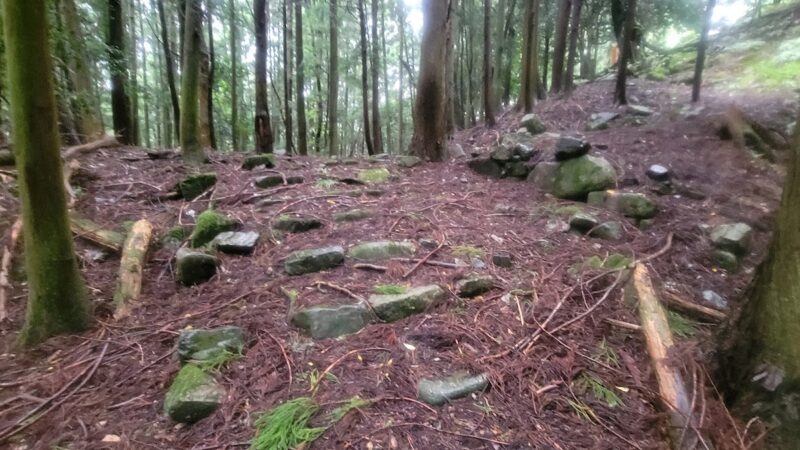
Traces of stone walls, constructed from stacked natural stones, can be seen in a part of the main enclosure. While not a full-fledged stone wall, it is a simple structure built using the “nozurazumi” (rough stone masonry) method, but it is a valuable remains that shows the evolution of castle construction techniques in the late 16th century.
Structure of the Entrance (Kotoguchi)
It is believed that entrances to the main enclosure were located on the east and west sides. The eastern entrance, in particular, clearly retains the shape of an opening in the earthen rampart, showing defensive ingenuity.
Highlights of Kashiwabara Castle | Remains You Can See on Site
Here are some points to pay attention to when actually visiting the Kashiwabara Castle ruins.
Earthen Ramp and View of the Main Enclosure
The earthen ramparts surrounding the main enclosure are well-preserved, allowing you to experience the atmosphere of a mountain castle from the Sengoku period. From the main enclosure, a spectacular view unfolds, overlooking the Kashiwabara settlement below, and Lake Biwa and Mount Ibuki in the distance. This view speaks to why Kashiwabara Castle was a strategically important location.
Clear Moat
The moat on the east side of the main enclosure is one of the most impressive remains of Kashiwabara Castle. The deep, sharply cut shape of the moats is still clearly visible nearly 500 years later, demonstrating the high level of castle-building technology of the time.
Vertical Moats
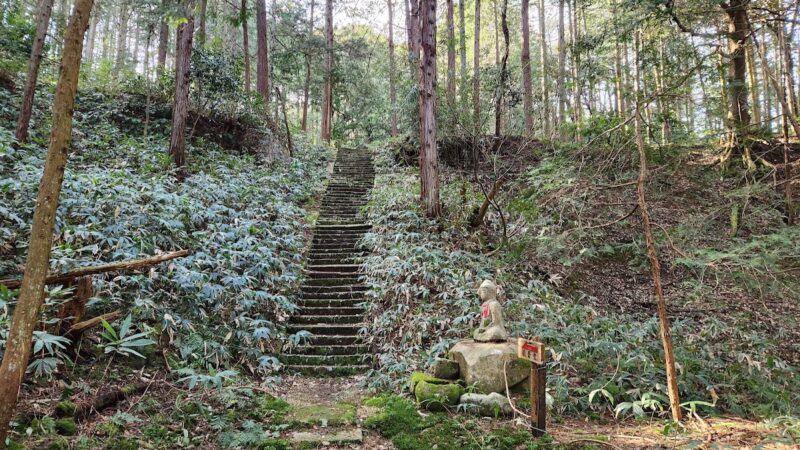
The vertical moats on the southern slope are arranged in a continuous pattern, showing ingenuity in slope defense. A path leading up to the castle runs along the moats, allowing for close observation.
Traces of Stone Walls
The traces of stone walls remaining in the northwestern part of the main enclosure, though small in scale, are important evidence indicating that Kashiwabara Castle was in a transitional period from a simple earthen castle to a modern castle utilizing stone walls.
Terraced Structure of the Enclosures
The terraced enclosures on the western slope are skillfully arranged to follow the terrain, demonstrating ingenuity in securing maximum defensive space on the limited mountaintop area.
How to Access Kashiwabara Castle
Using Public Transportation
From JR Tokaido Main Line “Kashiwabara Station”
- Get off at JR Tokaido Main Line “Kashiwabara Station”
- The castle entrance is approximately a 15-minute walk from the station.
- From the castle entrance to the main enclosure at the summit is approximately a 30-40 minute walk.
Kashiwabara Station is a small station where only local trains stop, but it is easily accessible, being only two stops (approximately 5 minutes) from Maibara Station and three stops (approximately 10 minutes) from Nagahama Station.
Using a Car
Via Hokuriku Expressway
- Approximately 10 minutes from Maibara IC via National Route 21
- Approximately 15 minutes from Nagahama IC via National Route 8 and prefectural roads
Parking Information
There is no dedicated parking lot for Kashiwabara Castle, but parking spaces near the Kashiwabara community center and shrines may be available (prior confirmation is recommended). Please avoid street parking and be considerate of local residents. ### Castle Ascent Route
Standard Route (Eastern Ascent Route)
- Head towards the castle entrance from within the Kashiwabara settlement (signposts are available).
- Climb the mountain path for approximately 30-40 minutes from the castle entrance.
- Pass through dry moats and the remains of baileys along the way.
- Arrive at the main enclosure.
The castle ascent route is well-maintained, but since it is a mountain path, comfortable walking shoes such as trekking shoes are essential.
Estimated Time
- Entrance to the castle → Main enclosure: Approximately 30-40 minutes
- Visiting the main enclosure: Approximately 30 minutes
- Descent: Approximately 20-30 minutes
- Total: Approximately 1 hour 30 minutes to 2 hours
Precautions and Preparations for Visiting the Castle
Clothing and Equipment
- Shoes: Trekking shoes or athletic shoes (non-slip)
- Clothing: Long-sleeved shirt and long pants (to prevent insect bites and injuries from branches)
- Hat: Protection from the sun and branches
- Gloves: Work gloves, etc. (useful for gripping rocks and trees)
Items to Bring
- Drinking Water: 500ml or more (especially in summer)
- Towel: For wiping sweat
- Insect repellent spray: Essential from spring to autumn
- Map and compass: Smartphone map apps are also effective
- First-aid kit: Band-aids, disinfectant, etc.
- Rain gear: Prepare for changing weather conditions
Seasonal Precautions
Spring (March-May)
The fresh greenery is beautiful, making it the perfect season for visiting the castle. However, be careful as the ground can be slippery after rain.
Summer (June-August)
Heatstroke prevention is essential. Visiting the castle during the cooler hours of early morning or evening is recommended. Be sure to take thorough insect repellent measures due to the abundance of insects.
Autumn (September-November)
The autumn foliage is beautiful, and the weather is stable, making it ideal for visiting the castle. However, be careful as fallen leaves can obscure the path in some areas.
Winter (December-February)
There is a possibility of snow and ice, so visiting the castle is not recommended. If you attempt it, sufficient equipment and experience are necessary.
Safety Precautions
- Avoid solo travel; climbing in groups is recommended.
- Inform family or friends of your destination before climbing.
- Turn back if weather deteriorates.
- Check cell phone reception beforehand (reception is generally available at the summit).
- Be aware of wild animals (wild boars, bears, etc.).
Tourist Attractions Around Kashiwabara Castle
Here are some nearby attractions that can be enjoyed in conjunction with a visit to Kashiwabara Castle.
Kashiwabara-juku (Hokkoku Kaido Road)
Kashiwabara has a history as a thriving post town on the Hokkoku Kaido Road. Some of the old townscape remains, allowing you to experience the atmosphere of a post town.
Jobodai-in Temple
An ancient temple located in the Kashiwabara area. It is said to be a temple associated with the Asai clan and houses historical Buddhist statues and cultural artifacts.
Mount Ibuki
One of Japan’s 100 Famous Mountains. Approximately 30 minutes by car from Kashiwabara. The summit can be accessed by hiking or driving. From the mountaintop, you can enjoy a grand panorama of Lake Biwa and the Japanese Alps.
Other Castle Ruins in Maibara City
Chōhi Castle
A mountain castle located in Chōkyūji, Maibara City. One of the important strongholds of the Kyōgoku clan.
Taosan Castle
A mountain castle located in Asahi, Maibara City. Functioned as a branch castle of Sawayama Castle.
Hikone Castle and Nagahama Castle
Hikone Castle (National Treasure)
Approximately 20 minutes by car from Kashiwabara. A famous castle known as the residence of the Ii clan.
Nagahama Castle
Approximately 15 minutes by car from Kashiwabara. The first castle where Hashiba Hideyoshi became lord (reconstructed keep).
Tips for Enjoying Kashiwabara Castle
Recommended Prior Study
Before visiting Kashiwabara Castle, gaining basic knowledge about the history of the Asai and Kyogoku clans, and the situation in Omi Province during the Sengoku period, will greatly enhance your experience. The following books and materials are particularly helpful:
- “Research on the Asai Clan of Omi Province” (various research books)
- Cultural property materials published by the Maibara City Board of Education
- Books related to castles in Shiga Prefecture
Photography Tips
- View from the Main Enclosure: Morning sunlight is ideal for photography
- Moat: Shoot from an angle that emphasizes its depth
- Earthwork: A composition looking up at the earthwork from within the enclosure is effective
- Vertical Moat: A vertical composition along the slope creates a powerful photograph
Guided Tour and Event Information
The Maibara City Board of Education and local historical organizations occasionally hold guided tours and history lectures of Kashiwabara Castle. We recommend checking the official website of Maibara City and the tourist association for information.
Historical Significance and Value of Kashiwabara Castle
Position in the Sengoku Period History of Northern Omi
Kashiwabara Castle played a key role in the network of branch castles that supported the Asai clan’s rule and was an important component of the defensive system centered around Odani Castle. By controlling the strategically important Hokkoku Kaido road, it played a crucial military and economic role.
Value in Mountain Castle Research
The remains of Kashiwabara Castle are valuable historical materials that show the evolution of mountain castle construction techniques from the mid-to-late 16th century. The use of stone walls in addition to traditional defensive structures such as earthworks and moats indicates a transitional period towards early modern castles.
Significance as a Regional Historical Heritage Site
The Kashiwabara Castle ruins are an important cultural property that forms the historical identity of the region. Maibara City is working to promote local history education and tourism through the preservation and utilization of the Kashiwabara Castle ruins.
Preservation of Kashiwabara Castle and Future Challenges
Current State of Preservation
Because Kashiwabara Castle was spared from large-scale development, its remains are relatively well-preserved. However, due to natural erosion and tree growth, some of the remains are becoming unclear.
Preservation Activities
The following preservation activities are being carried out, primarily by the Maibara City Board of Education:
- Regular grass cutting and tree management
- Maintenance and improvement of the castle approach path
- Installation of information boards and explanatory signs
- Promotion of surveying and academic research
Future Challenges
- Detailed academic research: Detailed elucidation of the remains through archaeological excavations
- Formulation of a preservation management plan: Establishment of a long-term preservation policy
- Public awareness activities: Strengthening information dissemination to local residents and tourists
- Safety measures: Improving the safety of the castle approach path and enhancing signage
- Collaboration with other historical sites: Building a tourism network with surrounding historical sites such as the Odani Castle ruins
Summary | Experience the Charm of Kashiwabara Castle
Kashiwabara Castle in Maibara City, Shiga Prefecture, is a valuable mountain castle that conveys the historical romance of the Sengoku period to the present day. This castle, which witnessed the rise and fall of the Asai and Kyogoku clans, two powerful daimyo families of Omi Province during the Sengoku period, captivates visitors with its clearly preserved remains and magnificent views.
Kashiwabara Castle’s greatest appeal lies in the opportunity to observe firsthand the castle-building techniques of the Sengoku period, such as the earthen ramparts surrounding the main enclosure, the deeply cut moats, and the series of vertical trenches running along the slopes. Furthermore, the view from the mountaintop makes it clear why this castle was a strategically important location.
Climbing to Kashiwabara Castle offers a moderate amount of exercise, making it an attractive activity that combines historical exploration with hiking. It’s easily accessible from Maibara Station and Kashiwabara Station, making it ideal for a day trip.
Immerse yourself in the history of Omi Province during the Sengoku period and visit Kashiwabara Castle. You too can experience the same views that the Sengoku warlords of 500 years ago saw. As a rich historical heritage of Maibara City, Kashiwabara Castle quietly but surely continues to convey its value to the present day.