Hattori Castle (Koka City, Shiga Prefecture) Complete Guide | The Headquarters of the Fifty-Three Families of Koka and Highlights of its Remains
What is Hattori Castle?
Hattori Castle is a medieval castle ruin located in Niihari, Konan-cho, Koka City, Shiga Prefecture. It is known as the residence of the Hattori clan, one of the fifty-three families that organized the Koka County Council and one of the three most powerful local families in the Shonai region. Built on a hill approximately 20 meters high, southwest of Shingu Shrine, the castle is now a forest and farmland, but clear remains still exist.
The Hattori clan was also related to the Iga Hattori clan, and this is a historically important location considered to be the ancestral home of the Hattori clan. Among the castles of the Koka region in Omi Province, it is a valuable site that exhibits a typical Koka-style castle architecture in terms of its location and structure.
The History of Hattori Castle and the Hattori Clan
The Hattori Clan and the Fifty-Three Families of Koga
The Hattori clan was one of the Fifty-Three Families of Koga and a powerful member of the Koga County Central Government. The Fifty-Three Families of Koga were a group of local lords who held power in Koga County from the Muromachi period to the Sengoku period. Among them, the Hattori clan was counted as one of the three most powerful families, known as the Shonai Three Families.
The Shonai Three Families refer to the Hattori, Ukai, and Naiki clans, and they formed the core of the Koga County Central Government. Rather than possessing great power individually, these families were characterized by their mutual cooperation in local autonomy and defense.
Relationship with the Iga Hattori Clan
The Hattori clan is also believed to be related to the Hattori clan of Iga Province. The Hattori clan of Iga is famous for Hattori Hanzo (Hattori Masanari), who later served Tokugawa Ieyasu, but there is a theory that the family’s ancestral home was around Hattori Castle in Koga. Koga and Iga are geographically close, and it is believed that there was interaction in terms of ninjutsu and martial arts, suggesting that the Hattori clan may have been an important family connecting the two regions.
From the Muromachi Period to the Sengoku Period
Hattori Castle is thought to have been built during the Muromachi period. During this time, local lords in the Koga region fortified their residences and formed the Koga-gun Chuso, a regional self-defense organization. Hattori Castle was built as part of this, and it is thought to have been constructed in cooperation with the surrounding Shingu Castle and Shingu branch castles to create a defensive system.
With the arrival of the Sengoku period, the Koga region came under the influence of warring daimyo such as Oda Nobunaga and Toyotomi Hideyoshi, but the 53 Koga families continued to exist while maintaining a degree of autonomy. It is unclear when Hattori Castle was abandoned, but it is presumed to have ceased use by the early Edo period.
Structure and Layout of Hattori Castle
Single-Enclosure Square Castle
Hattori Castle is a single-enclosure square castle, characteristic of the Koka region. A single-enclosure castle consists only of a main enclosure (honmaru), characterized by its simple structure without a complex arrangement of baileys (kuruwa). This is thought to be a result of the local Koka lords prioritizing daily defense and residence over large-scale battles.
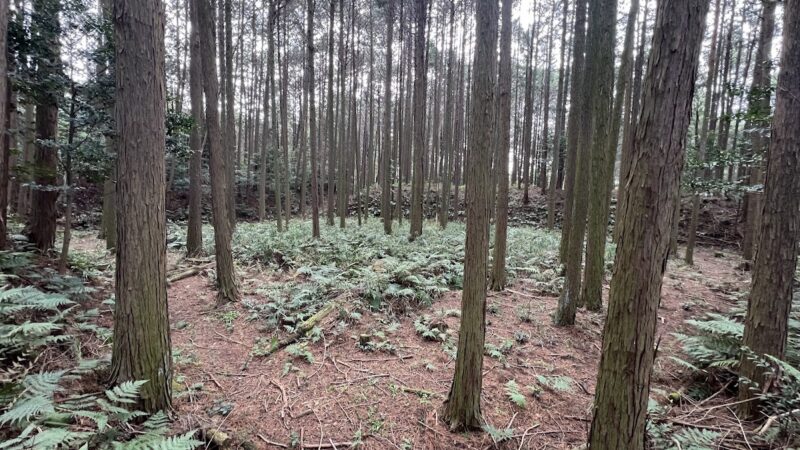
The castle is relatively small, with the main enclosure being approximately 50 meters east-west and 40 meters north-south in a square shape. It has the typical structure of a hill castle, with a flat surface created by leveling the top of a hill and defensive structures arranged around it.
Earthwork Arrangement
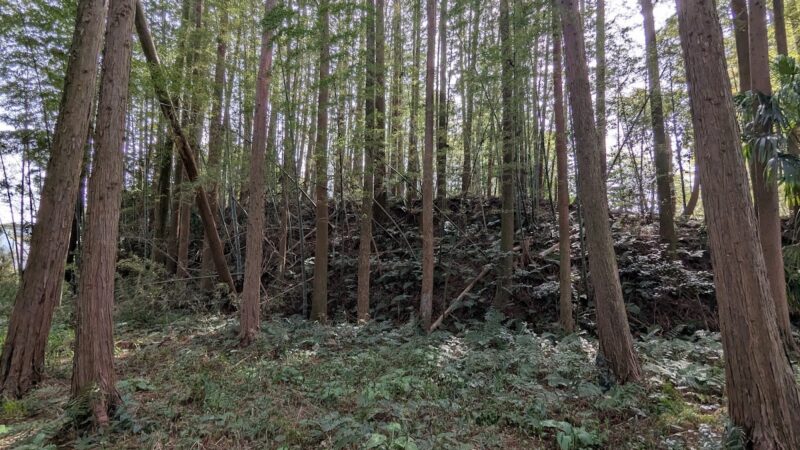
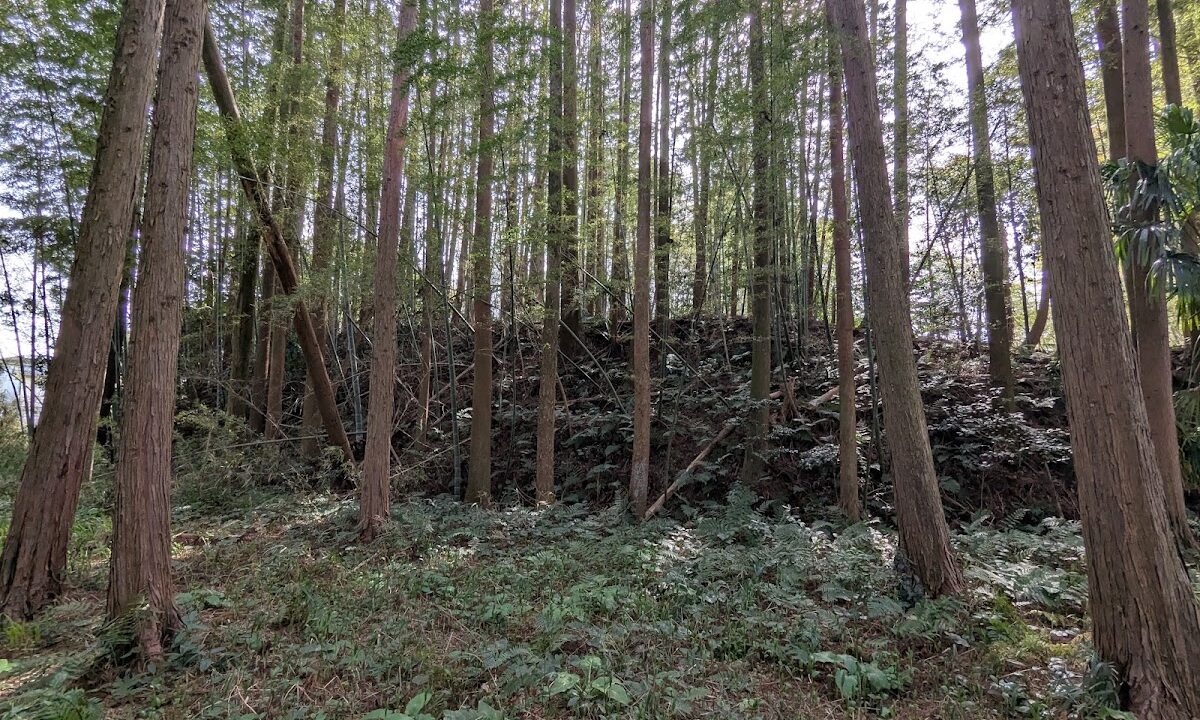
The most notable feature of Hattori Castle is the high earthwork that runs from the south to the east. Approximately 2-3 meters of this earthwork still remain today, clearly demonstrating the defensive structure of the time. The earthen ramparts are not simply piles of earth, but may have been reinforced using a technique called rammed earth, resulting in a sturdy construction.
The eastern rampart is particularly well-preserved and clearly visible. The southeastern section has a slight depression on the outside of the rampart, suggesting the possibility of a moat. However, no clear moat remains have been confirmed, and it may simply be a natural depression in the terrain.
On the north side, there is a raised platform, thought to be the remains of a watchtower or observation post. It is presumed that this position allowed for the early detection of approaching enemies.
Entrance/Exit
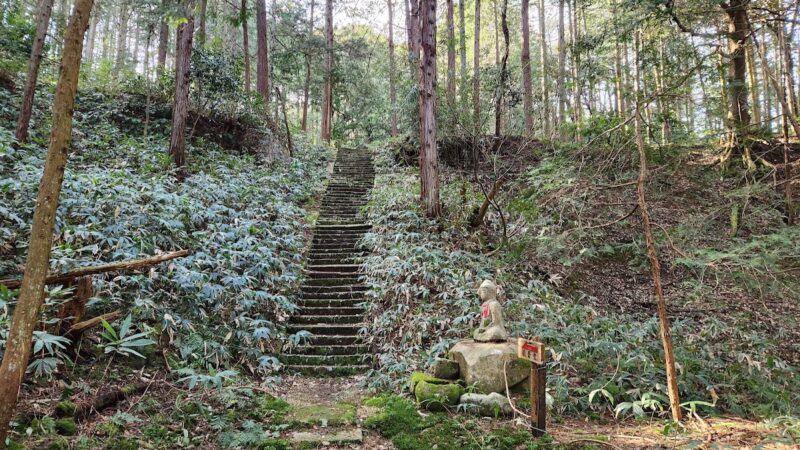
A gate/exit opens into the thicket on the northeast side of the castle. A gate/exit is the entrance/exit to a castle, and because it is a defensive weak point, it is usually fortified by surrounding it with earthen ramparts or by creating curves. The gate/exit at Hattori Castle has a relatively simple structure, but it is located at a break in the earthen rampart, suggesting that defensive structures such as wooden gates may have existed there at the time. The castle’s main entrance is located on the northeast side, a placement likely chosen to facilitate access from Shingu Shrine and the surrounding settlement. This location was probably chosen to balance daily access and defense.
Location of Hattori Castle and Surrounding Castles
Geographical Location
Hattori Castle is located in Niihari, Konan-cho, Koka City, Shiga Prefecture, built on a hill approximately 200 meters southwest of Shingu Shrine. It utilizes one of the low hills scattered across a relatively flat terrain near the center of the Koka Basin, surrounded by the Isoo River.
This location is a typical example of Koka-style castle site selection, balancing habitability in peacetime with defensive capabilities in times of conflict. Being on a low hill close to the plains, it offers convenience for daily life, while its slightly elevated position provides defensive advantages.
Relationship with Shingu Castle and Shingu Branch Castle
Shingu Castle is located approximately 200 meters southeast of Hattori Castle, and Shingu Branch Castle is located approximately 50 meters further south. These three castles are positioned on a tongue-shaped plateau and hills on the left bank of the Isoo River, arranged in a “linked enclosure” configuration to ensure coordinated defense.
Shingu Castle was also built by the Hattori clan during the Muromachi period and is thought to have served as a subsidiary castle of Hattori Castle. Its placement across a valley allowed for support from one castle if the other was under attack. This type of coordinated defense system involving multiple castles is a common characteristic of the castle complex in the Koka region.
Surrounding Koka Castles
Numerous other castles belonging to the Koka 53 clans exist around Hattori Castle. Murasame Castle and Teramae Castle are relatively close by, and these castles also share a similar single-enclosure, square structure. This indicates that the entire Koka region was defended by a network of such small castles.
The Koka-gun Chuso, a self-governing organization, functioned based on this castle network. A unique defense system was established where each local lord protected their own castle while cooperating as needed to resist external enemies. ## Highlights of Hattori Castle Remains
Remains Visible on Site
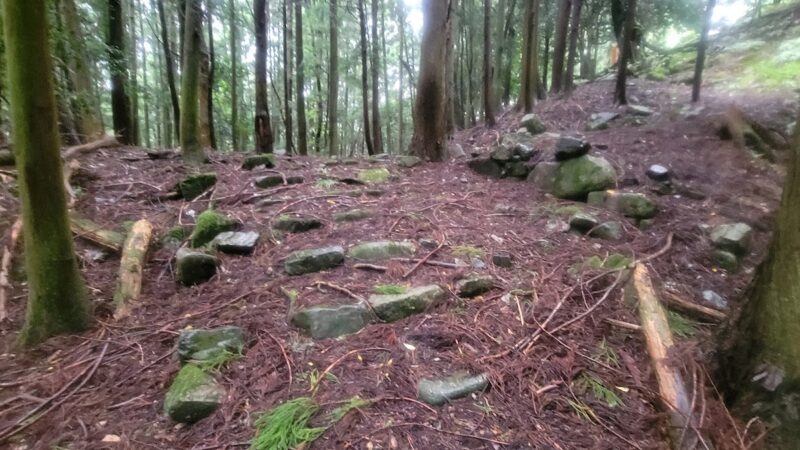
While the current Hattori Castle site is a mix of forest and farmland, the main remains are relatively well-preserved. The main remains visible to visitors are as follows:
Main Enclosure (Honmaru)
A clearly defined, leveled surface remains, allowing for the confirmation of the square layout. Part of it is currently used as farmland.
Earthworks on the South and East
This is the castle’s greatest highlight. A series of earthworks, 2-3 meters high, remain, allowing for a real understanding of the defensive structure of the time. The eastern earthworks, in particular, are well-preserved.
Northeast Gate
Although overgrown, the location of the gate can be identified as a break in the earthworks. This is an important clue to understanding the location of the castle’s entrance.
North Terrace
A raised section remains, thought to be the remains of a watchtower or observation post.
Preservation Status of the Remains
The remains of Hattori Castle are in relatively good condition compared to other castles in the Koka region. The earthworks, in particular, are well-preserved, allowing for a clear understanding of the castle’s outline. However, some areas are currently used as farmland, so there may be some minor alterations.
The area around the northeastern gate is overgrown with bushes, making it difficult to observe during summer visits. Visiting during the winter when the leaves have fallen will allow for a clearer overall view of the remains.
Access and Visiting Guide to Hattori Castle
Location
Address: Nakade, Niihari, Konan-cho, Koka City, Shiga Prefecture
Transportation Access
Using Public Transportation
- The nearest station is Konan Station on the JR Kusatsu Line.
- Approximately 25-30 minutes on foot from Konan Station.
- Approximately 10 minutes by taxi.
Using a Car
- Approximately 10 minutes from Konan Interchange on the Shin-Meishin Expressway.
- Accessible from National Route 1.
- There is no designated parking area, so you will need to park on the street around Shingu Shrine (please be considerate of local residents).
Notes for Visitors
Hattori Castle ruins are not developed as a historical park; they are a mix of forest and farmland. Please note the following points when visiting.
- As this may be private property, consideration is required when entering.
- No signs or explanatory plaques are installed.
- There are uneven areas underfoot, so please wear comfortable shoes.
- In summer, the area is overgrown with bushes and has many insects, so long sleeves and long pants are recommended.
- The best time to observe the remains is during the winter when the leaves have fallen.
Estimated Visiting Time
The castle ruins themselves are small, so 30 minutes to 1 hour is sufficient to examine the remains. If you plan to visit the surrounding Shingu Castle and Shingu Branch Castle as well, it is advisable to allow 2 to 3 hours.
Hattori Castle and the Castle Culture of Koga
Characteristics of Koga-style Castles
Hattori Castle exhibits a castle style unique to this region, also known as “Koga-style castles.” Its characteristics are as follows:
Single Enclosure Square Layout
It does not have a complex arrangement of enclosures, and consists only of a simple square main enclosure. This reflects its character as a fortified residence of a local lord rather than a large-scale military base.
Earthwork-Centered Defense
Instead of using stone walls, earthworks are the primary defensive structure. This is partly due to technical and economic constraints, but also reflects the regional style of warfare where earthworks provided sufficient defensive effectiveness.
Utilization of Low Hills
Low hills with a relative elevation of about 20 meters were utilized, prioritizing habitability during peacetime. Instead of building on high mountains like a mountain castle, it strikes a balance between daily life and defense.
Coordination of Multiple Castles
While small as a standalone castle, it forms a comprehensive defense system for the entire region by coordinating with several surrounding castles.
Koga-gun Chuso and Castle Network
The Koga-gun Chuso was an autonomous organization of local lords, centered around the 53 families of Koga. The foundation of this organization was a network of castles belonging to each local lord, such as Hattori Castle.
Each local lord maintained independence using their own castle as a base, while cooperating to resist invasions by external enemies and intervention by daimyo. This balance of “independence and cooperation” is a characteristic of the Koga region, and Hattori Castle played a part in this.
Even during the Sengoku period, as Oda Nobunaga advanced towards unifying Japan, the Koga district maintained a degree of autonomy. This demonstrates the strong sense of community supported by this network of castles.
Hattori Castle and Ninja Culture
Koga Ninjas and the Hattori Clan
While Koga is famous for its “Koga ninjas,” the Hattori clan also had deep ties to this ninja culture. Many of the 53 families of Koga mastered ninjutsu, and the Hattori clan was no exception.
It is well known that Hattori Hanzo of Iga served Tokugawa Ieyasu and achieved great success, but there is a theory that the ancestral home of his family was around Hattori Castle in Koga. While Koga and Iga ninjas are sometimes said to have been in conflict, in reality, there was exchange of people and technology between the two regions, and the Hattori clan may have been a family that served as a point of contact.
Castles and Ninjutsu
Castles in Koga, such as Hattori Castle, are thought to have been related to the practice of ninjutsu. The simple, single-enclosure, square structure was designed for defense by a small number of people, which was well-suited to ninjutsu-style combat methods (surprise attacks, ambushes, information warfare, etc.).
The arrangement of earthworks and the structure of the gates also suggest a focus on defense against small-scale attacks and night raids rather than large-scale frontal assaults. Such castle structures reflect the unique combat culture of the local Koga lords.
Tourist Attractions Around Hattori Castle
Shingu Shrine
This shrine is located approximately 200 meters northeast of Hattori Castle. It is possible that the Hattori clan worshipped here, and a connection to the castle has been suggested. The shrine grounds contain old trees, giving it a historical atmosphere.
Shingu Castle and Shingu Branch Castle
These castles were connected to Hattori Castle. Visiting them together with Hattori Castle will provide a deeper understanding of the Koga-style castle network.
Koga-ryu Ninja Residence (Koga Ninja Village)
This is a ninja-related tourist facility located in Konan-cho, Koga City. It is about a 15-minute drive from Hattori Castle. It is a facility where you can learn about the history of Koga ninjas and ninjutsu, allowing you to experience Koga’s history and culture in conjunction with a visit to Hattori Castle.
Minakuchi Castle Ruins, Koga City
These are the ruins of Minakuchi Castle, built during the Edo period. By comparing the structure of this early modern castle, which differs from medieval castles like Hattori Castle, you can understand the history of castle development.
Research and Study of Hattori Castle
Castle Distribution Survey
Hattori Castle has been confirmed in the castle distribution survey of Shiga Prefecture, and archaeological records remain. According to the survey, the castle ruins are located on flat land, currently consisting of forest and farmland, and the main period is the medieval period (the exact period is unknown).
Since detailed excavation surveys have not been conducted, many aspects of the castle’s detailed structure and age remain unknown. Further research may yield new insights.
Historical Documents
Historical documents concerning Hattori Castle are limited. The name of the Hattori clan appears only in documents related to the Koga County Central Headquarters and the 53 Families of Koga; no detailed documents describing the castle itself have been confirmed.
Therefore, much of the castle’s history is inferred from the analysis of the remains and comparisons with surrounding castles. There is a possibility that new information may be discovered in local traditions and ancient documents in the future.
Preservation and Utilization
Currently, Hattori Castle ruins are not under special protection and are managed as private land. There are no specific plans for development such as creating a historical park.
On the other hand, it is attracting attention among castle enthusiasts and history researchers as a typical example of a Koga-style castle, and many people visit it. The challenge lies in how to preserve and utilize it as a regional historical heritage site in the future.
Summary
Hattori Castle is a valuable medieval castle site remaining in Koga City, Shiga Prefecture. As the residence of the Hattori clan, one of the 53 families of Koga, Hattori Castle played a vital role in the central administration of Koga County. It exhibits typical characteristics of Koga-style castles, such as its single-enclosure, square layout, earthen rampart-centered defenses, and low-hill location, making it an important historical site for understanding the history and culture of the region.
The relatively well-preserved remains, including the earthen ramparts and gate entrances, convey the castle’s structure at the time. Visiting it along with the nearby Shingu Castle and Shingu Branch Castles will provide a deeper understanding of the Koga region’s castle network.
Hattori Castle is not a developed tourist attraction, but that’s precisely why it’s a place where you can truly experience the atmosphere of the Middle Ages. If you’re interested in Koga’s history or castles, why not visit it? Climbing the earthen ramparts and gazing into the castle from the gate entrance, you might even imagine the Hattori clan who once defended this land.