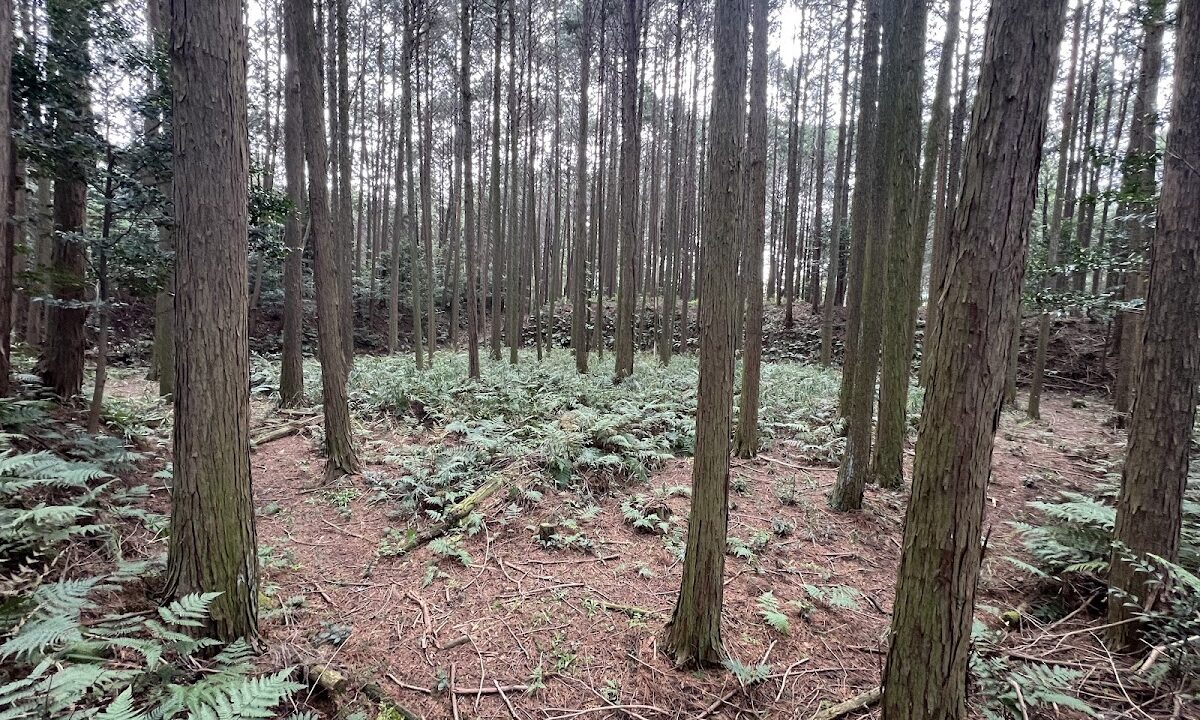
Shingu Branch Castle (Koka City, Shiga Prefecture) Complete Guide | A Famous Castle of the Koka County Central Headquarters with a 7-meter-high Earthen Embankment
What is Shingu Branch Castle?
Shingu Branch Castle is a medieval castle site located in Shinji, Konan-cho, Koka City, Shiga Prefecture. It was built by the Hattori clan, one of the 53 families of Koka that organized the Koka County Central Headquarters, from the Muromachi period to the Sengoku period.
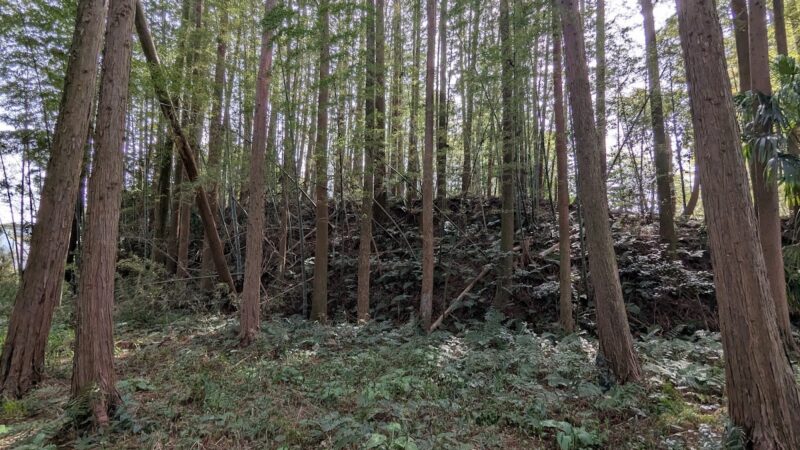
The most distinctive feature of Shingu Branch Castle is the thick, cut earthen embankment, approximately 7 meters high, surrounding the main enclosure. This embankment is remarkably well-preserved, conveying its original appearance almost perfectly to this day. The remains of the entire castle site are almost completely intact, making it a valuable historical resource for understanding the unique castle architecture style of the Koka region.
In 2017, it was designated a National Historic Site as one of the components of the “Kōka-gun Chūsō Archaeological Sites,” and is recognized as a castle ruin occupying an important position in the study of Japanese medieval history.
History of Shingu Branch Castle and the Hattori Clan
The Role of Kōka-gun Chūsō and the Hattori Clan
Understanding the Shingu Branch Castle is essential to understanding the unique organization known as “Kōka-gun Chūsō.” This was a self-governing organization formed by a horizontal alliance of local powerful families in the Kōka region from the Muromachi period to the Sengoku period.
The Hattori clan was one of the 53 families of Kōka, and was a particularly powerful local family, counted among the “Three Families of Shōnai.” The Hattori clan built not only the Shingu Branch Castle, but also Hattori Castle (their main castle) and Shingu Castle, located on the north side across the valley. These castle complexes formed a strong defensive system.
Coordinated Defense System with Shingu Castle
As its name suggests, Shingu Branch Castle functioned as a “branch castle” of Shingu Castle. Shingu Castle was built on the tip of a tongue-shaped plateau extending north-south on the left bank of the Isoo River, and Shingu Branch Castle was located approximately 50 meters south of the castle, separated by a valley.
These two castles, both similarly shaped, single-enclosure castles, were built close together and are thought to have served a single purpose. Their relative positions, allowing them to oversee each other across the valley, suggest a coordinated defense system where they would support each other in times of conflict.
Further west, across the valley, approximately 200 meters away, was Hattori Castle, the main castle of the Hattori clan. These three castles—Shingu Castle, Shingu Branch Castle, and Hattori Castle—worked together to protect the Hattori clan’s sphere of influence.
Transition from the Muromachi Period to the Sengoku Period
Shingu Branch Castle is believed to have been built during the Muromachi period. During this period, local lords in the Koga region built numerous castles and fortifications to protect their territories. These castles were not merely military facilities; they functioned as residences in daily life and served as defensive strongholds in times of conflict, possessing the characteristics of a “peacetime residence/wartime castle.”
With the arrival of the Sengoku period (Warring States period), the Koga County Central Headquarters changed its significance through its interactions with powerful figures like Oda Nobunaga and Toyotomi Hideyoshi. After Toyotomi Hideyoshi’s dissolution of the Koga County Central Headquarters in 1585, it is believed that the Shingu Branch Castle also ceased to serve its purpose.
Structure and Highlights of Shingu Branch Castle
A Typical Square Single-Enclosure Castle
Shingu Branch Castle is one of the typical square single-enclosure castles found in many castles in the Koga region. It features a central main enclosure surrounded by high earthen ramparts, a moat encircling it, and several smaller enclosures attached.
This structure is a common feature of castles in the Koga region and can be seen in other castles that make up the same Koga County Chuso archaeological site group, such as Teramae Castle, Murasame Castle, Mochizuki Murashima Castle, Mochizuki Murashima Branch Castle, and Mochizuki Castle.
Approximately 7-meter-high cut earthen rampart
The greatest highlight of Shingu Branch Castle is the thick cut earthen rampart, approximately 7 meters high (some say over 10 meters), surrounding the main enclosure. This rampart is also called a “super-dreadnought rampart,” and is particularly large in scale among the castles in the Koga region, and is in extremely good condition.
A cut earthen rampart is an earthen rampart formed by cutting into the earth, creating a steep slope that enhances defensive capabilities. The height from the bottom of the moat is impressive, and when you actually look up at it on site, you are overwhelmed by its imposing presence.
This rampart is thought to have been not merely a defensive structure, but also a symbol of the Hattori clan’s authority. In medieval castles, the height and scale of earthworks served as indicators of the lord’s economic power and mobilization capabilities.
Arrangement of the Main Enclosure and Enclosures
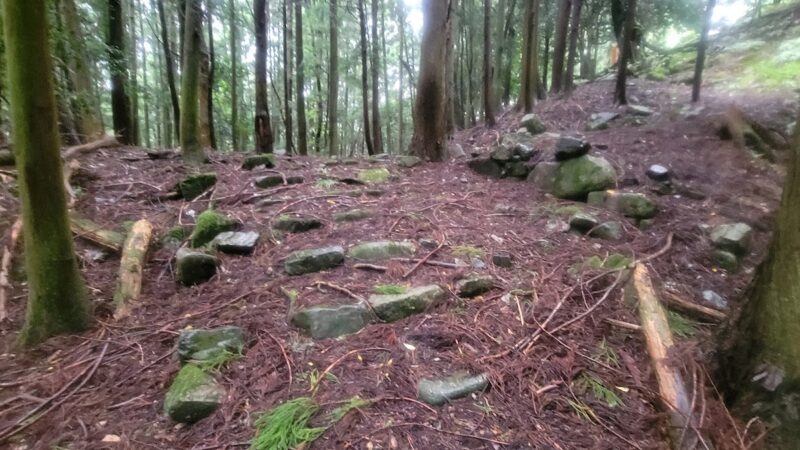
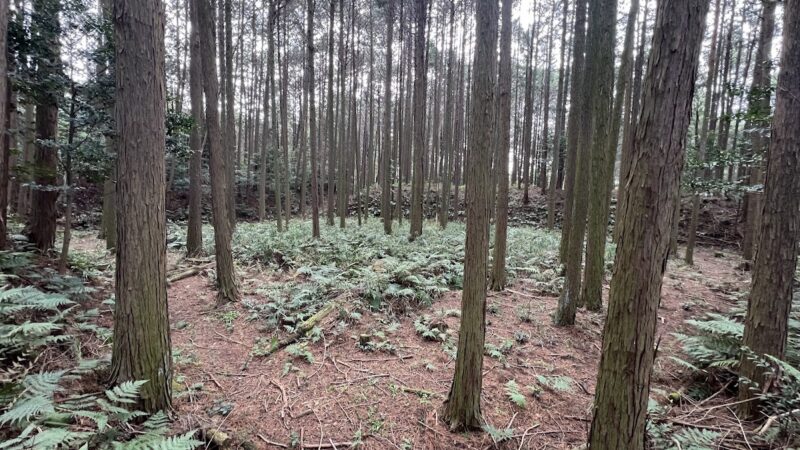
The main enclosure is roughly square in shape and surrounded by high earthworks. The interior of the main enclosure is relatively flat, suggesting it functioned as a residence.
A moat surrounds the main enclosure, and several other enclosures are located further outside. These enclosures are thought to have served as defensive structures to prevent intrusion into the main enclosure, as well as as quarters for retainers and soldiers.
Moats and Defensive Structures
Shingu Branch Castle has moats surrounding the main enclosure. Moats are artificially excavated moats created on ridges or flat areas, and are important defensive structures to prevent enemy intrusion.
In castles in the Koga region, dry moats (moats that do not hold water) are common, and the moats at Shingu Branch Castle are also constructed as dry moats. The earthen ramparts from the bottom of the moat reach a height of approximately 7 meters, forming a steep slope that is not easily climbed.
Preservation Status of the Remains
The remains of Shingu Branch Castle are considered to be almost completely preserved. Having suffered little development or alteration in later periods, it is a valuable historical site that conveys the appearance of the castle at the time of its construction.
All the major remains, including the earthen ramparts of the main enclosure, the moats, and the layout of the enclosures, are preserved in good condition, making it an excellent teaching tool for understanding the structure of medieval castles. With its designation as a National Historic Site, it is expected that appropriate preservation and management will continue in the future.
Value as part of the Koga-gun Nakasō Archaeological Sites
History of National Historic Site Designation
Shingu Branch Castle was designated a National Historic Site on October 13, 2017, as a component of the “Koga-gun Nakasō Archaeological Sites.” The Koga-gun Nakasō Archaeological Sites include Shingu Branch Castle, as well as Teramae Castle, Murasame Castle, Shingu Castle, and Takenaka Castle, for a total of five castles. These castle complexes are valued as precious historical sites that reveal the realities of the Koga-gun Chuso, a self-governing local community organization in the medieval period, and occupy an important position in the study of Japanese medieval history.
Castles Constituting the Koga-gun Chuso Ruins
The five castles constituting the Koga-gun Chuso Ruins are all built on small hills surrounding Hattori Castle. They have the following particular characteristics:
Teramae Castle and Murasame Castle: Located northwest of Hattori Castle, these two castles, built in close proximity, formed a unified defensive system.
Shingu Castle and Shingu Branch Castle: Located east of Hattori Castle, they are arranged to cooperate with each other across a valley.
Takenaka Castle: Located southeast of Hattori Castle, it protected the southern part of the Hattori clan’s sphere of influence.
All of these castle complexes have a square, single-enclosure structure and are defended by high earthen ramparts and moats. These commonalities suggest that the castles were constructed under a unified castle-building philosophy within the organization known as the Kōga-gun Chūsō.
Physical Evidence of Medieval Self-Governing Organizations
The greatest value of the Kōga-gun Chūsō archaeological site lies in its physical evidence of the reality of self-governing organizations in medieval local communities.
The Kōga-gun Chūsō was not a system of unilateral rule by a feudal lord, but rather a self-governing organization formed by a horizontal alliance of local powerful families. This is an important example demonstrating the high level of autonomy and self-governance capabilities of local communities in medieval Japan.
The castle complex, including the Shingu branch castle, represents defensive structures built by these local powerful families—members of this self-governing organization—to protect their territories and communities. These structures are indispensable historical sources for understanding the realities of medieval society.
Access and Visiting Guide to Shingu Branch Castle
Location and Basic Information
Location: Daimon, Niihari, Konan-cho, Koka City, Shiga Prefecture
Designation: National Historic Site (Koka-gun Nakasō Ruins Group)
Construction Period: Muromachi Period
Builder: Hattori Clan
Castle Type: Hilltop Castle (Square Single-Enclosure Castle)
Access by Public Transportation
The nearest station is Terasho Station on the JR Kusatsu Line. It takes approximately 30 minutes on foot from Terasho Station to Shingu Branch Castle. From the station, head northeast and follow the road along the Isoo River.
Since public transportation services are limited, it is recommended to check the timetable in advance before visiting.
Access by Car
Meishin Expressway: Approximately 40 minutes from Ritto IC or Ryuo IC
Shin-Meishin Expressway: Approximately 15 minutes from Konan IC
Access from Konan IC is the most convenient. By taking National Route 1 and then heading north on the prefectural road, you will reach the area around Shingu Branch Castle.
Please be careful not to park on the street, as there may not be a dedicated parking area. Please be considerate of the neighbors.
Entrance to the Castle and Visiting Route
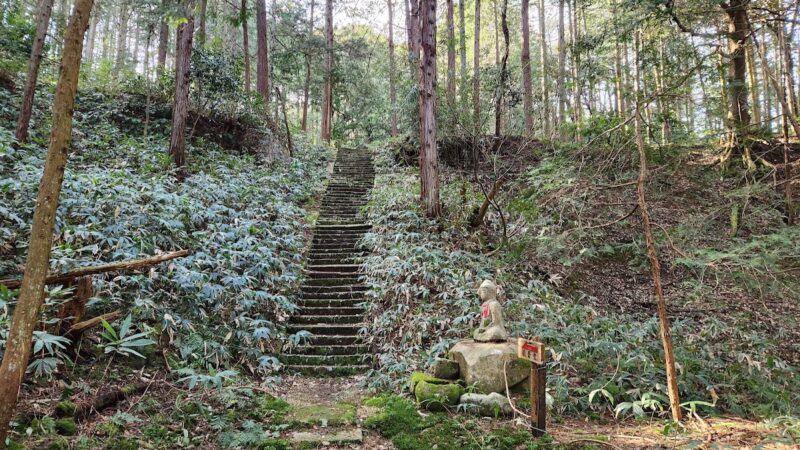
A signpost is installed at the entrance to Shingu Branch Castle, indicating the entrance to the castle ruins. The path to the castle is relatively well-maintained, but since it is a mountain path, we recommend wearing comfortable shoes.
It takes about 5-10 minutes on foot from the entrance to the main enclosure. Along the way, you can observe the moats and earthworks. Upon reaching the main enclosure, you can see the impressive earthworks, approximately 7 meters high, surrounding the area up close.
The interior of the main enclosure is relatively flat, allowing you to imagine what the former residence looked like. Walking around the main enclosure gives you a real sense of the scale of the earthworks and the depth of the moats.
Notes for Visitors
- Attire: Since you will be walking on mountain paths, comfortable shoes and clothing are necessary.
- Season: In summer, vegetation can be overgrown, making it difficult to see the remains. Visiting from autumn to spring is recommended.
- Insect Repellent: As it is a mountainous area, insect repellent spray is recommended.
- Weather: The ground can be slippery during and after rain, so caution is advised.
- Manners: This is a nationally designated historical site, and the preservation of the remains is important. Please be careful not to climb on the earthworks or damage the remains.
Estimated Visit Time
For a visit to Shingu Branch Castle alone, approximately 30 minutes to 1 hour is a good estimate. If you want to carefully observe the ruins, it’s best to allow about an hour and a half.
If you also plan to visit nearby castles such as Shingu Castle and Hattori Castle, we recommend allocating about half a day.
Castles to Visit Alongside Nearby Attractions
Shingu Castle
Shingu Castle is located approximately 50 meters north of Shingu Branch Castle, across a valley. Like Shingu Branch Castle, it was built by the Hattori clan and has a square, single-enclosure structure.
Shingu Castle also retains an earthen embankment about 10 meters high from the bottom of the moat, and together with Shingu Branch Castle, it is designated as a National Historic Site as part of the “Koga-gun Chuso Ruins Group.”
When visiting Shingu Branch Castle, we highly recommend also visiting Shingu Castle. You can truly appreciate the relative positions of the two castles and their coordinated defensive system.
Hattori Castle
Located approximately 200 meters west of Shingu Castle and Shingu Branch Castle, across a valley, is Hattori Castle, the main castle of the Hattori clan. Hattori Castle served as the Hattori clan’s residence, while Shingu Castle and Shingu Branch Castle functioned as defensive outposts to protect it.
Hattori Castle also features a square, single-enclosure structure, fortified by high earthen ramparts and moats. Visiting Hattori Castle, the main castle, is essential for understanding the Hattori clan’s castle complex.
Teramae Castle and Murasame Castle
Teramae Castle and Murasame Castle, located northwest of Hattori Castle, are also part of the Koga-gun Chuso Ruins. Similar to Shingu Castle and Shingu Branch Castle, these two castles, built in close proximity, formed a unified defensive system.
Both are designated as National Historic Sites and are important historical sites for understanding the characteristics of castle architecture in the Koga region.
Takenaka Castle
Located southeast of Hattori Castle, Takenaka Castle is also a component of the Koga-gun Chuso Ruins. It played a role in protecting the southern part of the Hattori clan’s sphere of influence.
Takenaka Castle also has a square, single-enclosure structure, and high earthen ramparts remain.
Koga-ryu Ninja Residence (Former Residence of the Koga Mochizuki Clan)
In Konan-cho, Koga City, lies the Koga-ryu Ninja Residence (Former Residence of the Koga Mochizuki Clan). This was the residence of the Mochizuki clan, one of the 53 Koga families, and the early Edo period architecture still exists.
Inside, exhibits related to ninjas and their mechanisms are displayed, allowing visitors to learn about the history and culture of Koga ninjas. Visiting this site in conjunction with a visit to Shingu Branch Castle will provide a deeper understanding of the history of the Koga region.
Mizuguchi Castle Ruins
In Mizuguchi-cho, Koga City, are the ruins of Mizuguchi Castle, built in the early Edo period. This castle was built as lodging for Tokugawa Iemitsu during his visit to Kyoto, and later became the administrative center of the Minakuchi Domain.
Currently, the site of the main keep is maintained as the Minakuchi Castle Museum, where visitors can learn about the history of Minakuchi Castle and the Koka region.
Characteristics of Koka Castle Architecture
Square Single Enclosure Structure
Castles in the Koka region, including the Shingu branch castle, are characterized by their square single enclosure structure. This means that the central main enclosure is constructed in a shape close to a square, and surrounded by high earthen ramparts and moats.
This structure is a rational design that efficiently enhances defensive capabilities with limited personnel and materials. Furthermore, because the interior of the main enclosure can be used as a residence, it also possesses functionality that can accommodate both peacetime and wartime.
Defense by High Earthen Ramparts
Another characteristic of castles in the Koka region is the defense provided by high earthen ramparts. The height of the earthworks at Shingu Branch Castle (approximately 7 meters) and Shingu Castle (approximately 10 meters) is astonishing considering the technological level of the time.
These earthworks were not simply piles of earth; they utilized a technique called “cut earthworks” to create steep slopes, maximizing their defensive capabilities.
Coordinated Defense System
The system of building two castles in close proximity and coordinating their defenses, as seen with Shingu Castle and its branch castle, is a characteristic of castles in the Koga region.
This strategy aimed to enhance defensive capabilities against large-scale attacks that a single castle could not withstand, by having multiple castles support each other. By positioning the castles across valleys from each other, effective coordination became possible.
Peacetime Residences and Wartime Castles
Castles in the Koga region had the characteristics of “peacetime residences and wartime castles.” They served a dual role: functioning as residences for local lords in peacetime and as defensive strongholds in times of conflict.
Therefore, the interior of the main enclosure is relatively spacious and flat, making it usable as living space. On the other hand, the high earthen ramparts and deep moats provide a robust defensive structure in times of need.
Preservation and Utilization of Shingu Branch Castle
Protection under National Historic Site Designation
With its designation as a National Historic Site in 2017, Shingu Branch Castle became subject to legal protection. This means that any alteration of the remains requires permission under the Cultural Properties Protection Law, ensuring appropriate preservation and management.
The designation as a National Historic Site signifies that the historical and academic value of Shingu Branch Castle has been recognized at the national level, representing a significant step towards future preservation and utilization.
Development and Public Access
Currently, Shingu Branch Castle has not undergone large-scale development; the basic policy is to preserve the remains in their original form. Minimum improvements have been made to create a suitable viewing environment, such as the installation of access paths and markers.
In the future, it is expected that further development and public access will be carried out based on the preservation and utilization plan for the entire Nakasō Archaeological Site in Kōga County.
Utilization as an Educational and Tourism Resource
Shingu Branch Castle is being used as a valuable teaching material for medieval history education and local history studies. Local elementary and junior high schools are conducting lessons using Shingu Branch Castle and the Nakasō Archaeological Site in Kōga County as subject matter.
Furthermore, for castle enthusiasts and history fans, it is a valuable opportunity to visit a well-preserved medieval castle, increasing its value as a tourism resource.
Future Challenges
Several challenges remain in the preservation and utilization of Shingu Branch Castle.
First, there is the maintenance and management of the remains. Continuous management is necessary to prevent deterioration of the remains due to natural influences such as overgrown vegetation and soil erosion.
Second, there is the improvement of the viewing environment. Currently, the access roads and information boards are only minimally maintained, and further improvements are needed to convey the value of Shingu Branch Castle to more people.
Furthermore, integrated utilization with surrounding castles and fortifications is also a challenge. The development of a tour route connecting the castles and fortifications that make up the Koga-gun Chuso Ruins Group, such as Shingu Castle, Hattori Castle, Teramae Castle, Murasame Castle, and Takenaka Castle, and the enhancement of unified explanatory guidance are expected.
Significance of Visiting Shingu Branch Castle
Hands-on Education of Medieval Castle Architecture
The greatest significance of visiting Shingu Branch Castle is the opportunity to witness actual examples of medieval castle architecture. You can experience firsthand the height of the earthworks, the depth of the moats, and the layout of the enclosures, which are difficult to understand solely from textbooks and documents.
In particular, the approximately 7-meter-high cut earthworks have an impressive presence that cannot be conveyed through photographs or drawings. Seeing them up close in person allows you to truly appreciate the high level of medieval castle-building technology and the authority of the local lords.
Understanding the Koga-gun Chuso Self-Governing Organization
Shingu Branch Castle is not merely a castle ruin, but tangible evidence of the Koga-gun Chuso, a medieval self-governing organization. Visiting this site allows you to understand the high level of autonomy and self-governance of local communities in medieval Japan.
You can learn about a characteristic aspect of medieval Japanese society: not unilateral rule by feudal lords, but rather a horizontal alliance of local powerful families for joint defense.
Understanding Local History and Culture
Visiting Shingu Branch Castle is also an opportunity to deepen your understanding of the history and culture of the Koka region. While the Koka region is known for its Koka ninjas, this was underpinned by a strong self-governing organization called the Koka-gun Chuso and the presence of numerous local powerful families who built many castles and fortresses.
Through Shingu Branch Castle, you can learn about the multifaceted history of the Koka region, beyond just the ninjas.
Summary
Shingu Branch Castle is a castle site located in Koka City, Shiga Prefecture, dating from the Muromachi period to the Sengoku period. Built by the Hattori clan, it formed a coordinated defense system together with Shingu Castle.
The main highlight is the thick, approximately 7-meter-high cut earthen rampart surrounding the main enclosure, which is remarkably well-preserved. The remains are almost completely preserved and are highly valued as a typical example of the square, single-enclosure castle style unique to the Koga region.
In 2017, it was designated a National Historic Site as part of the “Koga-gun Chuso Ruins,” and is recognized as a valuable historical site that demonstrates the reality of local self-governing organizations in the medieval period.
Access is approximately 15 minutes from the Konan Interchange on the Shin-Meishin Expressway, or about 30 minutes on foot from Terasho Station on the JR Kusatsu Line. When visiting, we recommend wearing comfortable shoes and clothing suitable for walking.
By visiting Shingu Branch Castle, you can experience actual medieval castle architecture, deepen your understanding of the unique self-governing organization of Koga-gun Chuso, and experience the multifaceted history and culture of the Koga region. This historical site is recommended not only for history enthusiasts and castle fans, but also for anyone interested in medieval history.