Complete Guide to the Owada Jinya Ruins (Saitama Prefecture): A Thorough Explanation from History to Site Visit
Located in Minuma Ward, Saitama City, Saitama Prefecture, the Owada Jinya Ruins are a valuable historical site that conveys the history from the Sengoku period to the early Edo period. The earthen ramparts remaining within the residential area tell the story of the Date clan, who once ruled this land. This article comprehensively introduces useful information for your visit, from the historical background of the Owada Jinya Ruins to the highlights of the site and how to access it.
What are the Owada Jinya Ruins?
The Owada Jinya Ruins are the remains of a jinya (fortified residence) located in Owada-cho 1-chome, Minuma Ward, Saitama City, Saitama Prefecture. Currently designated as a Saitama Prefecture Selected Important Historical Site, it is a valuable historical site that conveys the appearance of a samurai residence from the end of the Sengoku period to the early Edo period.
What is a Jinya?
A jinya refers to a residence established by hatamoto (direct retainers of the shogun) or kōtai-yoriai (alternate samurai) with a stipend of less than 10,000 koku during the Edo period. While not on the scale of a castle, it functioned as a base for governing the territory and played a central role in administration and military affairs. The Owada Jinya (fortified residence) was one such facility.
Location Characteristics
Owada is located at a crucial transportation hub connecting Omiya and Iwatsuki, and is the highest point (approximately 18.6 meters) in present-day Omiya Ward, Saitama City. Due to its excellent views of the surrounding area, it was considered an important military base from the medieval to the early modern period. This geographical advantage was one of the reasons for the establishment of the Jinya.
History of the Owada Jinya
Date Yohei Fusazane and the Iwatsuki Ota Clan
Indispensable to understanding the history of the Owada Jinya is the figure of Date Yohei Fusazane. Fusazane served as a senior retainer to Ota Ujifusa, the lord of Iwatsuki Castle, and held the position of chief retainer.
Fusazane initially resided at Date Castle, located north of Owada. Date Castle was one of the branch castles of the Iwatsuki Ota clan and functioned as a defensive base for the Owada region. Fusazane was also dispatched as an official when Ota Ujifusa entered Iwatsuki Castle, suggesting he was a highly trusted retainer of the Ota clan.
The Siege of Odawara in 1590
The turning point in his destiny was Toyotomi Hideyoshi’s siege of Odawara. In 1590, Hideyoshi advanced a large army into the Kanto region to subdue the Later Hojo clan and their allies. Iwatsuki Castle resisted on the Hojo side, but was forced to surrender due to the overwhelming difference in military strength.
Fusazane, who was in a position to defend the main keep of Iwatsuki Castle, surrendered to the Toyotomi forces. This decision would greatly influence Fusazane’s subsequent fate.
Service to Tokugawa Ieyasu and the Establishment of the Owada Jinya
After the Siege of Odawara, the Kanto region became the territory of Tokugawa Ieyasu. Fusazane was taken into service by Ieyasu, the new ruler. In November of Tensho 19 (1591), Fusazane was granted a fiefdom in Owada Village, Adachi District, Musashi Province, his former territory.
There are conflicting historical records regarding the exact amount of the fiefdom, with some stating 250 koku and others 450 koku. Regardless, it was a territory befitting a hatamoto (direct retainer of the shogun). Fusazane established a jinya (fortified residence) in this area and began administering the affairs of the people. This marked the beginning of the Owada Jinya.
The exact date of its construction is unclear, but the prevailing theory is that it was around Tensho 19 (1591). It is said that Fusazane either established the jinya within a section of Date Castle or built a new one; further research is ongoing.
Changes Since the Edo Period
The Date clan later moved to Edo and left the Owada area. The Toyama clan, influential local farmers, were appointed as magistrates at the jinya (fortified residence), and they managed the area in place of the Date clan.
Throughout the Edo period, the Owada jinya continued to function as a base for regional governance. However, after the Meiji Restoration, its role ended, and the land became private property. Many remains were lost due to subsequent residential development, but some earthworks have miraculously survived to this day.
Remains and Highlights of the Owada Jinya Site
Existing Earthworks
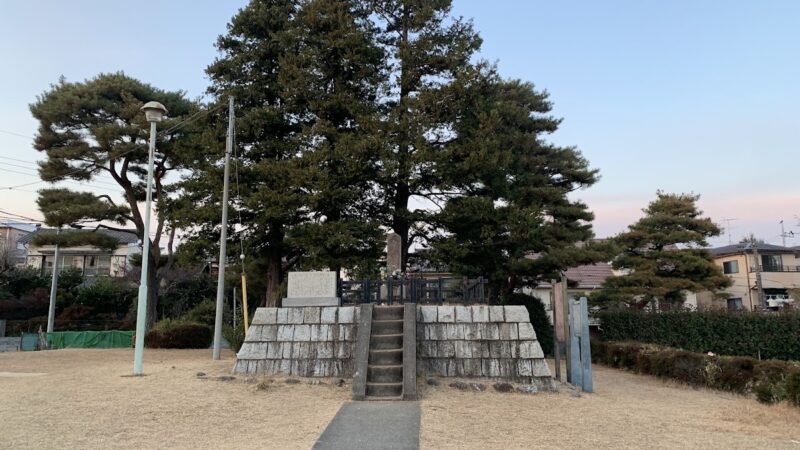
The greatest highlight of the Owada Jinya site is the existing earthworks. Although the jinya site is now a private residence, a portion of the earthworks surrounding the property is preserved.
The earthworks were built as defensive structures for the jinya, and while their height varies depending on the location, they retain a certain degree of their original appearance. Even within a residential area, this is a valuable historical site that evokes the atmosphere of the Sengoku period to the early Edo period.
Trees grow lushly on top of the earthen ramparts, creating a verdant landscape. In modern Saitama City, where urbanization is progressing, the preservation of such a historical landscape is extremely valuable.
Information Boards and Signs
An information board has been installed at the site of the jinya (fortified residence), where you can learn about the history of the Owada Jinya and Date Fusazane. The board describes the origins and historical background of the jinya, making it easy to understand even for first-time visitors.
Surrounding Historical Environment
To the north of the Owada Jinya site lies the Date Castle site, which was once Fusazane’s residence. The entire Owada area is dotted with historical sites indicating its role as a military base from the medieval to early modern periods, making it an enjoyable route for historical walks.
Value as a Saitama Prefecture Designated Important Historic Site
The Owada Jinya site is designated as a Saitama Prefecture Designated Important Historic Site. This designation is given to historically and academically important sites recognized by Saitama Prefecture, and their preservation and utilization are promoted.
Results of Academic Research
Multiple archaeological excavations have been conducted at the Owada Jinya site. The 5th excavation by the Saitama City Archaeological Survey Association (July 14th to September 12th, 2014) covered an area of 393.72 square meters, yielding new insights into the structure and changes of the Jinya.
The survey report was published in 2016 as “Saitama City Archaeological Survey Association Report 173: Owada Jinya Site,” and is used as a specialized research resource. These investigations are gradually revealing the scale, structure, and period of use of the Jinya.
Contribution to Local History Education
The Owada Jinya site also plays an important role in local history education. Local elementary and junior high schools sometimes visit the site as part of their local history studies, providing children with a place to learn about local history.
Access and Visiting Information
Access by Train
The nearest station to the Owada Jinya Ruins is Owada Station on the Tobu Noda Line (Tobu Urban Park Line).
- Approximately 10-12 minutes on foot from Owada Station (approximately 700 meters southwest)
- Approximately 18 minutes on foot from Omiya-Koen Station
- Approximately 22 minutes on foot from Toro Station
Owada Station is served only by local trains, but it is easily accessible, being only 2 stops from Omiya Station and 4 stops from Iwatsuki Station.
Access by Car
If visiting by car, access is possible via National Route 16 or Saitama Prefectural Road 2 (Saitama-Kasugabe Line). However, the Jinya Ruins are located within a residential area and there is no dedicated parking lot. We recommend using nearby coin-operated parking lots or public transportation.
Location Details
- Address: Around 1-371 Owada-cho, Minuma-ku, Saitama City, Saitama Prefecture
- Location: Southwest of Omiya Commercial High School
Precautions for Visiting
The Owada Jinya Ruins are located on private property, so careful consideration is required when visiting.
- Unauthorized entry onto private property is strictly prohibited: The earthworks can be viewed from the outside.
- View quietly: Remember that this is a residential area.
- Photography: Please be considerate of private property and individual privacy.
- Take your trash with you: Please cooperate in preserving the historical site and the surrounding environment.
Suitable Time for Visiting
The Owada Jinya Ruins are an outdoor historical site and can be visited throughout the year. However, please note the following:
- Spring/Autumn: Mild weather, ideal for historical walks
- Summer: Limited shade, so heatstroke prevention is necessary
- Winter: Early sunset, so visiting during daylight hours is recommended
- Rainy Days: Caution is needed as the ground can be slippery
Nearby Historical Spots
Date Castle Ruins
Located north of the Owada Jinya Ruins, Date Castle Ruins were the residence of Date Fusazane before he established the Jinya. Visiting both Owada Jinya and Date Castle Ruins together provides a deeper understanding of the region’s transition from the medieval to the early modern period.
Iwatsuki Castle Ruins
Iwatsuki Castle Ruins, the base of the Ota clan whom Date Fusazane served, is another must-see spot for history enthusiasts. Located a few stations away on the Tobu Noda Line, it has been developed into a castle ruins park. Understanding the history of Iwatsuki Castle provides a clearer understanding of the origins of the Owada Jinya.
Minuma Tsusenbori Canal
The Minuma Tsusenbori Canal, a water transport facility from the Edo period, is located nearby. It is a nationally designated historical site and a valuable relic demonstrating the advanced civil engineering technology of the time. We recommend including it in your historical walking route.
The Significance of Visiting the Owada Jinya Ruins
Experiencing the Transition Period from the Sengoku to the Edo Period
The Owada Jinya Ruins are a historical site symbolizing the transition period from the Sengoku period to the Edo period. Amidst the major historical currents of Toyotomi Hideyoshi’s unification of Japan and Tokugawa Ieyasu’s rule of the Kanto region, how did a local samurai survive and adapt to the new era? You can feel this story, along with the physical evidence of the earthworks.
The Importance of Local History
Local historical sites like the Owada Jinya Ruins teach us “another history” that isn’t found in textbooks. While not a nationally famous castle, it is a valuable legacy that conveys the lives of the people who lived in this area.
Historical Preservation Amidst Urbanization
In Saitama City, which is undergoing rapid urbanization, the survival of historical sites like the Owada Jinya Ruins is almost miraculous. The earthen ramparts, preserved amidst the wave of residential development, are a testament to the respect and efforts of the local people for history. A visit will allow you to reaffirm the importance of historical preservation.
Preservation and Future of the Owada Jinya Ruins
Challenges in Preservation
Since the Owada Jinya Ruins are privately owned, the understanding and cooperation of the owner are essential for preservation. Furthermore, because it is located within a residential area, balancing development pressures is also a challenge. Saitama Prefecture and Saitama City are continuing their efforts toward preservation from the perspective of cultural property protection.
Expectations for Utilization
In the future, it is hoped that improvements such as enhanced explanatory signs and the development of guide signs will create a more user-friendly environment for visitors. Additionally, virtual restoration using digital technology and the recreation of the site’s appearance in its heyday using AR applications are being considered as new possibilities for utilizing the historical site.
Collaboration with the Local Community
Developing tourist routes that utilize the local historical resources, including the Owada Jinya Ruins, and holding historical events are some possible future uses. Cooperation between local residents, the government, and researchers will allow us to convey the value of the historical site to a wider audience.
The Owada Jinya Ruins in Historical Research
A Valuable Example of Jinya Research
Many Jinya (fortified residences) existed throughout Japan during the Edo period, but many were lost due to development after the Meiji Restoration. The Owada Jinya Ruins, with its remaining structures, is a valuable example and serves as an important sample for studying the structure and function of Jinya.
Research on Regional Governance in the Kanto Region
How was regional governance established after Tokugawa Ieyasu’s entry into the Kanto region? The Owada Jinya Ruins contribute to historical research as a concrete example showing the treatment of former Hojo clan retainers and the process of constructing a new system of governance.
Archaeological Value
Artifacts and remains obtained through excavation reveal aspects of life and culture at the time that cannot be understood from written historical sources alone. Further investigations may lead to even more discoveries.
Summary
The Owada Jinya Ruins are a valuable historical site remaining in Minuma Ward, Saitama City, Saitama Prefecture. It is the site of a fortified residence established by Date Yohei Fusazane, who survived the turmoil of the Sengoku period, on land granted to him by Tokugawa Ieyasu. A portion of the earthworks is still preserved today.
The earthworks, quietly nestled within a residential area, are a precious witness to history from over 400 years ago. Its convenient location, within walking distance of Owada Station on the Tobu Noda Line, is also a major attraction, making it a recommended spot not only for history enthusiasts but for anyone interested in local history.
When visiting, please be mindful that it is private property and reflect on the footsteps of the people who lived through the transition from the Sengoku period to the Edo period. The Owada Jinya Ruins are a precious window into history, quietly telling us “another history of Japan” that is not found in textbooks.