Jingasa Castle (Hirado City, Nagasaki Prefecture) Complete Guide | History, Highlights, and Access Information
What is Jingasa Castle?
Jingasa Castle is a Sengoku period mountain castle located in Tabira-cho, Hirado City, Nagasaki Prefecture. Built on a 72.3-meter-high mountain, it is known as an important historical site that tells the story of the conflicts of the Matsuura clan in Hizen Province. Currently, it is maintained as Shiroyama Park and is a popular viewpoint offering panoramic views of the Hirado Strait.
The most distinctive feature of Jingasa Castle is its history as a branch castle of Sato Castle, the residence of the Mine clan. This castle, which was the stage for power struggles during the Sengoku period, later functioned as a branch castle of Hirado Castle, and in the Edo period, it housed a guard station of the Hirado Domain. It has been deeply involved in the history of the region, changing its role over time.
History of Jingasa Castle
Background of Construction and the Conflict of the Mine Clan
Jingasa Castle is estimated to have been built around the Entoku era (1489-1492). During this period, a serious internal conflict arose within the Matsuura clan of Hizen Province. Mine Masamasa, the head of the Mine clan (a branch of the Matsuura clan), allied himself with Arima Takazumi, a powerful daimyo of Hizen, and came into conflict with Matsuura Hirotada, his younger brother who had inherited the headship of the Matsuura clan.
To prepare for an attack by Matsuura Hirotada, Mine Masamasa was compelled to strengthen the defenses of his base, Sato Castle. The strategically chosen location was Shiroyama, towering north of Tabira Port. This location, situated on a hill overlooking the Hirado Strait, possessed ideal conditions for monitoring and defending maritime traffic. Thus, Jingasa Castle was rapidly constructed as a subsidiary castle of Sato Castle.
Peace Agreement and Integration into the Matsuura Clan
The conflict between Mine Masa and Matsuura Hirotada was shaping up to be a protracted war that depleted the forces of both sides. Concerned about this situation, Ouchi Yoshioki of Suo Province intervened, and a peace agreement was reached. As a result of this agreement, the Mine clan’s territory came under the control of the Matsuura clan, and Jingasa Castle was positioned as a branch castle of Hirado Castle.
After coming under the control of the Matsuura clan, Jingasa Castle functioned as an important base for monitoring maritime traffic in the Hirado Strait. Hirado flourished as a center of overseas trade from the medieval to the early modern period, and Jingasa Castle is thought to have played a role in ensuring the safety of that maritime route.
Role as a Guard Station in the Edo Period
With the end of the Sengoku period and the beginning of the Edo period, Jingasa Castle ceased to function as a military base. While the exact date of its abandonment is unclear, it is presumed that it had already lost its function as a castle by the early Edo period. However, due to its advantageous location, the Hirado Domain established a guard post on the castle site to monitor ship traffic.
This guard post was tasked with monitoring ships passing through the Hirado Strait and cracking down on smuggling. Under the Edo Shogunate’s isolationist policy, Hirado, along with Nagasaki, was one of the limited windows for foreign trade, making the monitoring of the maritime area a crucial task for the domain.
Structure and Layout of Jingasa Castle
Characteristics of the Main Enclosure
The main enclosure of Jingasa Castle is a slightly elongated oval shape from east to west. Currently, it is maintained as Shiroyama Park and is a flat open space, but it is believed that during the Sengoku period, the lord’s residence and soldiers’ quarters stood here. The main enclosure is relatively large for a mountain castle, and its design allows for the stationing of a considerable number of troops.
Stone walls can be seen encircling the main enclosure almost completely. These stone walls were built to defend the main enclosure and are valuable remains for understanding the castle construction techniques of the time. In particular, the southeastern side retains a terrain resembling a moat, showing ingenuity intended to prevent enemy intrusion.
Remains of the Stone Wall
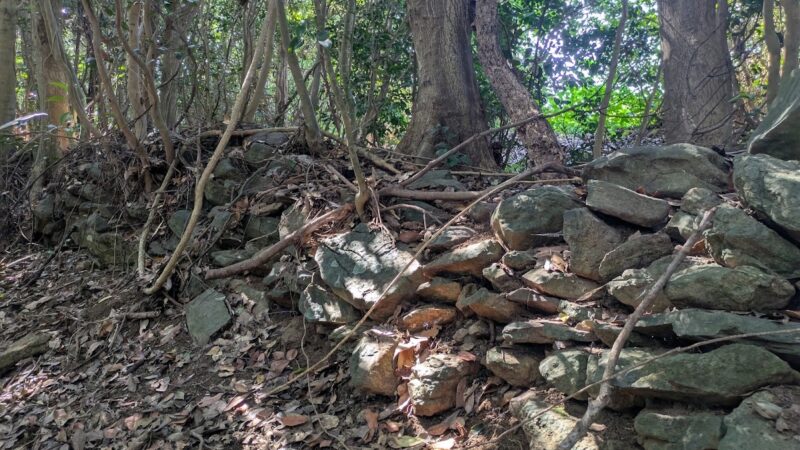
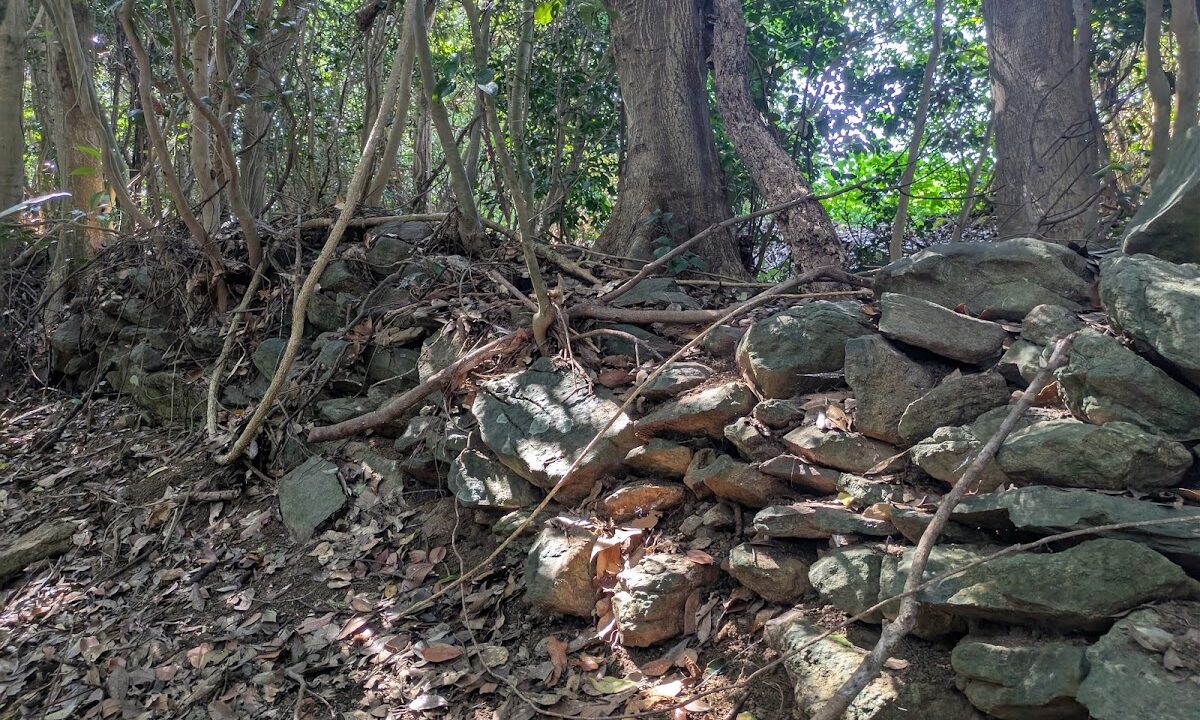
The most noteworthy remains of Jingasa Castle are the stone walls remaining on the eastern cliff face of the main enclosure. This considerably large stone wall is a valuable historical artifact that conveys the castle-building techniques of the Sengoku period. The stone wall was constructed using a technique called “nozura-zumi,” a simple method of stacking natural stones, yet it has remained intact for over 400 years, preserving its original form.
This stone wall is thought to be a remnant of the time when the Mine clan hastily built the castle. The adoption of nozura-zumi, which does not require advanced processing techniques, is presumed to be due to the need to shorten the construction period. Nevertheless, the scale of the stone wall is large, indicating that this castle was not merely a lookout post, but a full-fledged defensive facility designed for actual combat.
Outworks and Defensive Facilities
Remains of several enclosures and outworks have been confirmed around the main enclosure. These are thought to have functioned as forward positions to protect the main keep. The basic principle of mountain castle defense was to prevent the enemy from approaching the main keep, and the arrangement of multiple enclosures allowed for layered defense.
The moat-like terrain on the southeast side is a particularly noteworthy defensive feature. Moats hinder enemy lateral movement and make it easier for the defenders to attack from higher ground. While there is debate as to whether this terrain is natural or artificially created, it was undoubtedly utilized as a key defensive point.
Highlights of Jingasa Castle
Development as Shiroyama Park
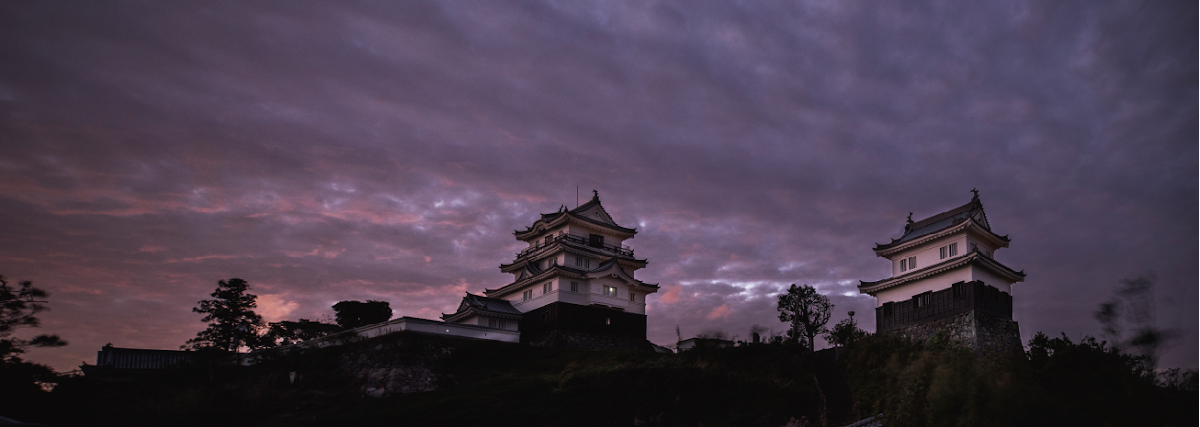
The current Jingasa Castle site has been developed as “Shiroyama Park,” a place of relaxation for local residents. An observation deck has been built on the site of the main keep, offering a panoramic view of the beautiful Hirado Strait. On a clear day, you can see Hirado Island on the opposite shore and even the distant Genkai Sea, making it an excellent location that clearly explains why a guard post was once located here.
The park has well-maintained walking paths, allowing visitors to enjoy a stroll while exploring the remains of stone walls and baileys. However, there are some areas with water facilities and overgrown undergrowth, so it is recommended to wear comfortable walking shoes when visiting.
View from the Observation Deck
The observation deck, located on the site of the main keep, is one of the biggest highlights of Jingasa Castle. While its elevation of 72.3 meters is not particularly high, the lack of obstructions in the surrounding area allows for a 360-degree panoramic view.
The view of the Hirado Strait is particularly breathtaking, allowing visitors to appreciate the geographical importance of this region, which flourished as a key point for maritime traffic since ancient times. You can also look down on Tabira Port and the surrounding townscape, and it’s enjoyable to imagine the current state of Tabira Town in Hirado City alongside the former castle town.
Observation of Stone Wall Remains
For history enthusiasts, the biggest highlight is undoubtedly the stone wall remains on the east side of the main keep. This stone wall is a valuable historical artifact that allows us to directly observe the castle-building techniques of the Sengoku period (Warring States period). While the rough-hewn stone wall may appear irregularly constructed at first glance, closer observation reveals the ingenuity of using large stones as a foundation and filling the gaps with smaller stones to ensure stability.
Standing before the wall, one can contemplate the labor and skill of the people who built it over 400 years ago. The effort of the people who constructed a stone wall of this scale in an era without modern heavy machinery is truly astonishing.
Historical Landscape of the Hirado Strait
The Hirado Strait, viewed from Jingasa Castle, holds historical significance beyond mere beauty. From ancient times through the Middle Ages and early modern period, this strait was a crucial maritime route connecting Japan and the continent. From the era of the Japanese envoys to Tang China, to the activities of the Wokou pirates, and the Nanban trade, it has been the stage for numerous historical events.
The fact that Mine Masaru built a castle here, that Matsuura Hirotada sought to bring this castle under his control, and that the Hirado Domain established a guard post here, were all due to the high strategic value of this strait. Being able to feel this layered history while gazing at the strait from the observation deck is a major attraction of visiting Jingasa Castle.
Access to Jingasa Castle
Access by Public Transportation
If visiting Jingasa Castle by public transportation, the nearest station is “Hiradoguchi Station” on the Matsuura Railway Nishikyushu Line. Jingasa Castle is approximately 3 kilometers from Hiradoguchi Station, taking about 40 minutes on foot. A taxi from the station will get you to the entrance of Shiroyama Park in about 10 minutes.
If using the bus, take a Nishihi Bus from Hiradoguchi Station and get off at the “Tabira Port” bus stop. From there, it’s about a 15-minute walk to Shiroyama Park. However, since bus services are limited, it is recommended to check the timetable in advance.
Access by Car
If traveling by car, take National Route 204 towards Hirado from the Sasa Interchange on the West Kyushu Expressway. The drive is approximately 15 kilometers, about 20 minutes. From Nagasaki city center, it’s about a 2-hour drive via National Routes 202 and 204.
Shiroyama Park has a parking lot, which is free to use. While parking spaces are limited, it’s usually possible to find a spot on weekdays. However, it can get crowded during peak tourist seasons such as cherry blossom season, so it’s recommended to visit earlier in the day.
Road Conditions and Precautions
The road leading to Shiroyama Park has some narrow sections. The slope just before the park is particularly steep, so driving requires caution. The roads within the park are also narrow, making it difficult for large vehicles to access. If renting a car, it’s recommended to choose a smaller vehicle.
When searching using a car navigation system, searching for “Shiroyama Park” or the address “Yamauchi-men, Tabira-cho, Hirado City, Nagasaki Prefecture” will display the accurate location. However, since it may not be displayed on older map data, it’s best to check the location on an online map beforehand.
Notes and Best Season for Visiting
Clothing and Equipment
Jingasa Castle is a mountain castle, and although it is maintained as a castle mountain park, some areas remain undeveloped. Especially if you plan to closely examine the stone wall remains and the bailey ruins, comfortable walking shoes and clothing are essential. Insect repellent is recommended in summer, and warm clothing in winter.
If you want to photograph the view from the observation deck, we recommend bringing a camera or binoculars. The view of the Hirado Strait on a clear day is particularly spectacular and ideal for photography. Also, if you are interested in history, obtaining books or pamphlets about the history of Hirado beforehand will allow you to understand the castle ruins more deeply.
Recommended Time to Visit
The best seasons to visit Jingasa Castle are spring (late March to May) and autumn (October to November). In spring, the cherry blossoms bloom, and Shiroyama Park is bustling with visitors enjoying the flowers. The combination of cherry blossoms, stone walls, and the Hirado Strait makes for an ideal photo opportunity. In autumn, the autumn foliage is beautiful, and the clear air allows for panoramic views.
Summer (June to September) is not ideal for observing the ruins due to high temperatures and overgrown undergrowth. However, it is relatively comfortable to stroll around in the early morning or evening. Winter (December to February) is cold, but the clear air makes it the most beautiful time of year to view the scenery from the observation deck.
Estimated Visiting Time
A leisurely visit to Shiroyama Park takes approximately 1 to 1.5 hours. This amount of time is sufficient to enjoy the view from the observation deck, observe the stone wall ruins, and walk around the main enclosure. If you plan to spend more time taking photos or contemplating the history, it is recommended to allow an additional 30 minutes to 1 hour.
Nearby Tourist Attractions
Hirado Castle
If you visit Jingasa Castle, be sure to extend your trip to Hirado Castle as well. Hirado Castle, also known as Kameoka Castle, served as the residence of the Matsuura clan of the Hirado Domain throughout the Edo period. Currently, a reconstructed keep stands, and the interior is open to the public as a museum. Considering that Jingasa Castle was a subsidiary castle of Hirado Castle, visiting both castles will allow you to gain a deeper understanding of the region’s history.
Hirado Castle is approximately a 20-minute drive from Jingasa Castle. The view from the keep is magnificent, offering a panoramic view of the Hirado Strait and Hirado city. Opening hours are 8:30 AM to 5:00 PM (October 1st to March 31st), and it is closed on December 30th and 31st.
Tabira Catholic Church
Tabira Catholic Church, located approximately a 10-minute drive from Jingasa Castle, is a Catholic church designated as a National Important Cultural Property. Built in 1918, this church is a beautiful brick structure that conveys the history of Christianity in the Hirado region. Hirado was visited by Francis Xavier in the 16th century, making it an important spot for understanding the history of the arrival of Christianity in Japan.
Sato Castle Ruins
The ruins of Sato Castle, the main castle of Jingasa Castle, are also an interesting spot for history enthusiasts. This castle, which functioned as the residence of the Mine clan, now only has a few remains, but considering its relationship with Jingasa Castle, it is worth a visit. Sato Castle Ruins are about a 15-minute drive from Jingasa Castle.
Jingasa Castle and the Castle Culture of Hizen Province
Characteristics of Mountain Castles in Hizen Province
Jingasa Castle is a typical example of the many mountain castles built in Hizen Province (present-day Saga and Nagasaki prefectures). Hizen mountain castles were built on relatively low mountains and their main purpose was to monitor maritime traffic and defend the territory. Characterized by its sturdy construction using stone walls, it reflects the tense situation of the Sengoku period.
The Sengoku daimyo of Hizen Province, such as the Matsuura, Arima, and Ryuzoji clans, built numerous branch castles in their respective territories, creating a network-like defensive system. Jingasa Castle functioned as part of this branch castle network.
Relationship between the Mine and Matsuura Clans
The Mine clan, while a branch of the Matsuura clan, was a powerful family with its own independent influence. The Matsuura clan was a prestigious family that had ruled the Matsuura region of Hizen Province since the Heian period, and is known for leading a naval force and playing an active role during the Mongol invasions in the Kamakura period. In the Sengoku period, power struggles within the Matsuura clan intensified, and the conflict between Mine Masa and Matsuura Hirotada was part of this.
After a peace agreement mediated by Ouchi Yoshioki, the Matsuura clan consolidated its power centered in Hirado, and eventually survived as the Hirado Domain during the Edo period. The history of Jingasa Castle is deeply intertwined with the rise and fall of the Matsuura clan.
Preservation and Future of Jingasa Castle
Value as a Cultural Property
Jingasa Castle is currently recognized as an important historical heritage site of Hirado City. The stone wall remains and traces of the castle’s layout are valuable historical materials for understanding the castle-building techniques of the Sengoku period, and hold high academic value. Furthermore, its preservation is recognized as essential as a historical site that conveys an important scene in local history: the conflict between the Mine and Matsuura clans.
Connection with the Community
The Jingasa Castle site, developed as Shiroyama Park, has become a familiar place of relaxation for local residents. It is used not only as a historical heritage site but also as a modern living space, for activities such as cherry blossom viewing in spring, enjoying the view from the observation deck, and using it as a walking path. This connection with the community leads to both the preservation and utilization of the historical site.
Local history enthusiasts and local history research groups also conduct surveys and cleaning activities, demonstrating a community-wide commitment to preserving Jingasa Castle. These activities are expected to contribute to the transmission of history to future generations.
Summary
Jingasa Castle is a Sengoku period mountain castle built on a small hill in Tabira-cho, Hirado City, Nagasaki Prefecture. Built as a branch castle of the Mine clan, it became the stage for conflicts with the Matsuura clan, and later served as a branch castle of Hirado Castle, and even as a guard station during the Edo period. It has been deeply involved in the history of the region, changing its role over time.
Currently, it is maintained as Shiroyama Park, offering many attractions such as stone wall remains and views from the observation deck. Its superb location overlooking the Hirado Strait makes it clear that this area was once a crucial point for maritime traffic.
Its easy accessibility is also a major draw, being approximately 10 minutes by car from Hiradoguchi Station and 20 minutes from the Sasa Interchange. Visiting it along with other nearby tourist spots such as Hirado Castle and Tabira Catholic Church will allow you to gain a deeper understanding of the rich history and culture of the Hirado region.
Jingasa Castle is a historical site worth visiting not only for history buffs, but also for those who want to enjoy the scenery and experience local culture. The next time you visit Nagasaki Prefecture, be sure to stop by Jingasa Castle and experience the atmosphere of the Sengoku period and the beautiful scenery of the Hirado Strait.
-680x450.png)