Naoya Castle (Sasebo City, Nagasaki Prefecture) Complete Guide | History, Remains, and Access Information
What is Naoya Castle?
Naoya Castle is a medieval mountain castle located in Naoya, Yoshii-cho, Sasebo City, Nagasaki Prefecture. Also known as Dairiyama Castle, it is a mountain castle built on the summit of Mount Dairiyama (175 meters above sea level), with a relative height of approximately 80-90 meters.
It functioned as the residence of the Shisa clan, a powerful family of the Matsuura clan in Hizen Province, and served as an important military base during the Sengoku period. Currently, it is protected as a Nagasaki Prefecture designated historical site, and remains such as earthworks, baileys, moats, vertical trenches, and well remains are well-preserved.
The distinctive name Dairiyama is said to originate from the legend that Emperor Antoku, who was supported by the Taira clan at the end of the Heian period, lived in seclusion there. This castle ruin, with its historical romance, attracts attention from castle enthusiasts.
History of Naotani Castle
Background of Construction and the Matsuura Clan
While there are no definitive records regarding the exact construction date of Naotani Castle, it is believed to have been built by the Matsuura Clan Shisa, who ruled this region from the Kamakura period to the Nanboku-cho period.
The Matsuura Clan was a samurai group based in the Matsuura region of Hizen Province, active from the late Heian period to the Sengoku period. The Shisa clan, a branch of the Matsuura Clan, expanded their power centered in what is now Shisa-cho, Matsuura City, Nagasaki Prefecture, and established their control over their territory by building several castles, including Naotani Castle.
Legend of Emperor Antoku
On Dairiyama, where Naotani Castle was built, there is a legend of Emperor Antoku’s seclusion from the late Heian period. While legends of Emperor Antoku, who is said to have drowned in the Battle of Dan-no-ura, actually surviving and fleeing to various locations exist throughout Japan, Naotani is considered one such place.
While the veracity of this legend has not been historically proven, it is certain that the name “Dairiyama” originates from this legend, and it is cherished and passed down as part of the local history and culture.
Naotani Castle in the Sengoku Period
During the Sengoku period (Warring States period), Naotani Castle functioned as an important branch castle of the Shisa clan. During this time, the Hizen region was constantly embroiled in internal conflicts within the Matsuura clan and clashes with surrounding daimyo such as the Ouchi, Otomo, and Ryuzoji clans. It is believed that Naotani Castle was caught in several battles.
In the latter half of the 16th century, influenced by Toyotomi Hideyoshi’s conquest of Kyushu, the Matsuura clan gradually lost power. The Shisa clan was no exception, and it is estimated that Naotani Castle was abandoned around this time.
From the Edo Period Onward
During the Edo period, the Sasebo region came under the control of the Matsuura clan of the Hirado Domain, but Naotani Castle had already been abandoned and lost its function as a castle. However, it continued to be recognized as a castle site by locals, and the legend, along with the name Dairiyama, has been preserved. Because it escaped development even after the Meiji era, and its remains were well preserved, it is now designated as a historical site of Nagasaki Prefecture and protected as an important cultural property of the region.
Structure and Layout of Naotani Castle
Overall Structure
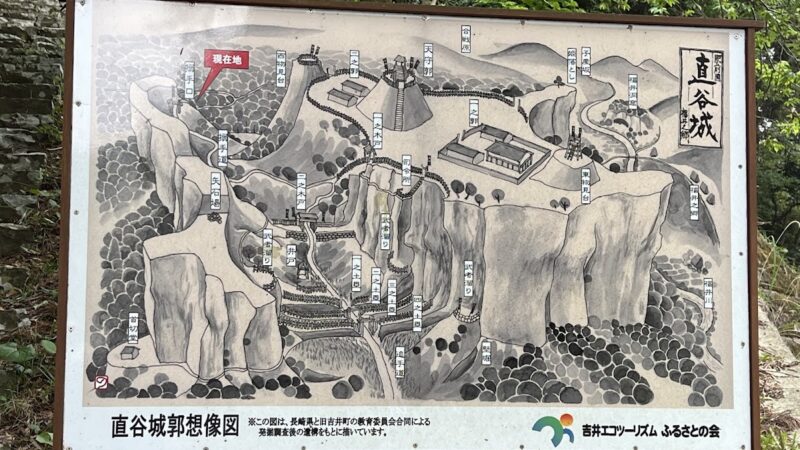
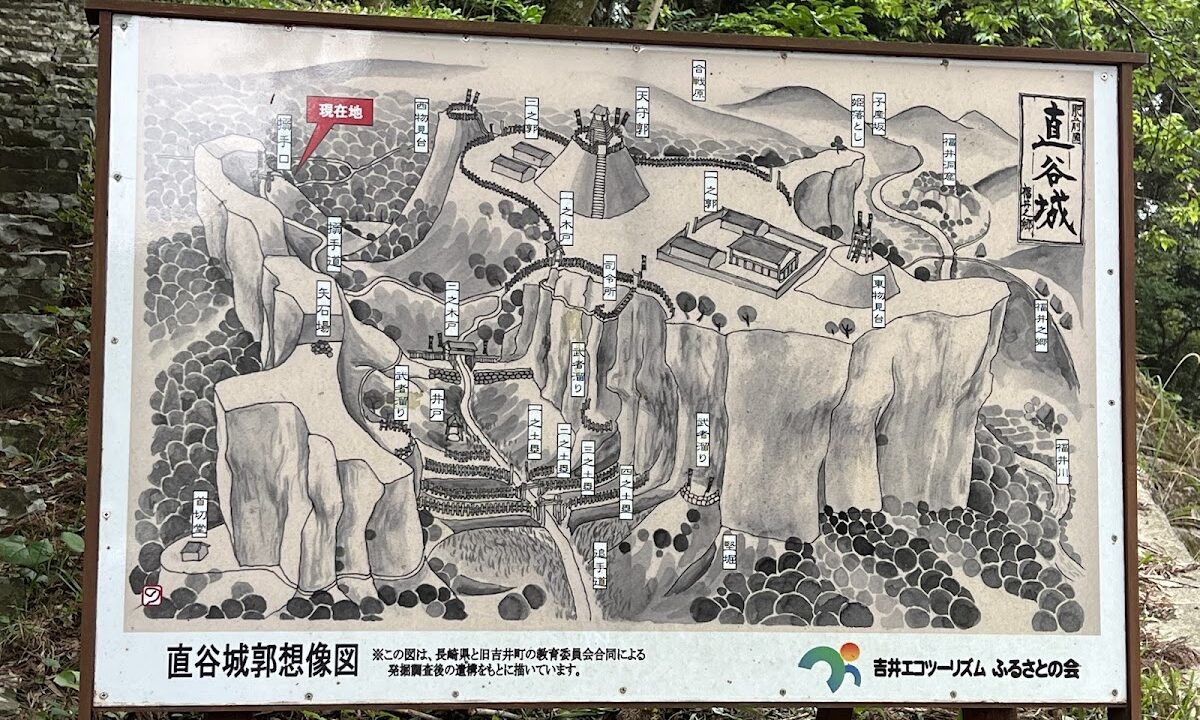
Naotani Castle is a multi-enclosure mountain castle built using the ridge from the summit of Dairiyama Mountain. Centered around the main enclosure (honmaru), multiple enclosures are arranged in a stepped fashion, and trenches and vertical moats are provided at key points on the ridge to strengthen defenses.
The castle area is approximately 200 meters east-west and 150 meters north-south, placing it in the medium-sized category for a medieval mountain castle. The relative height is 80-90 meters, suggesting that it was a formidable stronghold that was difficult for attacking enemies to capture.
Characteristics of the Main Enclosure (Honmaru)
The main enclosure, located at the summit, is a flat area approximately 40 meters east-west and 30 meters north-south. The area is surrounded by earthen ramparts, and the ramparts on the north and east sides, in particular, are well-preserved and over 2 meters high.
Within the main enclosure, an earthen platform believed to be a watchtower base has been identified, suggesting the presence of a watchtower or other structure. Furthermore, the remains of a well are found in one corner of the main enclosure, indicating that a water source was secured during sieges.
Second and Third Enclosures
To the south of the main enclosure lies the second enclosure, and below that, the third enclosure. These enclosures are also demarcated by earthen ramparts, creating a defensive structure utilizing elevation differences.
The second enclosure is the second largest after the main enclosure and is presumed to have housed the lord’s residence and soldiers’ quarters. The third enclosure was positioned to defend against attacks from the main entrance and was a crucial defensive feature.
Moats and Vertical Moats
Multiple moats are constructed along the ridge, creating a structure to hinder enemy incursions. In particular, the moats on the north and south sides of the main enclosure are clearly visible, measuring 3-4 meters deep and 5-6 meters wide.
Furthermore, numerous vertical moats have been dug into the slope, a technique designed to make lateral movement difficult. These remains are valuable evidence of the development of castle-building techniques during the Sengoku period.
Main Entrance and Ascent Route
The main entrance to the castle, the Ote-guchi, is thought to have been located on the ridge on the southwest side. The current ascent route basically follows this Ote-guchi route, passing between the enclosures to reach the main enclosure.
Stone steps have been constructed in some places along the ascent route, giving a glimpse of the castle’s past. However, there is debate as to whether these stone steps date back to the medieval period or were constructed in later times.
Highlights of Naotani Castle
Well-Preserved Earthworks
The greatest highlight of Naotani Castle is the well-preserved earthworks, centered around the main enclosure. The earthen rampart on the north side of the main enclosure is particularly impressive in both height and width, demonstrating the high level of castle-building technology of the time.
There are sections where you can walk along the top of the rampart, making it a valuable historical site where you can experience the castle’s defensive structure firsthand. Climbing the rampart and surveying the surroundings will help you understand the importance of the lookout posts for monitoring enemy movements.
Clear Layout of Enclosures
At Naotani Castle, the layout of the enclosures, from the main enclosure to the second and third enclosures, is remarkably clear. The elevation differences and earthen rampart divisions of each enclosure are clearly defined, making it an ideal castle site for learning about the structure of a medieval mountain castle.
Within the enclosures, some areas have been cleared of undergrowth, making it easier to identify the remains. However, in some cases, vegetation can be overgrown, so caution is advised when visiting.
The Impressive Moat
The moat, built to cut across the ridge, is a crucial element of Naotani Castle’s defense. Seeing the deep, sharply dug moat in person allows you to truly appreciate its defensive effectiveness.
The view from the bottom of the moat, looking up, and the view from above the moat, each offer a different sense of grandeur, so we recommend observing from multiple angles.
Stunning Views
From the main enclosure, you can see the city of Sasebo and the surrounding mountains. On clear days, the view extends as far as Hirado, allowing you to enjoy a panoramic view that truly captures the sphere of influence of the Matsuura clan.
At an altitude of 175 meters, the view is well worth the effort of climbing to the castle. Especially during the fresh greenery of spring and the vibrant autumn foliage, you can enjoy both the beautiful scenery and the exploration of the castle ruins simultaneously.
Information Boards and Explanation Boards
Information boards and explanation boards are installed at key points within the castle grounds, aiding in understanding the remains. Because it is a Nagasaki Prefecture historical site, even first-time visitors can easily understand the location and significance of the remains.
However, the number of explanation boards is limited, so studying the castle’s structure beforehand will allow for a deeper and more enjoyable experience.
Access to Naotani Castle
Location
Address: Near 1007-134 Kami-Naotani, Yoshii-cho, Sasebo City, Nagasaki Prefecture
Naotani Castle is located approximately 15 kilometers northeast of central Sasebo City. The castle ruins are on Dairiyama Mountain, which rises northwest of Yoshii Kita Elementary School.
Access by Car
From Central Sasebo City:
- Head north on National Route 204 towards Yoshii
- Travel time: Approximately 25-30 minutes
- Approximately 15 minutes from the Sasa Interchange on the West Kyushu Expressway
Parking: There is no dedicated parking lot for the castle ruins, but there are a few parking spaces near the entrance to the castle. However, the spaces are very narrow, so it is best to avoid visiting in large vehicles. Please avoid parking on the street to avoid inconveniencing local residents.
Access by Public Transportation
By Bus:
- Take the Nishihi Bus bound for “Yoshii” from Sasebo Station.
- Get off at the “Kami-Naotani” bus stop and walk for approximately 20 minutes to the castle entrance.
- Bus service is limited, so please check the timetable in advance.
Access by public transportation is not convenient, so we recommend visiting by car if possible.
About Visiting the Castle
It takes approximately 20-30 minutes to walk from the castle entrance to the main enclosure along the castle path. The climb involves an elevation gain of approximately 80 meters, so we recommend the following preparations:
- Clothing: Comfortable clothing, long sleeves and long pants (to protect against vegetation and insects)
- Shoes: Trekking shoes or athletic shoes (non-slip)
- Items to bring: Drinking water, towel, insect repellent (in summer)
- Equipment: A walking stick or trekking pole will make the climb easier.
While some sections of the trail are well-maintained, the footing can be uneven in places, so please climb with caution. The trail becomes particularly slippery during and after rain, so extra caution is required.
Best Time to Visit
Recommended Time:
- Spring (March-May): Mild weather, easy to climb
- Autumn (October-November): Beautiful autumn foliage, comfortable temperature
Time to Avoid:
- Mid-Summer (July-August): Hot and insect-heavy, beware of heatstroke
- Rainy Season (June): Paths can become muddy
- Mid-Winter (January-February): Poor freezing conditions
Nearby Tourist Attractions
Other Castle Ruins in Sasebo City
If you visit Naotani Castle, we recommend visiting other castle ruins in Sasebo City as well.
Takebe Castle: Approximately 15 minutes by car from Naotani Castle. Known as a castle of the Matsuura clan, the remains are well-preserved.
Daichian Castle: A mountain castle close to Sasebo city center. Easily accessible from the city center, making it a good castle ruin for beginners.
Sasebo Castle: A castle built during the Edo period as a branch castle of the Hirado Domain. It is now maintained as Sasebo Park.
Hario Castle: A seaside castle overlooking Sasebo Bay. Known for its magnificent views.
Attractions around Yoshii Town
Around Yoshii Kita Elementary School: Located at the foot of the castle ruins, this area retains its old townscape.
Naotani Rock Shelter Site: Known as a Paleolithic site, it is an important location for understanding the history of Sasebo City.
Tourist Attractions in Sasebo City
In conjunction with a visit to Naotani Castle, you can also enjoy major tourist attractions in Sasebo City.
Huis Ten Bosch: One of Japan’s largest theme parks. Approximately 40 minutes by car from Naotani Castle.
Kujukushima Islands: A tourist destination where you can enjoy the beautiful scenery of the archipelago. Approximately 30 minutes by car from Naotani Castle.
Saikai Bridge Park: Known as a famous cherry blossom viewing spot, it attracts many tourists in spring.
Evaluation of Naotani Castle
Among castle enthusiasts, Naotani Castle is highly regarded as a medieval mountain castle with well-preserved remains. According to data from Kojodan (a castle enthusiast website), the average visitor rating is a very high 4.80 stars, and the average visit time is 57 minutes.
Points of Evaluation
Good Points:
- Clearly preserved remains such as earthworks, baileys, and moats
- Designated as a Nagasaki Prefecture Historic Site
- Ideal for learning about the structure of medieval mountain castles
- Excellent views
Points to Note:
- Somewhat inconvenient access
- Requires physical stamina to climb
- No dedicated parking lot
- Overgrown with vegetation in summer
Precautions When Visiting Naotani Castle
Safety
- Avoid climbing alone; visit with multiple people if possible
- Check cell phone signal strength and ensure you have a means of contact in case of emergency
- Pay attention to sudden changes in weather; descend quickly if there are signs of thunderstorms
- Be careful of wild animals (wild boars, venomous snakes, etc.)
Manners
- Be careful not to damage the remains
- Always take your trash with you
- The use of fire is strictly prohibited
- Do not trespass on private property
- Please be considerate of the local residents and avoid making noise.
Photography
Photography is permitted, but please note the following:
- Drone use may require prior permission.
- Please be considerate of the privacy of other visitors.
- Please be mindful of location information when posting on social media.
Research and Preservation Activities of Naotani Castle
Naotani Castle is protected as a Nagasaki Prefecture designated historical site, and its preservation and management are primarily carried out by the Sasebo City Board of Education.
In recent years, local history enthusiasts and castle researchers have conducted surveys, and progress has been made in creating layout maps and meticulously documenting the remains. These research results are important resources for the study of medieval Hizen castles.
Local residents also conduct cleaning activities and maintain information boards, making it a good example of community-based cultural property preservation.
Summary
Naotani Castle is a valuable medieval mountain castle site remaining in Sasebo City, Nagasaki Prefecture. This castle, which flourished as the residence of the Matsuura clan’s Shisa family, boasts well-preserved remains such as earthworks, baileys, and moats, making it an ideal place to learn about medieval castle structures.
The castle ruins on Dairiyama Mountain, steeped in the historical romance of the legend of Emperor Antoku, are a historical site well worth the effort of climbing to. While access is somewhat inconvenient, this also contributes to the charm of being able to quietly appreciate the castle ruins.
When visiting Sasebo City, be sure to include a visit to Naotani Castle in your plans. An encounter with a valuable cultural asset awaits you, conveying the appearance of a fortress built by medieval samurai to the present day.
This is one of Nagasaki Prefecture’s leading mountain castle ruins, recommended not only for castle enthusiasts but also for history buffs and hiking lovers. Please prepare appropriately and equip yourself to safely experience the charm of Naotani Castle.
-680x450.png)