Complete Guide to the History and Highlights of Hekida Castle (Nakano City, Nagano Prefecture) | The Full Picture of the Takanashi Clan’s Branch Castle
What is Hekida Castle?
Hekida Castle is a Sengoku period mountain castle located in Hekida, Nakano City, Nagano Prefecture. Built on a river terrace on the right bank of the Chikuma River, at an altitude of approximately 480 meters, the castle’s relative height difference is about 140 meters. Currently, the castle ruins remain around Nagaoka Shrine, and it is known as an important border castle in Shinano Province.
As a strategic point located between the Zenkoji Plain and Iiyama Castle, it played a crucial role in the conflicts of northern Shinano, including the Battle of Kawanakajima. It was developed as a branch castle of the Takanashi clan, and the Yamada clan, vassals of the Takanashi clan, served as its lords.
History of Hekida Castle
Establishment as a Takanashi Clan Branch Castle
Hekida Castle was a branch castle built by the Takanashi clan, a powerful local family in northern Shinano. The Takanashi clan was based at Nakano-Kodate and maintained their sphere of influence by placing several branch castles in the surrounding area. Kabeta Castle was one of these branch castles, a crucial stronghold responsible for the defense of the east bank of the Chikuma River.
The castle was ruled by the Yamada clan, vassals of the Takanashi clan, with figures such as Yamada Hida-no-kami (Yamada Da-no-kami) and Yamada Saemon-no-jo recorded in historical records. The Yamada clan governed the Kabeta area and played a vital role in supporting the Takanashi clan’s military power.
The Battle of Kawanakajima and the Uesugi Clan’s Supply Base
In the early stages of the Battle of Kawanakajima, Kabeta Castle was used as a supply base by the Uesugi clan (Nagao clan). In the conflict between Takeda Shingen and Uesugi Kenshin over the Zenkoji Plain, northern Shinano became the front line between the two forces, and Kabeta Castle’s strategic importance increased.
With the Chikuma River providing a natural defensive line behind it, Kabeta Castle possessed ideal location conditions for the accumulation of supplies and the stationing of troops. For the Uesugi clan, Kabeta Castle was an indispensable staging point when advancing from the Iiyama area towards the Zenkoji Plain.
Surrender to the Takeda Clan in 1566
In 1566, when Takeda Shingen launched a large-scale invasion of northern Shinano, the situation changed dramatically. At this time, the castle lords, Yamada Hida-no-kami and Yamada Saemon-no-jo, chose to surrender to the Takeda clan.
This surrender symbolized the decline of the Takanashi clan’s power and the advancement of the Takeda clan’s control over northern Shinano. The Takanashi clan lost their base, Nakano-kodate, and fled to the Uesugi clan. Kabeta Castle also came under the control of the Takeda clan and is thought to have changed its role in subsequent history.
Subsequent History
Although there are few detailed records of how Kabeta Castle was used after its surrender to the Takeda clan, it is presumed to have functioned as one of the Takeda clan’s bases in their administration of northern Shinano. After the fall of the Takeda clan in 1582, it is believed to have been ruled by various generals under the Uesugi and Oda clans before finally being abandoned.
Investigations by the Nagano Prefectural Buried Cultural Properties Center did not uncover any clear remains or artifacts related to medieval or early modern mountain castles. The flat area initially thought to be related to a medieval mountain castle has been confirmed to be farmland created later for cultivating mulberry and fruit trees. This indicates that the castle site was used as agricultural land over a long period of time.
Structure and Layout of Kabeta Castle
Location and Topography
Kabeta Castle was built on a hill on a river terrace on the east bank of the Chikuma River. The Chikuma River flows in a large loop around the castle hill, functioning as a natural defensive line. Located at an altitude of approximately 480 meters, with a relative height difference of about 140 meters, the castle offered an excellent vantage point for observation, overlooking the vast Zenkoji Plain.
With the Chikuma River, a major river, at its rear, the castle’s defenses against attacks from the west were enhanced, and it is believed that the castle also benefited from convenient water transport for goods. This topographical advantage was one of the factors that made Kabeta Castle an important military base.
Arrangement of Enclosures and Baileys
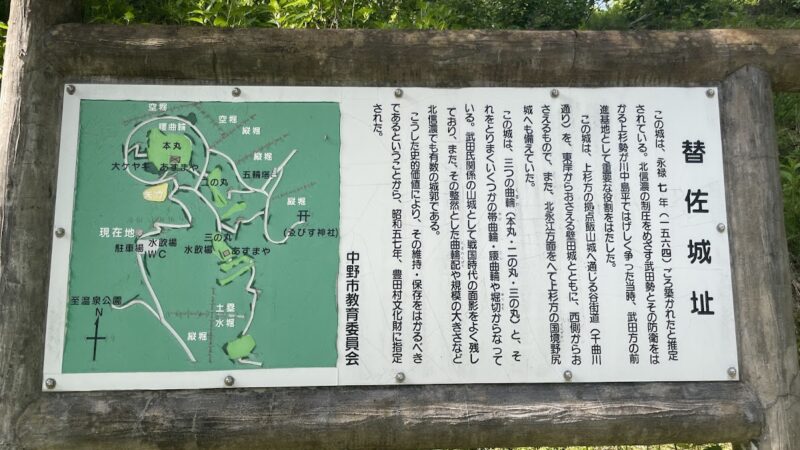
Kabeta Castle’s layout consists of multiple enclosures (baileys) running north-south. A series of enclosures, arranged in stages around the main enclosure, formed a defensive line.
The main enclosure, located at the highest point of the castle, is presumed to have served as the lord’s residence and command post. Secondary enclosures, such as the second and third baileys, were arranged around it, forming a multi-layered defensive structure. Each enclosure was demarcated by earthen ramparts, which are thought to have further enhanced its defensive capabilities.
Moats and Earthworks
As a mountain castle, Kabeta Castle featured moats and earthworks as important defensive structures. The moats were excavated to cut across the ridge, serving to prevent enemy incursions. It is presumed that multiple moats were strategically placed to defend against attacks from the north and south.
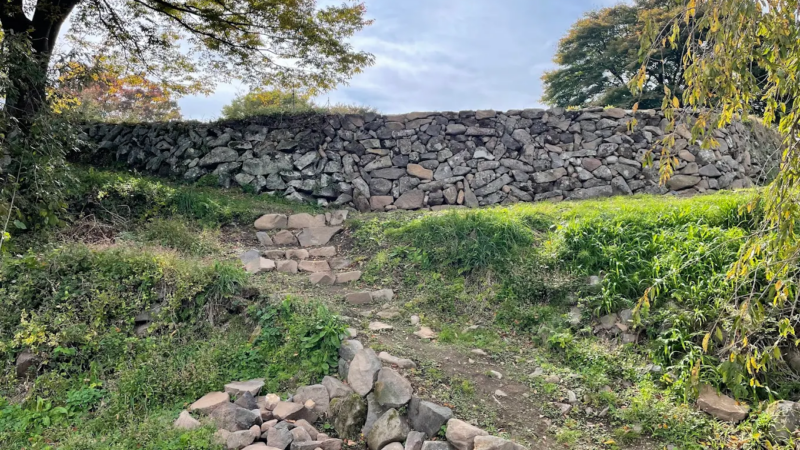
The earthworks were built along the edges of the baileys and functioned as defensive walls. They protected against enemy arrows and firearms, and also made it difficult to see inside the baileys. Even today, some remnants of the earthworks can be seen, offering a glimpse into the castle’s structure in its heyday.
Relationship between Nagaoka Shrine and the Castle Ruins
Currently, Nagaoka Shrine stands in the center of the Kabeta Castle ruins. Traces of the castle remain within the shrine grounds and surrounding area, serving as landmarks when visiting the castle remains.
The construction of shrines on castle sites is a phenomenon frequently seen in the history of Japanese castles. One aspect of the castle’s preservation is that, after its abandonment, the land was transformed into a place of local worship. Nagaoka Shrine, too, can be considered an important presence that conveys the history of Kabeta Castle to the present day.
Highlights of Kabeta Castle
View from the River Terrace
The greatest highlight of Kabeta Castle is the view from the river terrace. The scenery of the Zenkoji Plain viewed from an altitude of approximately 480 meters is breathtaking, and it is likely that the castle lords of the Sengoku period strategized while gazing at this view.
On a clear day, you can even see the mountains of the Northern Alps in the distance. The landscape, woven from the flow of the Chikuma River, the expanse of the plains, and the surrounding mountains, clearly represents the geographical characteristics of Shinano Province. This view makes it clear why Kabeta Castle was such an important military base.
Remaining Earthworks and Enclosures
Although many remains of Kabeta Castle have been lost over the long years, careful observation can reveal traces of earthworks and enclosures. In particular, around Nagaoka Shrine, traces of artificial flat surfaces and earthen mounds remain, offering a glimpse into the castle’s structure.
For castle enthusiasts, discerning these subtle topographical changes is the essence of exploring castle ruins. Within the vegetated slopes and terraces, you can find traces of Sengoku period castle construction techniques.
The Relationship Between the Chikuma River and the Castle Ruins
When visiting Kabeta Castle, pay attention to its relationship with the Chikuma River. The way the Chikuma River flows, making a large detour around the castle hill, demonstrates the ingenuity of the medieval castle’s location selection, skillfully utilizing the natural terrain.
Experiencing both the view looking up at the castle ruins from the riverbank and the view looking down at the river from the castle ruins will allow you to gain a deeper understanding of Kabeta Castle’s strategic value. You will surely appreciate the importance of the Chikuma River in both water transport and defense.
Access to Kabeta Castle
Location
Address: Kabeta, Nakano City, Nagano Prefecture 383-0061 (near Nagaoka Shrine)
The easiest way to visit Kabeta Castle ruins is to aim for Nagaoka Shrine. The area around the shrine is the central part of the castle ruins.
Access by Public Transportation
The nearest station is Shinshu-Nakano Station on the Nagano Electric Railway Nagano Line. Kabeta Castle ruins are approximately 5 kilometers from the station, taking over an hour on foot. Using a bus or taxi is more practical.
While Nakano City community buses sometimes operate, the number of services is limited, so it is recommended to check the service status in advance. If using a taxi, it takes approximately 15 minutes from Shinshu-Nakano Station.
Access by Car
If using the Joshinetsu Expressway:
- Approximately 10 minutes from Shinshu Nakano IC
- Approximately 20 minutes from Toyoda Iiyama IC
You can access the Kabeta area via National Route 292 or prefectural roads. Setting your navigation system to Nagaoka Shrine is recommended.
Parking
Nagaoka Shrine has a small parking area for visitors. However, spaces are limited, so please be careful if visiting with multiple vehicles. Some surrounding roads are narrow, so please drive with caution.
Points to Note When Visiting
Kabeta Castle Ruins are not a developed tourist area, and many of the remains are located on private land or within the shrine grounds. Please note the following points when visiting:
- Observe proper etiquette for visiting shrines.
- Do not trespass on private property.
- Always take your trash with you.
- When entering areas with vegetation, watch your step and wear appropriate clothing and shoes.
- Remember to take precautions against insects, especially in summer.
- Be aware of snow and ice in winter.
Related Historical Sites in the Surrounding Area
Nakano-Kodate (Takanashi-kan)
If you visit Kabeta Castle, you should definitely also visit Nakano-Kodate (Takanashi-kan), the base of the Takanashi clan. It has been developed as Takanashi-kan Ruins Park in Kodate, Nakano City, and is more easily accessible than Kabeta Castle, with well-preserved remains.
Visiting both the main castle and its branch castles will provide a deeper understanding of the history of the Takanashi clan and the Sengoku period history of northern Shinano.
Kaesa Castle
Kaesa Castle is also a castle site related to the Takanashi clan and is located within Nakano City. Similar to Kabeta Castle, this castle was part of the Takanashi clan’s network of branch castles and is an important historical site for understanding the overall layout of castles in northern Shinano.
Nakano Jinya
The Nakano Jinya (fortified residence) site, established during the Edo period, is also an interesting historical site for understanding the history of Nakano City. Tracing the transition from the Sengoku period to the Edo period allows for a three-dimensional understanding of the history of this region.
Historical Significance of Kabeta Castle
A Border Castle in Northern Shinano
The greatest historical significance of Kabeta Castle lies in its role as a “border castle” located on a transportation route connecting the Zenkoji Plain and the Iiyama area. In the conflicts between the Takeda and Uesugi clans, exemplified by the Battle of Kawanakajima, northern Shinano became the front line between the two forces.
Kabeta Castle maintained its military and political importance in this border region. The process of the ruler changing from the Uesugi to the Takeda clan clearly illustrates the fluctuations in the political situation of northern Shinano.
Research Materials on the Takanashi Clan’s Territory
The Takanashi clan was a powerful local lord in northern Shinano Province. The existence of branch castles like Kabeta Castle is invaluable for understanding the realities of their territory. It’s an important case study for researching the military and administrative structure of their branch castle network, centered around their main castle, Nakano-Kodate.
Research on Castles in the Chikuma River Basin
Numerous medieval castles were built in the Chikuma River (Shinano River) basin. Kabeta Castle, in particular, occupies an important position in the study of castle construction techniques and site selection, as it utilizes the distinctive topography of a river terrace.
Points to Consider When Visiting Kabeta Castle
Recommendation for Prior Study
Because the remains of Kabeta Castle are limited, it is recommended to study the historical background and layout beforehand. Understanding the history of the Takanashi clan, the course of the Battle of Kawanakajima, and the Sengoku period history of northern Shinano will greatly enhance your experience at the site.
The Joy of Reading the Topography
For advanced castle ruin visitors, interpreting the topography is a key aspect of the experience. Even in areas currently occupied by farmland or shrines, subtle elevation differences and the arrangement of flat areas can reveal the locations of former baileys and moats.
By checking topographic maps and aerial photographs from the Geospatial Information Authority of Japan beforehand and observing the terrain on-site, you can enjoy imagining the overall layout of the castle.
The Charm of the Four Seasons
The Kabeta Castle ruins display different appearances in each of the four seasons. Spring brings fresh greenery, summer offers deep green, autumn brings vibrant foliage, and winter presents a snowy landscape; visiting in each season allows you to enjoy different scenery.
The autumn and winter deciduous period is particularly suitable for observing the ruins, as the withered vegetation makes the topography easier to see. However, caution is necessary regarding snow and ice during winter.
Kabeta Castle and the Sengoku History of Shinano
Connection to the Battle of Kawanakajima
The Battle of Kawanakajima was a series of battles fought between Takeda Shingen and Uesugi Kenshin from 1553 to 1564 over control of northern Shinano. Kabeta Castle functioned as a supply base for the Uesugi clan in the early stages of this conflict.
In the struggle between the two powerful clans for control of the Zenkoji Plain, Kabeta Castle, located on the east bank of the Chikuma River, was a crucial supply base for the Uesugi clan. It held strategic value as a relay point when advancing from Iiyama to the Zenkoji Plain, and as a place to accumulate supplies.
Takeda Clan’s Invasion of Northern Shinano
The surrender to the Takeda clan in 1566 indicates a stage close to the completion of Takeda Shingen’s control over northern Shinano. During this period, the Takeda clan was gaining control of almost all of northern Shinano, excluding Iiyama Castle.
The surrender of Yamada Hida-no-kami and Yamada Saemon-no-jo symbolized the final collapse of the Takanashi clan’s power. The Takanashi clan fled to the Uesugi clan and continued to exist as vassals of the Uesugi clan thereafter.
Regional Governance Structure in the Sengoku Period
The history of Kabeta Castle is a good example of the structure of regional governance in the Sengoku period. It shows how the local lord, the Takanashi clan, controlled the territory through its main castle and several branch castles, and governed by deploying a group of vassals.
Furthermore, it provides interesting historical material as a concrete example of how local lords responded and what choices they were forced to make amidst the encroachment of powerful daimyo such as the Uesugi and Takeda clans.
Summary
Kabeta Castle, located in Nakano City, Nagano Prefecture, is a mountain castle that played an important role in northern Shinano during the Sengoku period. Built as a branch castle of the Takanashi clan, it functioned as a supply base for the Uesugi clan during the Battle of Kawanakajima, and ultimately surrendered to the Takeda clan.
Its location, cleverly utilizing the river terrace on the east bank of the Chikuma River, its layout of interconnected baileys running north and south, and its panoramic view of the Zenkoji Plain, all exemplify the characteristics of a medieval mountain castle. While much of the remains have been lost, traces of its former glory remain around the Nagaoka Shrine, making it a worthwhile historical site for history buffs and castle enthusiasts.
Visiting Kabeta Castle offers a multifaceted understanding of the history of northern Shinano during the Sengoku period, the Takanashi clan’s sphere of influence, and the realities of the Battle of Kawanakajima. Visiting it in conjunction with nearby sites such as Nakano-kodate and Kaesa Castle will provide a more comprehensive experience of the region’s history.
For those interested in the Sengoku period history of Shinano Province, those who enjoy exploring mountain castles, or those who want to learn about the history of Nagano Prefecture, Kabeta Castle is a must-see historical site. Why not experience the atmosphere of the Sengoku period at this castle ruin surrounded by the Chikuma River and the mountains of northern Shinano?