Tsumago Castle (Minami-Kiso Town, Kiso District, Nagano Prefecture) Complete Guide: History, Remains, and Access Explained in Detail
What is Tsumago Castle?: A Strategic Mountain Castle Protecting the Kiso Road
Tsumago Castle is a Sengoku period mountain castle located in Azuma, Minami-Kiso Town, Kiso District, Nagano Prefecture. Built on an isolated hill on the left bank of the middle reaches of the Kiso River, the castle sits at an altitude of 521 meters (some sources say 519 meters) with a relative height of approximately 150 meters, and functioned as an important military base protecting the southern part of the Kiso Road.
The most notable feature of Tsumago Castle is its successful defense against a large Tokugawa army led by Tokugawa Ieyasu in the “Battle of Tsumago Castle” in 1584. This battle was part of the Battle of Komaki-Nagakute, a confrontation between Toyotomi Hideyoshi and Tokugawa Ieyasu, and is known for the fierce defense of the castle by Yamamura Yoshikatsu (also known as Yamamoto Jinbei Yoshikatsu), a retainer of Kiso Yoshimasa.
The castle measures approximately 350 meters east-west and 250 meters north-south (some sources say 200 meters east-west and 300 meters north-south). Equipped with a main enclosure, second enclosure, dry moat, and outer enclosure (obi-kuruma), it boasts one of the largest scales and layouts among the remaining mountain castles in Kiso. Currently designated as a Nagano Prefecture Historic Site (some sources say a town-designated historic site), it is an important historical site for tourists visiting Tsumago-juku.
History of Tsumago Castle: From Construction to Abandonment
Muromachi Period: Construction by the Kiso Clan
Tsumago Castle is believed to have been built in the mid-Muromachi period. It was developed by the Kiso clan, who controlled the Kiso region, as a base in southern Kiso. The Kiso Valley was a strategic point on the Nakasendo road, connecting Shinano and Mino provinces. Tsumago Castle, controlling this important transportation hub, served as a southern defensive base protecting the Kiso clan’s sphere of influence.
The Kiso clan, as local lords of Shinano Province, sought to survive during the Sengoku period by maintaining relationships with powerful daimyo such as the Takeda and Oda clans. Tsumago Castle functioned as a crucial fortress for maintaining the Kiso clan’s control within this political and military environment.
Sengoku Period: The Era of Kiso Yoshimasa
During the Sengoku period, Kiso Yoshimasa ruled Tsumago Castle as its lord. Initially, Kiso Yoshimasa was subordinate to the Takeda clan of Kai Province, but after the Takeda clan’s downfall in 1582, he pledged allegiance to Oda Nobunaga. However, after Oda Nobunaga’s death in the Honnoji Incident, Kiso Yoshimasa approached Toyotomi Hideyoshi and began acting as a general on the Toyotomi side.
This political choice would lead to a major battle for Tsumago Castle.
1584 (Tensho 12): The Battle of Tsumago Castle
The most important event in the history of Tsumago Castle is the “Battle of Tsumago Castle,” which took place in 1584 (Tensho 12). This battle occurred as part of the Battle of Komaki-Nagakute, a conflict between Toyotomi Hideyoshi and Tokugawa Ieyasu.
Kiso Yoshimasa, who sided with the Toyotomi, fortified Tsumago Castle and appointed his retainer, Yamamura Yoshikatsu (Yamamoto Jinbei Yoshikatsu), as its commander. Meanwhile, the Tokugawa side dispatched forces led by Suganuma Sadatoshi, Hoshina Masanao, and Suwa Yoritada to attack Tsumago Castle. The Tokugawa forces are said to have numbered several thousand to over ten thousand.
Yamamura Yoshikatsu defended the castle with a small force and repelled the Tokugawa attack. Tsumago Castle, a strong mountain castle utilizing the rugged terrain, earned its place in history as an “impregnable” fortress that even the large Tokugawa army could not capture. The success of this defense greatly contributed to the maintenance of Kiso Yoshimasa’s power.
After the Battle of Sekigahara: The Yamamura Clan Era
In the Battle of Sekigahara in 1600, the Kiso clan, who succeeded Kiso Yoshimasa, is said to have sided with the Western Army, but they continued to control the Kiso Valley after the war. Subsequently, the Yamamura clan, who distinguished themselves in the defense of Tsumago Castle, were entrusted with the control of the Kiso Valley.
Even when Tokugawa Hidetada traveled along the Nakasendo road to Sekigahara, Tsumago functioned as an important post town, and the Yamamura clan was responsible for governing this region. With the arrival of the Edo period, a peaceful era prevailed, and Tsumago Castle’s military role as a mountain castle came to an end, leading to its abandonment.
Structure and Remains of Tsumago Castle: Highlights of the Mountain Castle
Layout and Overall Structure
Tsumago Castle is a typical mountain castle built on an isolated hill overlooking the Kiso River. The castle’s layout cleverly utilizes the terrain, with multiple enclosures arranged around the main enclosure, and defenses reinforced by dry moats, earthworks, and trenches.
The castle grounds extend approximately 350 meters east-west and 250 meters north-south, with the main enclosure situated on the mountaintop at an elevation of 521 meters. The steep terrain, with a relative height of approximately 150 meters, made it a natural stronghold, making it extremely difficult for attacking forces to even climb.
Main Enclosure (Honmaru)
The main enclosure, the heart of Tsumago Castle, is located at the highest point of the mountaintop. It is believed to have been the residence of the castle lord and commanders, and served as the castle’s final defensive stronghold. From the main enclosure, one could overlook the Kiso River and the Nakasendo road, and it also served a military surveillance function.
The flat area of the main enclosure still remains today, allowing us to imagine the central part of the castle in its heyday.
Second Enclosure and Group of Enclosures
Several enclosures, including the second enclosure, are arranged around the main enclosure. These enclosures are arranged in a stepped pattern, each functioning as an independent defensive stronghold. Each enclosure is connected by belt-shaped enclosures (belt enclosures), designed to efficiently facilitate troop movement and supply transport.
Belt enclosures are enclosures built in a belt-like shape along the mountain slope, used not only for defense but also as footholds during attacks. Multiple belt enclosures have been identified at Tsumago Castle, indicating their crucial role in enhancing the castle’s defensive capabilities.
Dry Moats and Earthworks
Particularly important defensive features of Tsumago Castle are the dry moats and earthworks. Dry moats are trenches dug between enclosures and around the castle’s perimeter to prevent enemy intrusion. They employ a “dry moat” system, meaning they are not filled with water. Dry moats were common in mountain castles due to the difficulty of securing water.
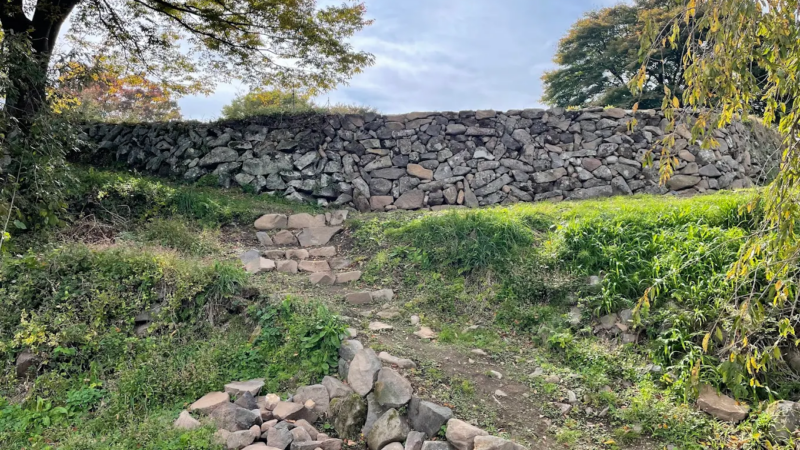
Earthen ramparts are walls of earth created by piling up soil excavated during the digging of moats. They served to defend against enemy attacks and also obstructed visibility from within the castle. At Tsumago Castle, earthen ramparts were built around the main enclosure and the second enclosure, and parts of them remain clearly visible today.
Moats
Tsumago Castle also features moats, a defensive structure unique to mountain castles. Moats are dug to cut across ridges, preventing enemies from attacking along the ridges. Multiple moats have been identified at Tsumago Castle, demonstrating a strategy to limit entry routes and facilitate defense.
Existing Remains
Currently, the following remains can be observed at the Tsumago Castle ruins:
- Flat surface of the main enclosure: The topography of the central part of the castle remains clearly.
- Remains of the second enclosure: The remains of an important enclosure second only to the main enclosure.
- Dry moat: A defensive structure separating the enclosures.
- Earthwork: Partially preserved in good condition.
- Belt enclosure: A belt-shaped enclosure encircling the mountainside.
- Moat: A defensive structure cutting across the ridge.
These remains have weathered over many years, but they provide valuable clues to understanding the structure of the mountain castle.
Highlights of Tsumago Castle: Points to consider when exploring the castle ruins
Views from the Castle Ruins
One of the greatest highlights of Tsumago Castle is the spectacular view of the Kiso River and Kiso Valley from the castle ruins. From the mountaintop at an altitude of 521 meters, you can enjoy a panoramic view of the Kiso River, the townscape of Tsumago-juku, and the surrounding mountains. During the Sengoku period (Warring States period), this viewpoint was used for military surveillance, but today it offers visitors a magnificent view.
Especially during the autumn foliage season and the fresh green season, you can enjoy the beautiful nature of the Kiso Valley, making it a spot where you can enjoy hiking and historical exploration simultaneously.
Defensive System of a Mountain Castle
When visiting Tsumago Castle, pay attention to the defensive system unique to mountain castles. You can gain a concrete understanding of the defensive philosophy of medieval mountain castles through its location utilizing steep terrain, multi-layered defenses with multiple baileys, physical barriers such as dry moats and earthworks, and the restriction of intrusion routes with trenches.
In particular, by considering the reasons why the large Tokugawa army was repelled in the “Battle of Tsumago Castle” while looking at the actual terrain and remains, you can gain a deeper understanding of the realities of siege warfare during the Sengoku period.
Connection to Tsumago-juku
Tsumago Castle has a close relationship with Tsumago-juku. The castle overlooks the post town and played a role in monitoring and protecting people and goods traveling along the Nakasendo road. When visiting Tsumago-juku, be sure to extend your trip to the castle ruins to experience the relationship between the post town and the castle.
Tsumago-juku is an important preservation district for traditional buildings, preserving the townscape of the Edo period. Visiting both the castle ruins and the town together will allow you to gain a comprehensive understanding of the history of the Kiso Valley from the medieval to the early modern period.
Access to Tsumago Castle: Visitor Guide
Access by Public Transportation
By Train and Bus:
- Get off at Minami-Kiso Station on the JR Chuo Main Line
- Take the Ontake Kotsu Bus (Tsumago Line) from the station (approx. 8 minutes)
- Get off at the Tsumago bus stop
- Walk approximately 10 minutes from the bus stop to the Tsumago Castle Ruins trailhead
- Walk approximately 30-40 minutes from the trailhead to the castle ruins
Since the number of buses from Minami-Kiso Station to Tsumago-juku is limited, it is recommended to check the timetable in advance. Additionally, the walking route from Tsumago-juku to Magome-juku (approximately 8 km, 2-3 hours) is also popular and can be planned in conjunction with a visit to the castle ruins.
Access by Car
If traveling by car:
- Approximately 30 minutes from Nakatsugawa IC on the Chuo Expressway via National Route 19
- Multiple parking lots available in Tsumago-juku (paid and free)
- Approximately 10 minutes on foot from the parking lot to the castle ruins trailhead
For car navigation, please search for “Tsumago-juku” or “Azuma, Minami-Kiso-machi, Kiso-gun, Nagano Prefecture.” Please be careful when driving, as some roads around Tsumago-juku are narrow.
Precautions When Visiting the Castle
Tsumago Castle Ruins is a mountain castle, and the following preparations and precautions are necessary when visiting:
- Clothing: Comfortable clothing and trekking shoes or athletic shoes are recommended.
- Estimated Time: 30-40 minutes one way from the trailhead to the castle ruins; allow 2-3 hours round trip including sightseeing time.
- Physical Fitness: A certain level of physical fitness is required as the elevation gain is 150 meters.
- Items to Bring: Drinking water, towel, insect repellent (summer), rain gear.
- Season: Due to the possibility of snow and ice in winter, it is best to avoid visiting unless you are an experienced hiker.
- Wildlife Prevention: Bears may be present in the area, so carrying a bear bell is recommended.
While the hiking trail is well-maintained, there are steep slopes and uneven terrain typical of mountain castles. Please plan your trip carefully and prioritize safety.
Visiting Hours and Fees
Tsumago Castle Ruins are maintained as a historical park and are generally open to visitors:
- Visiting Hours: Daytime (bright hours)
- Admission Fee: Free
- Closed Days: None (however, restrictions may apply depending on weather and season)
Information about the castle ruins can be obtained at the Tsumago-juku Tourist Information Center. Guided tours are also sometimes offered, so it is recommended to inquire with the Nagiso Town Tourism Association in advance.
Enjoying Tsumago-juku and Surrounding Areas: Local Sightseeing Information
Highlights of Tsumago-juku
When visiting Tsumago Castle Ruins, be sure to also enjoy a stroll through Tsumago-juku:
- Wakihonjin Okutani: Preserved buildings of the Edo period’s main and secondary inns
- Historical Museum: A facility where you can learn about the history of Tsumago-juku and the Kiso Road
- Terashita Townscape: A beautiful street that retains the atmosphere of the Edo period
- Kotoku-ji Temple: An ancient temple in Tsumago-juku
Tsumago-juku is committed to preserving its townscape through the three principles of “Don’t sell, don’t rent, don’t destroy,” with residents taking the lead in the process. It was designated as Japan’s first Important Preservation District for Groups of Traditional Buildings.
The Road to Magome-juku
The journey from Tsumago-juku to Magome-juku (Nakatsugawa City, Gifu Prefecture) is approximately 8 kilometers and takes 2-3 hours walking along the old Nakasendo road. You can walk along a mountain pass with Edo-period cobblestones, making it a popular course for history buffs and hiking enthusiasts. ### Surrounding Castle Ruins
Besides Tsumago Castle, several other castle ruins remain in the Kiso Valley:
- Fukushima Castle Ruins: A mountain castle overlooking the town of Kiso-Fukushima, the base of the Kiso clan.
- Kiso-Fukushima Checkpoint Ruins: An important checkpoint facility from the Edo period.
- Agematsu Castle Ruins: A mountain castle built at a strategic point in the central Kiso Valley.
Visiting these castle ruins will allow you to gain a deeper understanding of the Kiso clan’s sphere of influence and the Sengoku period history of the Kiso Valley.
Cultural Property Designation and Preservation Activities of Tsumago Castle
The Tsumago Castle ruins are protected as a Nagano Prefecture designated historical site (some sources say a Nagiso Town designated historical site). The local Nagiso Town and the Tsumago Lovers’ Association, a public interest incorporated foundation, are working to preserve and utilize the castle ruins.
In recent years, surveys of the remains and the creation of layout maps have been carried out, and its academic value is being re-evaluated. Furthermore, efforts are underway to create a safe environment for visitors, including the maintenance of hiking trails and the installation of information boards.
In conjunction with the preservation of the townscape of Tsumago-juku, the preservation activities of the Tsumago Castle ruins are attracting national attention as an important initiative to pass on the region’s history and culture to future generations.
Learning about Tsumago Castle: Related Books and Materials
For those who wish to learn more about Tsumago Castle and the history of Kiso, the following materials are available:
- “Medieval Castle Sites in Nagano Prefecture”: A comprehensive survey report of castles in the prefecture by the Nagano Prefectural Board of Education
- “Mountain Castles and Residences of Shinano” Series: A book that provides detailed explanations of mountain castles in Nagano Prefecture
- “Kiso Yoshimasa and the Sengoku History of the Kiso Valley”: A research book dealing with the history of the Kiso clan
- Local History Materials of Minami-Kiso Town: Historical materials and tourist pamphlets published by the town
In addition, castle information websites such as Kojodan and Nippon Jiro Meguri allow you to see reviews and photos from people who have actually visited, which is useful for gathering information before your visit. ## Summary: The Charm and Significance of Visiting Tsumago Castle
Tsumago Castle is an important historical site that tells the story of the turbulent history of the Sengoku period. The historical fact that Yamamura Yoshikatsu repelled the large army led by Tokugawa Ieyasu in the Battle of Tsumago Castle in 1584 demonstrates that even a small mountain castle can become impregnable if its terrain and defensive structures are utilized effectively.
Its location in Minami-Kiso Town, Kiso District, Nagano Prefecture, surrounded by beautiful nature, the spectacular view overlooking the Kiso River, and the combination with Tsumago-juku, a post town that retains the atmosphere of the Edo period, make Tsumago Castle a fascinating tourist spot that is more than just a castle ruin.
Visiting a castle ruin is not just about seeing the remains; it’s a valuable opportunity to experience the wisdom and hardships of the people of the Sengoku period, as well as the history and culture of the region. When traveling along the Kiso Road, be sure to visit Tsumago Castle ruins and enjoy the romance of history and the beauty of nature simultaneously.
Tsumago Castle was a place where historical figures such as Kiso Yoshimasa, Yamamura Yoshikatsu, and Tokugawa Ieyasu intersected, and it was also an important battlefield that played a part in the Battle of Komaki and Nagakute, a nationwide battle. Its historical value will become even clearer as research progresses.
The Tsumago Castle ruins in Minami-Kiso Town, Kiso District, Nagano Prefecture, are an indispensable historical site for understanding Japanese mountain castle culture and Sengoku period history, and we hope that many people will continue to visit it.