Iiyama Castle (Iiyama City, Nagano Prefecture) Complete Guide | A Sengoku Period Fortress Built by Uesugi Kenshin and Current Attractions
Located in the heart of Iiyama City, Nagano Prefecture, Iiyama Castle is a historical fortress where the famous Sengoku period general Uesugi Kenshin played a crucial role in his battles against Takeda Shingen. Currently, it is maintained as Iiyama Castle Ruins Park, a popular cherry blossom viewing spot in spring, and a beloved recreational area for citizens and tourists throughout the year.
History of Iiyama Castle
Origins of Construction and Early History
The exact year of Iiyama Castle’s construction is unknown, but it is believed to have existed as early as the beginning of the 14th century. The first lords were the Izumi clan. It is said that Izumi Kojiro Chikahira fled from Kamakura to Iiyama during the Kamakura period, settled there, and became the ancestor of the Izumi clan. The theory that Izumi Yashichiro built the castle is considered the most likely.
Later, Iiyama Castle became a branch castle of the Takanashi clan, whose base was the Takanashi Residence. The Takanashi clan was a powerful local family in northern Shinano, and Iiyama Castle was one of their important strongholds within their sphere of influence.
Major Renovations by Uesugi Kenshin
Iiyama Castle first appears on the historical stage around 1564, during the Sengoku period. Uesugi Kenshin of Echigo, in order to counter Takeda Shingen of Kai, who was expanding his power throughout Shinano, extensively renovated Iiyama Castle to serve as a frontline base for the defense of Echigo and the conquest of Shinano.
Uesugi Kenshin developed Iiyama Castle as a “fortified rear castle.” This refers to a castle structure with strong rear defenses, making maximum use of the terrain of the hilly area between the Chikuma River and Madarao River. By arranging the baileys in a stepped fashion, he created a structure that was extremely difficult for attackers to conquer.
The Battle of Kawanakajima and Iiyama Castle
During the Battle of Kawanakajima, Iiyama Castle functioned as a strategic base for the Uesugi army in northern Shinano. Uesugi Kenshin used this castle as his base to confront Takeda Shingen, and it is said that during the 12 years of fighting, the Takeda army was never able to capture Iiyama Castle.
This fact speaks to the excellence of Uesugi Kenshin’s castle renovations. The formidable strength of Iiyama Castle was something that even Takeda Shingen, one of the strongest warlords of the Sengoku period, could not overcome.
The Era of Uesugi Kagekatsu
Uesugi Kagekatsu, who succeeded Uesugi Kenshin, temporarily made Iiyama Castle his residence. Kagekatsu was Kenshin’s nephew and became the head of the Uesugi family after the Otate Rebellion. Iiyama Castle continued to be an important base for the Uesugi clan.
The Iiyama Domain in the Edo Period
In the Edo period, Iiyama Castle became the seat of the Iiyama Domain. The feudal lords changed over time, with various fudai daimyo (hereditary vassals) such as the Sakuma, Matsudaira, Hori, Nagai, Aoyama, and Honda clans taking turns ruling.
Although the Iiyama Domain was a small domain with a stipend of 20,000 to 40,000 koku, it played a strategically important role in governing the region located on the border between Echigo and Shinano provinces. Iiyama, which developed as a castle town, is still known today as a “town of temples,” with over 20 temples and shrines, forming a charming townscape that Shimazaki Toson called “Little Kyoto in the Snow Country.”
After the Meiji Restoration and the Present
After the Meiji Restoration, Iiyama Castle was abolished under the castle demolition order, and many of its buildings were demolished. However, remnants such as stone walls and earthworks remain, allowing us to imagine its former appearance.
Currently, the Iiyama Castle ruins are maintained as Iiyama Castle Ruins Park and designated as a historical site of Nagano Prefecture. It is a popular place of relaxation for citizens and a beloved tourist spot.
Structure and Features of Iiyama Castle
Layout and Arrangement of Enclosures
Iiyama Castle is a flatland castle built on a hill approximately 330 meters above sea level, nestled between the Chikuma River and the Madarao River. A key feature of the castle, renovated by Uesugi Kenshin, is its structure known as a “rear-fortified castle.”
The castle’s design features multiple enclosures arranged in a stepped fashion, with the main enclosure (Honmaru) at the highest point, and the second and third enclosures progressively lower in elevation. This arrangement allowed for attacks from higher ground whenever an enemy attacked, resulting in a highly defensive design.
Main Enclosure and Keep
Iiyama Castle did not have a keep (tenshu). Instead, a palace was located in the main enclosure, functioning as the center of the domain’s administration. The main enclosure was surrounded by high stone walls, boasting a strong defense.
Stone Walls and Earthworks
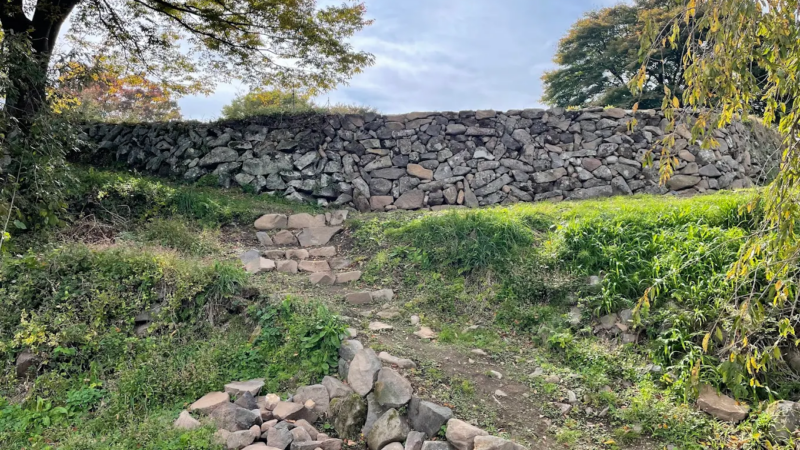
The greatest highlight of Iiyama Castle, which still remains today, is its stone walls and earthworks. The stone walls, especially around the main keep, retain much of their original appearance, allowing visitors to observe the castle-building techniques from the Sengoku period to the Edo period up close.
The stone walls are constructed using a technique called “nozurazumi,” a simple yet sturdy structure made by stacking natural stones as they are. Earthworks also remain in various places, allowing visitors to see the castle’s defensive lines.
Restored Gate
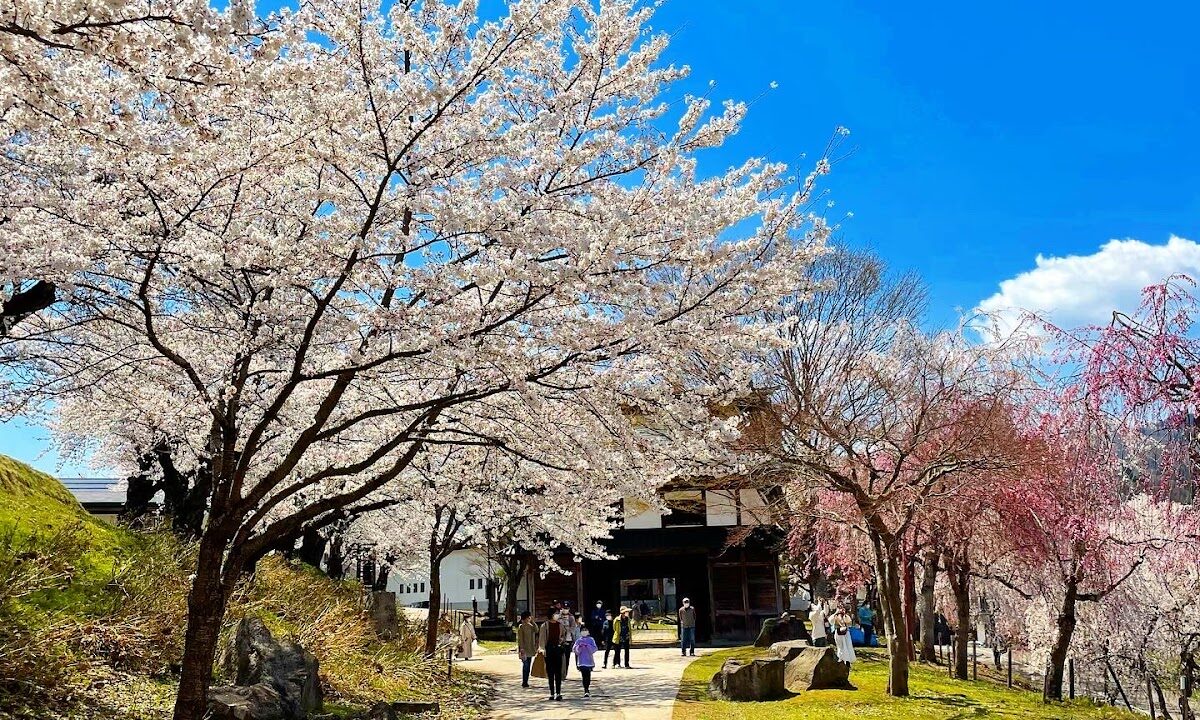
Iiyama Castle Ruins Park features a restored gate, allowing visitors to experience the atmosphere of the castle in its heyday. While not a complete historical reconstruction, it is a valuable resource for understanding the scale and structure of the castle gate.
Highlights of Iiyama Castle Ruins Park
Spring Cherry Blossoms
Iiyama Castle Ruins Park is known as one of Iiyama City’s leading cherry blossom viewing spots. Every year from mid- to late April, approximately 200 Somei Yoshino cherry trees in the park bloom simultaneously, beautifully decorating the castle ruins. The contrast between the stone walls and cherry blossoms is incredibly beautiful, attracting many photography enthusiasts and tourists. The trees are also illuminated at night, allowing visitors to enjoy a magical view of the cherry blossoms after dark.
Observation Spot
From the hilltop of Iiyama Castle Ruins Park, you can enjoy a panoramic view of Iiyama city. You can see the flow of the Chikuma River, the surrounding mountains, and on clear days, the magnificent scenery of the Five Peaks of Northern Shinano, giving you a real sense of why Uesugi Kenshin chose this location as a strategic base.
Historical Information Boards and Explanation Boards
Several information boards explaining the history and structure of Iiyama Castle are installed within the park. Old maps showing the castle layout from the Sengoku period and the appearance of the castle town from the Edo period are also on display, making it a valuable source of information for history buffs.
Stone Monuments and Memorials
Stone monuments and memorials related to Iiyama Castle are installed within the park. There are also memorials to Uesugi Kenshin and successive feudal lords, which are important elements in telling the history of Iiyama Castle.
History and Culture of Iiyama City
Development as a Castle Town
Iiyama City developed as a castle town centered around Iiyama Castle. During the Edo period, it was developed as the castle town of the Iiyama Domain, with samurai residences and merchant districts forming. Even today, remnants of the original town layout can be seen in the city center.
A Town of Temples
Iiyama city center is home to over 20 temples and shrines, earning it the nickname “Temple Town.” This stems from the strategic placement of temples as part of the castle town’s defenses. Walking along Temple Town Street, you can visit numerous historic temples, truly experiencing the atmosphere of a “Little Kyoto in the Snow Country.”
Major temples include Eiganji, Chūonji, Shōnenji, and Shinshūji, each possessing its own unique history and cultural assets.
Culture of a Snow Country
Iiyama City is known as one of Japan’s leading heavy snowfall areas. Annual snowfall is extremely high, and snow accumulation exceeding 2 meters is not uncommon during winter. The unique climate of this snowy region has fostered Iiyama’s distinctive culture and lifestyle.
Facilities where you can experience life in a snowy region, and events utilizing snow, are held throughout the year, showcasing the charm of Iiyama.
Access and Tourist Information
Access by Train
The nearest station to Iiyama Castle Ruins Park is Iiyama Station on the Hokuriku Shinkansen and JR Iiyama Line. It’s about a 20-minute walk (approximately 1.5 kilometers) from Iiyama Station to the park.
With the opening of the Hokuriku Shinkansen, it’s now possible to reach Iiyama Station from Tokyo in as little as 1 hour and 40 minutes, making day trips from the Tokyo metropolitan area quite feasible. From Nagano Station, it’s about 40 minutes by conventional train.
Access by Car
It’s about a 15-minute drive from the Toyoda-Iiyama Interchange on the Joshinetsu Expressway. Parking is available around Iiyama Castle Ruins Park for tourists. However, during peak seasons such as cherry blossom season, the parking lot can become full, so we recommend arriving early.
Nearby Tourist Attractions
When visiting Iiyama Castle Ruins Park, we recommend also visiting nearby tourist attractions.
Iiyama City Furusato Museum features detailed exhibits on the history of Iiyama Castle and the Iiyama Domain, and a visit before visiting the castle ruins park will deepen your understanding.
Teramachi Street allows you to enjoy the atmosphere of a castle town while touring historical temples. The scenery is particularly beautiful during the cherry blossom season in spring and the autumn foliage season.
Takahashi Mayumi Doll Museum is an art museum exhibiting the works of doll artist Takahashi Mayumi, a native of Iiyama, whose warm and charming dolls captivate many visitors.
Annual Events
Iiyama City hosts various events throughout the year.
In spring, the “Iiyama Castle Ruins Park Cherry Blossom Festival” is held, featuring cherry blossom illuminations and various events. Iiyama Castle Ruins Park offers a variety of seasonal events to entertain visitors, including the “Iiyama Lantern Festival” in summer, the “Iiyama Autumn Festival” in autumn, and the “Iiyama Snow Festival” in winter.
Estimated Visiting Time
For a thorough visit to Iiyama Castle Ruins Park, allow approximately one hour. This includes time for observing the stone walls and earthworks, enjoying the views, and taking photographs. Including a stroll through the surrounding temple district, a half-day visit is recommended.
Admission Fee and Opening Hours
Iiyama Castle Ruins Park is a park, so admission is free. There are no restrictions on opening hours, and you can visit anytime. However, due to limited lighting at night, daytime visits are recommended for safety reasons.
Model Itinerary for a Trip to Iiyama
Day Trip Course
Morning
- Arrive at Iiyama Station
- Learn about history at Iiyama City Furusato Museum (30 minutes)
- Stroll along Teramachi Street (1 hour)
Lunch
- Enjoy Iiyama’s specialty, botamochi set meal or sasa sushi.
Afternoon
- Visit Iiyama Castle Ruins Park (1 hour)
- Visit Takahashi Mayumi Doll Museum (1 hour)
- Purchase souvenirs
- Return from Iiyama Station
Two-Day/One-Night Course
On the first day, in addition to the above day trip course, stay overnight at Iiyama Onsen from the evening. On the second day, we recommend a plan to enjoy the nature around Madarao Plateau and Togari Onsen Ski Resort. Depending on the season, you can enjoy skiing, snowboarding, trekking, and golf during the green season.
Iiyama’s Local Products and Gourmet Food
Sasa Sushi
Sasa sushi is a representative local dish of Iiyama. This pressed sushi features vinegared rice placed on a bamboo leaf, beautifully arranged with mountain vegetables and mushrooms. Its visual appeal and the aroma of the bamboo leaves are sure to whet your appetite.
Botamochi
Iiyama is also known as the “town of botamochi,” and there are many specialty shops selling it. Each shop has its own unique method and dedication, making it fun to compare and contrast them.
Tomikura Soba
Tomikura soba, made with a local variety of buckwheat grown in the Tomikura district of Iiyama City, is known for its unique method of using oyamabokuchi (mountain burdock leaves) as a binder. It is characterized by its firm texture and rich flavor.
Local Sake
Iiyama City has sake breweries such as Mizuo Sake Brewery and Tanakaya Sake Brewery, producing delicious sake using abundant snowmelt water. Enjoying local sake while reflecting on the history of Iiyama Castle is a special experience.
Points to Note When Visiting Iiyama Castle
Clothing and Equipment
Iiyama Castle Ruins Park is located on a hillside, so you will be walking on stairs and slopes. We recommend wearing comfortable shoes and clothing suitable for walking. Particular caution is needed during rainy weather or snowmelt, as the ground can be slippery.
Visiting in Winter
Iiyama is a heavy snowfall area, so during winter (December to March), snow accumulation can make walking within the park difficult. If visiting in winter, we recommend preparing warm clothing, wearing non-slip shoes, and checking weather forecasts in advance.
Photography
Iiyama Castle Ruins Park has many spots suitable for photography. Beautiful photos can be taken especially during cherry blossom season and autumn foliage season. The morning and evening light also have their own charm, allowing you to enjoy different expressions depending on the time of day.
Surrounding Castles
If you have time when visiting Iiyama Castle, we recommend exploring the surrounding castles as well.
Takanashi Clan Residence Ruins (Nakano City) is the base of the Takanashi clan, the early lords of Iiyama Castle. It is approximately a 30-minute drive from Iiyama Castle.
Matsushiro Castle (Nagano City) is known as Kaizu Castle, the base of Takeda Shingen during the Battle of Kawanakajima, and is an important Sengoku period historical site that stands in contrast to Iiyama Castle. It is approximately a 1-hour drive from Iiyama Castle.
Kasugayama Castle Ruins (Joetsu City, Niigata Prefecture) is a mountain castle known as the base of Uesugi Kenshin. Visiting Kenshin’s castle, who built Iiyama Castle, allows for a deeper understanding of Sengoku period history. It is approximately a 1 hour 30-minute drive from Iiyama Castle.
Summary
Iiyama Castle was an important base during the Sengoku period, renovated by Uesugi Kenshin to oppose Takeda Shingen, and is now a popular tourist attraction as Iiyama Castle Ruins Park. Remains such as stone walls and earthworks still exist, and the area is also known as a famous spot for cherry blossoms in spring.
Iiyama City in Nagano Prefecture developed as a castle town centered around Iiyama Castle, and even today it is a tourist destination with a unique charm, known as a “town of temples” and a “Little Kyoto of the snow country.” With the opening of the Hokuriku Shinkansen, access from the Tokyo metropolitan area has improved, making day trips possible.
When visiting Iiyama Castle Ruins Park, a stroll through the surrounding temple district, learning about history at the Iiyama City Museum, and enjoying Iiyama’s unique cuisine will make your trip even more fulfilling. Be sure to experience the charm of Iiyama, where the historical romance of the Sengoku period and the culture of a snow country blend together.