Complete Guide to Asahi-kan Ruins (Fukushima City, Fukushima Prefecture) | History, Remains, and Access Information
The Asahi-kan Ruins, situated on a hill in the Hiraishi district of Fukushima City, are an important mountain castle site that played a significant role in the history of northern Fukushima Prefecture from the late Heian period to the Muromachi period. It was the site of many historical events, including fierce battles during Minamoto no Yoritomo’s conquest of Oshu, and as a castle ruled by prominent families such as the Nikaido and Date clans.
Currently, the site is maintained as Asahi-kan Park, with well-preserved remains such as earthworks and dry moats. This article will provide a comprehensive overview of this valuable historical site, including its detailed history, notable remains, and access information.
Overview of Asahi-kan Ruins
The Asahi-kan Ruins are a medieval mountain castle built on the summit of a hill approximately 174 meters above sea level in the Hiraishi district of Fukushima City, Fukushima Prefecture. Also known as “Hiraishi Castle,” it occupies a strategic location overlooking the Abukuma River.
The castle ruins are now a popular park known as Asahikan Park, and a water distribution plant is located on the mountaintop. The remaining structures, centered around the main enclosure, include dry moats, earthworks, and earthen bridges, making it a valuable historical site that conveys the structure of a medieval castle.
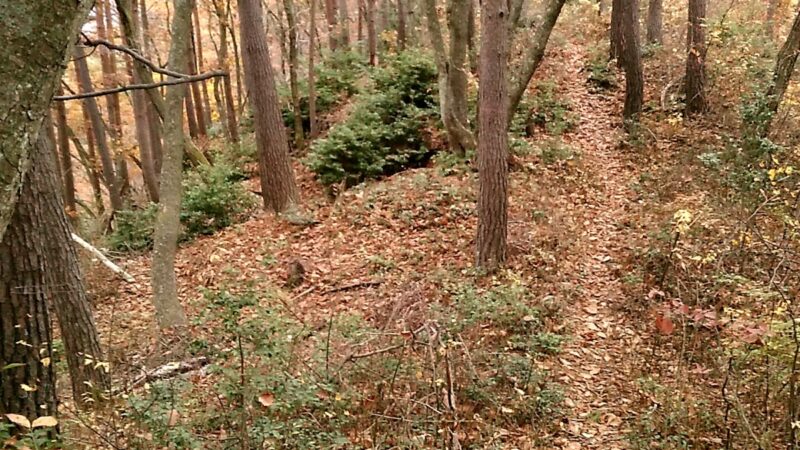
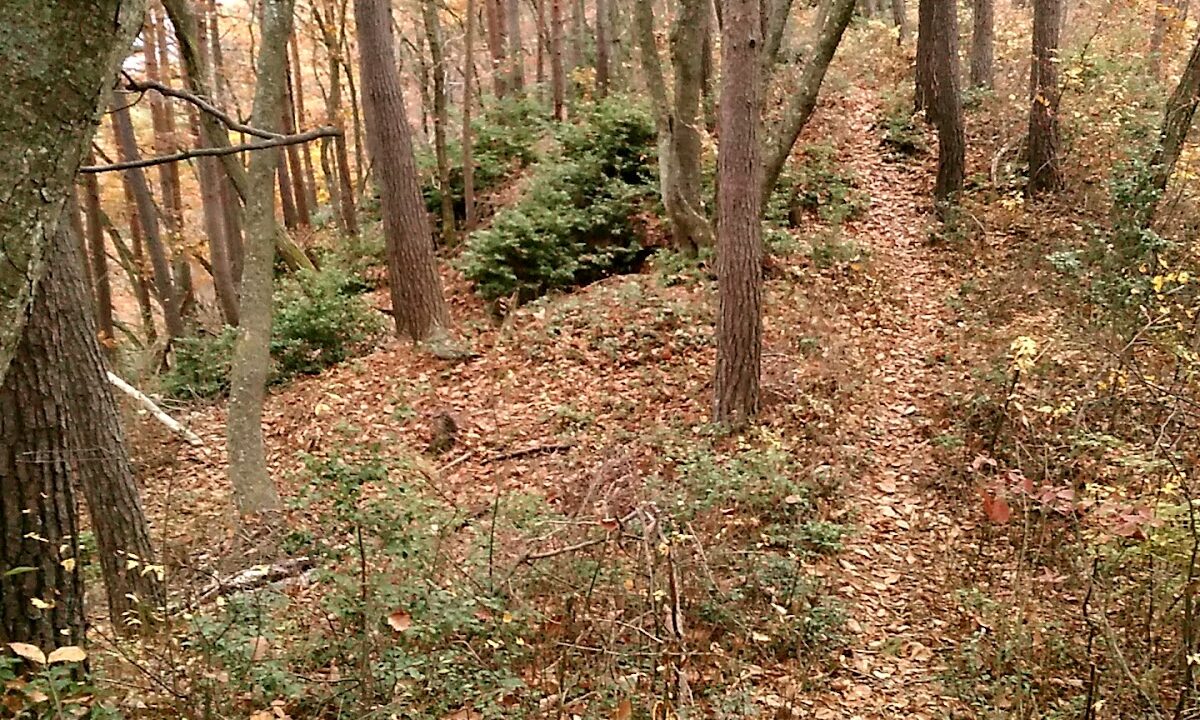
The castle’s scale is considerable, with a large main enclosure and a deep dry moat surrounding it, extending from west to south and east, demonstrating its high level of defense at the time. However, some parts are now buried by bushes and fallen trees, making it difficult to fully confirm its original appearance.
History of Asahikan
Late Heian Period: Residence of Shinobu no Shoji Kotaro
The exact construction date of Asahikan is unclear, but in the late Heian period, it functioned as the residence of Shinobu no Shoji Kotaro, a member of the family of Sato Motoharu, lord of Otori Castle.
Shinobu Shoji Kotaro was a powerful local lord who ruled this region, but his fate took a turn in 1189 (Bunji 5) during Minamoto no Yoritomo’s “Conquest of Oshu.”
The Battle of Ishinazaka and Kotaro’s End
Shinobu Shoji Kotaro attempted to resist Minamoto no Yoritomo’s army, which was advancing north to subdue the Oshu Fujiwara clan. This battle, known as the “Battle of Ishinazaka,” was a fierce battle fought near Ishinazaka in Fukushima City.
As a result, Kotaro is believed to have been killed in battle against Yoritomo’s army, and Asahi Castle fell. This battle is recorded in the history of the Tohoku region as one of the important local battles in the Conquest of Oshu.
Kamakura Period: Rule of the Nikaido Clan
Approximately 50 years after the Battle of Ishinasaka, in 1240 (Ninji 1), Nikaido Motoyuki, who held the important position of Hyojoshu (Councilor) in the Kamakura Shogunate, granted this land to his son, Yukiuji. As a result, the area around Asahi-kan became part of the Nikaido clan’s territory and was incorporated into the Kamakura Shogunate’s system of control.
The Nikaido clan was known as a family that managed political affairs within the Kamakura Shogunate and held many territories in the Tohoku region. Asahi-kan is believed to have been one of these territories, remaining under the control of the Nikaido clan throughout the Kamakura period.
Muromachi Period: Seizure by the Date Clan
In 1314 (Oei 20), Date Mochimune, the head of the Date clan, who would later become the ruler of the Tohoku region, seized Asahi-kan. During this period, the Date clan was in the process of expanding its power and consolidating its control over the Fukushima Basin.
The capture of Asahi Castle by Date Mochimune is seen as part of the Date clan’s process of strengthening their influence in the Shinobu district. However, historical records regarding the subsequent fate of Asahi Castle are scarce, and it is unclear when it ceased to function as a castle or how it was abandoned.
It is presumed to have been within the Date clan’s sphere of influence during the Sengoku period, but it is thought to have lost its role as a major base.
Remains and Highlights of Asahi Castle Site
Main Enclosure (Honmaru)
The main enclosure (honmaru), the central part of Asahi Castle, is located at the highest point of the hill and is quite large. Although it is difficult to measure the exact distance due to the current overgrown vegetation, it can be confirmed that it was a considerably large enclosure (kuruwa).
Earthly earthen ramparts were built around the main enclosure for defense, and some parts remain clearly visible today. A water distribution plant is located at the top of the hill, and a stone monument marking the site of Asahi Castle stands beside it. This monument serves as a landmark for visitors to the castle site.
Dry Moat and Earthen Bridge
The most striking feature of Asahi-kan is the deep dry moat surrounding the main enclosure. The moat, particularly the one running from west to south and east, is partially filled in by fallen trees, but its depth and scale demonstrate the high level of defense it possessed at the time.
An earthen bridge connects the second enclosure to the main enclosure, allowing us to observe the distinctive entrance structure (koguchi) characteristic of medieval castles. The bridge served as the only passage across the moat, a crucial defensive feature that restricted enemy incursions.
Second Enclosure and Enclosure Groups
It is believed that several enclosures, including the second enclosure, were arranged around the main enclosure. The second enclosure features a dry moat and earthen bridge, and a connecting path to the main enclosure was also present.
Currently, the area is overgrown with vegetation, making it difficult to grasp the overall layout, but it has been suggested that multiple defensive lines were constructed along the ridgeline.
Remains of the Approach and Stone Steps
It is said that there were old stone steps in the past, indicating the existence of an approach leading from the foot of the mountain to the main enclosure. Although currently overgrown and difficult to clearly identify, this is an important historical site that serves as a trace of the path leading to the castle.
The current route, accessed via a logging road from the south side of Yōtai-ji Temple to the castle ruins, may differ from the original approach road.
Development as Asahikan Park
The castle ruins have been developed as Asahikan Park and preserved as a local historical heritage site. However, no full-scale archaeological excavation has been conducted, and further research is needed to determine the details of the remains.
Park facilities are kept to a minimum, prioritizing the preservation of the remains. Visitors can quietly experience the atmosphere of a medieval mountain castle.
Access to Asahikan Ruins
Location
Address: Hiraishi, Fukushima City, Fukushima Prefecture
The Asahikan Ruins are located on a hill in the Hiraishi district, in the southern part of Fukushima City. It is approximately a 15-minute drive from the city center.
Access by Car
If using the Tohoku Expressway:
- Approximately 20 minutes from Fukushima-Nishi IC
- Approximately 25 minutes from Fukushima-Iizaka IC
Head towards Yotai-ji Temple as a landmark. The forest road entrance is located south of the temple. However, parking space is limited, so please be careful not to park on the road.
Access on Foot (Route to the Castle)
- Enter the work road from the forest road entrance south of Yotai-ji Temple.
- The work road is immediately to the right after the curve.
- Climb approximately 100 meters.
- Take the ridge on the left.
- Reach the main enclosure via the second enclosure with a dry moat and earthen bridge.
The climb takes approximately 15-20 minutes. Since you will be walking on a mountain path, comfortable clothing and shoes are recommended.
Access by Public Transportation
Direct access by public transportation is difficult. It is also a distance from the nearest bus stop, so visiting by car is the most practical option.
Points to Note When Visiting
- Long sleeves and long pants are recommended as there are areas with dense undergrowth.
- Insect repellent is necessary during the summer.
- Avoid reckless exploration due to fallen trees and unclear paths.
- Be aware of restricted areas around the water distribution plant.
- Be careful as the ground can be slippery after rain.
Nearby Historical Spots
Yōtai-ji Temple
This temple serves as the entrance to the Asahi-kan ruins. While its historical connection to Asahi-kan is unclear, it is worth visiting for understanding the region’s history.
Ōtori Castle Ruins
Ōtori Castle, the residence of Satō Motoharu, a member of the Shinobu Shōji Kotarō family, also remains in Fukushima City. Visiting it together with Asahi-kan will provide a deeper understanding of the medieval history of this region.
Fukushima Castle Ruins (Sugitsuma Castle Ruins)
Fukushima Castle Ruins, located in the center of Fukushima City, is another important castle associated with the Date, Gamō, and Uesugi clans. It is interesting to compare it with castles from a later period than Asahi-kan.
Historical Significance of the Asahi-kan Site
The Asahi-kan site is an important historical site that tells the story of medieval history in northern Fukushima Prefecture. Its historical value is particularly recognized in the following respects:
The Stage of the Oshu Conquest
As a castle that served as a base for the Battle of Ishinazaka during Minamoto no Yoritomo’s conquest of Oshu—a crucial event in Japanese history—it marks a turning point in the medieval history of the Tohoku region.
From Local Clans to Samurai Government
The history of its transition from the residence of Shinobu-shoji Kotaro, a local clan leader, to the control of the Nikaido clan, a powerful vassal of the Kamakura Shogunate, and then to the territory of the Date clan, who became the rulers of Tohoku, symbolizes the changing power structure in medieval Tohoku.
A Typical Example of a Medieval Mountain Castle
Basic defensive structures of a medieval mountain castle, such as earthworks and dry moats, remain well-preserved. Excavation surveys have the potential to contribute to understanding the structure of medieval castles in northern Fukushima Prefecture.
Summary
The Asahi-kan ruins are the site of a mountain castle that existed in the Hiraishi district of Fukushima City from the late Heian period to the Muromachi period. It is a historical site associated with important figures and families of history, including Shinobu Shoji Kotaro, the Nikaido clan, and the Date clan.
Currently preserved as Asahi-kan Park, visitors can see the remains of the main enclosure, dry moat, and earthworks. Although some areas are overgrown, it is a valuable place where one can quietly experience the atmosphere of a medieval mountain castle.
For those interested in the history of Fukushima City or medieval castles, the Asahi-kan ruins are a historical site worth visiting. When visiting, please be mindful of safety and reflect on the historical drama that unfolded in this place.
Fukushima Prefecture has many other castle ruins and historical sites. We recommend using the Asahi-kan ruins as a starting point for a journey exploring Fukushima’s medieval history.