
Miyazawa Castle (Osaki City, Miyagi Prefecture): A Complete Guide to its History and Highlights | The Battlefield of the Kasai-Osaki Rebellion
What is Miyazawa Castle?
Miyazawa Castle is a flatland castle located in Miyazawa, Furukawa, Osaki City, Miyagi Prefecture. Also known as Miyazawa Fortress or Uga Castle, it holds historical significance as a major stronghold for the rebels during the Kasai-Osaki Rebellion of 1590.
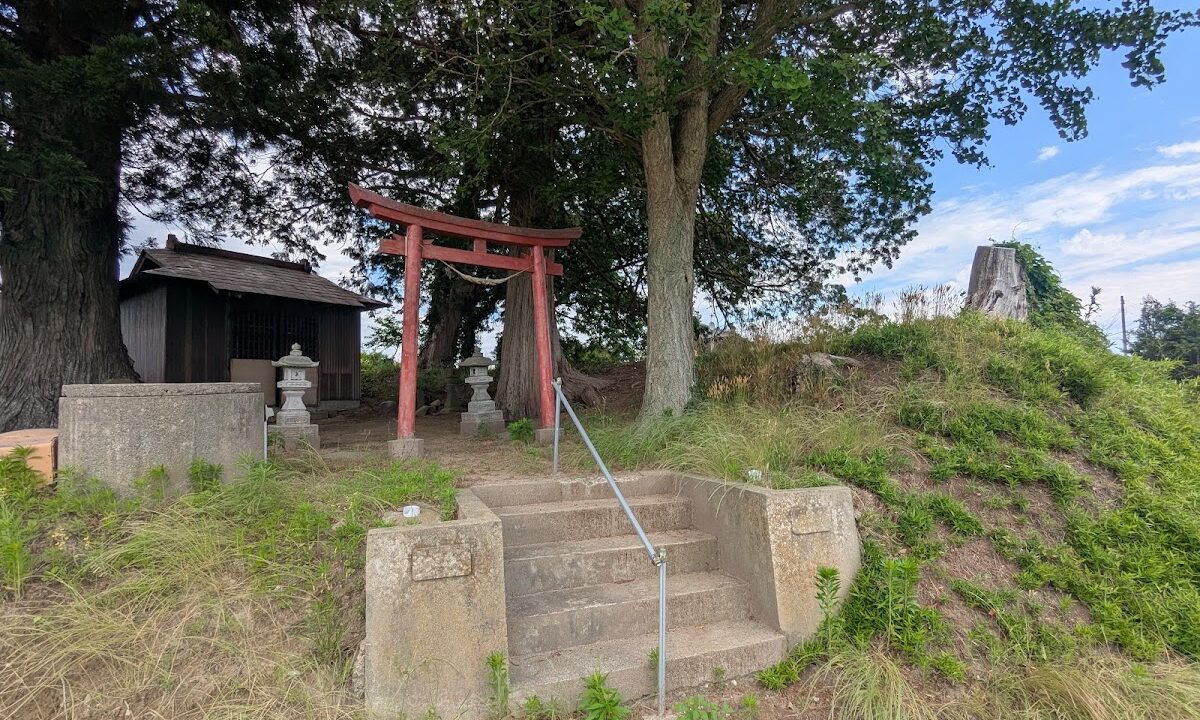
The castle site is located within the grounds of the current Kashima Shrine (some sources refer to it as Hachiman Shrine) and its surroundings, with remnants such as earthworks and moats still partially remaining. Although relatively small in scale, it is a valuable historical site that conveys the characteristics of a Sengoku period flatland castle, such as defensive facilities utilizing the surrounding rivers and its location overlooking the Osaki Plain.
Location and Basic Information
- Location: Nishinosawa and Tateuchi, Miyazawa, Furukawa, Osaki City, Miyagi Prefecture
- Castle Structure: Flatland Castle
- Builder: Unknown (Tradition suggests a connection to Fujiwara no Hidesato)
- Year of Construction: Unknown (Possibly from the Heian period to the Middle Ages)
- Main Lords: Iwasaki Sanuki Yoshihisa (Miku), a retainer of the Osaki clan; during the Edo period, the Naganuma clan
- Year of Abandonment: Estimated to be the early Edo period
- Remains: Enclosures, earthworks, moat remains, place names (Tateuchi, Nishikan, etc.)
- Elevation Relative: Almost flat (Slight difference in elevation from the surrounding area)
History of Miyazawa Castle
From Construction to the Middle Ages
The exact construction date and builder of Miyazawa Castle are unclear, but tradition suggests that Fujiwara no Hidesato used it as his base during the Heian period. This region has been a strategically important transportation hub since ancient times. The presence of the Miyazawa Ruins, the remains of an ancient government office or fortification, nearby suggests it was a military and administrative center from a young age.
During the medieval period, it was incorporated into the sphere of influence of the Osaki clan, with the Iwasaki clan, their vassals, serving as its castle lords. During the Sengoku period, it is believed to have played a crucial role as a branch castle of the Osaki clan, amidst the complex political situation of Oshu.
Kasai-Osaki Rebellion of 1590
Miyazawa Castle first appears on the historical stage during the Kasai-Osaki Rebellion of 1590.
After Toyotomi Hideyoshi’s conquest of Odawara, the Osaki and Kasai clans were dispossessed of their lands as part of the Oshu Settlement, and this region was distributed among figures such as Date Masamune and the Kimura Yoshikiyo and Kiyohisa father and son. However, discontent with the new lords’ oppressive rule led to a large-scale rebellion centered around the former retainers of the Osaki and Kasai clans. Miyazawa Castle became a major stronghold for the rebels, with former Osaki retainers Iwasaki Sanuki Yoshihisa (Yoshihisa) and his son, Goto Yasuyuki, and the Kamigoriyama clan taking refuge there. The rebels dammed surrounding rivers to flood the castle, expanding the moats and strengthening its defenses, thus repelling attacks from the punitive force led by Date Masamune.
This defensive strategy against the water siege made maximum use of the topographical characteristics of Miyazawa Castle, a flatland castle. However, ultimately, the rebellion was suppressed by the overwhelming military power of the Date army, and Miyazawa Castle fell.
Miyazawa Fortress in the Edo Period
After the suppression of the rebellion, Miyazawa Castle was reorganized as the Miyazawa Fortress within the Date domain. During the Edo period, the Naganuma clan took control, and it functioned as a key fortress playing a part in the northern defense of the Sendai domain.
However, due to the Edo Shogunate’s “One Castle Per Province” decree, its function as a full-fledged castle was reduced, and it is believed to have eventually been abandoned. Afterward, the castle site was used as a settlement, farmland, and shrine grounds, and remains so to this day.
Structure and Layout of Miyazawa Castle
Overall Structure
Miyazawa Castle is presumed to have been a typical flatland castle with a simple layout surrounded by a moat. The current grounds of Kashima Shrine and its surroundings correspond to the main keep, and it is thought that the second keep and the residences of the retainers were located around it.
The castle area is estimated to be approximately 200 meters east-west and 150 meters north-south, so it was not a particularly large castle. However, the defensive system utilizing the surrounding rivers and wetlands is considered to have provided sufficient defense for a flatland castle.
Main Keep (Around Kashima Shrine)
The main keep corresponds to the current location of Kashima Shrine. Parts of the original earthworks remain within the shrine grounds, and earthworks approximately 2-3 meters high can be seen. This earthen embankment remains in particularly good condition next to the shrine and is the most important point of interest among the remains of Miyazawa Castle.
A moat surrounded the main keep, but it has now been filled in and is used for rice paddies and residential areas. However, it is possible to estimate the location of the former moat from the subtle undulations of the terrain and the arrangement of waterways.
Enclosures and Place Names
It is believed that there were multiple enclosures within the castle, and place names such as “Tatenouchi” and “Nishikan” still remain today. These place names indicate the remnants of the medieval castle and provide clues to the layout of the former enclosures and residential areas.
“Tatenouchi” is thought to be the location of a major enclosure adjacent to the main keep, and “Nishikan” is thought to be a enclosure responsible for the defense of the west side or likely the residential area of a retainer.
Moats and Defensive System
The most distinctive feature of Miyazawa Castle is its moat system, which utilizes the surrounding rivers. During the Kasai-Osaki Rebellion, the surrounding rivers were dammed to divert water around the castle, expanding the moat and preventing attacks from the Date army.
Although most of the moat has now been filled in, the size and layout of the former moat can be inferred from the surrounding topography and the arrangement of waterways. The fact that a strong defensive system utilizing water could be constructed despite it being a flatland castle demonstrates the unique topographical characteristics of the region.
Highlights of Miyazawa Castle
Earthworks of Kashima Shrine
The biggest highlight when visiting Miyazawa Castle is the earthworks remaining within the grounds of Kashima Shrine. A well-preserved earthwork, approximately 2-3 meters high, stands beside the shrine, allowing for a close-up observation of a defensive structure from a flatland castle during the Sengoku period.
This earthwork has a relatively solid structure and retains a sufficient scale to imagine its former appearance. While it is not possible to climb onto the earthworks, viewing them from below allows one to appreciate their function as a defensive structure of the castle.
Information Boards and the Atmosphere of the Castle Site
Information boards are installed at the castle ruins, allowing visitors to learn about the history and structure of Miyazawa Castle. The information boards are concise yet cover the essential points, making them easy to understand even for first-time visitors.
The surrounding area is a quiet settlement, allowing visitors to quietly experience the atmosphere of the castle in its heyday. While much of the area is now farmland and residential land, walking around and looking for place names such as “Tatenouchi” and “Nishikan” allows you to appreciate the former extent of the castle grounds.
Surrounding Topography and Waterways
Walking around the castle ruins, you’ll notice subtle undulations in the terrain and the arrangement of waterways. These are likely remnants of the moats and defensive structures from the past, making them interesting elements from the perspective of castle research.
In particular, observing the arrangement of surrounding rivers and irrigation canals allows you to speculate on how the Kasai-Osaki Rebellion brought water around the castle.
Relationship with the Miyazawa Ruins
Near Miyazawa Castle lies the Miyazawa Ruins, a nationally designated historic site. The Miyazawa Ruins are believed to be the remains of a government office or fortification used during the Nara or Heian period, and were designated a national historic site on July 13, 1976.
The Miyazawa Ruins are a vast archaeological site spanning the Furukawa Miyazawa, Furukawa Nagaoka, and Furukawa Kawakuma districts, and are thought to have been one of the imperial court’s administrative centers in the ancient Tohoku region. While Miyazawa Castle and the Miyazawa Ruins are from different periods, they demonstrate that the same area was continuously considered an important military and administrative center from ancient to medieval times.
When visiting Miyazawa Castle, if time permits, visiting the Miyazawa Ruins as well will provide a comprehensive understanding of the region’s long history.
Access and Visiting Guide
Access by Car
If using the Tohoku Expressway:
- Approximately 10 minutes from Furukawa IC
- Via National Route 47 to Miyazawa area
Parking:
There is no dedicated parking lot at Kashima Shrine, but a few cars can be parked in the area for shrine visitors. However, please use the parking lot while observing proper etiquette so as not to inconvenience local residents. Some roads within the village are narrow, so please drive with caution.
Access by Public Transportation
JR Rikuu East Line:
- Approximately 15 minutes by car from Furukawa Station
- Taking a taxi from Furukawa Station is convenient
- Bus services are limited, so please check in advance.
Points to Note During Your Visit
- Visiting Time: The average visiting time is about 20-30 minutes. Observing the earthworks and strolling around the surrounding area is sufficient.
- Clothing: Since the castle ruins are located within the shrine grounds and village, no special equipment is required. However, if you plan to explore the surrounding area in detail, comfortable walking shoes are recommended.
- Photography: Photography is permitted within the shrine grounds, but please be considerate and avoid disrupting worshippers.
- Respect for Private Property: Much of the castle area is now private property or farmland. Please refrain from entering restricted areas and be mindful of the local residents’ lives during your visit.
- Information Boards: Information boards are installed at the castle ruins, but detailed explanations are limited. Learning about the history beforehand will allow for a deeper understanding.
Related Historical Sites in the Surrounding Area
Iwadeyama Castle
Located approximately 15km northwest of Miyazawa Castle, Iwadeyama Castle is an important castle that served as the residence of Date Masamune before the construction of Sendai Castle. During the Kasai-Osaki Rebellion, Masamune used Iwadeyama Castle as a base to suppress the rebellion. Understanding the connection between Iwadeyama Castle and Miyazawa Castle is crucial to understanding the history of Miyazawa Castle.
Iwadeyama Castle is a mountain castle, and its remains, such as stone walls and baileys, are still well-preserved. Visiting it together with Miyazawa Castle will allow you to gain a deeper understanding of the differences between flatland and mountain castles, and the realities of Date Masamune’s rule over Oshu.
Furukawa Castle (Tsuruga Castle)
Located approximately 5 km southeast of Miyazawa Castle, Furukawa Castle is a castle known as the base of the Osaki clan. Miyazawa Castle functioned as a branch castle of the Osaki clan, and therefore had a close relationship with Furukawa Castle.
While the current site of Furukawa Castle is undergoing urbanization, some remains, such as earthworks, still exist.
Other Surrounding Castles
- Ono Castle: A medieval castle located north of Miyazawa Castle
- Yuyama Castle: A castle in the Naruko area, known for its hot springs
- Ichikuri Castle: An important branch castle in the Osaki region
Visiting these castles will allow you to gain a comprehensive understanding of the medieval castle network in the Osaki region.
Evaluation and Appeal of Miyazawa Castle
Evaluation as a Castle
Although Miyazawa Castle is not large in scale, it is highly valued as a castle of great historical significance due to its role as the stage for the important historical event of the Kasai-Osaki Rebellion. In particular, the fact that it was a flatland castle yet incorporated a water-based defensive system is an interesting example for understanding castle construction techniques of the Sengoku period.
While only partial remains exist, the earthworks are preserved in relatively good condition, allowing visitors to imagine its former glory. Among castle enthusiasts, it is quietly appreciated as a “hidden gem.”
Visitor Feedback
The following are comments from castle enthusiasts who have actually visited Miyazawa Castle:
- “The preservation of the earthworks was better than expected, and I was very satisfied.”
- “The explanations on the information boards were easy to understand, and I was able to learn about history while visiting.”
- “I was able to slowly appreciate the castle ruins in a quiet environment.”
- “It was fun to imagine the castle grounds in its heyday based on the surrounding place names and topography.”
On the other hand, some have commented that “the limited number of remains might be unsatisfying for castle beginners.” However, there is no doubt that it is a castle ruin that can be thoroughly enjoyed if you visit with an understanding of the historical background.
Historical Significance of Miyazawa Castle
The greatest historical significance of Miyazawa Castle lies in its function as a base for the rebel forces during the Kasai-Osaki Rebellion. This rebellion was a large-scale resistance movement during the chaotic period after Toyotomi Hideyoshi’s pacification of Oshu, and was a major event that shook Date Masamune’s rule over Oshu.
As a result of the uprising, Masamune faced the risk of having his territory temporarily confiscated. Ultimately, he regained his lands through Hideyoshi’s ruling, but this incident significantly impacted Masamune’s political position. Miyazawa Castle was a crucial historical stage during this transitional period from the late Sengoku period to the early modern period in the Tohoku region.
Furthermore, the history from the ancient Miyazawa ruins to the medieval Miyazawa Castle demonstrates that this region remained a military and political center for a long period. Despite being a small, provincial castle, Miyazawa Castle played a significant role in the larger currents of Japanese history, making it a valuable case study in regional history research.
Summary
Miyazawa Castle (Miyazawa Fortress) is a flatland castle located in Furukawa, Osaki City, Miyagi Prefecture. It is a historically important castle that served as a major base for the rebels during the Kasai-Osaki Uprising of 1590. Currently, remnants such as earthworks and moat remains are partially preserved within the grounds of Kashima Shrine and its surroundings, conveying the appearance of a flatland castle from the Sengoku period.
Although not large in scale, its defensive system utilizing the surrounding rivers and its role as the site of the important historical event, the Kasai-Osaki Rebellion, give it a significant position in castle history. It is a fascinating castle site where one can reflect on history in a tranquil environment.
Visiting it along with other nearby castles such as Iwadeyama Castle will allow for a deeper understanding of Date Masamune’s rule over Oshu and the history of the Tohoku region at the end of the Sengoku period. It is a historical site worth visiting not only for castle enthusiasts but also for anyone interested in Japanese history.
Through a visit to Miyazawa Castle, one can feel the way of life of local samurai during the Sengoku period and the resistance of the people at a major turning point in history. Why not imagine the tense battles of the past from the earthworks and place names that remain today, and savor the romance of history?


