
A Thorough Explanation of the History and Remains of Teraiike Castle (Miyagi Prefecture) – From the Kasai Clan to the Tome Date Clan
Teraike Castle (Teraike-jo) was a Japanese castle located in Teraiike, Tome-cho, Tome City, Miyagi Prefecture. Also known as “Teraike-kan,” “Tome-yogai,” and “Gagyu-jo,” it played an important role as a strategic point in Oshu from the Sengoku period to the Edo period. Located on the southern end of the hills on the west bank of the Kitakami River, remains such as baileys and earthworks still exist today.
This article will provide a detailed explanation of the history of Teraiike Castle, from its construction to its abandonment, the successive lords including the Kasai, Kimura, and Tome Date clans, and the remains that still exist today.
Overview and Location of Teraiike Castle
Teraike Castle is a flatland castle located in Teraiike, Tome-cho, Tome City, Miyagi Prefecture. It is located approximately 60 km northeast of Sendai Castle and was built on the southern end of the hilly area that spreads along the west bank of the Kitakami River. This location was a strategically crucial position for monitoring and controlling the Oshu Kaido road and the Kitakami River water transport.
The castle is classified as a mountain castle, functioning as a defensive structure that skillfully utilized the natural terrain. Its alternative name, “Gagyu-jo” (臥牛城), is said to derive from its resemblance to a reclining ox.
During the Edo period, it was known as “Tome Yogai” (東米ヨガ) and served as one of the 21 fortresses designated by the Sendai Domain, becoming a key point in the domain’s northern defense.
History of Teraiike Castle
Construction and Control by the Kasai Clan
The exact construction date of Teraiike Castle is unknown, but the prevailing theory is that it was built around 1536 by the Kasai clan. The Kasai clan was a Sengoku-period daimyo (feudal lord) who ruled over approximately 300,000 koku of land spanning from southern Iwate Prefecture to northern Miyagi Prefecture, and they used Teraiike Castle as their base of operations for controlling the Tome region.
The Kasai clan’s origins are ancient, beginning with Kasai Kiyoshige, who served in Minamoto no Yoritomo’s campaign against the Oshu Fujiwara clan. He was appointed as the chief magistrate of Oshu and established his power in the region. From then on, the Kasai clan ruled this area for generations, and Teraiike Castle developed as the base of the Tome Kasai clan.
During the Sengoku period, the Kasai clan maintained their independent power while repeatedly engaging in conflicts with surrounding daimyo. Their relationship with the Nanbu and Date clans was particularly complex, characterized by alternating alliances and conflicts.
Toyotomi Hideyoshi’s Oshu Settlement and the Kasai Clan’s Dispossession
In 1590, Toyotomi Hideyoshi launched the Odawara campaign, and various daimyo of Oshu were requested to participate. The Kasai clan also complied, but as a result of Hideyoshi’s Oshu Settlement, the Kasai clan had their territories confiscated and were dispossessed of their lands.
The Oshu Settlement was a policy implemented by the Toyotomi regime to reorganize the governing system of the Tohoku region, resulting in the elimination of many local powers. The Kasai clan was among those targeted, bringing an end to their centuries-long rule in the Tome region.
After their downfall, the former Kasai territory, including Teraiike Castle, was granted to Kimura Yoshikiyo and his son Kiyohisa. While the Kimura clan established their base at Sanuma Castle, Teraiike Castle remained an important subsidiary castle.
The Kasai-Osaki Rebellion and the Fall of Teraiike Castle
In 1591 (Tensho 19), a large-scale rebellion occurred in the former Kasai and Osaki territories. This was the “Kasai-Osaki Rebellion.” Former retainers of the dispossessed Kasai and Osaki clans, along with local samurai, rose up in opposition to the rule of the new lord, the Kimura clan.
The rebels rose up in various locations, threatening the Kimura clan’s control. It is said that Teraiike Castle was also attacked by the rebel forces and fell after a fierce battle. This rebellion became a serious problem for the Toyotomi regime, and Date Masamune and Gamo Ujisato were dispatched to suppress it.
After the rebellion was quelled, the Kimura clan was dispossessed of their lands for their failed governance, and the former Kasai and Osaki territories were given to Date Masamune. As a result, the Tome region, including Teraiike Castle, came under the control of the Date clan.
Date Clan Rule and the Establishment of Tome Fortress
During the Keicho era (1596-1615), Date Masamune reorganized the governance system for his newly acquired territories. Shiraishi Munenao (later known as the Tome Date), a member of the Date clan, was stationed in the Tome region, and Teraiike Castle was redeveloped as the “Tome Fortress.”
Shiraishi Munenao was a trusted retainer of Date Masamune and was granted 21,000 koku in Tome. The Tome Date clan, who made Teraiike Castle their base, ruled this area for approximately 270 years until the Meiji Restoration.
During the Edo period, Teraiike Castle was one of the 21 fortified strongholds designated by the Sendai Domain, serving as an important base for the domain’s northern defense. A fortified stronghold is a castle constantly fortified in preparation for war. In peacetime, it served as a residence for domain samurai, and in times of emergency, it functioned as a base for surrounding samurai to gather.
The Tome Date clan managed their territory from Teraiike Castle for generations, striving to develop the castle town and promote industry. The town of Tome developed as a commercial city utilizing the Kitakami River’s water transport, and even today, its historical townscape, which retains traces of that era, is preserved as “Miyagi’s Meiji Village.”
Meiji Restoration and Castle Abolition
After the Meiji Restoration, the Meiji government implemented the abolition of the feudal domains and the establishment of prefectures, and the Sendai Domain was dissolved. With the abolition of the feudal domains and establishment of prefectures in 1871 (Meiji 4), castles throughout Japan, including Teraiike Castle, were relieved of the domain’s control.
Furthermore, the Castle Abolition Order issued in 1873 (Meiji 6) led to the dismantling and destruction of many castles nationwide. Teraiike Castle was no exception, and most of its structures were demolished. However, some gates were relocated and remain to this day.
After the castle’s abandonment, the castle sites were sold off to private individuals and used as farmland and residential land. However, the basic remains such as the shape of the baileys, earthworks, and moats still exist as part of the topography, allowing us to imagine the scale of the castle in its heyday.
Structure and Layout of Teraiike Castle
Teraike Castle was a flatland castle that utilized the hilly terrain and had a multi-bailey layout with several baileys. The main bailey was at the center, with the second and third baileys arranged in a stepped pattern, and each bailey was demarcated by earthworks and moats.
The castle’s defensive features included the following:
- Earthworks: Earthen embankments surrounding the baileys, preventing enemy intrusion and serving as a foundation for fences and walls.
- Moats: Dry moats dug across ridges, blocking enemy access routes.
- Cliffs: Cliffs carved at a near-vertical angle along the edge of the baileys, making climbing difficult.
- Tiger’s Mouth: Entrances to the baileys, considered weak points in defense and therefore heavily guarded.
Teraike Castle, a strategic stronghold in Tome during the Edo period, featured baileys such as the main bailey, second bailey, and third bailey, as well as structures like watchtowers, gates, and palaces. The lord’s residence was located in the main bailey, where administrative affairs and ceremonies were conducted.
Gates were located at the front (Ote) and rear (Karamete) of the castle, and the Karamete Gate, in particular, has been relocated and remains to this day. The castle town spread out to the east of the castle, with samurai residences and merchant districts systematically arranged.
Current Remains
The following remains are preserved at the current Teraiike Castle site:
Enclosure Remains
The topography of multiple enclosures, including the main enclosure, is still clearly visible. The main enclosure, in particular, has well-preserved flat areas, allowing one to appreciate its former scale. However, most of the castle site is private property, and access is currently restricted.
The arrangement and shape of the enclosures reveal a layered structure, showcasing characteristics of a Sengoku period mountain castle and its function as a fortified stronghold during the Edo period. Clear elevation differences between each enclosure indicate a design that prioritized defense.
Earthworks and Moats
Traces of earthworks remain around the enclosures, and are particularly well-preserved around the main enclosure. The height of the earthworks varies depending on the location, but the highest points reach several meters.
Multiple trenches cutting across the ridge can be observed, indicating they formed the castle’s defensive line. These trenches served to prevent enemy intrusion and also clearly demarcated the boundaries between the castle’s baileys.
Relocated Rear Gate
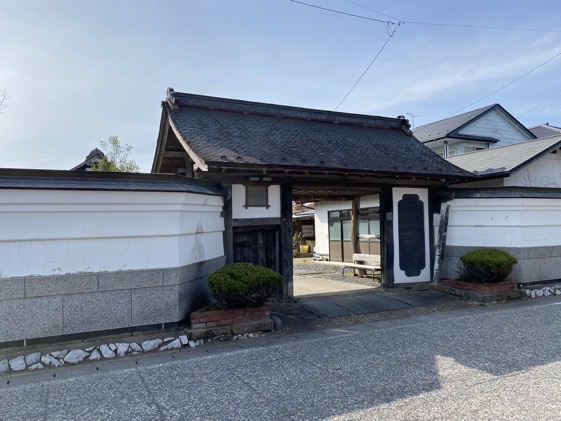
The rear gate (back gate) of Teraiike Castle was relocated after the castle’s abandonment and still exists in Tome City today. This gate is designated as a cultural property of Tome City and is preserved as the “Traditional Teraiike Castle Rear Gate.”
The rear gate was located on the back side of the castle and was used for the entry and exit of retainers and supplies during peacetime, and also functioned as an escape route during wartime. The existing gate retains many characteristics of Edo period castle architecture and is a valuable resource for understanding the architectural techniques of the time.
The gate’s structure is in the Yakui-mon style, with supporting pillars behind the main pillars to support the roof. The roof is a gable roof, simple yet robust in construction.
Traces of Stone Walls
While large-scale stone walls were not built at Teraiike Castle, it is believed that stone masonry was used at some gates and important locations. Even today, scattered stone materials suggest the existence of stone walls from that era.
Castles in the Tohoku region, compared to those in western Japan, used stone walls more extensively, with earthen ramparts being the primary structure. This is thought to be due to factors such as the difficulty of obtaining stone, regional differences in castle construction techniques, and climatic conditions (damage to stone walls due to freezing).
Teraiike Castle and the Townscape of Tome
The town of Tome, which developed as a castle town for Teraiike Castle, preserves a historical townscape now known as “Miyagi’s Meiji Village.” Western-style buildings, samurai residences, and merchant houses built during the Meiji era are preserved, conveying the atmosphere of that time.
Particularly important buildings include:
- Tome Historical Museum: The former Tome Police Station building, a Western-style wooden structure built in 1889 (Meiji 22).
- Educational Materials Museum: The former Tome Higher Elementary School building, built in 1888 (Meiji 21).
- Samurai Residences: Several residences of retainers of the Tome Date clan still exist.
These buildings demonstrate that Tome continued to prosper as a regional center even after the abandonment of Teraiike Castle. The town layout of the castle town influenced the current road layout, telling the story of the history of the castle and town developing together.
Historical Significance of Teraiike Castle
Teraike Castle is a castle that symbolizes the transition period from the medieval to the early modern period in Oshu. As the residence of the Sengoku daimyo Kasai clan, and later as a stronghold of the Sendai Domain during the Edo period, it was the political and military center of the region for approximately 400 years.
It is historically significant in the following respects:
- A castle directly affected by the Oshu Settlement: A symbolic example of Toyotomi Hideyoshi’s nationwide unification policy extending to the Tohoku region.
- The stage of the Kasai-Osaki Rebellion: Exhibits resistance from the dispossessed former lords and the process of establishing a new governing order.
- A part of the Date clan’s territorial control: A key element of northern defense in the Sendai Domain’s strategic system.
- The center of the local community: Laid the foundation for the development of the castle town of Tome.
Currently, most of the Teraiike Castle ruins are privately owned, and preservation and utilization are challenges. Appropriate preservation and public access as a regional historical heritage site are being considered.
Access and Visiting Information for Teraiike Castle
Teraike Castle ruins are located in Teraiike, Tome-cho, Tome City, Miyagi Prefecture. Access information is as follows:
Public Transportation:
- Approximately 20 minutes by bus from JR Tohoku Main Line “Nitta Station,” get off at “Tome City Hall,” and walk for approximately 15 minutes.
By Car:
- Approximately 30 minutes from Tohoku Expressway “Tsukidate IC” via National Route 398.
- Approximately 15 minutes from Sanriku Expressway “Tome IC.”
Notes for Visitors:
- Most of the castle ruins are on private land, so access is currently restricted.
- Please limit your visit to viewing from the exterior and refrain from trespassing on private land.
- We recommend visiting the related remains that are open to the public, such as the relocated rear gate.
Visiting in conjunction with a stroll through the townscape of Tome will allow you to experience the historical atmosphere of a castle town. We recommend obtaining information from the Tome City Tourism and Products Association before visiting.
Summary
Teraike Castle was a fortress that played a significant role in the history of Oshu for approximately 400 years, from its construction by the Kasai clan to its role as the residence of the Tome Date clan, and finally to its abandonment during the Meiji era. Having experienced crucial turning points in Japanese history, such as Toyotomi Hideyoshi’s pacification of Oshu, the Kasai-Osaki Rebellion, and the rule of the Date clan, it holds historical importance.
The remaining structures, including the baileys, earthworks, and moats, are valuable historical sites that illustrate the evolution of castles from the Sengoku period to the Edo period. Furthermore, the relocated rear gate is preserved as a cultural asset that conveys the architectural techniques of the time.
The townscape of Tome, which developed as a castle town, is preserved as “Miyagi’s Meiji Village,” and is an important element in understanding the historical context of Teraike Castle. Those interested in the history of Oshu should definitely visit Tome and reflect on the history of Teraike Castle.


