Mine Castle (Kameyama City, Mie Prefecture): The Residence of the Mine Clan, One of the Five Seki Families, and a Site of Hashiba Hideyoshi’s Invasion of Northern Ise
Mine Castle is a hilltop castle located in Mori, Kawasaki-cho, Kameyama City, Mie Prefecture. Built as the residence of the Mine clan, known as one of the Five Seki Families, it became an important stage in the conflict between Hashiba Hideyoshi and Oda Nobuo during the Sengoku period. This article provides a detailed explanation of Mine Castle’s history, structure, highlights, and access methods.
History of Mine Castle
Construction and the Rise of the Mine Clan
The construction of Mine Castle dates back to the Shohei era (1346-1370). It is believed that Seki Masazane, the fifth son of Seki Moritada (or possibly Seki Morimasa), adopted the name Mine and built the castle in this location. Masazane constructed a castle on a natural stronghold across a valley northeast of the Mori settlement in Kawasaki Village (present-day Mori, Kawasaki Town).
The Mine clan was a branch of the Seki clan and was one of the so-called “Five Seki Families,” wielding considerable power in the northern Ise region. The Five Seki Families refer to the five families that branched off from the Seki clan: the Mine, Kabuto, Kofu, Kaya, and Kada clans, each maintaining their own castles and controlling their respective regions.
The Mine clan ruled this area for six generations after Masazane. The castle grounds extended approximately 135 meters east-west and 72 meters north-south, and the remains of a keep base have been confirmed in the southeastern part of the main enclosure. Taking advantage of its location as a flatland castle, it possessed a defensive structure that skillfully utilized the surrounding terrain.
Changes during the Oda Nobunaga Era
In 1574 (Tensho 2), a major turning point occurred for the Mine clan. The head of the family, Mine Hachiro Shiro Morisuke, was killed in battle during the suppression of the Ikko-ikki rebellion in Nagashima, Ise Province. This Nagashima rebellion was a struggle for Oda Nobunaga for several years, resulting in the loss of many warriors.
After Morisuke’s death, his younger brother, Yohachiro, should have succeeded him, but being still a child, Okamoto Yoshikatsu (also known as Okamoto Shimotsuke-no-kami or Okamoto Munenori), a retainer of Oda Nobunaga, was appointed as the lord of Mine Castle. This made Mine Castle one of the important bases in the Oda clan’s control of northern Ise Province.
Okamoto Yoshikatsu governed the surrounding area from Mine Castle, but eventually became embroiled in internal power struggles within the Oda family.
Takigawa Kazumasu and the Battle of Mine Castle
In 1582, when Oda Nobunaga fell in the Honnoji Incident, the balance of power within the Oda family changed dramatically. Takigawa Kazumasu, who ruled northern Ise, retreated to Ise after being defeated by the Hojo clan at the Battle of Kannagawa.
In 1583, Takigawa Masashige, a retainer of Takigawa Kazumasu, attacked and captured Mine Castle. At this time, Takigawa Kazumasu was in conflict with Oda Nobuo and was trying to strengthen his power base by conquering various castles in northern Ise. The fall of Mine Castle meant that the Takigawa forces secured an important base around Kameyama.
Hashiba Hideyoshi’s Invasion of Northern Ise and the Siege of Mine Castle
In 1583, after defeating Shibata Katsuie at the Battle of Shizugatake, Hashiba Hideyoshi set his sights on eliminating Takigawa Kazumasu. This invasion of northern Ise was a crucial part of Hideyoshi’s unification of Japan.
Hideyoshi led a large army to besiege Mine Castle. Inside the castle, Takigawa Masashige and other officers and soldiers of the Takigawa faction put up fierce resistance. The siege lasted for several months, but due to the overwhelming difference in troop numbers and the cutoff of supply lines, Mine Castle fell once again.
This battle for Mine Castle is considered a crucial battle, a prelude to the Battle of Shizugatake. With this victory, Hideyoshi successfully eliminated the Takigawa forces in northern Ise and strengthened his relationship with Oda Nobuo.
Mine Castle After the War and its Abandonment
After the fall of Mine Castle, Oda Nobuo is believed to have taken up residence there. Later, when Gamo Ujisato came to rule Ise, Mine Castle served as a subsidiary castle of Kameyama Castle.
During the period when Sakuma Masakatsu became the lord of Kameyama Castle, Mine Castle was also under his control, but it is believed that its strategic importance eventually declined, and it was abandoned. In the Edo period, its function as a castle was completely lost, and only ruins remained.
Structure and Layout of Mine Castle
Location and Utilization of Topography
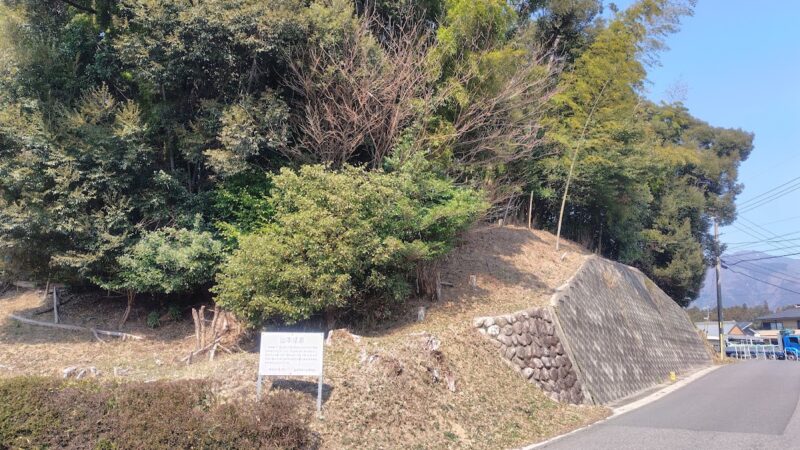
Mine Castle is a flatland castle built on a plateau approximately 20 meters high. Located about 200 meters northeast of Rinsho-ji Temple, it utilized the Yashima River as a natural moat. The castle grounds can be accessed from the southern end of the plateau, and an information board is still in place today.
The castle’s location maximized the use of natural fortifications; the surrounding valleys and rivers enhanced its defensive capabilities. This type of terrain selection is a common characteristic of medieval castles and demonstrates the Mine clan’s superior castle-building skills.
Size of the Castle Grounds
The castle grounds of Mine Castle are recorded as approximately 135 meters east-west and 72 meters north-south. While this is a standard size for a medieval local lord’s castle, it was large enough to control a strategic location.
It is presumed that the castle grounds were arranged with the main keep (Honmaru) at the center, surrounded by the second and third baileys (Ninmaru). However, much of the remains have been lost, making a detailed reconstruction of the layout difficult. Nevertheless, the remaining topography allows for some degree of inference regarding the arrangement of the baileys and defensive lines.
Castle Tower Base and Major Remains
The remains of a castle tower base have been confirmed in the southeastern part of the main keep. However, this “castle tower base” is thought to be more likely a medieval-style watchtower base rather than a large-scale structure with stone walls like those found in early modern castles.
This watchtower base offered a panoramic view of the surrounding area, likely serving as a lookout tower to detect approaching enemies early. It is also presumed to have been used as a command post in times of emergency.
Currently, traces of earthworks and moats remain partially at the castle site, but due to later development and natural erosion, it does not completely retain its original form. Nevertheless, it is still possible to interpret the arrangement of the baileys and defensive structures from the topography.
Yashima River and Defensive System
The Yashima River flows to the east of Mine Castle, functioning as a natural moat. Castle remains have also been confirmed on the east side of this river, and researchers are divided on whether this was a fortified camp of Hideyoshi’s army or a subsidiary castle of Mine Castle.
If it was a subsidiary castle of Mine Castle, then the placement of castles on both banks of the Yashima River would have created a stronger defensive system. On the other hand, if the theory that it was a fortified camp of Hideyoshi’s army is correct, then Hideyoshi’s forces would have deployed at this location during the siege, cutting off the supply lines to Mine Castle.
Highlights of Mine Castle
Remains Visible on Site
Upon visiting the Mine Castle ruins, the first thing you’ll notice is the information board at the southern end. Entering the castle grounds from here, the plateau topography remains intact, giving a sense of the atmosphere of a medieval castle.
The flat area believed to be the site of the main keep is relatively large, suggesting that the main buildings were constructed here. The remains of the castle tower base in the southeast, though now only recognizable as an earthen mound, provide important clues to understanding its original structure.
Partial traces of earthworks can also be seen, suggesting that the castle’s enclosures were demarcated. Furthermore, the remains of a moat are also present, demonstrating a defensive strategy that divided the plateau.
Surrounding Historical Landscape
Near the Mine Castle ruins, numerous historical buildings, including Rinsho-ji Temple, are scattered. These temples and shrines may have existed since the time of the Mine clan, offering clues to the beliefs and culture of the period.
The scenery along the Yashima River also evokes the past, and the relationship between the castle and the river allows us to understand how the defensive system functioned. A stroll including the castle ruins on the opposite bank will allow you to experience the history of Mine Castle more deeply.
View from the Castle Ruins
From the castle ruins on the plateau, you can overlook the surrounding terrain. Imagining the Mine clan and Okamoto Yoshikatsu surveying their territory and monitoring enemy movements from this very spot evokes a sense of historical romance.
The view from the main keep ruins is particularly magnificent, offering a panoramic view of the plains of northern Ise and the surrounding mountains. During the Sengoku period, this excellent visibility undoubtedly played a crucial role in the castle’s defense.
Access and Visiting Information
Location
Address: Tonomachi, Mori, Kawasaki-cho, Kameyama City, Mie Prefecture
Mine Castle Ruins are located somewhat away from the city center of Kameyama, but are accessible by car.
Access by Car
- Approximately 10 minutes from the Kameyama IC on the Tomeihan Expressway
- Accessible via a prefectural road from National Route 1
- Easy to find using Rinsho-ji Temple as a landmark
There is no dedicated parking lot around the castle ruins, but there may be parking spaces on the roadside. However, consideration should be given to avoiding inconveniencing local residents.
Access by Public Transportation
You will need to take a bus or taxi from JR Kansai Main Line “Kameyama Station”. Walking is difficult, so visiting by car is recommended.
Points to Note During Your Visit
- The castle ruins are not a well-maintained tourist area, so comfortable clothing and shoes are necessary.
- In the summer, the area is overgrown with vegetation, so insect repellent is recommended.
- Although there are information boards, explanations of the remains are limited, so learning about the history beforehand will enhance your experience.
- Please be careful not to trespass on private property.
Nearby Castles and Tourist Spots
Kameyama Castle
Located approximately 5 kilometers from Mine Castle, Kameyama Castle was the base of the Seki clan and later served as the castle lord of important retainers of Oda Nobunaga. Currently located in the center of Kameyama City, some of the stone walls and moats remain.
Kameyama Castle is larger in scale than Mine Castle and exhibits characteristics of a modern castle. Visiting Mine Castle in conjunction with Sekijuku allows you to understand the changes in castle architecture from the medieval to the early modern period.
Sekijuku
Sekijuku, which flourished as a post town on the Tokaido highway, is about a 15-minute drive from Mine Castle. Its Edo-period townscape is preserved, and it has been designated a National Important Preservation District for Groups of Traditional Buildings.
Visiting Sekijuku in conjunction with Mine Castle will allow you to understand the history of this region from multiple perspectives.
Suzuka Pass
South of Mine Castle lies Suzuka Pass, known as a difficult section of the Tokaido highway. This spot allows you to appreciate the geographical importance of this region, which has been a transportation hub since ancient times.
Historical Significance of Mine Castle
The Five Seki Families and Regional Control of Northern Ise
Mine Castle was the residence of the Mine clan, one of the five Seki families, and served as a base for regional control in Northern Ise. With the five families, each branching off from the Seki clan, each building their own castle, a balance of power was maintained in this region. This regional structure is a typical example of local governance in medieval Japan, and the study of Mine Castle is of great significance in understanding the social system of the time.
Control of Northern Ise under the Oda Regime
When Oda Nobunaga conquered Ise, Mine Castle became a base of control for the Oda retainers. The placement of Okamoto Yoshikatsu was part of Nobunaga’s regional control strategy, a manifestation of his policy of replacing local forces with his retainers.
During this period, Mine Castle functioned as an important military base in the Oda regime’s control of northern Ise, serving as a center for governing the surrounding area and for military operations.
Its Place in Hashiba Hideyoshi’s Unification of Japan
The Battle of Mine Castle in 1583 (Tensho 11) held significant importance in Hashiba Hideyoshi’s unification of Japan. Having defeated Shibata Katsuie at the Battle of Shizugatake, eliminating the influence of Takigawa Kazumasu was Hideyoshi’s next challenge.
By conquering Mine Castle and other castles in northern Ise, Hideyoshi strengthened his alliance with Oda Nobuo and solidified his political base, which would lead to the Battle of Komaki and Nagakute. The siege of Mine Castle was not merely a local castle battle, but a crucial part of the battles that determined the course of Japan’s unification.
Current Status and Challenges of Mine Castle Research
Archaeological Investigation
Regarding Mine Castle, no full-scale archaeological excavations have been conducted; research is primarily based on historical documents and surface observations. Future archaeological investigations could potentially provide more detailed information about the castle’s structure and period of use.
In particular, excavation of the area believed to be the castle tower base would be crucial for understanding the structure of turrets in medieval castles. Furthermore, excavated artifacts could potentially reconstruct the lifestyle and battles of the time.
Limitations of Documentary Sources
Documentary sources concerning Mine Castle are limited, and many details remain unclear, particularly regarding the castle’s construction period and the era of the Mine clan. The discovery of genealogies and ancient documents related to the Seki and Mine clans could potentially allow for a more accurate reconstruction of the castle’s history.
Regarding the battles during the Tensho period, records primarily focus on Hideyoshi’s side, with limited historical sources from the defending side. Further discoveries of new historical materials are hoped for.
Challenges of Preservation and Utilization
Currently, the Mine Castle ruins are not under special protection, and the remains are left in a natural environment. Appropriate preservation and utilization are required for this regional historical heritage.
Creating a safe environment for visitors, such as installing signposts and walking paths, will be a future challenge. Simultaneously, its use as a resource for regional history education and tourism should also be considered.
Summary
Mine Castle is a medieval castle ruin located in Kameyama City, Mie Prefecture, built as the residence of the Mine clan, one of the five prominent families of the Seki region. From its construction during the Shohei era to its role as a crucial battlefield during Oda Nobunaga’s rule of northern Ise and Hashiba Hideyoshi’s unification of Japan, it is a castle that symbolizes the turbulent Sengoku period.
Currently, the castle ruins retain traces of earthworks and the keep’s foundation, making it a worthwhile spot for history enthusiasts. Visiting it along with other nearby historical sites such as Kameyama Castle and Sekijuku will allow for a deeper understanding of the Sengoku history of northern Ise.
The history of Mine Castle encapsulates the major currents of the Sengoku period: the rise and fall of local powerful families, the Oda regime’s regional control, and Toyotomi Hideyoshi’s unification of Japan. Understanding the historical role played by this small castle is crucial to understanding Japan’s Sengoku history.
When visiting Mie Prefecture, be sure to visit the Mine Castle ruins and experience the spirit of the Sengoku period.