Yamamoto Castle (Suzuka City, Mie Prefecture) Complete Guide | History, Remains, Access Information, and Visitor Highlights
What is Yamamoto Castle?
Yamamoto Castle is a Sengoku period (Warring States period) hilltop castle located in Yamamoto-cho, Suzuka City, Mie Prefecture. Also known as “Ise Yamamoto Castle,” it is known as one of the castles that played an important role in the Sengoku history of the Tokai region.
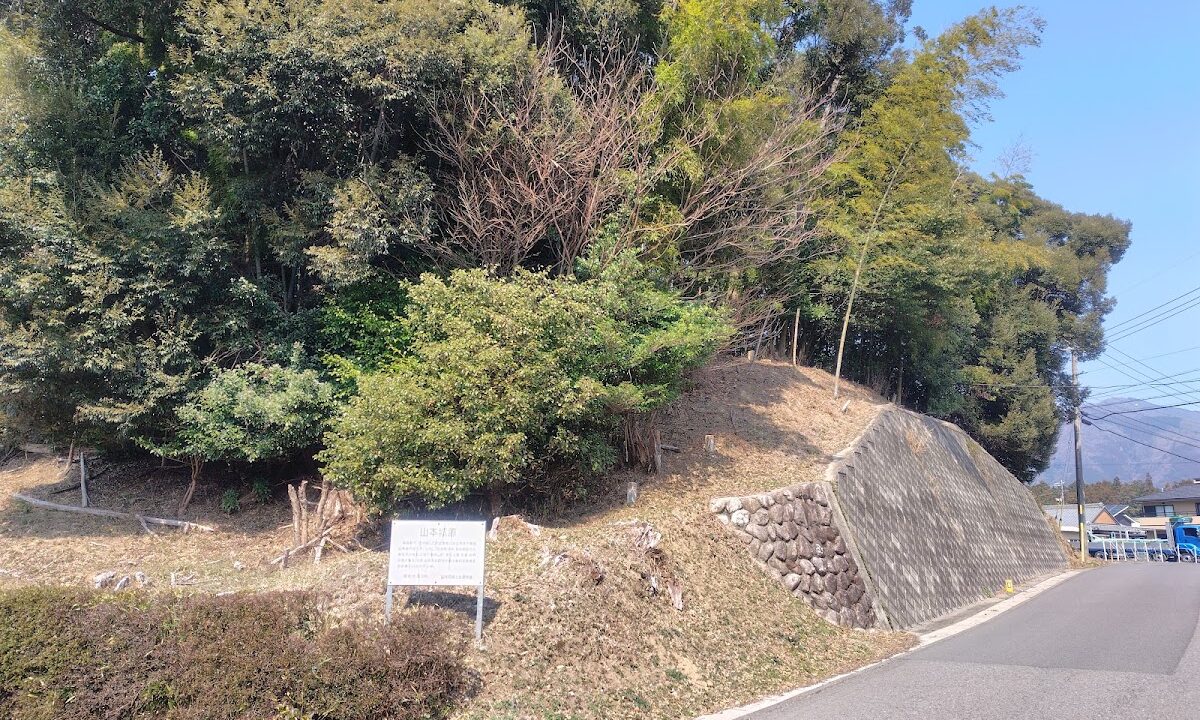
The current Yamamoto Castle site is located on a plateau behind Saiganji Temple, built on a hill approximately 20 meters high. The castle grounds mainly consist of the western bailey, and remains such as earthworks and dry moats are well-preserved. Among the medieval castles remaining in Suzuka City, it attracts attention from castle enthusiasts and history researchers for its relatively well-preserved remains.
While many Sengoku period castles exist in Mie Prefecture, Yamamoto Castle is a valuable historical site that tells the story of the political situation in the Tokai region during the turbulent period after the death of Oda Nobunaga. Although the castle ruins are now covered in forest, the earthworks and dry moats that still convey the atmosphere of the past can be seen, making it an excellent field for learning about the structure of castles from the Sengoku period.
History of Yamamoto Castle
Construction and the Yamamoto Clan
Yamamoto Castle is said to have been built by Yamamoto Gyobu, also known as Murao Gyobu, a branch family of the Tahara clan, who were lords of Hamada Castle. The Yamamoto clan were local lords with considerable power in northern Ise Province and were active as a local force in the Suzuka region.
While there are no clear records of the exact construction date, it is believed that the castle was already functioning as a fortress by the mid-Sengoku period, probably around the mid-16th century. The Yamamoto clan developed Yamamoto Castle as a base of regional control, making it the center of governance and defense for the surrounding area.
The relationship with the Tahara clan indicates a network among local lords in northern Ise, suggesting that the Yamamoto clan did not exist in isolation but maintained their power within a regional alliance.
Subordination to Oda Nobutaka
In 1582 (Tensho 10), when Oda Nobunaga died in the Honnoji Incident, the political situation in the Tokai region changed dramatically. During this period, the Yamamoto clan chose to submit to Oda Nobutaka, the third son of Oda Nobunaga.
Oda Nobutaka controlled Owari, Mino, and parts of Ise, and acted as one of his father Nobunaga’s successors. The reasons for the Yamamoto clan’s submission to Nobutaka are thought to be related to their geographical proximity and the fact that Nobutaka’s influence extended to northern Ise.
During this period, the Yamamoto clan, as a local lord playing a part in the Oda regime, participated in military activities under Nobutaka’s command. In particular, they acted as a member of Nobutaka’s camp in the succession struggle after Nobunaga’s death.
Fall of the Castle and the Downfall of the Yamamoto Clan
In 1583 (Tensho 11), Yamamoto Castle met a dramatic end. That year, Oda Nobutaka deepened his conflict with Hashiba Hideyoshi (later Toyotomi Hideyoshi) and was carrying out military operations in the Mino region. Yamamoto Gyobu accompanied Nobutaka to Mino, leaving his castle unattended.
Taking advantage of this absence, the forces of Tsutsui Junkei, who was allied with Hashiba Hideyoshi, attacked Yamamoto Castle. Tsutsui Junkei was a Sengoku daimyo of Yamato Province and one of Hideyoshi’s important generals. With its lord absent, Yamamoto Castle was unable to defend itself adequately and fell to Tsutsui’s attack.
This fall is believed to have annihilated the Yamamoto clan’s power, and Yamamoto Castle was abandoned. Oda Nobutaka himself was defeated by Hideyoshi and committed suicide that year, making the fall of Yamamoto Castle a symbolic event representing the political turmoil after Nobunaga’s death and Hideyoshi’s process of unifying Japan.
The fall of Yamamoto Castle illustrates the harsh reality of the Sengoku period, where even small, provincial castles were directly affected by the political situation in the central government.
Structure and Layout of Yamamoto Castle
Location and Topography
Yamamoto Castle is a flatland castle built on a plateau in Yamamoto-cho, Suzuka City. Its elevation is approximately 20 meters higher than the surrounding plains, and it utilizes the natural fortifications of its location, sandwiched between a river flowing to the west and lowlands to the east.
The castle’s location is on a plateau west of Prefectural Road 11, adjacent to the present-day Saiganji Temple, utilizing the tip of a long, narrow hill running north-south. This topography was advantageous for defense, especially the steep slopes on the west and south sides, which functioned as a natural defensive line.
From the plateau, it was possible to overlook the surrounding plains, making it a suitable location for monitoring transportation routes in the Suzuka region. It was also a strategically important location controlling the roads connecting northern Ise Province and Omi Province.
Main Enclosure and Enclosure Structure
The layout of Yamamoto Castle is presumed to have had the main enclosure (honmaru) on the west side. The main enclosure was the core of the castle, and it is thought to have housed the lord’s residence and important facilities.
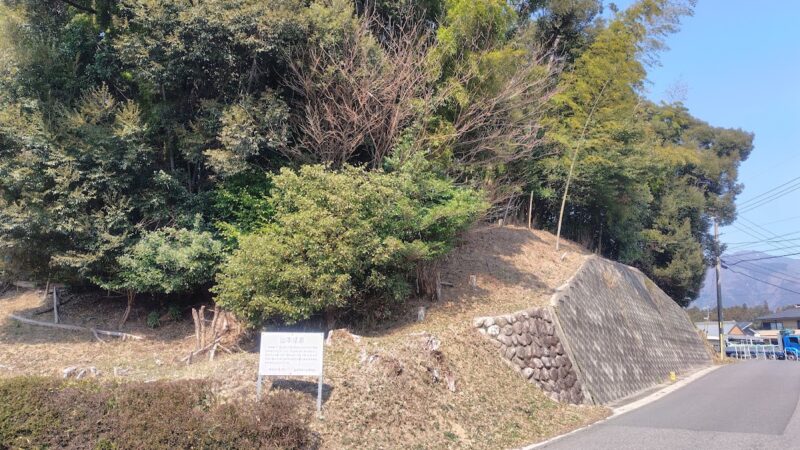
A well-preserved earthen rampart remains at the western end of the main enclosure, clearly demonstrating its function as a defensive structure. The rampart is approximately 2 meters high and of considerable width, a robust structure designed to prevent enemy intrusion.
A ditch-like depression is visible in the center of the rampart; this may be the remains of a castle gate (koguchi), or it may be a later alteration. A marker post currently stands at this location, indicating the site of Yamamoto Castle.
It is presumed that several enclosures were connected to the east of the main enclosure, but currently, the area is covered with bamboo groves and woodlands, making it difficult to clearly distinguish the boundaries.
Earthen Ramparts and Dry Moats
The greatest highlight of Yamamoto Castle is its well-preserved earthen ramparts and dry moats. The earthen rampart is prominently preserved at the western end of the main enclosure, clearly indicating the castle’s defensive line. Although trees now grow on top of the rampart, its basic shape is believed to retain its original form. The structure of the rampart suggests that Yamamoto Castle was not merely a residence, but a fortress equipped with military defensive functions.
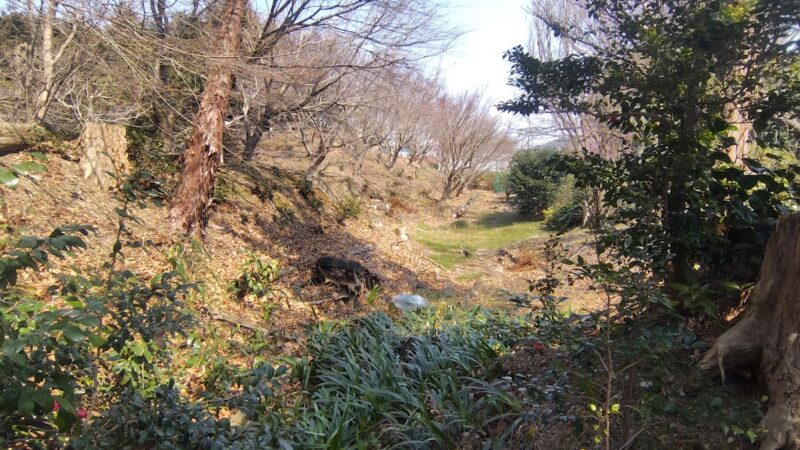
The dry moat remains in a north-south direction within the bamboo grove east of the main enclosure. This dry moat served as a defensive structure separating the enclosures and played a crucial role in preventing enemy incursions. The moat is still several meters deep, and its bottom is relatively clearly visible.
The scale of the dry moat suggests that Yamamoto Castle was a full-fledged castle constructed with considerable fortification technology and labor. Because it is covered in bamboo, caution is needed when visiting, but it is a valuable historical site that allows visitors to directly experience the structure of a Sengoku period castle.
Other Remains
Besides the earthworks and dry moats, traces of terraces and cut slopes (artificial steep slopes) of the castle grounds remain. However, due to years of weathering and overgrown vegetation, only a limited number of these can be clearly identified.
There is a possibility that traces of castle-related alterations can also be found in the topography around Saiganji Temple, and it has been suggested that the temple grounds may have utilized part of the castle.
Currently, the area is covered in forest, making it difficult to grasp the overall layout of the castle in its heyday. However, if a survey by experts is conducted, it may be possible to create a more detailed layout map.
Highlights of Yamamoto Castle
Earthworks at the Western End (Must-See Point)
The biggest highlight of a visit to Yamamoto Castle is the earthworks remaining at the western end of the main enclosure. These earthworks are the best-preserved in Yamamoto Castle, allowing visitors to see a castle defense structure from the Sengoku period firsthand.
Standing on top of the earthworks, one can imagine the view the castle lord had from this spot overlooking his territory in the past. The height and thickness of the earthworks indicate that the Yamamoto clan intended to give this castle considerable defensive capabilities.
A marker post erected in the center of the earthworks reads “Yamamoto Castle Ruins,” clearly indicating that it is a castle site. It’s also an ideal spot for photography.
Dry Moat in the Bamboo Grove
The dry moat remaining in the bamboo grove east of the main enclosure is a point where you can feel the power of the castle ruins. The sight of the dry moat stretching north and south in the dim light of the bamboo grove conveys the tension of the Sengoku period.
Looking up from the bottom of the dry moat, you can appreciate the height of the cliffs on both sides, and understand that this moat was a powerful obstacle to prevent enemy intrusion. However, the ground can be slippery, so caution is necessary when visiting.
Relationship with Saiganji Temple
The Yamamoto Castle ruins are located behind Saiganji Temple, and visiting both the temple and the castle ruins together will provide a deeper understanding. Nishiganji Temple not only serves as a landmark for accessing the castle ruins, but also, as a temple that conveys local history, it may provide information related to the history of Yamamoto Castle.
Following the path from the temple grounds to the castle ruins allows you to feel the relationship between the castle and the local community.
View from the Plateau
From the plateau of Yamamoto Castle, you can see the plains of Suzuka City. During the Sengoku period, the castle lord would have monitored his territory and watched for enemy movements from this location.
Currently, the view is not as clear as it once was due to the dense trees, but you can still appreciate the castle’s excellent location. Especially during winter, when the leaves have fallen, a wider view may be possible.
Access Information
Location
- Address: Yamamoto-cho, Suzuka City, Mie Prefecture
- Postal Code: 519-0315
- Landmark: Nishiganji Temple
Access by Car
Access to Yamamoto Castle Ruins is most convenient by car.
- Tomeihan Expressway: Approximately 15 minutes from Suzuka IC
- National Route 1: Approximately 20 minutes from Suzuka city center via Prefectural Route 11
- Parking: There may be parking spaces around Saiganji Temple, but it is recommended to check in advance.
If using a car navigation system, searching for “Saiganji Temple, Yamamoto-cho, Suzuka City” will take you to your destination. Saiganji Temple is located along Prefectural Route 11, and the castle ruins are behind it.
Access by Public Transportation
Access by public transportation is limited.
- Nearest Station: JR Kansai Main Line “Kasato Station” or Kintetsu Suzuka Line “Hirata-cho Station”
- Distance from Station: Approximately 3-4 km
- Walking: Approximately 40-50 minutes on foot from the station
- Taxi: Taking a taxi from the station is the most practical option.
There may be bus routes, but the number of services may be limited, so it is recommended to check bus information from Mie Kotsu or other companies in advance.
Points to Note When Visiting
- Clothing: As the castle ruins are in a wooded area, long sleeves, long pants, and comfortable walking shoes (such as trekking shoes) are recommended.
- Season: The ruins are easier to see in winter, as the vegetation is dense from spring to autumn.
- Insect Repellent: Mosquitoes and horseflies are abundant in summer, so insect repellent spray is essential.
- Safety: The slopes of the dry moats and earthworks can be slippery, so watch your step.
- Private Property: Private property may be included around the castle ruins, so please follow any signs indicating “No Entry.”
Estimated Visiting Time
- Castle Ruins Only: 30 minutes to 1 hour
- Including Saiganji Temple: 1 hour to 1 hour 30 minutes
- Focusing on Photography: 1 hour 30 minutes to 2 hours
Nearby Tourist Information
Other Castle Ruins in Suzuka City
When visiting Yamamoto Castle, visiting other castle ruins in Suzuka City and the surrounding area will give you a deeper understanding of the Sengoku period history of the Tokai region.
- Kambe Castle: A flatland castle located in Kambe, Suzuka City, where Takigawa Kazumasu, a senior retainer of Oda Nobunaga, served as the castle lord. Stone walls and moats remain, and it is larger in scale than Yamamoto Castle.
- Suzuka Checkpoint: The site of a checkpoint on the Tokaido Fifty-three Stations, where you can learn about the transportation history of the Edo period.
- Tsubaki Grand Shrine: An ancient shrine located at the foot of Mount Suzuka, about 30 minutes by car from Yamamoto Castle.
Historical Facilities in Suzuka City
- Suzuka City Archaeological Museum: Exhibits archaeological materials from the Suzuka region. Possibility of castle-related materials
- Suzuka City Traditional Industries Hall: A facility introducing Suzuka’s traditional crafts
Gourmet Information
Suzuka City is located midway between the Nagoya and Kansai regions, and is influenced by the food cultures of both.
- Ise Udon: A representative local dish of Mie Prefecture
- Matsusaka Beef: A specialty of the nearby Matsusaka City, and can be enjoyed at restaurants in Suzuka City as well
- Seafood: Facing Ise Bay, you can enjoy fresh seafood
Accommodation Information
Suzuka City has accommodations such as hotels related to the Suzuka Circuit, as well as business hotels. If you plan to thoroughly explore the castle ruins, you can also consider staying in Suzuka City or the nearby cities of Yokkaichi and Tsu.
Significance of Visiting Yamamoto Castle
Understanding the Reality of Local Castles
Yamamoto Castle is not a so-called “famous castle,” but that is precisely why it is a valuable historical site for understanding the reality of local castles during the Sengoku period. Unlike the large-scale castles of the early modern period with their towering keeps and stone walls, Yamamoto Castle preserves the appearance of a medieval castle, primarily composed of earthworks and moats.
While there are tens of thousands of castle ruins throughout Japan, the vast majority were small, regional castles like Yamamoto Castle. The remains of Yamamoto Castle eloquently speak to what a castle of the Sengoku period was like, how it was constructed, and how it functioned.
Experiencing the Political Situation of the Sengoku Period
The history of Yamamoto Castle symbolizes the political situation in the Tokai region during the turbulent period after the death of Oda Nobunaga. The fate of Yamamoto Castle—falling after being attacked by Tsutsui Junkei, who was loyal to Hashiba Hideyoshi and served Oda Nobutaka—is a concrete example of how central political struggles affected small local lords.
Standing at the castle ruins, you can experience firsthand the choices and destinies of the people who lived during the Sengoku period—something you can’t learn from history textbooks.
The Importance of Historical Preservation
While Yamamoto Castle Ruins are not designated as a special historical site, they are preserved as a regional historical heritage. The remaining earthworks and dry moats are thanks to the understanding and cooperation of the local community.
Visiting such local castle ruins and recognizing their value provides an opportunity to consider the importance of preserving historical heritage. Numerous castle ruins across Japan are in danger of disappearing due to development and weathering, and efforts are needed to pass on remains like Yamamoto Castle to future generations.
Current Status and Challenges of Yamamoto Castle Research
Limitations of Historical Sources
Primary sources concerning Yamamoto Castle are limited, leaving many questions unanswered regarding its construction period, detailed layout, and the lineage of its lords. Only fragmentary records remain in local history materials such as the “Mie Prefecture History” and later compilations.
In particular, further historical research is needed regarding the relationship between the Yamamoto and Tahara clans, the circumstances of their subservience to Oda Nobutaka, and the treatment of the castle ruins after its fall.
The Need for Archaeological Investigation
It appears that no full-scale archaeological excavation has been conducted at the Yamamoto Castle site. An excavation could potentially clarify the castle’s age and characteristics based on unearthed artifacts.
In particular, if building remains or artifacts of daily life are discovered through excavation of the main enclosure, it would deepen our understanding of the lord’s lifestyle and the castle’s function.
Deepening the Study of Castle Layout
Currently, only a simplified layout map of Yamamoto Castle exists. A detailed survey by experts and the creation of a precise layout map would allow for a more accurate understanding of the castle’s overall structure and construction techniques.
In particular, clarifying the scale and arrangement of the dry moats, the number and arrangement of enclosures, and the location of the entrance gates would be significant for the overall study of castles in northern Ise.
Advice for Castle Enthusiasts
Points for Beginners
For those new to visiting castle ruins, Yamamoto Castle is a good introduction. It’s small in scale, can be visited in a short time, and allows for clear observation of basic castle defensive structures such as earthworks and dry moats.
Before visiting, learning basic knowledge about Sengoku period castles (terms such as kuruwa, earthworks, dry moats, and koguchi) will deepen your understanding at the site. We recommend reading websites like Kojodan or introductory books on castles.
Intermediate Visitor Points
Those who have already visited several castle ruins can gain a deeper understanding by positioning Yamamoto Castle within the network of castles in northern Ise. Visit nearby castle ruins such as Kobe Castle, Hamada Castle, and Mine Castle, and compare their locations and structures.
Also, sketching the layout of Yamamoto Castle is a good exercise for deepening your understanding of castles.
Advanced Visitor Points
For those deeply pursuing castle research, we recommend researching historical materials on Yamamoto Castle and conducting comparative studies with similar castles. In particular, there is still room for research regarding the details of Tsutsui Junkei’s siege and the actions of the Ise provincial lords under Oda Nobutaka.
Detailed observation at the site may reveal remains not shown in existing castle layout maps.
Summary
Yamamoto Castle is a Sengoku period hilltop castle located in Yamamoto-cho, Suzuka City, Mie Prefecture. It is a valuable historical site with well-preserved earthworks and dry moats. Built by the Yamamoto clan, it served Oda Nobutaka before being attacked and captured by Tsutsui Junkei, a retainer of Hashiba Hideyoshi.
The castle ruins are located behind Saiganji Temple and are easily accessible by car. The main highlights are the earthworks at the western end of the main enclosure and the dry moat within the bamboo grove, allowing visitors to experience the structure of a Sengoku period castle firsthand.
While not a famous tourist destination, it is a valuable historical site for understanding the realities of regional castles during the Sengoku period, and is worth visiting for castle enthusiasts. Visiting Yamamoto Castle ruins along with other castle ruins and historical sites in Suzuka City will deepen your understanding of the Sengoku period history of the Tokai region.
Visiting Yamamoto Castle ruins is not just about seeing ancient remains; it’s an opportunity to reflect on the choices and destinies of the people who lived during the Sengoku period and to consider the significance of passing on the region’s historical heritage to future generations. We highly recommend visiting Yamamoto Castle ruins in Yamamoto-cho, Suzuka City, Mie Prefecture.