A Complete Guide to the History and Highlights of Okubo Castle (Suzuka City, Mie Prefecture)
Located in Okubo-cho, Suzuka City, Mie Prefecture, Okubo Castle is a flatland castle that served as the residence of the Okubo clan, vassals of the Mine clan, during the Sengoku period. Even today, the remains of earthworks and dry moats are well-preserved, making it a valuable historical site that conveys the appearance of a medieval castle, attracting attention from castle enthusiasts and history buffs.
This article comprehensively explains everything you need to know before visiting, including the detailed history of Okubo Castle, the highlights of the remains that can be seen on-site, access methods, and related castles in the surrounding area.
Overview and Basic Information of Okubo Castle
Location: Nakaseko, Okubo-cho, Suzuka City, Mie Prefecture
Castle Classification: Flatland Castle (Manor Castle)
Elevation: Approximately 190m
Construction Period: Sengoku Period (Warring States Period)
Builder: Okubo Clan
Main Lord: Okubo Izunokami
Year of Abandonment: 1583 (Tensho 11)
Remains: Earthworks, dry moats, baileys
Designated Cultural Property: None
Okubo Castle is an important historical site for understanding the lifestyle and defense systems of local samurai during the Sengoku period, as a typical medieval manor castle in Ise Province (present-day Mie Prefecture). Among the castles remaining in Suzuka City, it is characterized by its well-preserved remains and easy accessibility for visitors.
History of Okubo Castle
Relationship between the Mine and Okubo Clans
Okubo Castle was built by the Okubo clan, vassals of the Mine clan, who held power in Ise Province. The Mine clan were local lords with influence in the northern Ise region, and several powerful vassals served under them. The Okubo clan held a particularly important position among them, and was responsible for governing and defending the surrounding area from Okubo Castle.
During the Sengoku period, Ise Province was in a complex political situation with multiple powers such as the Kitabatake, Kambe, and Seki clans vying for power. It is believed that the Okubo clan, while supporting their lord, the Mine clan, while also managing their own territory within this regional power balance.
Oda Nobunaga’s Invasion of Ise and Okubo Castle
In the latter half of the 16th century, when Oda Nobunaga intensified his invasion of Ise Province, various forces in Ise, including the Okubo clan, sought to establish a relationship with the Oda family. During his conquest of Ise Province, Oda Nobunaga sent his third son, Nobutaka, as an adopted son to the Kambe clan, and also had his second son, Nobukatsu, adopted into the Kitabatake clan, thus advancing his control over Ise through marriage alliances.
It is presumed that the Okubo clan was also incorporated into the Oda family’s sphere of influence during this period. However, this Oda control of Ise would later determine the fate of Okubo Castle.
The Conflict of 1583 and the Abandonment of Okubo Castle
In June 1582 (Tensho 10), when Oda Nobunaga was killed by Akechi Mitsuhide in the Honnoji Incident, a succession struggle intensified within the Oda family. This turmoil continued into the following year, 1583 (Tensho 11), and had serious repercussions in Ise Province.
In particular, the conflict between Kambe Nobutaka (Oda Nobutaka) and Kitabatake Nobuo (Oda Nobuo) divided the warlords of Ise Province. In this conflict, Okubo Izunokami, the lord of Okubo Castle, chose to side with Kambe Nobutaka.
However, this choice proved fatal for the Okubo clan. Okubo Izunokami followed Nobutaka to Gifu and was killed in battle there. Having lost its lord, Okubo Castle was abandoned in 1583, ending its role.
During this period, Oda Nobutaka himself was defeated in a power struggle with Hashiba Hideyoshi and driven to suicide, and many of the warlords who followed Nobutaka met tragic ends. The death of Okubo Izunokami and the abandonment of Okubo Castle can be seen as events that illustrate one facet of this turbulent era.
Okubo Castle After its Abandonment
After its abandonment, the grounds of Okubo Castle were gradually converted into farmland and residential areas. However, it was not completely destroyed, and major remains such as earthworks and dry moats have survived to the present day.
Throughout the Edo period, this region came under the control of the Tsu Domain (Todo clan), but the Okubo Castle ruins were not used for military purposes and were preserved as a local historical heritage site.
Structure and Layout of Okubo Castle
Characteristics as a Flatland Castle (Mansion Castle)
Okubo Castle is a flatland castle built on relatively flat land at an altitude of approximately 190m. Unlike mountain castles and hill castles, it has a structure that prioritizes habitability and is also known as a “mansion castle.”
Mansion castles of the Sengoku period are characterized by combining the function of an everyday living space with the function of a defensive base in times of emergency. Okubo Castle, while possessing strong defensive capabilities thanks to its earthworks and moats, also strongly served as a residence where the lord and his retainers conducted their daily lives.
Arrangement of Enclosures (Kuruwa)
Okubo Castle is believed to have consisted of multiple enclosures (kuruwa). Generally, a main enclosure (main bailey) is surrounded by secondary enclosures containing the residences and warehouses of retainers.
Based on the remains that can be confirmed today, the main enclosure appears to have been roughly square in shape, surrounded by earthworks and moats. This main enclosure served as the lord’s residence and was the center of government affairs and daily life.
Structure of Earthworks
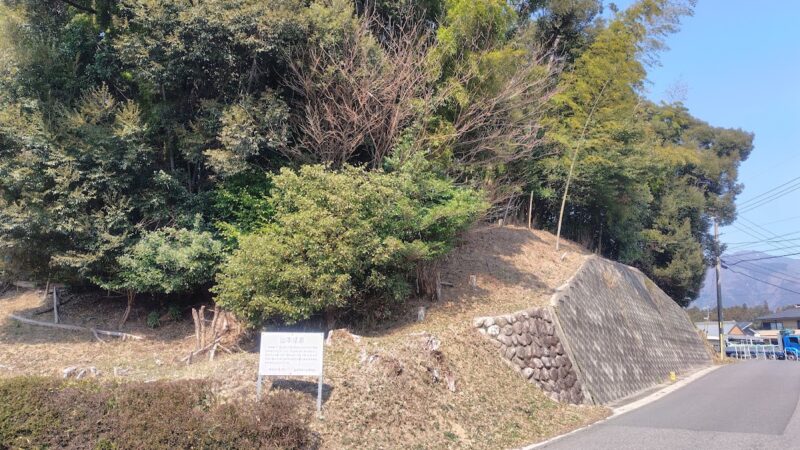
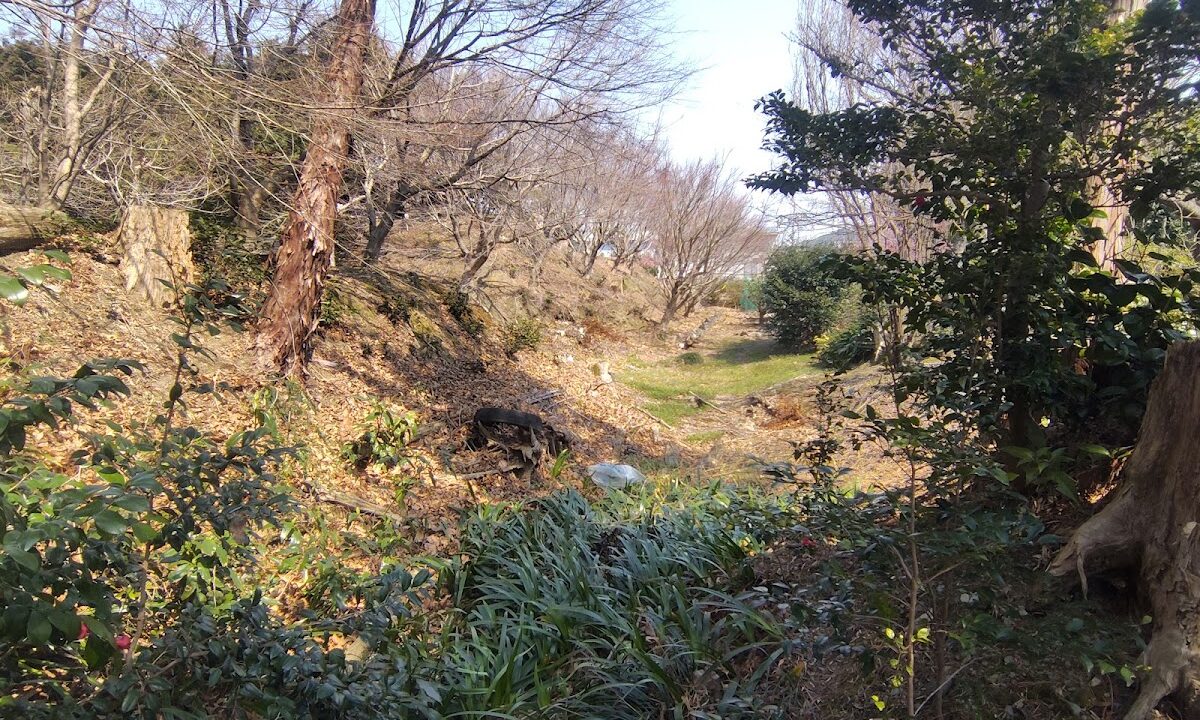
The most impressive remains of Okubo Castle are the earthworks. These earthworks were built surrounding the enclosures, and their shape can still be clearly seen today.
The height of the earthworks varies depending on the location, but in well-preserved sections, they remain at a height of approximately 2-3 meters. The top of the earthworks is flat, suggesting that fences or walls may have once been installed there.
Earthen ramparts served not only as mere defensive walls, but also as visual intimidation and as a clear boundary separating the castle grounds from the outside. The earthen ramparts of Okubo Castle are a valuable example for understanding medieval castle construction techniques.
Layout of Dry Moats
Along with earthen ramparts, dry moats are another important defensive structure. At Okubo Castle, a double defensive line was constructed by surrounding the earthen ramparts with dry moats.
Dry moats are moats that do not contain water, physically hindering enemy intrusion, and the difference in elevation from the bottom of the moat to the top of the rampart was utilized to enhance the defensive effect. Even today, traces of dry moats can be seen in some sections, and their depth and width allow us to infer the defensive plan of the time.
For Okubo Castle, a flatland castle, the combination of earthen ramparts and dry moats was the most important means of defense. Lacking the topographical advantages of mountain castles, the castle ensured its functionality by enhancing artificial defensive structures.
Highlights of Okubo Castle
Well-Preserved Earthwork Remains
The greatest highlight of a visit to Okubo Castle is the well-preserved earthwork remains. While parts of the castle site are still privately owned or farmland, the main earthworks are clearly visible.
Particularly noteworthy is the continuity of the earthworks. Although there are some interruptions, the overall layout can be understood, allowing visitors to grasp the former extent of the castle grounds.
Vegetation grows on the surface of the earthworks, but this actually serves to protect their shape. In areas where the cross-section of the earthworks can be observed, traces of the rammed earth construction technique, where soil was compacted in layers, can be seen.
Traces of Dry Moats
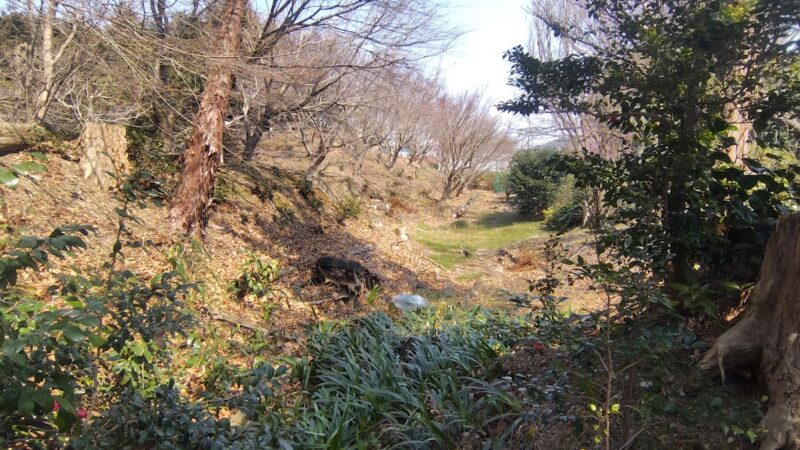
The dry moats are not as clearly defined as the earthworks, but careful observation reveals areas where depressions continue along the outside of the earthworks. These are traces of the dry moats.
Although much of the moat has been filled in over the years, imagining its layout and scale provides clues to understanding the castle’s defensive system at the time. Especially after rain, when the ground is damp, the traces of the moat can sometimes be seen more clearly.
Topography within the Enclosure
The interior of the enclosure, surrounded by earthen ramparts, is now flat farmland and open spaces. However, careful observation reveals subtle differences in elevation, suggesting the possibility of building foundations and well remains.
Walking within the enclosure allows you to experience the size and layout of the space where the castle lord and his retainers actually lived. This is a valuable opportunity to grasp the scale of a medieval castle.
Surrounding Topography and Location
Okubo Castle is a flatland castle, but it is not on completely flat ground; it is located on a slightly elevated area. Observing the surrounding topography reveals that the castle was built in a location blessed with water resources.
Understanding the castle’s location allows us to consider why this location was chosen and what strategic intentions were behind its construction. Exploring the surrounding area and observing the relationship between the terrain and the castle is also an interesting experience.
Access Information
Access by Public Transportation
Nearest Station: JR Kansai Main Line “Kasato Station”
Distance from Station: Approximately 3.5km
Travel Time: Approximately 45 minutes on foot, approximately 10 minutes by taxi
While it is possible to access the castle on foot from Kasato Station, it is a bit of a distance, so you may want to consider taking a taxi. Since taxis may not always be stationed in front of the station, it is recommended to arrange one in advance using a ride-hailing app.
Access by Car
Nearest Interchange: Tomeihan Expressway “Suzuka IC”
Distance from IC: Approximately 8km
Travel Time: Approximately 15 minutes
Access by car is the most convenient. From Suzuka IC, take National Route 1 and then a prefectural road towards Okubo-cho. If using a car navigation system, searching for “Okubo-cho, Suzuka City, Mie Prefecture” is recommended.
Parking: There is no dedicated parking lot, so you will need to park in a location that does not inconvenience the surrounding area. The area around the castle ruins is residential and farmland, so please be careful not to park on private property without permission.
Points to Note When Visiting
- Consideration for Private Property: Part of the castle ruins is private property. Please do not enter areas marked “No Entry.”
- Visiting Manners: Since farmland and residential areas are nearby, please observe proper etiquette, such as refraining from shouting or littering.
- Season and Clothing: During the season when vegetation is lush (summer), wearing long sleeves and long pants is recommended. Bringing insect repellent is also a good idea.
- Visiting Hours: As this is not a dedicated viewing facility, visiting during daylight hours (daytime) is recommended.
- During Rainy Weather: The earthworks and moat remains become slippery in rainy weather, so visiting on a fine day is safer.
Related Castles in the Surrounding Area
When visiting Okubo Castle, visiting other castles around Suzuka City will allow you to gain a deeper understanding of the Sengoku period history of this region.
Yamamoto Castle
Location: Yamamoto-cho, Suzuka City, Mie Prefecture
Distance: Approximately 4km from Okubo Castle
Yamamoto Castle, like Okubo Castle, is a castle associated with the Mine clan and is a typical example of a medieval castle in Ise Province. Yamamoto Castle also retains the remains of earthworks and moats, making it interesting to visit while comparing it with Okubo Castle.
Ogisu Castle
Location: Ogisu-cho, Suzuka City, Mie Prefecture
Distance: Approximately 6km from Okubo Castle
Ogisu Castle is a mountain castle and has a different structure from flatland castles like Okubo Castle. This is an excellent example of experiencing the difference between mountain castles and flatland castles firsthand.
Kambe Castle
Location: Kambe, Suzuka City, Mie Prefecture
Distance: Approximately 10km from Okubo Castle
Kambe Castle is known as the residence of Oda Nobutaka (Kambe Nobutaka) and is deeply intertwined with the history of Okubo Castle. Currently, it is maintained as Kambe Park, where you can see the remains of the stone walls and moats. Visiting the base of Kambe Nobutaka, whom Okubo Izunokami served, will give you a deeper understanding of the historical background of Okubo Castle.
Castle Tour in Suzuka City
There are many other castle ruins scattered throughout Suzuka City. Planning a “castle tour” to visit multiple castles over a day will give you a three-dimensional view of the Sengoku period in Ise Province.
Best Season to Visit Okubo Castle
Spring (March-May)
Early spring, before the plants begin to grow, is the best time to observe the remains. The shape of the earthworks is clearly visible, making it ideal for photography. The mild temperatures make it a perfect season for a stroll.
Autumn (October-November)
Autumn is also a suitable season for visiting the ruins. The grass that grew profusely in summer begins to wither, making the outlines of the earthworks and moats easier to see. The surrounding scenery is beautiful during the autumn foliage season, allowing you to enjoy both historical exploration and nature appreciation.
Summer (June-September)
During this time of year, the vegetation is dense, making observation of the ruins somewhat difficult. However, the earthworks covered in greenery have a charming atmosphere, allowing you to experience the feel of a medieval castle ruin. Be sure to take precautions against insects and heatstroke when visiting.
Winter (December-February)
This is the time when the vegetation has withered and the ruins are most clearly visible, but cold weather precautions are necessary. While snowfall is unlikely, frost can make the ground slippery, so caution is advised.
Historical Value of Okubo Castle
A Typical Example of a Medieval Castle
Okubo Castle holds an important position in castle research as a typical example of a castle built by a local samurai during the Sengoku period. Unlike early modern castles with large stone walls and keeps, its simple structure, mainly consisting of earthworks and moats, is a valuable resource for understanding the essence of medieval castles.
A Heritage Site Conveying the Sengoku History of Ise Province
Okubo Castle, which is associated with important historical events of the Sengoku period such as Oda Nobunaga’s invasion of Ise, the chaos after the Honnoji Incident, and internal conflicts within the Oda family, is a heritage site that concretely illustrates the Sengoku history of Ise Province.
The tragic end of the castle, with the death of its lord Okubo Izunokami and the subsequent abandonment of the castle, illustrates the harshness of the Sengoku period and the difficult choices faced by local samurai.
Value as a Regional Historical Heritage Site
Okubo Castle is also an important site for understanding the history of Suzuka City. While modern-day Suzuka City is known as an industrial city, during the Sengoku period (Warring States period), it was a region where many castles were built and which was the stage for fierce battles.
Preserving historical remains like Okubo Castle and passing them on to future generations is significant in protecting the region’s identity.
Points to Note When Visiting Okubo Castle
Preparation
- Check the Map: There are few signs at the castle site, so check the location on a map beforehand. A smartphone map app is also useful.
- Reference Materials: Studying the history and structure of Okubo Castle in books or on websites related to castles will deepen your understanding at the site.
- Prepare Your Camera: Bring a camera or smartphone to record the remains.
Points to Observe at the Site
- Height and Thickness of the Earthworks: Approach the earthworks and appreciate their height and thickness.
- Continuity of the Earthworks: As you walk, observe how the earthworks surrounded the enclosure.
- Traces of the Moat: Observe depressions and water flow to infer the location of the moat.
- Size of the Enclosure: Stand inside the enclosure and experience the size of the space where the castle lords lived.
- Surrounding Topography: Observe the relationship between the castle’s location and the surrounding topography, and consider why this location was chosen.
Photography Tips
- Panoramic View of the Earthworks: Taking a photo of the entire earthwork from a slightly distant position makes its scale easier to understand.
- Cross-Section of the Earthworks: Including people or objects in the photo helps to show the height of the earthworks.
- Depressions of the Moat: Taking a photo from a low position emphasizes the depth of the moat.
- Surrounding Landscape: Photographs including the castle ruins and surrounding scenery are helpful for understanding the location.
History and Culture of Suzuka City, Mie Prefecture
Overview of Suzuka City
Suzuka City is located in the northern part of Mie Prefecture and has a population of approximately 190,000. It is a naturally rich area overlooking Ise Bay to the east and the Suzuka Mountains to the west, and has flourished since ancient times as a post town on the Tokaido road.
Today, it is known for Honda Motor Co., Ltd.’s Suzuka Plant and Suzuka Circuit, and is internationally famous as a “motorsports city.” However, it also retains many historical sites such as Okubo Castle, making it a fascinating city where history and modernity coexist.
Suzuka City in the Sengoku Period
During the Sengoku period, the area of Suzuka City was located in the northern part of Ise Province, and was a region where forces such as the Kitabatake clan and the Kambe clan held influence. Many local lords and samurai vied for power, each maintaining their influence by building small castles and residences.
Oda Nobunaga’s invasion of Ise Province drastically altered the balance of power in this region. The history of Okubo Castle can be understood as part of this turbulent era.
Other Historical Spots in Suzuka City
Besides Okubo Castle, Suzuka City has numerous other historical spots worth visiting.
- Tsubaki Grand Shrine: An ancient shrine known as the Ichinomiya (first-ranked shrine) of Ise Province
- Kobe Castle Ruins: The ruins of a castle associated with Oda Nobutaka
- Suzuka Barrier Ruins: The ruins of an ancient barrier station
- Ise Katagami Museum: A facility where you can learn about the history of traditional crafts
Visiting these spots in conjunction with a visit to Okubo Castle will allow you to experience the diverse history and culture of Suzuka City.
Summary
Okubo Castle in Suzuka City, Mie Prefecture, is a flatland castle built as the residence of a local samurai during the Sengoku period, and has a history of being abandoned due to internal conflicts within the Oda family. Even today, the remains of earthworks and dry moats are well-preserved, making it a valuable historical site for learning about the structure of medieval castles.
The tragic history of the castle—where Lord Okubo Izunokami died fighting alongside Kambe Nobutaka and the castle was abandoned in 1583—conveys the harshness of the Sengoku period (Warring States period).
While Okubo Castle is not a large-scale tourist attraction, it is a place worth visiting for castle enthusiasts and history buffs as a place to quietly experience history. Why not walk along the top of the earthworks and trace the remains of the dry moats, and reflect on the lives and battles of the samurai of the Sengoku period?
When visiting Suzuka City, be sure to visit the Okubo Castle ruins and experience a part of Ise Province’s Sengoku history. Visiting related castles in the surrounding area will provide a deeper understanding of history and a more fulfilling castle tour experience.