A Complete Guide to the History and Highlights of Tabika Castle (Komono-cho, Mie-gun) | Visiting Mountain Castle Ruins in Mie Prefecture
Tabika Castle, located in Komono-cho, Mie-gun, Mie Prefecture, is a mountain castle that retains strong traces of the Sengoku period (Warring States period). Built on a hill approximately 110 meters above sea level, this castle played an important role as a strategic point in northern Ise Province. This article comprehensively introduces information useful for castle enthusiasts and history lovers, from the historical background of Tabika Castle to details of existing ruins and access methods.
Basic Information on Tabika Castle
Tabika Castle is a medieval mountain castle located in Tabika, Komono-cho, Mie-gun, Mie Prefecture. Built on a hill with a relative elevation difference of approximately 30 meters, the remains such as stone walls, earthworks, baileys, moats, and wells remain in good condition today.
Location and Geographical Characteristics
Takō Castle was built in the present-day Takō district of Komono-cho, Mie-gun. Mie-gun is located in the northern part of Mie Prefecture and currently consists of three towns: Komono-cho, Asahi-cho, and Kawagoe-cho. Komono-cho is spread across the eastern foothills of the Suzuka Mountains, and the Takō district is located in its northern part.
The castle’s location was militarily advantageous, built on a hill overlooking the surrounding plains. This geographical condition allowed for early detection of enemy movements and the establishment of a defensive position. It was also in an important position for monitoring the transportation routes connecting northern Ise Province with Ōmi and Mino Provinces.
Castle Classification and Scale
Takō Castle is classified as a hill castle (flatland castle) and exhibits the typical form of a mountain castle from the late medieval period. Multiple enclosures are arranged around the main enclosure, and the overall layout takes advantage of a relative elevation difference of approximately 30 meters. Although it is a small to medium-sized castle, the remains are well-preserved, making it a valuable historical site that conveys the castle-building techniques of the time.
History of Tamitsu Castle
Background and Period of Construction
While there are few clear historical records regarding the construction period of Tamitsu Castle, it is estimated to have been built in the early to mid-16th century, during the mid-Sengoku period. During this period, while the Kitabatake clan held power in Ise Province, the Hokusei region was characterized by a situation of regional powerful families vying for power.
The Hokusei region, including Mie County, was under particularly complex political circumstances within Ise Province. While influenced by neighboring daimyo such as the Rokkaku clan of Omi, the Saito clan of Mino, and the Oda clan of Owari, local powerful families maintained their own spheres of influence. Tamitsu Castle is thought to have been built as a base for one of these regional powerful families.
Lords and Changes
There are various theories regarding the lords of Tamitsu Castle, but it has been suggested that the Tamitsu clan, a local powerful family, may have used it as their residence. The Tamitsu clan was one of the local powerful families in the Komono region, maintaining their own power while cooperating with surrounding minor lords.
In the late Sengoku period, the political situation in the northern Ise region changed dramatically with Oda Nobunaga’s invasion of Ise. From 1568 to the Tensho era, Oda forces advanced into Ise Province, and many local powerful families were incorporated under Oda rule. It is believed that Tamitsu Castle lost its strategic importance during this period and was abandoned.
Historical Background of Mie District
Mie District was one of the important districts of Ise Province from ancient times. There are various theories about the origin of the district’s name, but the place name “Mie” has been used since ancient times, and the current name of Mie Prefecture also originates from this Mie District.
In the medieval period, Mie District, along with Asake District (later incorporated into Mie District), formed the core of the northern Ise region. From the Kamakura period to the Muromachi period, samurai groups descended from the Ise Taira clan and local lords competed for power. During the Sengoku period, as mentioned earlier, many castles were built amidst the complex political situation.
In the Edo period, most of Mie County became the territory of the Kuwana and Komono domains, ushering in an era of peace. After the Meiji Restoration and the abolition of the feudal domains, the present-day Mie County of Mie Prefecture was formed.
Remains and Highlights of Takō Castle
Structure of the Main Enclosure (Honmaru)
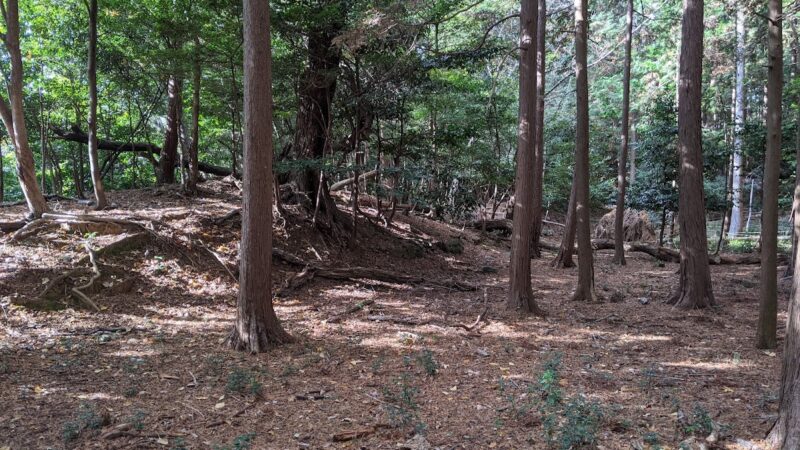
The main enclosure, the central part of Takō Castle, is located at the highest point of the castle mountain. It is almost square in shape and surrounded by earthen ramparts. The main enclosure measures approximately 30 meters east-west and 25 meters north-south, a standard size for a medieval mountain castle.
The interior of the main enclosure is relatively flat, and flat areas believed to be the remains of buildings can be seen. Although no archaeological excavations have been conducted, surface observations suggest the possibility of a foundation building. The main enclosure offers a panoramic view of the surrounding plains, indicating its function as a surveillance and command post.
Features of the Stone Walls
A notable feature of Takō Castle is its partially remaining stone walls. While many medieval mountain castles were built of earth without stone walls, Takō Castle features stone walls constructed using the “nozurazumi” (rough-stone masonry) method. This is an important remains demonstrating the development of castle construction techniques from the mid-16th century onward.
The stone walls are found in part of the main enclosure and on the cliffs of the enclosures. The stones used are natural stones quarried locally, and the nozurazumi method, with minimal processing, was employed. While the maximum height is only about 2 meters, it is a valuable resource for understanding the castle construction techniques of the time.
Earthworks and Moats
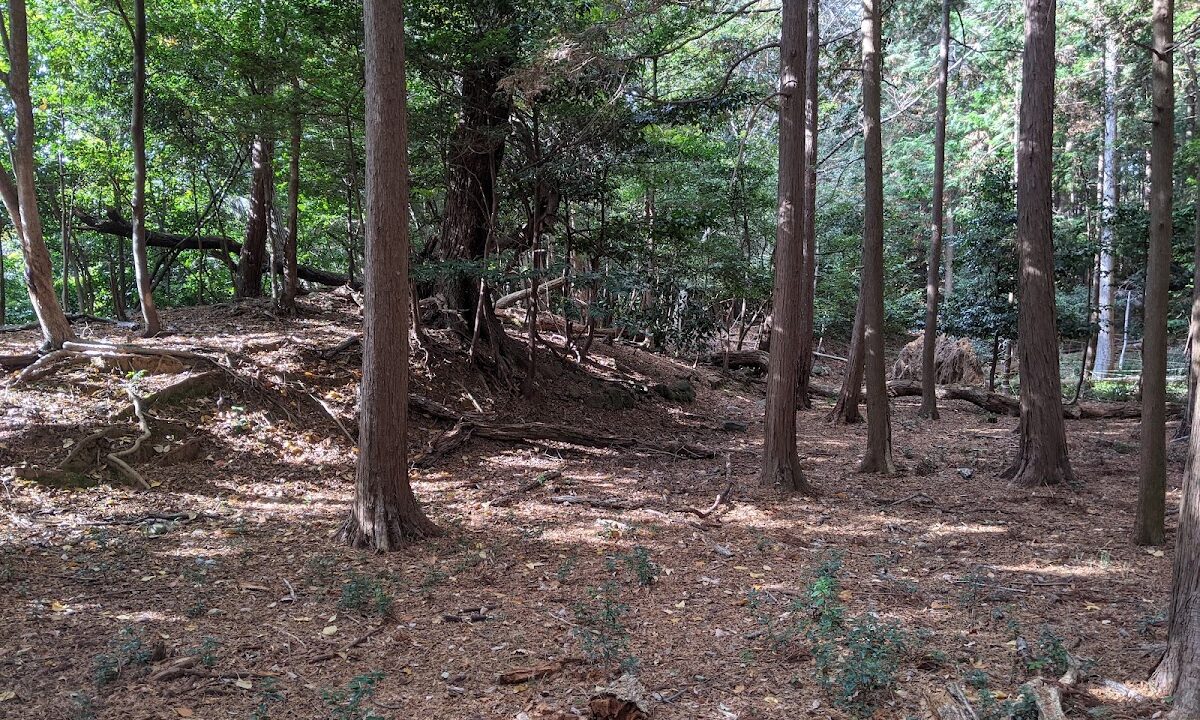
Each enclosure, including the main enclosure, is surrounded by earthworks, enhancing its defensive capabilities. The height of the earthworks varies depending on the location, but the highest point remains at approximately 2 meters. The base of the earthen rampart is 3-4 meters wide, indicating a fairly robust structure.
Moats are located between the main enclosure and the second enclosure, and around the outer perimeter of the castle grounds. Multiple moats of the type called “horikiri,” which cut across the ridge, have been identified, demonstrating ingenuity in preventing enemy intrusion. Although now shallower due to burial and weathering, they are estimated to have been approximately 3-4 meters deep in their heyday.
Layout of Enclosures
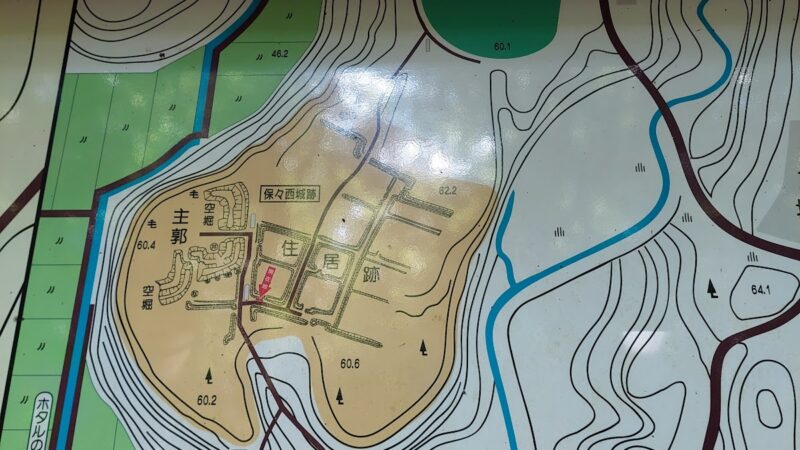
Takou Castle features multiple enclosures arranged in a stepped pattern around the main enclosure. The second and third enclosures are located to the north and east of the main enclosure, while a belt enclosure is situated to the southwest. Each enclosure is demarcated by steep slopes, forming defensive lines utilizing the differences in elevation.
The second enclosure is the second most important enclosure after the main enclosure, measuring approximately 40 meters east-west and 20 meters north-south. It is believed to have housed soldiers’ quarters and storage facilities for supplies. The enclosures below the third enclosure are smaller in scale and appear to have functioned as lookout posts or auxiliary defensive lines. ### Well Remains
The remains of a well have been confirmed within the castle grounds, indicating its important role as a water source during sieges. The well is located in the northwest corner of the main enclosure and remains as a depression today. While its depth is unknown, it is presumed to have been dug down to a spring.
Securing water was a matter of life and death for mountain castles, and the existence of the well indicates that Takō Castle was a full-fledged fortress designed for long-term sieges.
Structure of the Entrance (Koguchi)
The entrance to the main enclosure, the koguchi, is located on the southwest side. Its winding structure prevents direct entry, demonstrating a design intended to deter enemy intrusion. Traces of stonework exist around the koguchi, suggesting the possibility of a gate structure.
Access and Visiting Information for Takō Castle
Access by Public Transportation
Access to Takō Castle by public transportation is somewhat inconvenient. The nearest station is Nakakomono Station on the Kintetsu Yunoyama Line, approximately 3 kilometers from the station to Takō Castle. From the station, you can either take a taxi or walk. Walking takes approximately 40 minutes.
Mie Kotsu buses also operate, but the number of services is limited, so it is recommended to check the timetable in advance. The nearest bus stop is “Takou,” from which it is about a 15-minute walk to the castle ruins.
Access by Car
Access by car is the most convenient. It is about 20 minutes from the Yokkaichi IC on the Tomeihan Expressway via National Route 477, and about 15 minutes from the Komono IC on the Shin-Meishin Expressway.
There is no dedicated parking lot around the castle ruins, but there are a few parking spaces near the community center in the Takou area. However, please be considerate as this is also a local road used by residents.
Ascent Route and Time Required
The ascent route from the Takou area to the castle ruins utilizes a mountain path maintained by local residents. The trailhead is located on the north side of the Takou settlement, and there is a signpost. The path to the castle is relatively gentle, and you can reach the main enclosure in about 15-20 minutes.
The path is covered with trees, making it relatively cool even in summer. However, the ground can become slippery during or after rain, so caution is advised. Wearing hiking boots or trekking shoes is recommended.
If you plan to visit the entire castle site, allow 30 minutes to an hour. Those who want to carefully observe the remains should allow at least an hour.
Points to Note During Your Visit
Takou Castle is not a developed tourist spot, but a natural mountain castle ruin. Please keep the following points in mind when visiting:
- Clothing: Wear long-sleeved shirts, long pants, a hat, and non-slip shoes. Insect repellent is essential in summer.
- Items to Bring: Bring drinking water, a towel, a map, and a mobile phone. A smartphone with GPS functionality is convenient.
- Safety: Avoid visiting alone; it is recommended to visit with others if possible. Please be careful not to approach cliffs or steep slopes.
- Manners: Do not damage the ruins or collect plants. Always take your trash with you.
- Season: The best time to visit is spring (April-May) and autumn (October-November). Be aware of the heat and insects in summer, and snow in winter.
Other Historical Spots in Komono-cho, Mie-gun
Komono Castle Ruins
Besides Takō Castle, Komono-cho has other important castle ruins. Komono Castle was the administrative center of the Komono Domain during the Edo period, and is now the site of Komono Elementary School. Part of the stone walls remain, allowing visitors to imagine its former glory. It is about a 10-minute drive from Takō Castle.
Yunoyama Onsen
Yunoyama Onsen, a representative tourist destination in Komono Town, is a historic hot spring resort located at the foot of the Suzuka Mountains. You can relax in the hot springs after visiting the castle ruins. It’s about a 20-minute drive from Takō Castle.
Mt. Gozaisho
Mt. Gozaisho (1,212 meters above sea level), one of the main peaks of the Suzuka Mountains, is a popular mountain accessible by ropeway. From the summit, you can enjoy panoramic views of Ise Bay and the Nōbi Plain, and on clear days, you can even see Mt. Fuji in the distance.
Comparison with other castle ruins in Mie Prefecture
Comparison with Iga Ueno Castle
Iga Ueno Castle, a representative castle of Mie Prefecture, is a modern castle built by Tōdō Takatora and is famous for its high stone walls. While it differs greatly in era and scale from Takō Castle, comparing them as castles in the same Mie Prefecture allows us to understand the development of castle construction techniques.
Iga Ueno Castle is about an hour’s drive from Tsu City and about an hour and a half from Takō Castle.
Comparison with Matsusaka Castle
Matsusaka Castle is a modern castle built by Gamō Ujisato, and its impressive stone walls remain. It is located in Matsusaka City, about an hour’s drive from Takō Castle. Comparing it to the simple, rough-hewn stonework of Takō Castle, one can appreciate the evolution of stonework technology.
Comparison with Kuwana Castle
Kuwana Castle is a water castle built at the mouth of the Ibi River and is now maintained as Kyūka Park. Kuwana City is adjacent to Mie County, about a 30-minute drive from Takō Castle. Comparing the differences in castle layout due to the different locations would be interesting.
Research and Preservation Activities of Takō Castle
Academic Evaluation
Takō Castle is highly regarded among medieval mountain castles in Mie Prefecture for its well-preserved remains. The presence of the stone walls, in particular, is considered important evidence of the level of castle construction technology in the Hokusei region during the mid-16th century.
Local historians and castle researchers are conducting investigations, and the creation of layout maps and documentation of remains is underway. Further detailed excavations may reveal even more historical facts.
Current Status and Challenges of Preservation
The Takō Castle ruins currently do not have any special protection designation. While local volunteers conduct cleaning activities and maintain the access roads, organized preservation efforts have not yet materialized.
The following are some of the challenges for the future:
- Cultural Property Designation: Aiming for designation as a municipal or prefectural cultural property.
- Academic Survey: Conducting detailed surveys and trial excavations.
- Development Plan: Formulating a development plan that balances visitor safety with the preservation of the remains.
- Public Relations: Disseminating information and providing history education to local residents and tourists.
Connection with the Community
For the residents of the Tamitsu district, Tamitsu Castle symbolizes the history of the region. Local elementary schools sometimes conduct tours of the castle ruins as part of their local history studies. Furthermore, local history enthusiast groups regularly conduct cleaning activities to preserve the remains.
Situation in Northern Ise Province during the Sengoku Period
The Kitabatake Clan and the Hokusei Region
During the Sengoku period, Ise Province was largely divided into two spheres of influence: the Kitabatake clan, which controlled the south, and the local powerful families in the north. The Kitabatake clan held authority as the governor of Ise Province since the Middle Ages, but their influence in the Hokusei region was limited. In the Hokusei region, including Mie County, local powerful families such as the Chigusa, Nagano, and Akahori clans formed their own spheres of influence. These powerful families, sometimes allied and sometimes opposed, created a complex political situation.
Oda Nobunaga’s Invasion of Ise
In 1568 (Eiroku 11), Oda Nobunaga began his march to Kyoto, supporting Ashikaga Yoshiaki. During this process, he invaded northern Ise, and the powerful families of the Hokusei region successively came under the control of the Oda clan.
The area around Takō Castle was no exception; the expansion of Oda forces drastically altered the regional political situation. Many small and medium-sized castles lost their strategic importance and were abandoned. It is believed that Takō Castle also ended its historical role during this period.
The Charm of Medieval Mountain Castles and Takō Castle
Characteristics of Mountain Castles
Medieval mountain castles possess a unique charm that differs from castles on flatlands. The castle’s layout, skillfully utilizing the natural terrain, its ingenuity in maximizing defensive effectiveness with limited resources, and its harmony with nature—all these aspects embody the wisdom and technology of the people of that time.
Takō Castle retains many of the characteristics of a medieval mountain castle. With its complete set of basic defensive structures such as stone walls, earthworks, and moats, it serves as an excellent learning tool for studying the structure of medieval castles.
How to Enjoy Visiting Mountain Castles
Visiting mountain castles offers an experience far beyond simply sightseeing historical sites. Walking the paths leading to the castle ruins allows you to experience the undulations of the terrain as the people of that time would have felt. The view from the main enclosure allows you to relive the scenery the castle lord saw.
When visiting Takō Castle, paying attention to the following points will enhance your enjoyment.
- Observing the Topography: Consider the topographical advantages and why the castle was built in this location.
- Confirming the Remains: Observe how defensive structures such as stone walls, earthworks, and moats are arranged.
- Confirming the View: Infer what can be seen from the main enclosure and what targets were being monitored.
- Understanding the Flow of Movement: Imagine the flow of movement within the castle based on the arrangement of gates and enclosures.
Model Course for Visiting Takō Castle
Half-Day Course (Duration: Approx. 3 Hours)
Morning
- 9:00 Arrive at Nakakomono Station
- 9:15 Take a taxi or walk to the Takō area
- 10:00 Begin climbing to Takō Castle
- 10:15 Arrive at the main enclosure and view the remains
- 11:00 Depart from the castle
- 11:30 Visit Komono Castle Ruins
- 12:00 Lunch in Komono Town
One-Day Course (Duration: Approx. 7 Hours)
Morning
- 9:00 Arrive at Nakakomono Station
- 9:30 Ascend to Takō Castle
- 11:00 Descend from the castle, visit Komono Castle ruins
- 12:00 Lunch
Afternoon
- 13:00 Travel to Yunoyama Onsen
- 13:30 Take the Gozaisho Ropeway to the summit
- 15:00 Descend from the mountain, enjoy the hot springs
- 16:30 Return home
Summary
Takō Castle is a valuable medieval mountain castle ruin remaining in Komono-cho, Mie-gun, Mie Prefecture. Although not large in scale, the remains such as stone walls, earthworks, baileys, moats, and wells are well-preserved, conveying the castle-building techniques of the Sengoku period.
Built as a base for a local powerful family in northern Ise Province, Takō Castle played an important role in the complex political situation of the Sengoku period. Although its historical purpose ended with Oda Nobunaga’s invasion of Ise, its remains still evoke its former glory more than 400 years later.
While Mie Prefecture boasts famous castles such as Iga Ueno Castle and Matsusaka Castle, medieval mountain castles like Takō Castle possess a unique charm. Visiting these ruins, quietly nestled in nature, deepens one’s understanding of history and allows one to reflect on the wisdom and efforts of those who came before.
We highly recommend that castle enthusiasts and history buffs visit Takō Castle at least once. Enjoy the rich nature and history of Komono Town, Mie Prefecture, while fully appreciating the charm of this medieval mountain castle.